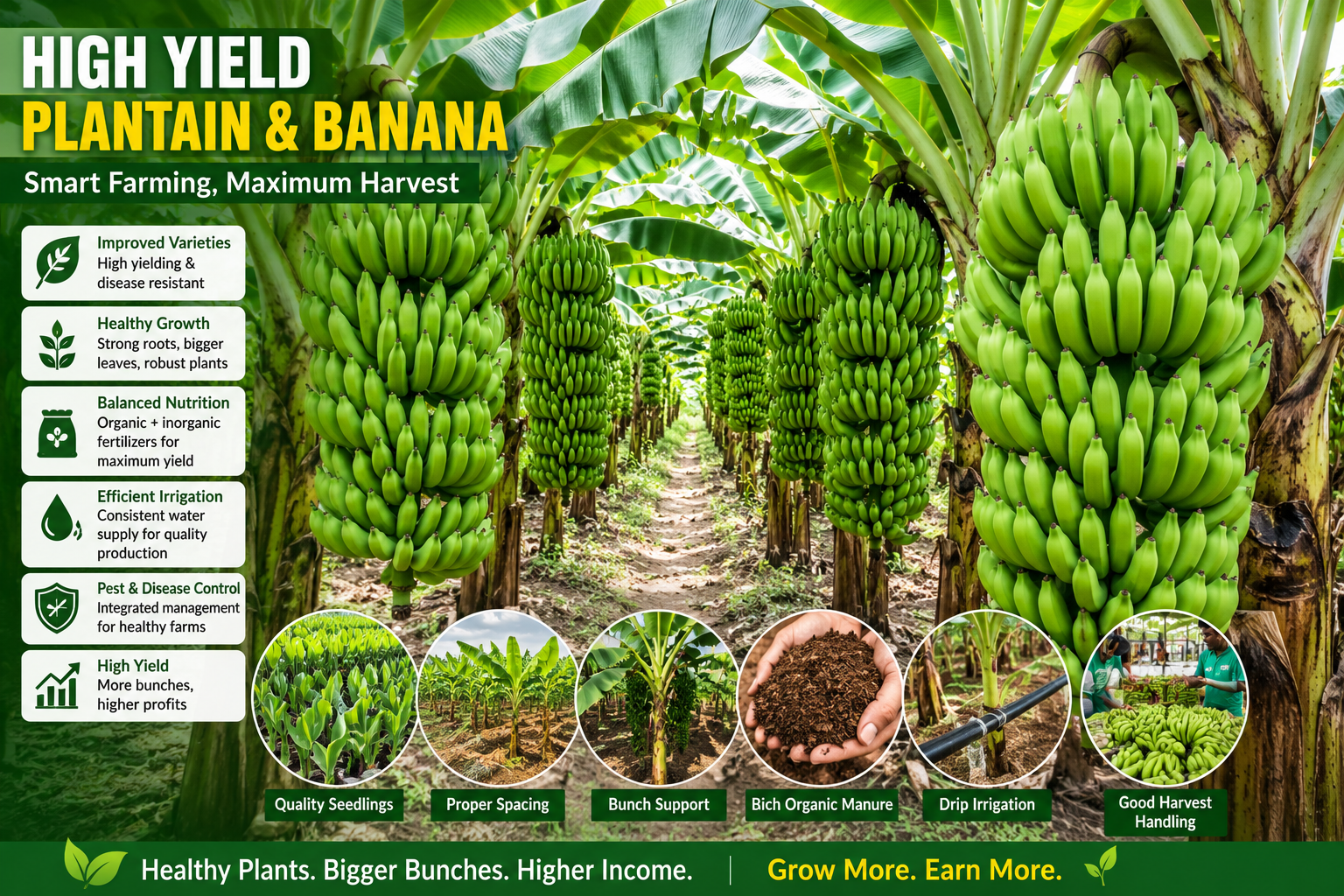
Learn how to start a profitable modern plantain and banana farm using improved farming practices. Discover land preparation, variety selection, planting methods, fertilizer application, pest control, harvesting, and marketing strategies for maximum profit.
INTRODUCTION TO PLANTAIN AND BANANA FARMING.
Plantain and banana are among the most valuable food crops grown in tropical regions, especially in Nigeria and across West Africa.
They serve as staple foods for millions of people while providing excellent business opportunities for farmers, food processors, wholesalers, retailers, and exporters.
As Nigeria's population continues to grow and demand for nutritious foods increases, commercial production of plantain and banana has become one of the most attractive agricultural investments.
Unlike traditional farming, modern plantain and banana farming uses improved planting materials, scientific crop management, efficient irrigation, balanced fertilization, integrated pest management, and better post-harvest handling to increase productivity and profitability.
Farmers who adopt these methods can harvest higher-quality bunches, reduce losses, and build sustainable agribusinesses.
AT IKHLAS AGROTECH,
we believe agriculture should be treated as a business rather than merely a means of subsistence. With proper planning and modern techniques, plantain and banana farming can become a reliable source of long-term income while contributing to food security and rural development.
WHY PLANTAIN AND BANANA FARMING IS A PROFITABLE INVESTMENT.

Plantain and banana are consumed daily in homes, restaurants, hotels, schools, and food industries. Their versatility makes them suitable for fresh consumption and processing into products such as chips, flour, puree, baby food, pastries, and animal feed.
Some key reasons to invest include:
✓Strong demand throughout the year.
✓Attractive market prices in many regions.
✓Multiple harvest cycles from one establishment.
✓Ability to generate steady cash flow.
✓Opportunities for value addition through processing.
✓High employment potential.
✓Suitable for small, medium, and large-scale farms.
✓With good management, a plantation can remain productive for several years, providing consistent returns on investment.
Understanding the Difference Between Plantain and Banana.
Although they belong to the same botanical family, plantain and banana differ in their uses.
Plantain is generally larger, contains more starch, and is commonly cooked by boiling, frying, roasting, or processing into flour and chips. It is a staple food in many households.
Bananas are sweeter, softer, and usually eaten fresh. They are also widely used in smoothies, desserts, and bakery products.
Both crops can be cultivated using similar management practices, making them ideal companions on commercial farms.
CLIMATIC REQUIREMENTS.
Plantain and banana thrive in warm, humid tropical environments.
Ideal conditions include:
✓Average temperature between 25°C and 30°C.
✓Annual rainfall of approximately 1,500–2,500 mm.
✓Relative humidity above 60%.
Plenty of sunlight.
✓Protection from strong winds.
Where rainfall is unreliable, irrigation helps maintain steady growth and improve yields.
SOIL REQUIREMENTS.
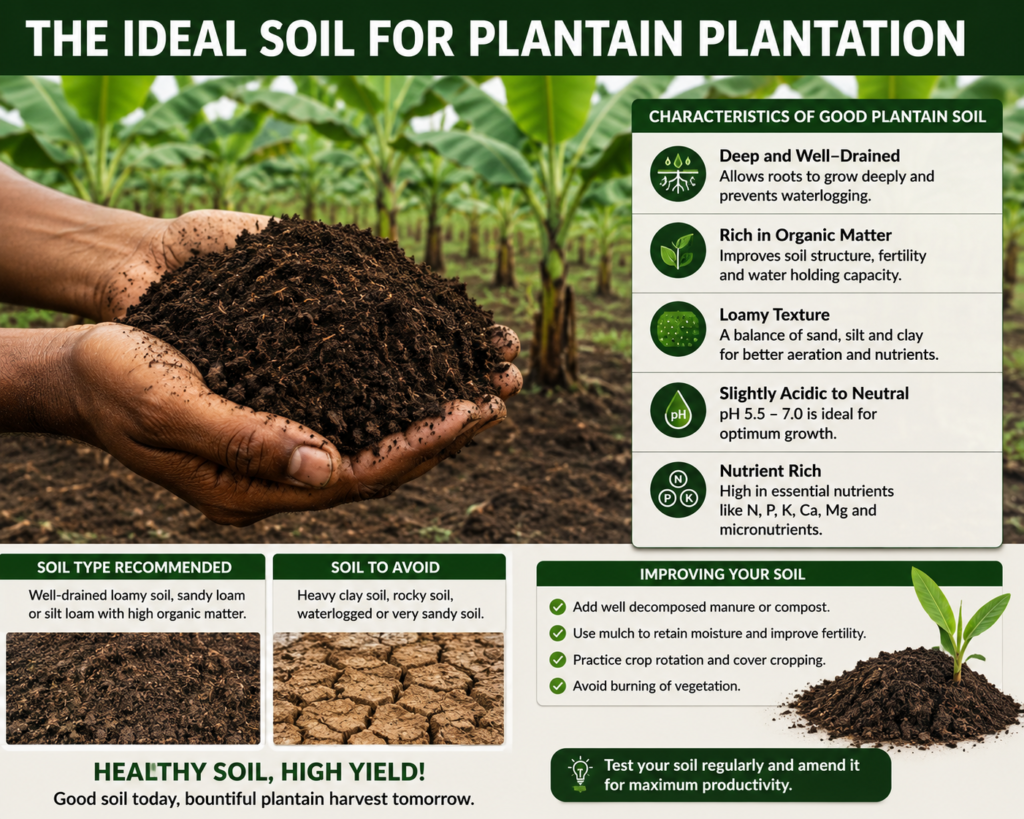
Healthy soil is one of the most important factors in successful production.
The ideal soil should have:
✓Good drainage.
✓High organic matter content.
✓Deep rooting depth.
✓Loamy texture.
✓Soil pH between 5.5 and 7.0.
✓Adequate moisture-holding capacity.
Heavy clay soils with poor drainage can increase the risk of root diseases, while extremely sandy soils may require more frequent irrigation and organic matter additions.
Before establishing a plantation, conducting a soil test is highly recommended to determine nutrient levels and soil pH. This information helps farmers develop an effective fertilization plan.
Choosing the Right Location:
Selecting a suitable farm site greatly influences productivity.
Important considerations include:
✓Accessibility to roads and markets.
✓Availability of clean water.
✓Good drainage.
✓Fertile soil.
✓Security of the farm.
✓Access to labour.
✓Space for future expansion.
✓A well-located farm reduces transportation costs and improves market access.
✓Land Preparation
✓Proper land preparation lays the foundation for healthy crop establishment.
Modern land preparation involves:
Clearing
Remove bushes, weeds, tree stumps, and unwanted vegetation while preserving useful shade trees where appropriate.
Soil Improvement
Incorporate compost, poultry manure, or well-decomposed organic matter to improve soil fertility and structure.
LAYOUT
Mark planting positions according to the selected spacing system to ensure uniform growth and easy field management.
PLANTING HOLES
Dig generous planting holes and mix topsoil with organic manure before transplanting.
This encourages rapid root establishment.
Selecting Improved Planting Materials
One of the biggest mistakes many farmers make is planting unhealthy suckers collected from unknown sources.
Modern commercial farms prefer:
✓Tissue-cultured seedlings.
✓Certified disease-free sword suckers.
✓Improved, high-yielding varieties.
Benefits include:
✓Faster establishment.
✓Uniform plant growth.
✓Reduced disease incidence.
✓Earlier fruiting.
✓Better bunch size.
✓Higher yields.
Healthy planting material is an investment that pays for itself through improved productivity.
Popular Plantain and Banana Varieties
Farmers should choose varieties suited to their climate, soil, and target market.
Factors to consider include:
Yield potential.
Fruit size.
Disease resistance.
Consumer preference.
Maturity period.
Suitability for processing.
Consult reputable agricultural research institutes or certified nurseries for recommended varieties in your location.
PLANTATION DESIGN AND SPACING
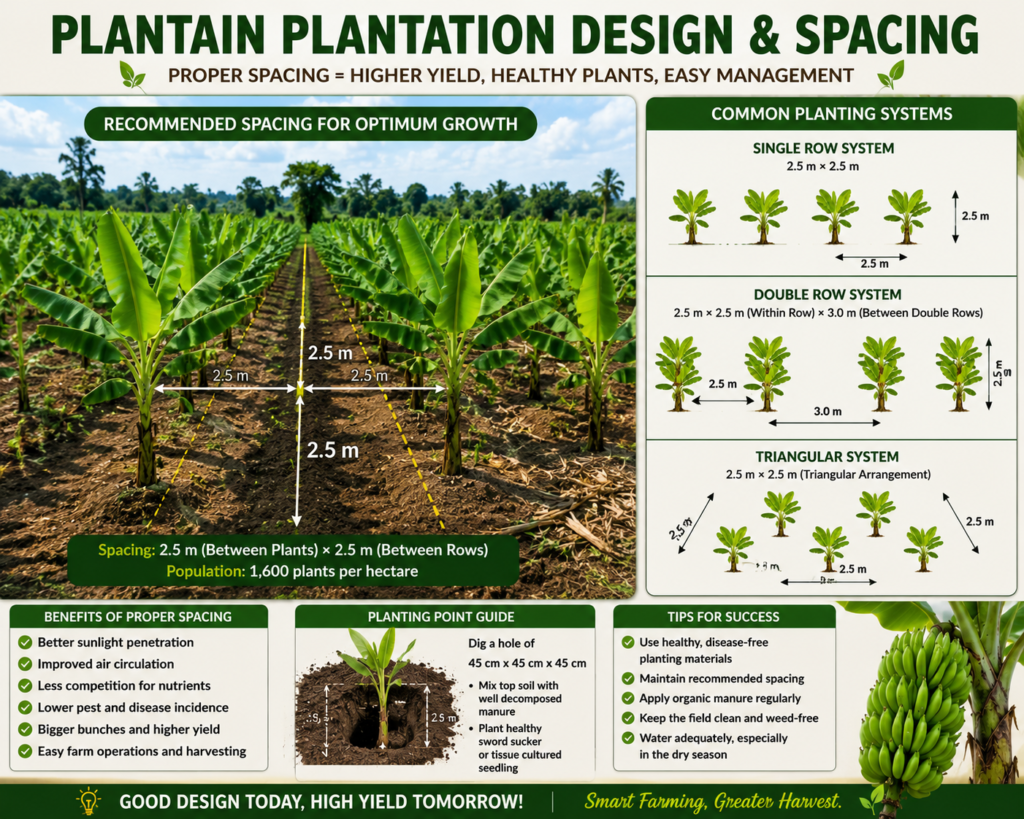
Proper spacing ensures that each plant receives enough sunlight, water, and nutrients.
Benefits of correct spacing include:
Better air circulation.
Reduced disease spread.
Easier weeding.
Efficient fertilizer application.
Simpler harvesting.
Improved bunch development.
Overcrowding can lead to poor yields and increased pest and disease pressure, while excessive spacing wastes valuable land.
WATER MANAGEMENT
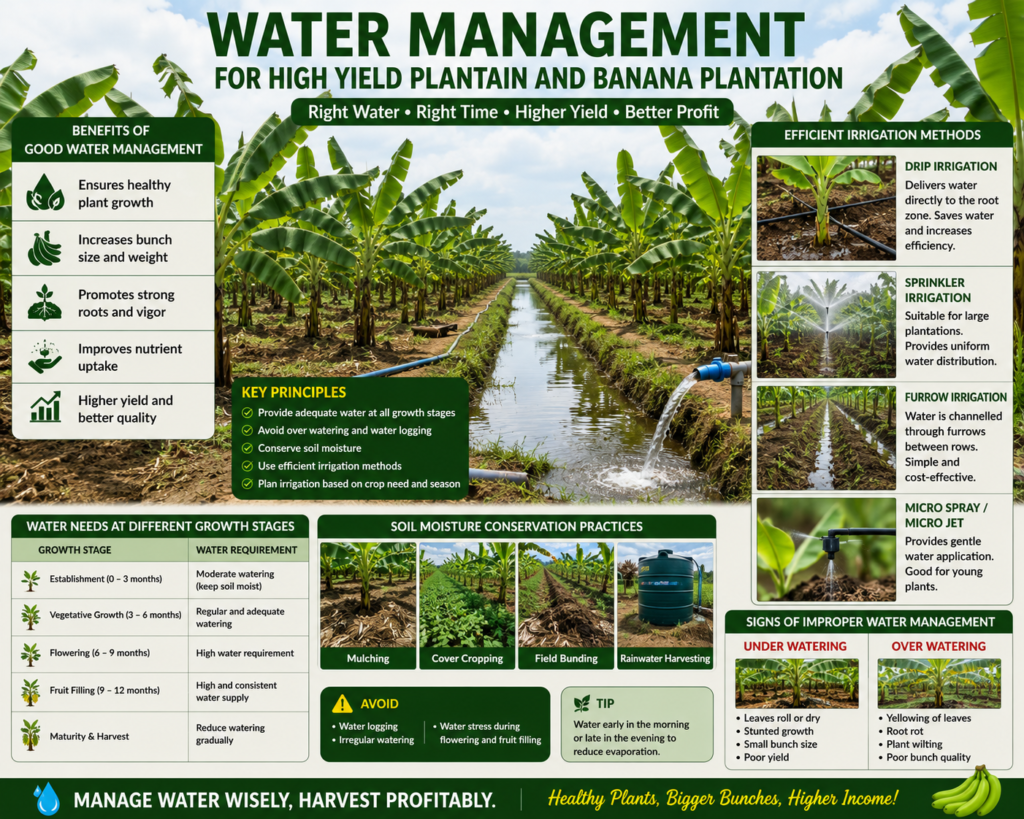
Water is essential throughout the crop's growth cycle.
Modern farms adopt practices such as:
✓Drip irrigation.
✓Sprinkler irrigation.
✓Rainwater harvesting.
✓Mulching.
✓Conservation of soil moisture.
Adequate water supply during flowering and fruit development significantly improves bunch weight and fruit quality.
PREPARING FOR LONG-TERM SUCCESS
Commercial plantain and banana farming requires careful planning before the first seedling is planted. Investing in fertile land, quality planting materials, proper irrigation, and sound agronomic practices creates the foundation for a productive plantation that can generate income for many years.
The most successful farmers view every stage—from site selection to planting—not as isolated tasks but as interconnected investments that determine future productivity and profitability.
CROP MANAGEMENT FOR MAXIMUM YIELD AND PROFIT

PLANTING TECHNIQUES
The success of a commercial plantation depends greatly on proper planting techniques.
Healthy seedlings planted correctly establish quickly, develop strong root systems, and produce vigorous growth.
BEST TIME TO PLANT
In areas that depend on rainfall, planting should begin at the start of the rainy season. This gives young plants enough moisture to establish before the dry season.
Where irrigation is available, planting can be done throughout the year, allowing farmers to target periods of high market demand.
PREPARING THE PLANTING HOLE
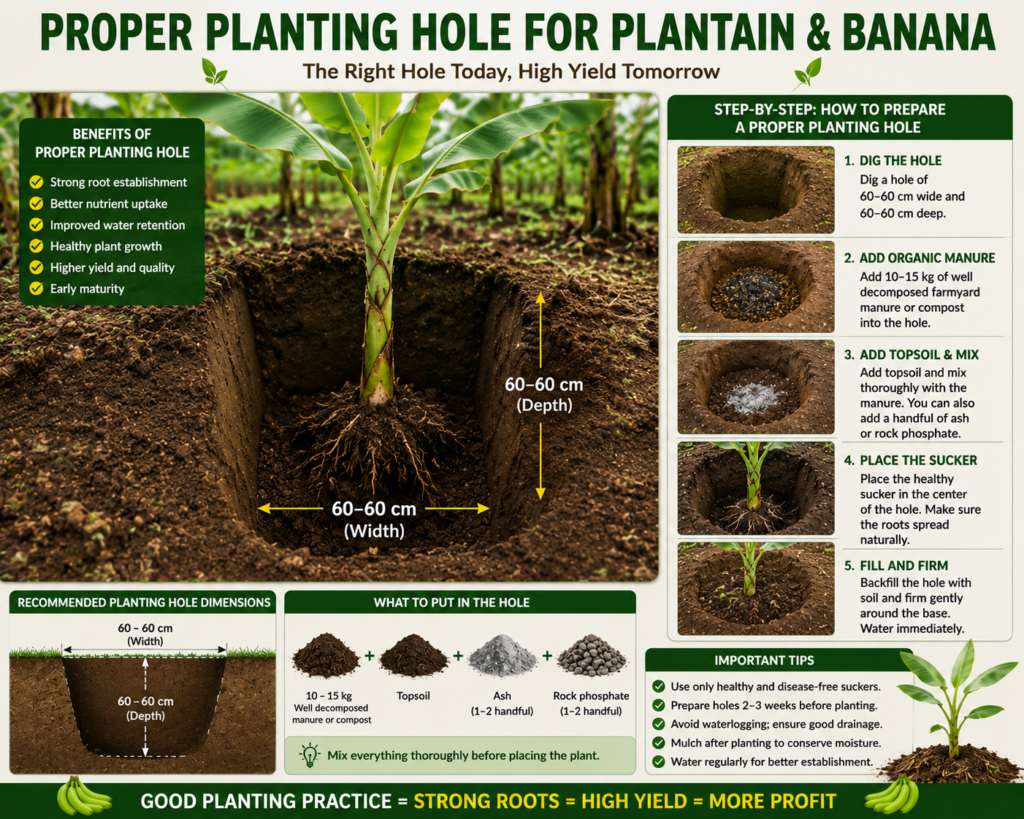
Each planting hole should be large enough to accommodate the seedling without bending or damaging the roots.
Mixing topsoil with well-decomposed organic manure before planting improves early growth and nutrient availability.
Avoid using fresh animal manure because it can damage young roots and attract pests.
PLANTING PROCEDURE
Plant seedlings upright and ensure the root system is fully covered with soil. Gently firm the soil around the base to eliminate air pockets while avoiding excessive compaction.
Water immediately after planting if rainfall is not available.
MULCHING
Mulching is one of the simplest yet most effective modern farming practices.
Suitable mulching materials include:
Dry grass
Rice straw
Palm fronds
Dry leaves
Compost
Benefits of mulching include:
Conserves soil moisture.
Reduces weed growth.
Improves soil fertility.
Prevents soil erosion.
Moderates soil temperature.
Encourages beneficial microorganisms.
As mulch decomposes, it adds organic matter that improves soil structure and nutrient availability.
FERTILIZER MANAGEMENT
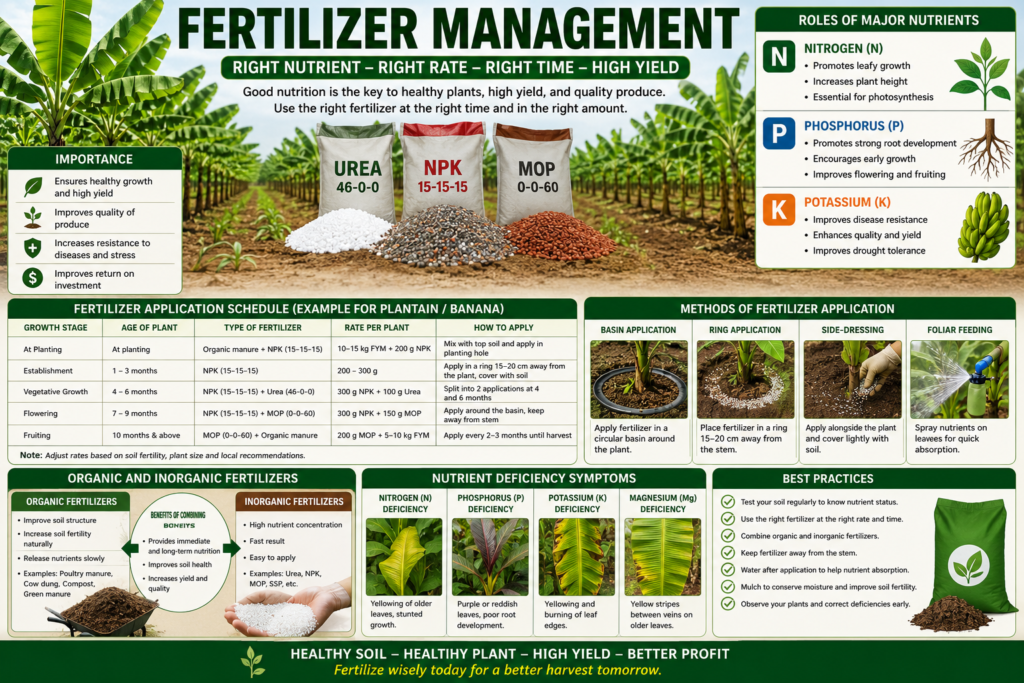
Plantain and banana are heavy feeders and require a continuous supply of nutrients for healthy growth and fruit production.
A balanced nutrient management program combines organic manure with appropriate mineral fertilizers based on soil test recommendations.
KEY NUTRIENTS
✓Nitrogen (N) promotes vigorous leaf and stem growth.
✓Phosphorus (P) supports strong root development and early establishment.
✓Potassium (K) is essential for flowering, fruit development, bunch weight, and fruit quality.
Secondary nutrients such as calcium, magnesium, and sulfur, along with micronutrients like zinc and boron, also contribute to healthy crop development.
Split fertilizer applications throughout the growing season are generally more effective than applying all nutrients at once, as they reduce nutrient losses and provide a more consistent supply to the plants.
IRRIGATION MANAGEMENT
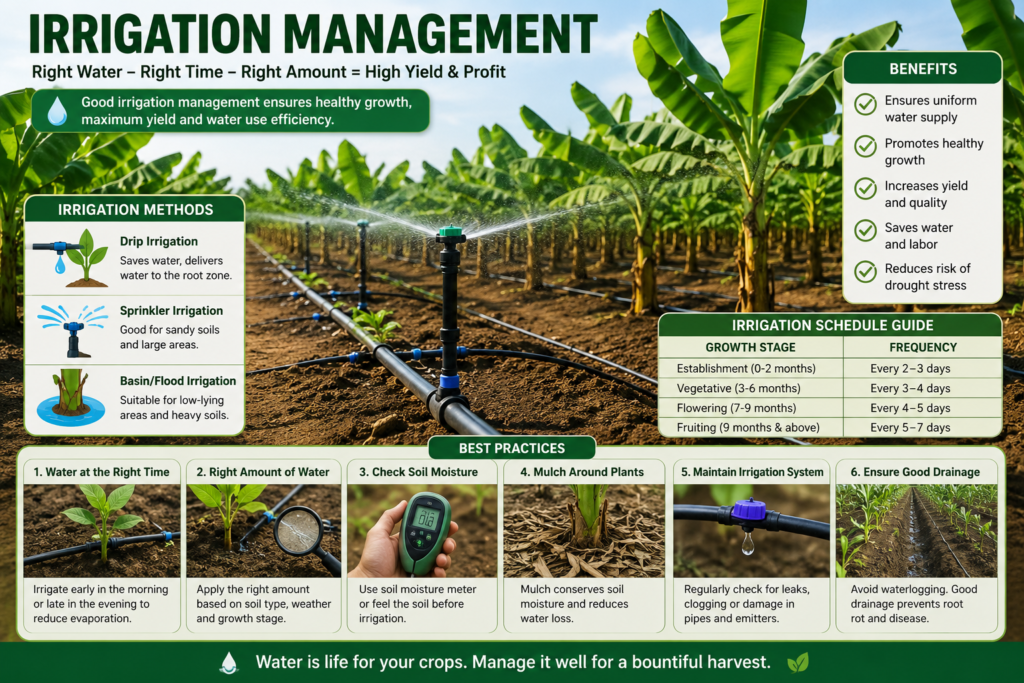
Water availability strongly influences bunch size, fruit quality, and overall yield.
Modern irrigation methods include:
✓Drip Irrigation
This system delivers water directly to the root zone, reducing wastage and improving water-use efficiency.
✓Sprinkler Irrigation
Suitable for larger plantations where water resources are sufficient.
✓Rainwater Harvesting
Collecting and storing rainwater provides an additional source of irrigation during dry periods.
✓Maintaining consistent soil moisture is particularly important during flowering and fruit filling, when water stress can reduce both yield and fruit quality.
WEED CONTROL
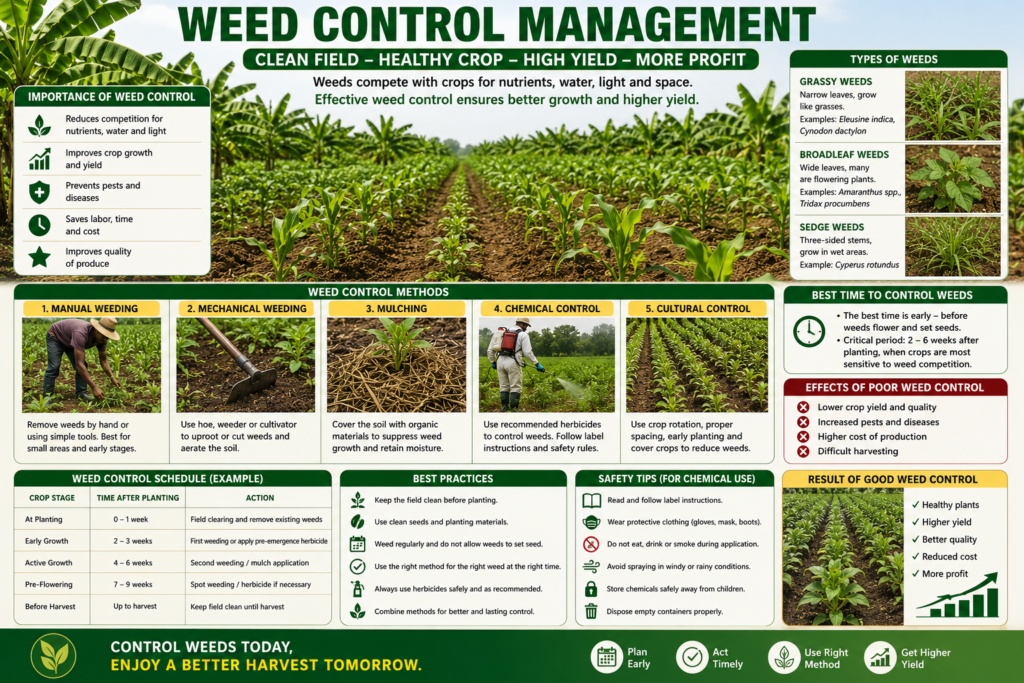
Weeds compete with crops for sunlight, water, and nutrients. Poor weed management can significantly reduce productivity.
An integrated weed management strategy combines:
✓Regular manual weeding.
✓Mulching.
✓Cover crops.
✓Careful use of approved herbicides where necessary.
✓Keeping the area around each plant free from weeds improves nutrient uptake and reduces competition during critical growth stages.
DESUCKERING
Plantain and banana naturally produce numerous suckers around the mother plant.
If all suckers are left to grow, competition for nutrients increases and bunch size declines.
A good practice is to retain only one or two healthy followers while removing excess suckers regularly. This ensures continuous production without overcrowding.
PRUNING
Old, damaged, or diseased leaves should be removed regularly.
Benefits include:
✓Better air circulation.
✓Reduced disease spread.
✓Improved sunlight penetration.
✓Easier field operations.
✓Healthier fruit development.
Only remove leaves that are no longer functional, as excessive pruning can reduce photosynthesis.
PROPPING
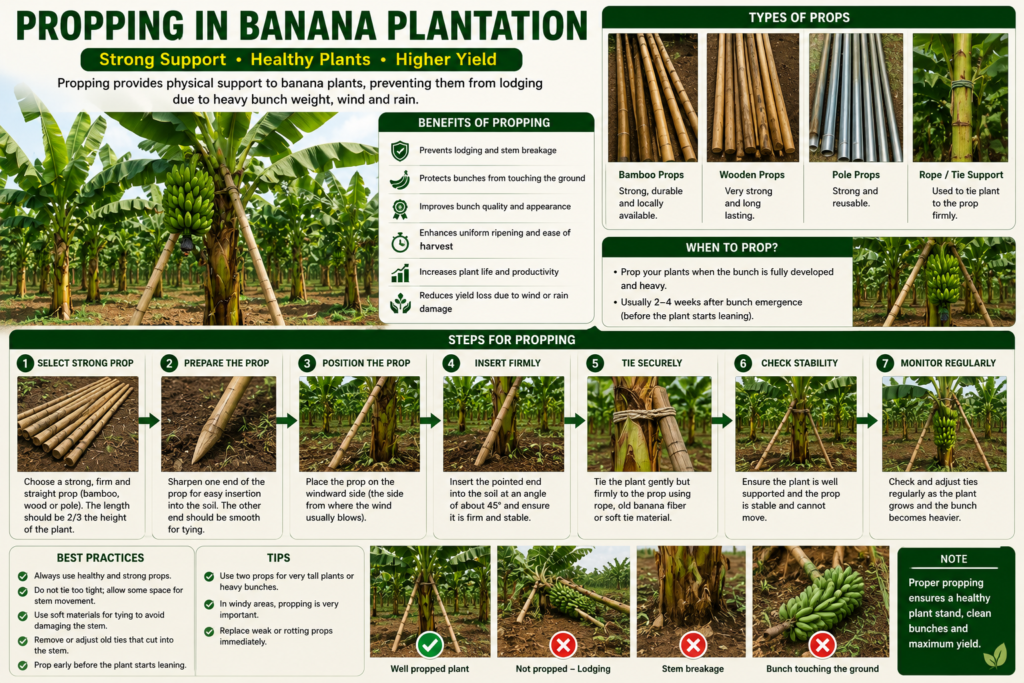
Heavy bunches can cause plants to bend or fall, especially during strong winds.
Supporting fruit-bearing plants with wooden or bamboo props helps prevent lodging and minimizes fruit damage before harvest.
PEST MANAGEMENT
Several pests can affect commercial plantations if not properly managed.
Common pests include:
✓Banana Weevil
These insects bore into the corm, weakening plants and reducing yields.
✓Nematodes
Microscopic worms attack roots, limiting nutrient and water uptake.
✓Aphids
They weaken plants by feeding on sap and can transmit viral diseases.
✓Mealybugs and Thrips
These pests damage leaves and fruits, affecting quality and market value.
Modern farmers should regularly inspect fields, maintain sanitation, and encourage natural predators. Chemical control should only be used when necessary and according to approved agricultural guidelines.
DISEASE MANAGEMENT
Plant diseases can significantly reduce productivity if left unchecked.
Important diseases include:
✓Black Sigatoka
A fungal disease that attacks leaves and reduces photosynthesis, leading to smaller bunches.
✓Fusarium Wilt (Panama Disease)
One of the most destructive banana diseases, causing wilting and eventual plant death.
✓Bacterial Diseases
These can spread rapidly through contaminated tools, infected planting materials, or water.
Preventive measures include:
✓Using certified disease-free planting materials.
✓Practicing field sanitation.
✓Removing infected plants promptly.
✓Disinfecting farm tools between uses.
✓Ensuring proper drainage.
✓Maintaining recommended plant spacing.
Early detection and quick intervention are essential to minimize crop losses.
INTEGRATED PEST MANAGEMENT (IPM)
Integrated Pest Management combines multiple environmentally friendly techniques to control pests and diseases while reducing dependence on chemical pesticides.
Key principles include:
✓Regular field monitoring.
✓Biological control using beneficial organisms.
✓Good farm hygiene.
✓Crop nutrition management.
✓Resistant varieties.
✓Responsible pesticide use only when necessary.
This approach supports sustainable farming and protects both the environment and human health.
MAINTAINING PLANTATION RECORDS

Successful commercial farmers treat their farms like businesses.
Important records include:
✓Planting dates.
✓Fertilizer applications.
✓Irrigation schedules.
✓Pest and disease observations.
[Labour costs.
✓Harvest quantities.
✓Sales records.
✓Input purchases.
Accurate records help evaluate performance, improve decision-making, and identify opportunities to increase profitability.
Safety and Environmental Stewardship:
Modern agriculture places strong emphasis on protecting workers, consumers, and the environment.
Farmers should:
✓Wear protective clothing when handling agrochemicals.
✓Follow label instructions carefully.
✓Store chemicals securely.
✓Dispose of empty containers responsibly.
✓Protect water sources from contamination.
✓Encourage biodiversity by conserving beneficial insects and surrounding vegetation.
Sustainable farming practices not only protect natural resources but also enhance the long-term productivity of the plantation.
Looking Ahead
By applying proper planting techniques, balanced nutrition, effective irrigation, and integrated pest and disease management, farmers can dramatically increase yields and produce high-quality bunches that command premium market prices.
Harvesting, Marketing, Value Addition, Profitability and Business Success.
HARVESTING AT THE RIGHT STAGE
Harvesting is one of the most important stages in commercial plantain and banana production.
Harvesting too early can reduce fruit quality, while harvesting too late shortens shelf life and increases post-harvest losses.
The right harvesting stage depends on the intended market. Fruits destined for distant markets are usually harvested slightly earlier than those meant for local consumption.
SIGNS OF MATURITY.

Farmers should observe several indicators before harvesting:
✓Fruits are fully developed.
✓Fingers become rounder and less angular.
✓The bunch reaches the expected size for the variety.
[Fruit colour changes from deep green to a lighter green.
✓The crop has reached its normal maturity period after flowering.
Harvesting should be carried out carefully to prevent bruising, cuts, or impact damage, which can reduce market value.
POST-HARVEST HANDLING
Proper handling after harvest preserves quality and increases profits.
Recommended practices include:
✓Handle bunches gently to avoid bruises.
Remove damaged or diseased fruits.
✓Wash fruits with clean water where appropriate.
✓Sort according to size and quality.
✓Package carefully for transportation.
✓Store in a cool, clean, and well-ventilated area before sale.
✓Good post-harvest management reduces waste and helps farmers supply premium-quality produce.
STORAGE AND TRANSPORTATION.

Plantain and banana are highly perishable crops.
To minimize losses:
✓Avoid direct sunlight after harvest.
✓Prevent fruits from being thrown or dropped.
✓Use clean transport vehicles.
✓Protect bunches with padding during transportation.
✓Deliver produce to buyers as quickly as possible.
✓Efficient logistics improve customer satisfaction and increase repeat business.
VALUE ADDITION

One of the biggest opportunities in modern agriculture is processing fresh produce into higher-value products.
Popular value-added products include:
✓Plantain chips
✓Banana chips
✓Plantain flour
✓Banana flour
✓Plantain powder
✓Banana puree
✓Baby food ingredients
✓Bakery ingredients
✓Smoothie products
✓Livestock feed ingredients
Processing helps farmers reduce post-harvest losses, extend shelf life, and access more profitable markets.
MARKETING STRATEGIES
Growing high-quality crops is only part of a successful agribusiness. Farmers must also develop reliable marketing channels.
Potential buyers include:
✓Open markets
✓Supermarkets
✓Hotels
✓Restaurants
✓Schools
✓Food processors
✓Wholesalers
✓Retail fruit vendors
✓Export companies
✓Online agricultural marketplaces
Building long-term relationships with buyers ensures a steady market and improves income stability.
PROFITABILITY OF COMMERCIAL PLANTAIN AND BANANA FARMING
Plantain and banana farming can be highly profitable when managed professionally.
Several factors influence profitability:
✓Farm size.
✓Variety grown.
✓Soil fertility.
✓Irrigation availability.
✓Management practices.
✓Labour efficiency.
✓Market prices.
✓Post-harvest handling.
✓Access to buyers.
Commercial farms that adopt modern technologies generally produce higher yields and enjoy better financial returns than those relying solely on traditional practices.
COMMON MISTAKES FARMERS SHOULD AVOID
Many production problems result from avoidable management errors.
Common mistakes include:
✓Using unhealthy planting materials.
✓Poor land preparation.
✓Planting in waterlogged soils.
✓Incorrect spacing.
✓Poor weed control.
✓Delayed fertilizer application.
✓Ignoring pest and disease outbreaks.
✓Allowing too many suckers to grow.
✓Harvesting too early or too late.
✓Poor record keeping.
Avoiding these mistakes can significantly improve productivity and profitability.
CLIMATE-SMART FARMING PRACTICES
Climate change is affecting agricultural production across many regions.
Farmers can improve resilience by adopting:
✓Drip irrigation.
✓Rainwater harvesting.
✓Mulching.
✓Organic manure application.
✓Soil conservation practices.
✓Windbreak establishment.
✓Efficient fertilizer management.
✓Integrated Pest Management (IPM).
These practices help conserve resources while maintaining high yields.
FREQUENTLY ASKED QUESTIONS (FAQS):
HOW LONG DOES IT TAKE FOR PLANTAIN TO PRODUCE FRUIT?
=>Depending on the variety, climate, and management practices, plantain generally reaches harvest within 9–15 months after planting.
CAN BANANA AND PLANTAIN BE GROWN ON THE SAME FARM?
=>Yes. They belong to the same plant family and require similar growing conditions. Many commercial farms successfully cultivate both crops together.
WHICH FERTILIZER IS BEST?
=>There is no single fertilizer suitable for every farm. The best choice depends on soil test results, crop stage, and local conditions. Combining organic manure with balanced mineral fertilizers often produces excellent results.
IS IRRIGATION NECESSARY?
=>In areas with reliable rainfall it may not always be essential, but supplemental irrigation during dry periods can greatly improve yield and fruit quality.
CAN COMMERCIAL FARMING BE PROFITABLE ON A SMALL AREA?
=>Yes. Even small farms can generate attractive income when they use improved planting materials, good management, and effective marketing strategies.
The Future of Plantain and Banana Farming
Growing urban populations, changing consumer preferences, and expanding food-processing industries continue to increase demand for plantain and banana products.
Modern technologies—including improved varieties, precision agriculture, irrigation systems, mechanization, and digital farm management—are making commercial production more productive and sustainable.
Farmers who embrace innovation, invest in quality planting materials, and adopt sound business practices will be well positioned to benefit from these opportunities.
CONCLUSION
Modern plantain and banana farming is more than planting crops—it is a business that requires planning, knowledge, and consistent management.
Success depends on selecting suitable land, using healthy planting materials, maintaining soil fertility, applying efficient irrigation, controlling pests and diseases, harvesting at the right stage, and developing reliable markets.
For farmers, investors, and agribusiness entrepreneurs in Nigeria, plantain and banana production offers an excellent opportunity to generate income, create employment, and contribute to national food security.
By combining sustainable farming practices with modern technology and sound business management, producers can build profitable enterprises that remain productive for many years.
Why Choose Ikhlas Agrotech?
At Ikhlas Agrotech, we are committed to helping farmers succeed through modern agricultural knowledge, practical guidance, and innovative farming solutions. Our goal is to empower individuals and agribusinesses with reliable information that improves productivity, profitability, and sustainability.
Whether you are establishing your first plantation or expanding an existing commercial farm, Ikhlas Agrotech is your trusted partner in modern agriculture.
Visit us regularly for expert farming guides, agribusiness insights, crop production tips, and the latest innovations shaping the future of agriculture.