Introduction
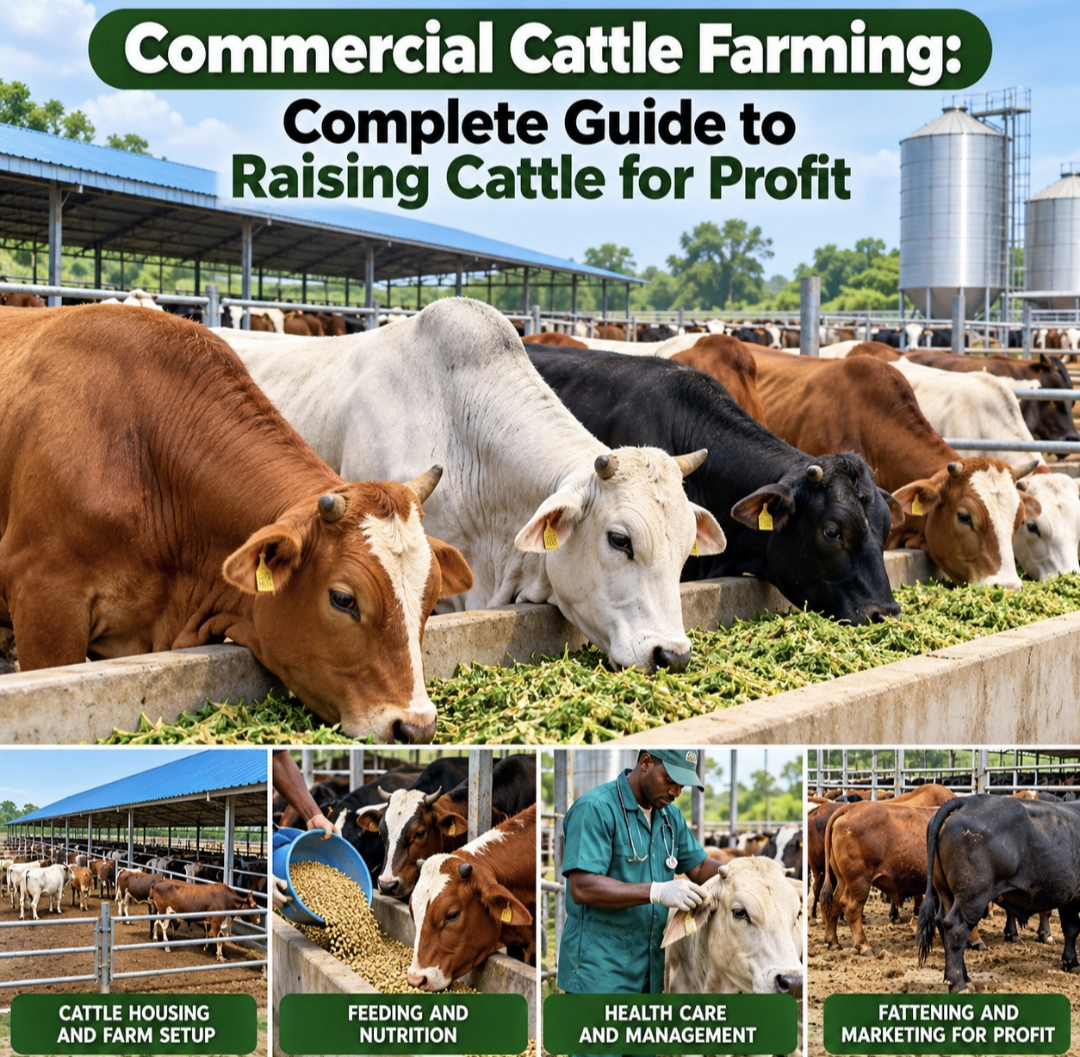
Commercial cattle farming is the organized production of cattle for meat, milk, breeding, and other valuable livestock products. It is one of the most important branches of animal agriculture because cattle contribute to food production, employment, trade, leather production, manure and other agricultural value chains.
Modern cattle farming is very different from simply keeping animals on open land. Successful commercial farmers carefully manage breeds, pasture, feeding, water, housing, breeding, animal health, record keeping, labour, security and marketing.
Cattle can be raised under different systems, including extensive grazing, semi-intensive production, intensive production, ranching, feedlot systems and integrated crop-livestock farming. The appropriate system depends on land availability, climate, capital, feed resources, market opportunities and the farmer's production objectives.
This comprehensive guide explains how commercial cattle farming works, how to choose cattle, prepare land, establish pasture, provide proper nutrition, manage breeding, prevent diseases, control costs and develop a profitable cattle enterprise.
What Is Commercial Cattle Farming?
Commercial cattle farming is the production of cattle primarily for economic purposes.
Depending on the farm, cattle may be raised for:
- Beef
- Milk
- Breeding stock
- Fattening
- Calves
- Hides and skins
- Manure
- Other livestock products
A commercial cattle farm can range from a small family enterprise to a large ranch or highly specialized dairy or beef operation.
The major difference between commercial production and casual livestock keeping is the emphasis on planned production, productivity, records and profitability.
Major Types of Cattle Farming
There are several major cattle production systems.
Beef Cattle Farming
Beef cattle are raised primarily for meat production.
Farmers may purchase calves, grow them to market weight and sell them to traders, processors, butcheries or other buyers.
Some farms maintain breeding herds that continuously produce calves for future beef production.
Dairy Cattle Farming
Dairy farming focuses on milk production.
Dairy cattle require careful management of:
- Nutrition
- Breeding
- Milking
- Hygiene
- Water
- Animal health
- Calf management
Milk production requires a consistent market because fresh milk is highly perishable.
Dual-Purpose Cattle Farming
Some cattle are raised for both meat and milk.
This can be useful where farmers want to diversify revenue rather than depend on a single product.
Cattle Fattening
Cattle fattening involves purchasing animals, providing high-quality nutrition for a defined period and selling them after they reach the desired body condition or weight.
The profitability of fattening depends heavily on the purchase price, feed cost, growth rate and selling price.
Cattle Breeding
Breeding farms maintain selected cows and bulls to produce calves.
The calves may be sold as:
- Breeding stock
- Beef animals
- Dairy animals
- Fattening animals
Good breeding management can increase the productive value of the herd over time.
Choosing the Right Cattle Breed
Breed selection is an important decision.
Farmers should consider:
- Climate
- Disease pressure
- Feed availability
- Growth rate
- Milk production
- Meat quality
- Heat tolerance
- Reproductive performance
- Local market demand
- Availability of breeding stock
A breed that performs well in one environment may not necessarily perform equally well in another.
Farmers should therefore select cattle suited to their local conditions rather than choosing a breed solely because it is popular elsewhere.
Indigenous and Adapted Cattle
Locally adapted cattle often have valuable characteristics such as tolerance to local environmental conditions and familiarity with locally available feed resources.
Their production potential should be evaluated according to the intended business model.
Improved and Crossbred Cattle
Crossbreeding can combine desirable characteristics from different cattle populations.
For example, a farmer may seek to combine:
- Local adaptation
- Disease tolerance
- Growth performance
- Milk production
- Reproductive ability
However, crossbreeding should be planned carefully rather than performed randomly.
Land Requirements for Cattle Farming
Land requirements depend on the production system.
A grazing farm generally requires substantially more land than an intensive feedlot operation because animals obtain much of their feed directly from pasture.
Important factors include:
- Pasture productivity
- Rainfall
- Soil fertility
- Animal numbers
- Cattle breed
- Season
- Supplementary feeding
- Grazing management
The concept of carrying capacity is more useful than using a universal acres-per-cow rule.
Understanding Carrying Capacity
Carrying capacity is the number of animals that a particular area can sustainably support.
If a farmer keeps more cattle than the land can support, pasture quality may decline.
Over time, this can lead to:
- Soil degradation
- Reduced forage production
- Weight loss
- Higher feed costs
- Increased competition among animals
Farmers should therefore monitor pasture conditions and adjust herd size or supplementary feeding accordingly.
Developing a Cattle Pasture
Pasture is one of the most important resources in grazing cattle production.
A productive pasture should provide sufficient forage throughout the production cycle.
Potential forage plants vary by climate and soil conditions, but may include suitable grasses and legumes.
Farmers should select forage varieties based on:
- Local climate
- Soil
- Rainfall
- Drought tolerance
- Growth rate
- Nutritional quality
- Grazing tolerance
Rotational Grazing
Rotational grazing divides grazing land into several paddocks.
Cattle are moved between paddocks so that grazed areas can recover.
A simplified system could be:
Paddock A → Paddock B → Paddock C → Paddock D → back to A
The exact timing should depend on pasture growth rather than a rigid schedule.
Good rotational grazing can help farmers make more efficient use of available forage.
Water Requirements
Cattle require reliable access to clean water.
Water consumption varies according to:
- Body size
- Temperature
- Diet
- Milk production
- Activity
- Stage of pregnancy
- Humidity
A commercial farm should have a dependable water system.
Possible sources include:
- Boreholes
- Wells
- Properly managed surface water
- Storage tanks
- Trough systems
Water troughs should be cleaned regularly.
Cattle Housing
Cattle housing depends on the production system.
Grazing cattle may require relatively simple shelters for shade, rain and protection.
Dairy and intensive cattle operations may require more developed facilities.
A good cattle facility should provide:
- Adequate ventilation
- Good drainage
- Shade
- Clean resting areas
- Easy access to water
- Safe handling areas
- Adequate space
Poorly designed housing can increase disease and injury risks.
Feeding Commercial Cattle
Nutrition is one of the biggest determinants of cattle performance.
Cattle feed can come from:
- Pasture
- Hay
- Silage
- Crop residues
- Forage legumes
- Grains
- Protein supplements
- Commercial concentrates
- Mineral supplements
The appropriate diet depends on the animal's age and production objective.
A growing calf, breeding cow and finishing steer do not necessarily have identical nutritional requirements.
The foundation of a successful cattle enterprise is built around appropriate cattle, adequate feed, reliable water, suitable land, effective health management, good breeding, accurate records and dependable markets.
Dry-Season Feeding
Pasture availability may decline during dry periods.
Farmers should prepare feed reserves before shortages occur.
Possible conserved feeds include:
- Hay
- Silage
- Dried forage
- Suitable crop residues
Feed should be stored properly to prevent mould, contamination and unnecessary losses.
Mineral Nutrition
Minerals are important for:
- Bone development
- Growth
- Reproduction
- Milk production
- General health
Farmers may need to provide appropriate mineral supplements where pasture and other feeds do not meet animal requirements.
Calf Management
Calves are the future of a breeding operation.
Good calf management includes:
- Adequate colostrum after birth
- Clean surroundings
- Proper nutrition
- Appropriate vaccination
- Parasite control
- Monitoring growth
- Early identification of illness
A healthy calf has a better chance of becoming a productive adult animal.
Cattle Breeding Management
A commercial breeding programme should aim for regular reproduction and healthy offspring.
Important factors include:
- Healthy breeding cows
- Fertile bulls or appropriate artificial insemination programmes
- Adequate nutrition
- Disease control
- Proper reproductive records
Poor nutrition can reduce reproductive performance even when the genetics of the herd are good.
Selecting Breeding Cows
Breeding cows should be selected based on characteristics such as:
- Health
- Fertility
- Good body structure
- Reproductive history
- Mothering ability
- Adaptability
- Production performance
Keeping detailed records makes selection easier.
Selecting Breeding Bulls
A breeding bull can influence many calves.
Farmers should consider:
- Fertility
- Structural soundness
- Health
- Growth characteristics
- Breed suitability
- Reproductive history
A veterinary professional can assist with breeding soundness assessments.
Artificial Insemination
Artificial insemination can allow farmers to access genetics from selected bulls without maintaining a breeding bull on the farm.
However, successful artificial insemination requires:
- Appropriate reproductive management
- Skilled technicians
- Good timing
- Proper semen handling
- Accurate records
Cattle Health Management
Healthy cattle grow faster, reproduce more efficiently and generally require fewer emergency interventions.
A cattle health programme may include:
- Vaccination
- Parasite control
- Regular observation
- Proper nutrition
- Quarantine
- Clean water
- Good hygiene
- Veterinary examinations
Disease prevention is generally more sustainable than waiting until animals become seriously ill.
Common Cattle Health Problems
Cattle can be affected by numerous diseases and parasites.
Potential problems vary according to geographical location and management system.
Examples include:
- Internal parasites
- External parasites
- Bacterial diseases
- Viral diseases
- Reproductive diseases
- Nutritional disorders
- Foot problems
Farmers should work with qualified veterinarians to develop a local disease-prevention programme.
Quarantine
New cattle should ideally be separated from the existing herd for an appropriate period.
This allows farmers to observe their health and implement necessary veterinary procedures before introduction.
Quarantine can reduce the risk of introducing disease into an established herd.
Cattle Identification
Every commercial cattle farm should have a reliable animal identification system.
Identification may involve:
- Ear tags
- Electronic identification
- Other approved identification methods
Identification helps farmers track:
- Birth
- Parentage
- Treatments
- Breeding
- Weight
- Sales
- Health history
Record Keeping
Good records are essential for commercial cattle production.
Farmers should record:
- Animal identification
- Birth dates
- Parentage
- Purchase prices
- Sales
- Weight
- Breeding dates
- Calving
- Vaccinations
- Treatments
- Feed expenses
- Mortality
- Labour
- Transportation
Records allow the farmer to identify productive animals and remove poor performers.
Labour Management
The labour requirements of a cattle farm depend on herd size and production system.
Daily activities may include:
- Feeding
- Herd inspection
- Water management
- Pasture management
- Cleaning
- Animal movement
- Health observation
- Calf care
- Record keeping
- Fence inspection
Workers should understand basic cattle handling and safety procedures.
Cattle Handling Facilities
Commercial farms benefit from safe handling facilities.
Depending on farm size, these may include:
- Holding pens
- Chutes
- Gates
- Loading facilities
- Weighing equipment
- Treatment areas
Good facilities reduce stress and make routine management easier.
Cattle Fattening Business
Cattle fattening can be operated as a specialized business.
The basic model is:
Purchase cattle → provide appropriate nutrition → monitor growth → sell at target condition
The major financial factors are:
- Purchase price
- Feed cost
- Growth rate
- Veterinary expenses
- Labour
- Transport
- Selling price
Farmers should calculate these costs before purchasing animals.
Calculating Fattening Profit
A simplified calculation is:
Profit = Selling Revenue − Purchase Cost − Feeding Cost − Other Costs
Other costs may include:
- Veterinary care
- Labour
- Transport
- Water
- Housing
- Marketing
The calculation should be performed for each production cycle.
Cattle Marketing
Cattle can be marketed through:
- Livestock traders
- Abattoirs
- Butchers
- Meat processors
- Restaurants
- Direct consumers
- Breeding farms
- Other livestock farmers
Building relationships with reliable buyers can make marketing more predictable.
Value Addition in Cattle Farming
Cattle can generate several products.
The main value chains include:
Cattle → beef
Cattle → milk
Cattle → breeding stock
Cattle → hides
Cattle → manure
Farmers may eventually expand into processing or other value-added businesses where they have the required infrastructure and regulatory approvals.
Manure Management
Cattle manure is a valuable agricultural resource when properly handled.
It can be:
- Composted
- Applied to fields
- Used to improve soil organic matter
- Integrated into crop production
Manure should be managed carefully to reduce odour, nutrient losses and environmental contamination.
Integrated Crop and Cattle Farming
Crop and cattle farming can complement each other.
For example:
Crop production → suitable crop residues → cattle feed
and:
Cattle → manure → crop fields
This can improve resource utilization and diversify farm income.
Major Risks in Cattle Farming
Commercial cattle farming has several risks.
These include:
- Disease
- Drought
- Feed shortages
- Theft
- Poor breeding performance
- Market-price changes
- Poor pasture management
- High input costs
- Extreme weather
- Mortality
A good business plan should include strategies for managing these risks.
How to Improve Cattle Farm Profitability
Profitability can be improved by focusing on productivity rather than simply increasing herd size.
Important strategies include:
- Improve pasture quality
- Reduce mortality
- Improve breeding performance
- Monitor animal growth
- Reduce feed waste
- Maintain accurate records
- Improve water management
- Establish reliable markets
- Sell animals strategically
- Reinvest in infrastructure
Starting a Commercial Cattle Farm
A practical startup sequence is:
Step 1: Define your business objective.
Step 2: Choose the cattle production system.
Step 3: Assess available land and carrying capacity.
Step 4: Establish reliable water.
Step 5: Develop pasture or arrange feed supply.
Step 6: Construct suitable housing and handling facilities.
Step 7: Install appropriate fencing.
Step 8: Identify reputable livestock suppliers.
Step 9: Purchase healthy cattle.
Step 10: Quarantine new animals.
Step 11: Establish a veterinary programme.
Step 12: Start detailed production records.
Step 13: Establish buyer relationships.
Step 14: Monitor growth and reproductive performance.
Step 15: Sell animals or livestock products according to the business plan.
Step 16: Reinvest part of the revenue and expand gradually.
How Much Capital Is Needed?
There is no single startup figure because commercial cattle farming varies considerably.
Your budget will depend on:
- Number of cattle
- Breed
- Age of animals
- Land ownership or rental
- Fencing
- Water infrastructure
- Housing
- Feed
- Labour
- Veterinary services
- Transport
- Security
A farmer with existing land, water and fencing may need substantially less capital than someone starting from completely undeveloped land.
The most important rule is to avoid using the entire startup budget to purchase animals.
Infrastructure and working capital are equally important.
Example Budget Structure
An illustrative cattle-farming budget could allocate funds approximately as follows: Expense Example allocation Cattle purchase 45–55% Fencing 10–15% Water system 5–10% Housing and handling facilities 8–12% Feed reserve 5–10% Veterinary care 3–5% Labour and transportation 5–10% Emergency reserve 3–5%
These are planning percentages rather than current market prices.
Actual costs should be calculated using current local prices before investment.
Common Mistakes in Commercial Cattle Farming
Beginners should avoid:
Buying too many cattle too early
A large herd can become difficult to feed and manage.
Ignoring pasture capacity
Land should be matched with livestock numbers.
Poor water management
Insufficient water can severely affect productivity.
Buying unhealthy cattle
Poor-quality animals can create significant veterinary and financial problems.
Ignoring records
Without records, it is difficult to know which animals are profitable.
Neglecting breeding
Poor reproductive performance can reduce herd growth.
Waiting until feed runs out
Feed reserves should be prepared before shortages occur.
Ignoring the market
Production should be connected to realistic market opportunities.
Modern Technology in Cattle Farming
Technology is increasingly being used to improve cattle production.
Examples include:
- Electronic identification
- Digital farm records
- GPS tracking
- Electronic weighing
- Automated water systems
- Remote monitoring
- Farm-management software
- Weather information systems
Technology should be adopted where it provides a measurable management benefit.
Sustainable Cattle Farming
Sustainable cattle farming focuses on maintaining animal productivity while protecting the land and natural resources required for future production.
Important practices include:
- Avoiding overgrazing
- Protecting soil
- Managing water responsibly
- Conserving pasture
- Maintaining animal health
- Recycling manure
- Using appropriate stocking rates
- Protecting vegetation
Sustainability is not only an environmental issue; it is also a long-term business issue.
Frequently Asked Questions About Commercial Cattle Farming
Is commercial cattle farming profitable?
It can be profitable, but profitability depends on production efficiency, animal prices, feed costs, mortality, reproductive performance and market conditions.
Which cattle breed is best?
There is no universally best breed. The appropriate breed depends on climate, disease pressure, feed resources, production objective and market demand.
How much land is required for cattle?
The requirement depends on pasture productivity, cattle numbers, climate, management and whether supplementary feed is provided.
Can cattle farming be started on a small scale?
Yes. A farmer can start with a manageable number of cattle and expand as infrastructure, experience and market access improve.
What do cattle eat?
Cattle can consume pasture grasses, forage legumes, hay, silage, suitable crop residues and other appropriately formulated feeds.
How important is water?
Water is essential for cattle health and productivity and should be available regularly.
Is cattle fattening different from cattle breeding?
Yes. Fattening focuses primarily on increasing the condition or weight of purchased or young cattle for sale, while breeding focuses on producing offspring and maintaining a productive herd.
Can cattle and crops be produced on the same farm?
Yes. Crop-livestock integration can allow suitable crop residues to contribute to livestock feeding while manure contributes nutrients to crop production.
Final Thoughts
Commercial cattle farming is a long-term agricultural business that requires careful planning rather than simply purchasing animals.
Farmers who start at a manageable scale can learn their production environment, identify profitable markets and improve their management systems before expanding.
The ultimate goal is not simply to own a large number of cattle. The goal is to create a productive, healthy and financially sustainable cattle enterprise in which land, feed, animals, labour and capital are efficiently managed.
With proper planning, commercial cattle farming can become an important source of food, employment, income and agricultural value addition.
Latest posts
- Beans Farming: A Complete Guide to Different Types of Beans, Their Uses, Nutrition, and Farming
- Cassava Farming in Africa: A Complete Guide to Planting, Growing, Harvesting and Making Profit from Cassava
- CATFISH FARMING(HYBRID): THE COMPLETE STEP-BY-STEP GUIDE FOR BEGINNERS AND COMMERCIAL FARMERS (2026 EDITION)
- Cattle Fattening Business: Complete Guide to Raising Beef Cattle for Profit
- COCOA FARMING IN AFRICA: A Complete Professional Guide (Part 1)
- COCOA FARMING IN AFRICA: A Complete Professional Guide (Part 2)
- Commercial Carrot Farming: A Complete Guide to Growing Carrots for Profit
- Commercial Cashew Farming: A Complete Guide to Growing Cashew for Profit