Overview
Poultry meat is one of the most widely consumed animal-source foods in the world. Chicken, turkey, duck, goose, guinea fowl and other edible poultry species provide valuable nutrients while supporting farmers, processors, traders, restaurants, retailers and millions of workers throughout the food supply chain.
The growing importance of poultry meat is closely connected to its nutritional value, affordability, versatility and relatively efficient production. Compared with many other animal proteins, poultry meat can provide high-quality protein while offering consumers a wide range of preparation and cooking options.
Beyond nutrition, poultry meat contributes to food security, employment, household income, agricultural development and economic activity. Poultry farming can also provide opportunities for small-scale farmers and commercial producers because poultry can be raised on different scales, from household production to highly specialized industrial farms.
This article explores the major benefits of poultry meat to humanity, including its nutritional, health, economic, agricultural, social and food-security contributions.
What Is Poultry Meat?
Poultry meat refers to the edible meat obtained from domesticated birds raised for human consumption. Chicken is the most widely consumed poultry meat in many parts of the world, but other poultry species also contribute to the global food supply.
Common poultry meat sources include chicken, turkey, duck, goose, guinea fowl and other domesticated birds used for food.
Poultry meat can be sold fresh, chilled, frozen, processed, smoked, dried, canned or prepared into products such as sausages, nuggets, burgers, meatballs and ready-to-cook meals.
Its versatility has made poultry an important component of diets across different cultures and income groups.
Why Is Poultry Meat Important to Humanity?
Poultry meat is important because it combines nutritional value with relatively broad accessibility and versatility.
It supplies high-quality protein and several important vitamins and minerals. At the same time, poultry production creates economic opportunities for farmers and businesses involved in feed production, hatcheries, transportation, processing, storage, marketing and retail.
For many households, poultry meat is also easier to incorporate into everyday meals than some other animal proteins because it can be prepared in numerous ways and used in different cuisines.
The importance of poultry therefore extends beyond the plate. It forms part of a large agricultural and economic system that supports food production and livelihoods.
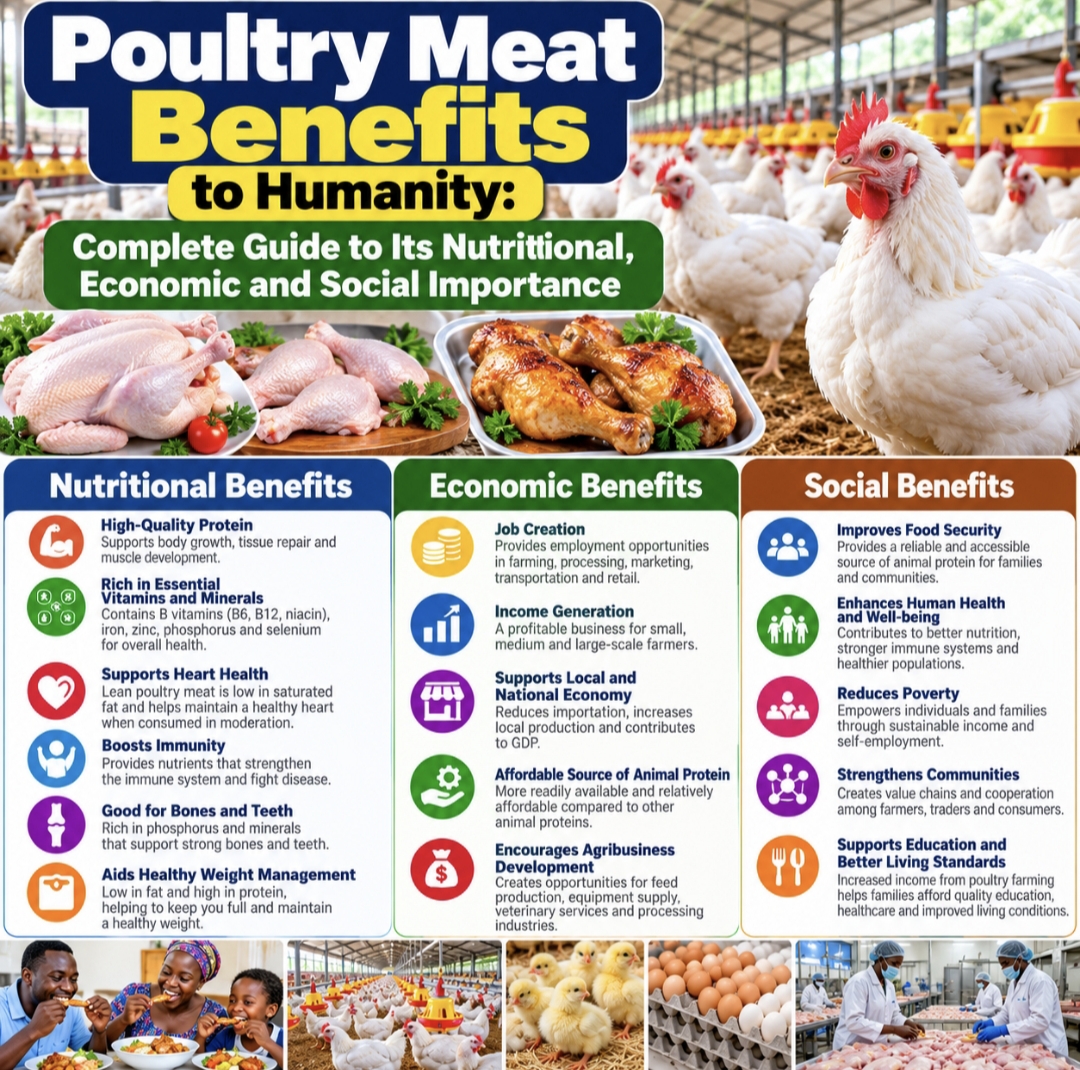
Poultry Meat Provides High-Quality Protein
One of the most important benefits of poultry meat is its protein content.
Protein is essential for maintaining and repairing body tissues. The human body uses amino acids from dietary protein to build and maintain muscles, skin, organs, enzymes and other structures.
Poultry meat generally provides complete or high-quality protein because it contains all of the essential amino acids that humans need from their diets.
This makes poultry particularly valuable in diets where adequate protein intake is a priority.
Protein is important throughout life. Children require protein for growth and development, adults need it for maintenance and repair, and older adults can benefit from adequate protein intake as part of maintaining muscle mass.
Poultry Meat Supports Muscle Development and Maintenance
Adequate protein intake contributes to the development and maintenance of muscle tissue.
People who engage in physical work, sports or exercise require sufficient dietary protein as part of an overall balanced diet.
Poultry meat can therefore serve as one convenient source of protein for active individuals.
However, muscle health depends on more than protein alone. Adequate calories, vitamins, minerals, physical activity, hydration and an overall balanced diet are also important.
Poultry Meat Provides Essential Vitamins
Poultry meat contains several vitamins that contribute to normal body functions.
Depending on the species, cut and preparation method, poultry can provide B vitamins such as vitamin B6, niacin and vitamin B12.
These nutrients participate in processes including energy metabolism, nervous-system function and the formation of blood cells.
The nutritional composition can differ between breast meat, thigh meat, wings and other parts of the bird. Cooking and processing methods can also influence the final nutritional profile.
Poultry Meat Is a Source of Vitamin B12
Vitamin B12 is particularly important because it naturally occurs mainly in foods of animal origin.
It contributes to normal red blood cell formation and nervous-system function and plays an important role in DNA-related processes.
Poultry meat can therefore contribute to dietary vitamin B12 intake, especially for people who consume animal-source foods.
People following strict plant-based diets may need to obtain vitamin B12 from fortified foods or supplements under appropriate professional guidance.
Poultry Meat Provides Vitamin B6
Vitamin B6 is another important nutrient found in poultry.
It participates in protein metabolism and contributes to normal nervous-system and immune-system functions.
Including poultry as part of a varied diet can therefore help contribute to the body's requirement for vitamin B6.
Poultry Meat Provides Niacin
Poultry meat can be a useful source of niacin, also known as vitamin B3.
Niacin is involved in energy metabolism and supports normal skin and nervous-system function.
Because poultry can provide meaningful amounts of niacin, it can contribute to overall micronutrient intake when included in a balanced diet.
Poultry Meat Contains Important Minerals
In addition to protein and vitamins, poultry meat provides minerals such as phosphorus, selenium and zinc, with amounts varying according to species and cut.
These minerals perform different functions within the body.
Phosphorus contributes to normal bones and teeth and participates in energy-related processes. Selenium supports antioxidant defense and normal thyroid function, while zinc contributes to immune function and many other biological processes.
Poultry Meat Can Support Immune Function
A healthy immune system depends on adequate nutrition rather than one particular food.
Poultry meat can contribute several nutrients involved in normal immune function, including protein, zinc, selenium and vitamin B6.
Consuming poultry as part of a varied diet that includes vegetables, fruits, whole grains, legumes and other nutrient-rich foods can contribute to overall nutritional adequacy.
It is important to understand that eating poultry does not automatically prevent infections or disease. Good nutrition supports normal body functions, but it is only one part of maintaining health.
Poultry Meat Can Be Part of a Balanced Diet
Poultry meat can fit into many different healthy eating patterns.
The nutritional quality of a poultry-based meal depends not only on the meat itself but also on the preparation method and foods served alongside it.
For example, grilled or roasted poultry served with vegetables, legumes or whole grains can form part of a balanced meal.
By contrast, heavily breaded or deep-fried poultry combined with high-sodium sauces and highly processed side dishes can produce a very different nutritional profile.
Therefore, the health value of poultry depends significantly on how it is prepared and consumed.
Poultry Meat Is Highly Versatile
Another major benefit of poultry meat is versatility.
Chicken and other poultry products can be grilled, roasted, boiled, steamed, baked, stewed or incorporated into soups and other dishes.
Poultry can also be combined with vegetables, grains, legumes, pasta and other foods.
This versatility allows different cultures and communities to incorporate poultry into traditional and modern cuisines.
Poultry Meat Is Used in Traditional Foods Around the World
Poultry has an important place in cuisines across continents.
Different cultures have developed their own methods of preparing chicken, turkey, duck and other birds.
Poultry may be used in soups, stews, rice dishes, grilled meals, curries, sandwiches and festive foods.
This cultural versatility contributes to the popularity and continued demand for poultry meat.
Poultry Meat Contributes to Food Security
Food security depends on people's ability to access sufficient, safe and nutritious food.
Poultry production contributes to food security by supplying animal-source protein and other nutrients to consumers.
Because poultry can be produced on small, medium and large farms, the sector can operate across different agricultural systems.
Small-scale poultry production can provide households with meat and income, while commercial farms can supply large urban populations.
Poultry Farming Can Produce Meat Relatively Quickly
Compared with many larger livestock species, chickens raised specifically for meat can reach market weight within a relatively short production cycle.
This short production cycle can allow farmers to produce several batches within a year, depending on the production system, breed, climate, management practices and market conditions.
Rapid production can help poultry farmers respond to changes in consumer demand.
Poultry Production Can Require Less Land Than Some Livestock Systems
Modern poultry production can produce substantial quantities of meat using relatively compact housing systems.
This does not mean poultry farming has no environmental footprint. Poultry production requires feed, water, housing, energy, transportation and waste management.
However, the ability to raise birds in controlled housing systems can allow efficient use of land for the production process itself.
The overall environmental performance depends heavily on feed production, farm management, energy use, manure management and other factors.
Poultry Meat Supports Agricultural Livelihoods
Poultry meat creates economic opportunities throughout the agricultural value chain.
Farmers produce birds, while other businesses supply chicks, feed, vaccines, equipment, housing materials and transportation.
After birds reach market weight, processors, wholesalers, retailers, restaurants and other businesses become involved.
This creates a broad network of economic activity.
Poultry Farming Creates Employment
The poultry industry creates direct and indirect employment.
Direct employment can include farm workers, managers, hatchery technicians, veterinarians and processing workers.
Indirect employment can involve feed manufacturing, transportation, equipment sales, veterinary services, packaging, cold-chain logistics, marketing and retail.
As the poultry industry expands, these interconnected businesses can create additional opportunities for employment and entrepreneurship.
Poultry Meat Supports Small-Scale Farmers
Poultry production can be accessible to farmers operating on different scales.
A household may keep a small number of birds, while another producer may operate a commercial farm with thousands or millions of birds.
Small-scale poultry farming can provide families with meat for household consumption and birds or eggs for sale.
With appropriate management and market access, poultry can become an important source of supplemental or primary farm income.
Poultry Meat Supports Women and Youth Entrepreneurship
Poultry-related businesses can provide opportunities for women and young entrepreneurs.
Businesses can include broiler production, chick rearing, feed distribution, poultry processing, egg and meat marketing, transportation and food preparation.
Entrepreneurship opportunities vary by location and access to finance, training, infrastructure and markets.
Developing these areas can help make poultry value chains more inclusive.
Poultry Processing Adds Economic Value
The economic value of poultry does not end when a bird leaves the farm.
Processing can transform live birds into cleaned, portioned, packaged and branded products.
Value-added products can include chicken portions, sausages, burgers, nuggets, smoked poultry and ready-to-cook products.
Processing creates opportunities for businesses to differentiate products and potentially reach higher-value markets.
Poultry Meat Supports the Food Processing Industry
Poultry is an important raw material for the food processing industry.
Processed poultry products can be sold through supermarkets, restaurants, hotels, catering businesses and food-service companies.
This creates demand for packaging, refrigeration, transportation, quality control and food-processing equipment.
Poultry Meat Supports Restaurants and Food Businesses
Restaurants and food vendors rely heavily on poultry because of its popularity and versatility.
Chicken dishes appear on menus ranging from fast food to fine dining.
This creates business opportunities for restaurants, caterers, street-food vendors, hotels and meal-delivery companies.
Poultry Meat Contributes to International Trade
Poultry products are traded internationally in various forms.
Countries can import or export frozen poultry, processed products and other poultry-related commodities depending on production capacity, consumer demand, regulations and trade policies.
International poultry trade connects farmers and processors with markets beyond their local communities.
Poultry Meat Can Help Diversify Household Nutrition
A diversified diet is generally important for obtaining a broad range of nutrients.
Poultry can complement plant-based foods such as grains, vegetables, fruits, legumes, nuts and seeds.
Instead of relying on a single food category, households can combine different foods to create meals with varied nutritional characteristics.
Poultry Meat Can Be Useful for Meal Planning
Poultry can be purchased in different forms and portions, allowing households to plan meals according to their needs.
Whole birds can be used across multiple meals, while specific cuts can be purchased when convenience is more important.
Frozen poultry can also provide longer storage opportunities when properly handled.
Poultry Meat Can Reduce Dependence on a Single Protein Source
Food systems benefit from diversification.
A population that has access to multiple protein sources can be less dependent on one particular livestock sector.
Poultry can therefore complement fish, eggs, dairy products, legumes and other protein sources.
Diversification can be especially important when prices, weather events, disease outbreaks or supply-chain disruptions affect a particular food category.
Poultry Meat Provides Important Nutrients During Growth
Children and adolescents have nutritional needs associated with growth and development.
Protein and micronutrients are important components of adequate diets during these stages.
Poultry can contribute useful nutrients, but children's diets should include a variety of foods rather than relying heavily on one animal-source food.
Food safety is particularly important when preparing poultry for children.
Poultry Meat Can Support Nutritional Needs in Older Adults
Older adults can face challenges related to maintaining adequate protein and micronutrient intake.
Poultry can provide a relatively soft and versatile protein option when appropriately prepared.
For individuals with chewing or swallowing difficulties, preparation methods can be adapted to produce softer meals.
Individual dietary needs should always be considered, particularly where medical or nutritional conditions are involved.
Poultry Meat Can Be Prepared With Different Fat Levels
Different poultry cuts have different nutritional compositions.
Removing the skin can reduce the amount of fat in a serving, while cooking methods can also influence the final calorie and fat content.
Grilling, roasting, steaming and baking can be useful alternatives to frequent deep frying.
Consumers should consider the complete meal rather than focusing on a single nutrient.
Poultry Meat Can Be Convenient
Modern lifestyles have increased demand for convenient foods.
Poultry can be sold as whole birds, portions, fillets, minced meat and ready-to-cook products.
This makes it possible for consumers to choose products based on cooking time, budget and household preferences.
Convenience is one reason poultry has become such an important component of modern food systems.
Poultry Meat Supports Rural Economies
Poultry farming can stimulate economic activity in rural areas.
Farmers purchase feed and equipment, hire workers, transport birds and interact with traders and processors.
These activities can create a multiplier effect throughout agricultural communities.
Where infrastructure and markets are developed effectively, poultry can contribute significantly to rural economic development.
Poultry Feed Production Creates Additional Business Opportunities
The poultry industry depends heavily on feed.
Feed manufacturers require agricultural commodities such as grains, protein ingredients, minerals and other nutritional components.
This creates connections between poultry production and crop agriculture.
Farmers producing feed ingredients can therefore benefit indirectly from growth in poultry meat demand.
Poultry Manure Can Support Crop Production
Poultry production also generates manure.
When properly collected, handled, composted and applied, poultry manure can provide organic matter and nutrients for agricultural soils.
This creates an important connection between poultry farming and crop production.
However, manure must be managed carefully. Excessive or poorly handled application can contribute to nutrient losses, odors, water pollution and other environmental problems.
Poultry Production Can Support Circular Agriculture
Circular agriculture seeks to use agricultural resources efficiently and reduce unnecessary waste.
Poultry manure can be integrated into crop production, while some agricultural by-products may be used as components of livestock feed where appropriate and safe.
Properly managed integration can help improve resource efficiency.
Poultry Meat Encourages Agricultural Innovation
Growing demand for poultry has encouraged innovation in breeding, nutrition, housing, disease prevention, processing and logistics.
Modern poultry farms increasingly use technologies such as automated feeding, climate control, environmental monitoring, digital record keeping and precision management.
These technologies can improve productivity and help farmers make more informed decisions.
Poultry Meat Supports Veterinary and Animal Health Services
A healthy poultry industry requires professional animal-health services.
Veterinarians, animal-health technicians, laboratories and pharmaceutical suppliers play important roles in maintaining flock health and food safety.
This creates specialized employment and business opportunities.
Responsible poultry production also requires disease monitoring and appropriate biosecurity.
Food Safety Is Essential for Poultry Meat Benefits
The benefits of poultry meat depend on safe production, processing, storage and preparation.
Raw poultry can carry harmful microorganisms if it becomes contaminated.
Consumers should therefore handle raw poultry carefully, prevent cross-contamination, cook it adequately and maintain appropriate refrigeration.
Food businesses must also follow applicable hygiene and food-safety requirements.
Proper Cooking Makes Poultry Safer to Eat
Poultry should be cooked thoroughly to a safe internal temperature appropriate for the food and applicable food-safety guidance.
Consumers should avoid relying solely on the outside appearance of meat to determine whether it is adequately cooked.
Using a food thermometer is one of the most reliable ways to check cooking temperature.
Preventing Cross-Contamination Is Important
Raw poultry should be kept separate from ready-to-eat foods.
Cutting boards, knives, plates and kitchen surfaces that contact raw poultry should be cleaned properly.
Hands should also be washed thoroughly after handling raw poultry.
These simple practices can significantly reduce food-safety risks.
Responsible Poultry Production Protects Animal Welfare
The benefits of poultry meat to society should be considered alongside responsible animal management.
Birds require appropriate housing, access to clean water and feed, suitable environmental conditions, disease prevention and humane handling.
Good welfare practices can also support productivity because healthy birds are generally better able to grow and perform normally.
Poultry Production Must Consider Environmental Sustainability
Although poultry production can be resource-efficient compared with some livestock systems, it still has environmental impacts.
Major considerations include feed production, greenhouse-gas emissions, energy use, water consumption, manure management, land use and transportation.
Farmers and the wider industry can improve sustainability through efficient feed use, reduced wastage, responsible manure management, energy efficiency and better production practices.
Improving Feed Efficiency Can Benefit the Environment
Feed production is one of the major resource requirements in poultry farming.
When birds convert feed efficiently into meat, fewer resources may be required to produce a given amount of meat.
This is one reason feed conversion and flock performance are important not only for farm profitability but also for resource efficiency.
Reducing Poultry Waste Benefits Society
Waste can occur at many stages of the poultry value chain.
It can occur through feed wastage, mortality, processing losses, spoilage, damaged products and household food waste.
Better planning, storage, processing and marketing can reduce unnecessary losses.
Reducing waste means that more of the resources invested in producing poultry meat are ultimately converted into food for people.
Poultry Meat Can Contribute to Affordable Protein
Affordability varies considerably by country and market, but poultry has often become an important source of animal protein because it can be produced efficiently at commercial scale.
The actual affordability of poultry depends on feed prices, production costs, transportation, taxes, processing costs, market conditions and consumer purchasing power.
Improving productivity and supply-chain efficiency can help make poultry products more accessible.
Poultry Meat Supports Emergency and Institutional Food Supply
Poultry products can be used by institutions such as schools, hospitals, hotels, restaurants and catering organizations.
Frozen and processed poultry can also be incorporated into organized food supply systems where cold-chain infrastructure is available.
Reliable poultry supply can therefore support large-scale meal preparation.
Poultry Meat Has Cultural and Social Importance
Food is more than nutrition.
Poultry dishes are often associated with family gatherings, celebrations, festivals and hospitality.
In many societies, chicken and other poultry products are served during important occasions.
This gives poultry meat cultural significance beyond its nutritional and economic value.
Poultry Meat Can Support Urban Food Systems
As cities expand, reliable food supply chains become increasingly important.
Commercial poultry production, processing, cold storage and distribution help connect rural producers with urban consumers.
Urban residents can access poultry products through supermarkets, markets, restaurants and food-delivery businesses.
Poultry Meat Supports Innovation in Food Products
The poultry industry continues to develop new products designed around convenience, nutrition, taste and consumer preferences.
Examples include portion-controlled products, ready-to-cook meals, low-fat options, marinated products and processed poultry foods.
Innovation can create additional value from poultry production.
The Importance of Responsible Poultry Consumption
The benefits of poultry meat do not mean that everyone needs to consume large quantities.
A healthy diet is based on balance, variety and appropriate portions.
Poultry can be included alongside vegetables, fruits, whole grains, legumes, nuts, seeds and other nutritious foods.
The ideal dietary pattern varies according to individual nutritional needs, culture, availability and health considerations.
How Consumers Can Get More Benefits From Poultry Meat
Consumers can make poultry meals more nutritious by choosing appropriate portions and combining poultry with nutrient-rich foods.
Useful practices include choosing less processed poultry more often, removing skin when appropriate, using healthier cooking methods, limiting excessive salt and pairing poultry with vegetables, legumes and whole grains.
The goal should be a balanced diet rather than dependence on poultry alone.
How Farmers Can Increase the Social Benefits of Poultry Production
Farmers can increase the positive contribution of poultry farming by focusing on productivity, food safety, animal welfare and environmental responsibility.
Good management includes maintaining healthy birds, providing quality feed and water, preventing disease, minimizing mortality, keeping accurate records and managing manure responsibly.
Farmers should also maintain good relationships with customers and comply with relevant regulations.
How Governments Can Support the Poultry Industry
Governments can support poultry development through policies and infrastructure that improve agricultural productivity and food safety.
Important areas include veterinary services, farmer training, agricultural research, transportation infrastructure, reliable electricity, cold-chain development, access to finance and transparent market systems.
Support for smallholder farmers can also improve access to technology and markets.
The Role of Research in Poultry Production
Research is essential for improving poultry production.
Researchers continue to study genetics, nutrition, disease prevention, animal welfare, environmental management and food safety.
Scientific improvements can help farmers produce more food while using resources more efficiently.
Future Opportunities in Poultry Meat Production
The global demand for animal protein is influenced by population growth, urbanization, income levels, consumer preferences and food prices.
These trends may create continued opportunities for poultry producers.
Future growth is likely to focus increasingly on efficient production, improved animal health, sustainability, traceability, food safety and value-added products.
Challenges Associated With Poultry Meat
Despite its many benefits, poultry production has challenges.
These include disease outbreaks, feed-price volatility, climate-related risks, market fluctuations, energy costs, transportation problems and environmental concerns.
Poultry meat also requires proper handling to reduce food-safety risks.
Addressing these challenges requires cooperation among farmers, governments, researchers, processors, veterinarians, retailers and consumers.
Poultry Meat and Humanity: A Balanced Perspective
Poultry meat has made an important contribution to human nutrition and agricultural development.
It provides protein and several essential nutrients, supports livelihoods, creates employment and contributes to food security.
At the same time, responsible production and consumption are essential.
The future of poultry should therefore focus not simply on producing more meat, but on producing safe, nutritious and affordable food while improving animal welfare, environmental sustainability and economic resilience.
Frequently Asked Questions About Poultry Meat Benefits to Humanity
Is poultry meat good for human nutrition?
Poultry meat can be a nutritious source of high-quality protein and provides several vitamins and minerals. Its nutritional value depends on the species, cut, portion size and preparation method.
What is the main benefit of poultry meat?
One of its major benefits is its ability to provide high-quality protein along with nutrients such as vitamin B6, vitamin B12, niacin, selenium, phosphorus and zinc.
Does poultry meat help build muscle?
Protein from poultry contributes amino acids needed for muscle maintenance and development. However, muscle development also depends on physical activity, overall nutrition, energy intake and other factors.
Can children eat poultry meat?
Poultry can be part of a balanced diet for children when prepared safely and served in age-appropriate portions. Proper cooking and prevention of choking hazards are particularly important.
Is chicken the only important poultry meat?
No. Chicken is the most widely consumed poultry meat in many markets, but turkey, duck, goose and guinea fowl can also contribute to human diets.
Does poultry meat contribute to food security?
Yes. Poultry production contributes to food security by providing animal-source protein and supporting agricultural livelihoods and food supply chains.
Does poultry farming create employment?
Yes. Poultry farming creates direct employment on farms and indirect employment in hatcheries, feed manufacturing, veterinary services, processing, transportation, marketing, retail and food service.
Can poultry farming help small farmers?
Yes. Poultry can be produced at different scales, allowing smallholder farmers to raise birds for household consumption and income while larger commercial farms supply larger markets.
Is poultry meat environmentally friendly?
Poultry production can be relatively resource-efficient compared with some livestock systems, but it still has environmental impacts. Feed production, energy use, manure, transportation and other factors must be managed responsibly.
Can poultry manure be useful?
Yes. Properly managed poultry manure can provide organic matter and nutrients for crop production. It must be handled and applied responsibly to prevent environmental problems.
Is processed poultry as healthy as fresh poultry?
Not necessarily. Nutritional quality varies greatly among processed products. Some processed poultry foods can contain significant amounts of sodium, fat or other ingredients, so consumers should compare product labels and choose appropriately.
What is the healthiest way to prepare poultry?
Preparation methods such as baking, roasting, grilling, steaming or boiling can reduce the need for large amounts of added fat compared with frequent deep frying. The overall meal and portion size also matter.
How can poultry meat be made safer for consumers?
Consumers should keep raw poultry separate from ready-to-eat foods, wash hands after handling it, prevent cross-contamination, refrigerate it appropriately and cook it thoroughly.
Can poultry meat replace vegetables in the diet?
No. Poultry provides protein and certain micronutrients but does not provide all the nutrients supplied by vegetables, fruits, whole grains and other plant foods. A varied diet is generally preferable.
What is the economic importance of poultry meat?
Poultry meat supports farmers, processors, feed manufacturers, transporters, retailers, restaurants and many other businesses. It contributes to employment, household income, food processing and agricultural development.
What is the future of poultry meat production?
The future is likely to emphasize efficient production, improved genetics and nutrition, disease prevention, food safety, animal welfare, environmental sustainability, digital technology and value-added poultry products.
Conclusion: Why Poultry Meat Matters to Humanity
Poultry meat is much more than a popular food. It is an important component of the global food and agricultural system.
It provides high-quality protein and several essential nutrients while offering consumers a versatile and convenient food source. Poultry production also creates employment, supports farmers, strengthens rural economies and connects multiple industries, including feed manufacturing, veterinary services, processing, transportation, retail and food service.
For humanity, one of the greatest advantages of poultry is the combination of nutrition, production efficiency, versatility and economic opportunity.
However, maximizing these benefits requires responsible production and consumption. Poultry farmers need to prioritize bird health, biosecurity, animal welfare, efficient feed use, environmental management and food safety. Processors and retailers must maintain appropriate hygiene and storage systems, while consumers should handle and prepare poultry safely.
As the world's population continues to grow and demand for nutritious food increases, poultry meat can remain an important part of global food systems. The greatest opportunity is not simply to produce more poultry meat, but to develop a poultry industry that provides safe, nutritious and affordable food while creating sustainable livelihoods and using agricultural resources responsibly.
When nutrition, food safety, animal welfare, environmental responsibility and economic development are considered together, poultry meat can continue to make a meaningful contribution to human well-being and global food security.
Latest posts
- Types of Yam in Africa and Their Commercial Benefits: A Complete Guide to Yam Production, Uses and Business Opportunities
- Types of Potato: Complete Guide to Potato Varieties, Uses, Characteristics and Best Types for Farming.
- Types of Pepper Widely Known and Used in Africa: A Comprehensive Guide to Pepper Varieties, Uses, Cultivation and Economic Importance
- Transforming Agriculture: How an Effective Website Can Boost Your Agro Business

- Transforming Agriculture with Cutting-Edge Web Solutions

- Tilapia Farming: Complete Guide to Raising Tilapia for Commercial Production

- SUCCESSFUL WATERMELON FARMING: A Complete Guide to Growing Watermelon for Profit.
- Soybean Farming: Complete Guide to Growing Soybeans for Profit