Introduction
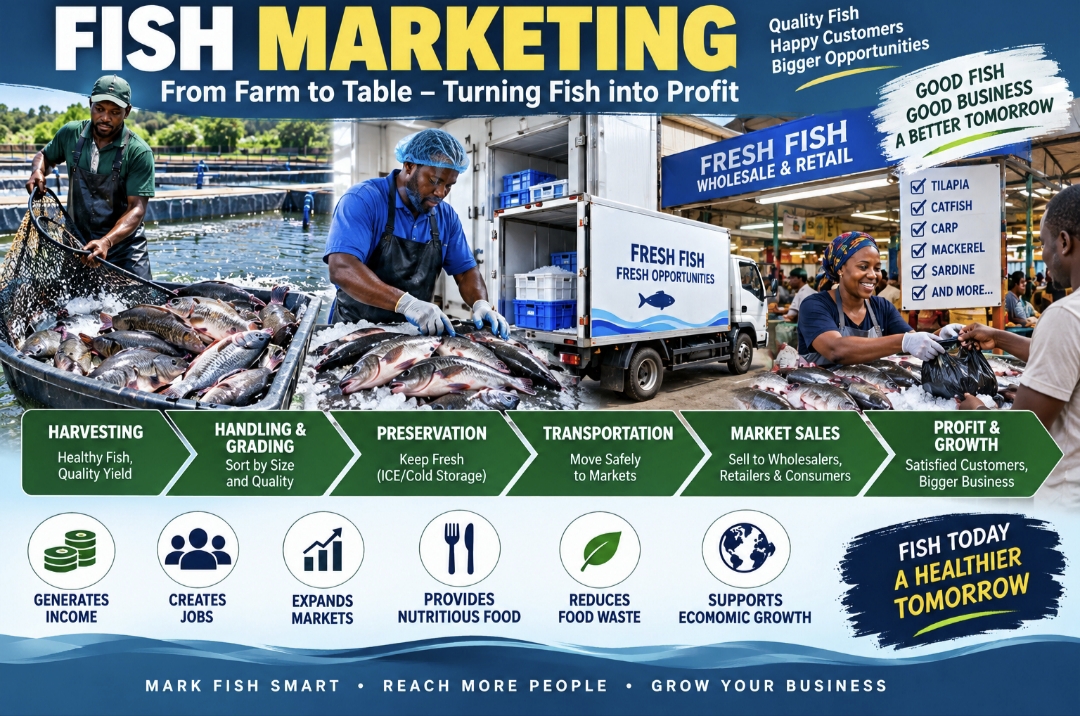
Fish marketing is one of the most important parts of running a successful aquaculture business. Producing healthy fish is only one side of the business; finding customers, establishing reliable distribution channels, setting appropriate prices and delivering quality products are equally important.
A fish farm can produce excellent fish and still struggle financially if the farmer does not have an effective marketing strategy.
Fish marketing involves everything that happens between production and the final customer. It includes identifying target markets, understanding customer preferences, pricing, branding, packaging, promotion, transportation, customer relationships, wholesale distribution, retail sales and online marketing.
Modern fish farmers have more marketing opportunities than ever before. In addition to traditional markets, farmers can sell directly to households, restaurants, hotels, supermarkets, retailers, processors and online customers.
This comprehensive guide explains how to develop a fish marketing strategy, find buyers, determine prices, build a fish brand, use digital marketing and increase the commercial value of farmed fish.
What Is Fish Marketing?
Fish marketing is the process of promoting, pricing, selling and distributing fish from the producer to the final consumer or another buyer.
The fish marketing chain may look like:
Fish farm → Wholesaler → Retailer → Consumer
Or:
Fish farm → Restaurant → Consumer
Or:
Fish farm → Processor → Retailer → Consumer
A farmer can also sell directly:
Fish farm → Consumer
Each marketing channel has different advantages, costs and requirements.
Why Fish Marketing Matters
Effective marketing can help a fish farmer:
- Find customers
- Sell fish faster
- Reduce unsold inventory
- Improve cash flow
- Build customer loyalty
- Increase brand recognition
- Access higher-value markets
- Develop repeat business
- Plan production around demand
- Improve profitability
Marketing should therefore begin before fish reach harvest size.
The Importance of Market Research
Before investing in fish production, farmers should understand the local and regional market.
Market research can answer questions such as:
- Who buys farmed fish?
- What species do customers prefer?
- What sizes do buyers want?
- How frequently do they purchase?
- Do customers prefer fresh, frozen, smoked or dried fish?
- What packaging do they prefer?
- What prices are buyers currently paying?
- Who are the major competitors?
- Where are the largest customer groups?
- How far will customers travel to buy fish?
This information can influence production decisions.
Identifying Your Target Customers
Not every fish buyer has the same needs.
Potential customer groups include:
- Households
- Restaurants
- Hotels
- Food vendors
- Supermarkets
- Fish retailers
- Wholesalers
- Processors
- Caterers
- Institutions
- Exporters
- Online customers
A farmer should decide which customer groups best fit the farm's production capacity.
Selling Fish to Households
Households can provide a large market for farmed fish.
Consumers may purchase fish for:
- Everyday meals
- Special occasions
- Parties
- Religious or cultural events
- Family gatherings
- Freezer storage
Household customers may value freshness, cleanliness, convenient packaging and reliable delivery.
Selling Fish to Restaurants
Restaurants can become valuable repeat customers.
They may require:
- Consistent supply
- Specific fish sizes
- Reliable delivery
- Clean products
- Competitive prices
- Consistent quality
Farmers should understand each restaurant's requirements before supplying them.
Selling Fish to Hotels
Hotels may purchase fish for restaurants, events and food-service operations.
The quantity required may vary considerably.
A farmer who wants to supply hotels should be able to maintain reliable quality and delivery schedules.
Selling Fish to Food Vendors
Food vendors may buy fish regularly for cooked meals.
Their priorities can include:
- Price
- Availability
- Size
- Freshness
- Convenient purchasing
- Consistent supply
Building relationships with multiple food vendors can diversify demand.
Selling Fish to Supermarkets
Supermarkets can provide access to retail consumers but may have stricter requirements.
Depending on the market, supermarkets may require:
- Standardized packaging
- Labelling
- Product weights
- Traceability
- Food-safety compliance
- Consistent supply
- Reliable delivery
Farmers should understand retailer requirements before targeting this channel.
Selling Fish to Wholesalers
Wholesalers can purchase large quantities.
The main advantage is volume.
A farmer may be able to sell a large harvest quickly instead of spending significant time selling individual portions.
However, wholesale prices may be lower than direct-to-consumer prices.
Selling Fish Directly to Consumers
Direct sales can allow farmers to retain more of the final selling price because fewer intermediaries are involved.
Possible direct-sales methods include:
- Farm-gate sales
- Home delivery
- Online ordering
- Social media orders
- Community sales
- Subscription programs
- Pre-orders
The farmer, however, must handle more marketing and customer service.
Fresh Fish Marketing
Fresh fish marketing focuses on freshness and quick delivery.
Important factors include:
- Harvest timing
- Chilling
- Clean handling
- Packaging
- Transportation
- Delivery speed
Fresh fish should be marketed to customers who can purchase and consume or process it promptly.
Frozen Fish Marketing
Frozen fish can be marketed over a wider geographic area because freezing can extend storage life.
However, frozen fish marketing requires:
- Freezing equipment
- Cold storage
- Reliable electricity
- Appropriate packaging
- Temperature monitoring
- Suitable transportation
Smoked Fish Marketing
Smoked fish can reach customers who prefer preserved or ready-to-cook products.
Potential buyers include:
- Households
- Restaurants
- Food vendors
- Retailers
- Supermarkets
- Wholesalers
Packaging and product presentation are particularly important for branded smoked fish.
Dried Fish Marketing
Dried fish can have a longer shelf life when properly processed and stored.
Marketing may target:
- Retail customers
- Wholesale traders
- Restaurants
- Food processors
- Specialty markets
Moisture control and hygienic packaging are important.
Fish Value Addition
Value addition involves transforming raw fish into products with additional convenience or market value.
Examples include:
- Cleaned fish
- Gutted fish
- Fillets
- Portions
- Frozen fish
- Smoked fish
- Dried fish
- Vacuum-packed fish
- Ready-to-cook fish
Value-added products can provide additional marketing opportunities.
Understanding Customer Preferences
A successful fish marketer listens to customers.
Ask customers:
- What fish size do you prefer?
- Do you prefer fresh or frozen fish?
- Would you buy cleaned fish?
- Would you buy fillets?
- How frequently do you purchase?
- How much do you normally purchase?
- Would you prefer delivery?
- What packaging size is convenient?
Customer feedback can guide production.
Fish Market Segmentation
Market segmentation means dividing customers into groups with similar needs.
For example:
Budget segment: customers looking for affordable fish.
Premium segment: customers willing to pay more for convenience, packaging or quality.
Restaurant segment: buyers requiring consistent supply.
Wholesale segment: buyers focused on large quantities.
Retail segment: consumers purchasing smaller quantities.
A farmer can develop different products for each segment.
Fish Pricing Strategy
Pricing is one of the most important marketing decisions.
A fish price should consider:
- Production cost
- Processing cost
- Packaging
- Transportation
- Labour
- Market demand
- Fish size
- Product quality
- Competition
- Selling channel
- Desired profit margin
Avoid setting prices simply by copying another farmer.
Calculating the Cost Per Kilogram
A useful approach is to calculate total production cost and divide it by the amount of marketable fish produced.
For example:
Total production cost = $4,000
Harvested fish = 2,000 kg
Cost per kilogram:
$4,000 ÷ 2,000 = $2 per kg
If the farmer sells at an illustrative $3 per kg:
Revenue per kilogram = $3
Estimated gross margin before other business-level expenses:
$3 − $2 = $1 per kg
These figures are illustrative and should not be treated as guaranteed market prices.
Wholesale Versus Retail Pricing
A farmer may sell fish wholesale at a lower price per kilogram but move large quantities quickly.
Retail sales may generate a higher price per kilogram but involve:
- More packaging
- More communication
- More delivery
- More customer service
- Smaller individual orders
Farmers should compare the net profit and labour involved in each channel.
Pricing Different Fish Sizes
Different markets may value different fish sizes.
A farmer can create separate price categories such as:
- Small
- Medium
- Large
- Extra-large
Exact categories should be based on customer demand rather than arbitrary labels.
Seasonal Fish Demand
Fish demand can change during:
- Holidays
- Festivals
- Wedding seasons
- School events
- Religious celebrations
- Community events
- Certain weather periods
Farmers can monitor historical sales to identify seasonal opportunities.
Pre-Orders and Advance Sales
Pre-orders can reduce marketing uncertainty.
Farmers can contact customers before harvest and collect orders for available fish.
This can help estimate:
- Expected demand
- Required harvest quantity
- Delivery requirements
- Packaging needs
Pre-orders can also reduce the amount of unsold fish after harvest.
Building a Fish Customer Database
Farmers should keep customer information where lawful and appropriate.
Useful business records include:
- Customer name
- Contact information
- Product purchased
- Quantity
- Purchase frequency
- Preferred size
- Delivery location
- Payment status
A simple spreadsheet or customer-management system can be sufficient for a small farm.
Customer Retention
Getting a customer once is not enough.
The objective should be to provide a consistent experience that encourages repeat purchases.
Customer retention can be improved through:
- Reliable quality
- Honest pricing
- Good communication
- On-time delivery
- Clean packaging
- Quick responses
- Problem resolution
- Consistent availability
Fish Farm Branding
Branding helps customers recognize and remember a business.
A fish brand can include:
- Farm name
- Logo
- Product packaging
- Brand colours
- Tagline
- Contact information
- Website
- Social-media identity
A professional brand can make a small farm appear more established.
Choosing a Fish Farm Name
A good business name should ideally be:
- Easy to remember
- Easy to pronounce
- Relevant to the business
- Distinctive
- Suitable for future expansion
Farmers should check name availability and applicable registration requirements before committing to a brand.
Fish Packaging
Packaging is both a practical and marketing tool.
Good packaging can:
- Protect fish
- Improve presentation
- Communicate product information
- Support brand recognition
- Make transportation easier
Packaging should be suitable for the product and storage conditions.
Information on Fish Packaging
Depending on local regulations and product type, packaging may include:
- Product name
- Net weight
- Processing date
- Storage instructions
- Business name
- Contact information
- Batch or lot information
- Applicable regulatory information
Commercial products should follow the labelling requirements of their market.
Using Photography to Market Fish
High-quality images can help customers understand the product.
Useful images include:
- Fresh fish
- Cleaned fish
- Packaged fish
- Smoked fish
- Fillets
- Harvest scenes
- Processing facilities
- Farm ponds
- Delivery packaging
Images should accurately represent the product.
Social Media Fish Marketing
Social media can provide a low-cost way to reach customers.
Farmers can publish:
- Harvest announcements
- Fish availability
- Farm videos
- Customer testimonials
- Product images
- Educational content
- Processing videos
- Special offers
- Behind-the-scenes content
Consistency is more important than posting excessively.
WhatsApp Marketing for Fish Farmers
Messaging platforms can be particularly useful for local businesses.
Farmers can use them to:
- Share product availability
- Receive orders
- Send price lists
- Confirm deliveries
- Communicate with restaurants
- Build customer relationships
Avoid sending excessive unsolicited messages.
Website Marketing
A professional fish-farm website can serve as a permanent business presence.
Useful website pages can include:
- Home
- About the farm
- Products
- Fresh fish
- Smoked fish
- Frozen fish
- Contact
- Delivery information
- Frequently asked questions
The website can also collect customer inquiries and orders.
Search Engine Optimization for Fish Marketing
Search engine optimization, or SEO, can help potential customers discover a fish business through search engines.
Useful content can target searches related to:
- Fresh farmed fish
- Farmed catfish
- Farmed tilapia
- Smoked fish
- Frozen fish
- Fish delivery
- Fish suppliers
- Wholesale fish
- Local fish farms
The exact keywords should reflect the farm's actual products and market.
Local SEO for Fish Farms
Local SEO can help customers discover nearby businesses.
Farmers can optimize their online presence by providing accurate:
- Business name
- Address
- Phone number
- Opening hours
- Website
- Product information
Local business listings should contain accurate and consistent information.
Content Marketing
Fish farmers can attract potential customers by publishing useful content.
Examples include:
- How fish are raised
- How to store fresh fish
- How to prepare fish
- Benefits of consuming fish
- Fish recipes
- Farm tours
- Harvest stories
- Aquaculture education
Educational content can help establish credibility.
Video Marketing
Short videos can show:
- Fish harvesting
- Pond management
- Fish feeding
- Fish processing
- Packaging
- Farm tours
- Customer orders
Video can demonstrate the quality and professionalism of a farm more effectively than text alone.
Customer Testimonials
Satisfied customers can provide testimonials describing their experience.
Testimonials may discuss:
- Freshness
- Product quality
- Delivery
- Packaging
- Customer service
Testimonials should be genuine and used with appropriate permission.
Referral Marketing
Existing customers can help introduce new customers.
A referral strategy might offer customers an appropriate incentive for introducing new buyers.
The exact incentive should be designed around the farm's margins.
Restaurant Supply Contracts
Regular supply arrangements can help stabilize demand.
A restaurant may agree to purchase a certain quantity at an agreed price or according to a negotiated pricing formula.
Contracts should clearly define:
- Quantity
- Quality
- Fish size
- Delivery schedule
- Payment terms
- Pricing
- Responsibilities
Farmers should understand all contractual obligations before accepting them.
Institutional Fish Markets
Potential institutional buyers can include:
- Schools
- Hospitals
- Caterers
- Food-service companies
- Large kitchens
- Event companies
These buyers may require consistent volume and documentation.
Fish Distribution Channels
A farm can use several distribution models.
Farm-gate distribution: customers collect directly from the farm.
Direct delivery: the farm delivers to customers.
Retail distribution: products move through shops or supermarkets.
Wholesale distribution: large quantities are sold to traders.
Processor distribution: fish are supplied to processing businesses.
The appropriate model depends on location, production scale and customer demand.
Fish Delivery Business Model
Delivery can make fish more convenient for consumers.
Delivery costs should be calculated carefully.
Consider:
- Fuel
- Driver labour
- Vehicle maintenance
- Packaging
- Ice
- Distance
- Delivery time
A delivery charge can be added where appropriate.
Minimum Order Quantities
For delivery, minimum order quantities can protect profitability.
For example, delivering a very small order over a long distance may be uneconomical.
Minimum-order policies should be clearly communicated to customers.
Fish Marketing During Low-Demand Periods
When demand falls, farmers can consider:
- Promotions
- Bulk discounts
- New product formats
- Restaurant partnerships
- Subscription plans
- Processed products
- Improved digital marketing
Farmers should avoid permanently reducing prices without understanding the cause of weak demand.
Fish Promotions and Discounts
Promotions can attract customers, but excessive discounting can reduce profit.
Possible promotions include:
- Bulk purchase discounts
- New-customer offers
- Repeat-customer rewards
- Seasonal promotions
- Free delivery above a certain order value
Every promotion should have a defined business objective.
Fish Subscription Model
A fish subscription allows customers to receive products regularly.
For example, customers could receive fish:
- Weekly
- Biweekly
- Monthly
This model may provide more predictable demand.
It requires reliable production and delivery.
Community-Based Fish Marketing
Local communities can provide valuable customer networks.
Farmers can build awareness through:
- Community events
- Local associations
- Restaurants
- Food businesses
- Neighbourhood groups
- Local online communities
Relationship-based marketing can be particularly effective for small farms.
Fish Market Competition
Competition can come from:
- Other fish farms
- Wild-caught fish
- Imported fish
- Frozen fish distributors
- Large food companies
- Local traders
Farmers should understand what makes their product different.
Competitive Advantages in Fish Marketing
Possible differentiators include:
- Freshness
- Consistent size
- Reliable supply
- Convenient delivery
- Clean processing
- Attractive packaging
- Traceability
- Customer service
- Specialty products
- Strong brand identity
A competitive advantage should be genuine and sustainable.
Avoiding Misleading Fish Marketing Claims
Marketing should accurately describe products.
Farmers should avoid unsupported claims about:
- Health benefits
- Production methods
- Purity
- Environmental impact
- Nutritional superiority
Claims should be truthful and comply with applicable advertising and food-labelling rules.
Fish Marketing and Food Safety
Marketing should never compromise food safety.
Customers need confidence that fish have been:
- Properly handled
- Properly chilled
- Hygienically processed
- Safely packaged
- Appropriately transported
Food safety is part of the brand.
Measuring Fish Marketing Performance
Farmers should measure marketing results.
Useful indicators include:
- Number of new customers
- Repeat customers
- Total sales
- Average order value
- Sales by product
- Sales by channel
- Marketing expenses
- Delivery costs
- Customer complaints
- Conversion rate
These measurements help determine what is working.
Customer Acquisition Cost
Customer acquisition cost is the average amount spent to obtain a new customer.
A simplified calculation is:
Marketing and sales expenses ÷ Number of new customers
For example, if a business spends $500 on marketing and gains 50 new customers:
$500 ÷ 50 = $10 per new customer
The business should compare this cost with the expected value of those customers.
Customer Lifetime Value
A repeat customer may purchase many times.
For example, a customer who buys $30 of fish every month for one year generates:
$30 × 12 = $360
This demonstrates why retaining customers can be valuable.
Actual profitability depends on product margins and other costs.
Fish Marketing Budget
Marketing does not necessarily require a huge budget.
A small farm may use:
- Social media
- Messaging platforms
- Word-of-mouth
- Customer referrals
- Local partnerships
- Simple product photography
- A basic website
Larger farms may invest in:
- Advertising
- Professional branding
- Sales teams
- E-commerce
- Search marketing
- Delivery infrastructure
Fish E-Commerce
Online ordering can simplify fish sales.
An online system can allow customers to:
- View available products.
- Select quantity.
- Choose delivery or pickup.
- Submit an order.
- Make payment where supported.
- Receive confirmation.
- Receive the fish.
The system should clearly communicate product availability and delivery conditions.
Managing Online Fish Orders
Online orders should be tracked carefully.
Record:
- Customer
- Product
- Quantity
- Price
- Payment
- Delivery location
- Delivery time
- Order status
Good order management reduces mistakes.
Fish Marketing and Cash Flow
Marketing directly affects cash flow.
Fast-moving products can help farmers recover money invested in:
- Feed
- Fingerlings
- Labour
- Water
- Electricity
- Equipment
Farmers should therefore coordinate production with expected sales.
Harvest-to-Market Planning
Before harvesting, the farmer should know:
- Expected harvest quantity
- Expected fish size
- Available buyers
- Selling price
- Transportation
- Storage
- Packaging requirements
This prevents a situation where a large harvest is ready but customers are not available.
Fish Marketing and Production Planning
Marketing should influence production.
For example, if customers consistently prefer a certain fish size, farmers can design production cycles around that demand.
If restaurants prefer consistent weekly deliveries, the farm may use staggered stocking and harvesting.
Staggered Fish Production
Instead of stocking all ponds at the same time, larger farms can stagger production.
This can allow:
- Regular harvests
- Continuous sales
- More consistent cash flow
- Better labour utilization
- More predictable supply
Fish Market Risk Management
Marketing risks include:
- Price declines
- Weak demand
- New competitors
- Buyer default
- Transport problems
- Product spoilage
- Seasonal demand changes
Risk can be reduced by diversifying customers and sales channels.
Avoiding Dependence on One Buyer
Selling the entire harvest to one buyer may appear convenient, but it can create vulnerability.
If that buyer stops purchasing, the farm may suddenly have difficulty moving its products.
A diversified customer base can provide greater flexibility.
Building Long-Term Buyer Relationships
Long-term relationships can be more valuable than occasional sales.
Farmers should:
- Communicate clearly
- Deliver what was promised
- Maintain quality
- Respect agreed prices
- Resolve complaints professionally
- Keep reliable records
Trust can become an important business asset.
Fish Marketing Strategy for a Small Farm
A small farm can begin with a simple strategy:
Step 1: Identify local customers.
Step 2: Determine preferred fish sizes.
Step 3: Establish a production target.
Step 4: Create a simple price list.
Step 5: Build a customer contact list.
Step 6: Promote products consistently.
Step 7: Collect orders before harvest.
Step 8: Harvest according to confirmed demand.
Step 9: Deliver quickly and hygienically.
Step 10: Follow up with customers.
Fish Marketing Strategy for a Medium Farm
A medium-sized farm can expand into:
- Restaurant supply
- Wholesale
- Retail
- Smoked fish
- Frozen fish
- Online sales
- Branded packaging
- Scheduled deliveries
Fish Marketing Strategy for a Large Farm
Large farms may develop:
- Dedicated sales teams
- Distribution networks
- Processing facilities
- Cold-chain infrastructure
- Retail partnerships
- Institutional contracts
- Export markets
- E-commerce platforms
Common Fish Marketing Mistakes
Producing Without Knowing the Market
A farmer should understand demand before investing heavily in production.
Competing Only on Price
Always being the cheapest seller can create weak margins.
Ignoring Customer Feedback
Customer preferences can provide valuable information for production planning.
Poor Product Presentation
Good fish can lose value if presented poorly.
Inconsistent Supply
Customers may switch suppliers when fish are repeatedly unavailable.
Poor Delivery
Late or poorly handled deliveries can damage customer relationships.
Failing to Calculate Marketing Costs
Revenue does not equal profit.
Selling Everything at Wholesale Prices
Farmers may miss opportunities to build higher-value retail channels.
Relying on One Customer
Customer diversification reduces dependence on a single buyer.
Ignoring Digital Marketing
Online channels can provide additional ways to reach customers.
Fish Marketing Plan Template
A basic fish marketing plan can contain:
Business name:
Your fish farm name.
Products:
Fresh, frozen, smoked, dried or processed fish.
Target customers:
Households, restaurants, retailers, wholesalers, etc.
Target market:
Local, regional or broader market.
Competitive advantage:
Freshness, quality, convenience, packaging or reliable supply.
Pricing strategy:
Wholesale, retail or tiered pricing.
Sales channels:
Farm-gate, delivery, restaurants, retailers, online.
Promotion:
Social media, website, referrals, advertising and partnerships.
Distribution:
Delivery vehicles, third-party transport or customer pickup.
Customer retention:
Repeat orders, subscriptions and customer service.
Performance metrics:
Revenue, customers, repeat orders, average order value and profit margin.
Final Thoughts
Fish marketing is the bridge between aquaculture production and commercial success.
A farmer can raise healthy fish, achieve good survival and produce excellent harvests, but without customers and an effective distribution system, the business may struggle to generate sustainable returns.
Successful fish marketing starts with understanding the market before production begins. Farmers should know who their customers are, what fish sizes they prefer, how they want the fish processed and how much they are willing to pay.
Different marketing channels can then be combined. Direct-to-consumer sales can provide close relationships with buyers, while restaurants, retailers and wholesalers can help move larger quantities.
Value addition creates additional opportunities. Fresh, frozen, smoked, dried, cleaned, filleted and packaged fish can serve different market segments.
Digital marketing has also transformed the way small and large fish farms can reach customers. Websites, social media, messaging platforms, online ordering and video content can help farmers build visibility and develop repeat customers.
Ultimately, good fish marketing is not about simply selling fish at the highest possible price. It is about creating a reliable system that connects the right product with the right customer at the right time while controlling production, processing, transportation and marketing costs.
A farmer who combines quality fish production with strong customer relationships, accurate pricing, professional presentation, dependable supply and effective marketing can build a more resilient aquaculture business.
Latest posts;
- Poultry Meat Benefits to Humanity: Complete Guide to Its Nutritional, Economic and Social Importance

- Tilapia Farming: Complete Guide to Raising Tilapia for Commercial Production

- Fish Pond Construction: Complete Guide to Designing and Building a Modern Fish Pond

- Grazing Livestock Farming Business: Complete Guide to Starting and Making Profit

- Commercial Cattle Farming: Complete Guide to Raising Cattle for Profit

- Goat Farming Business: Complete Guide to Meat and Breeding Production

- Sheep Farming: Complete Guide to Raising Sheep for Commercial Profit

- Modern Pasture Farming: How to Grow High-Quality Livestock Feed

- Rotational Grazing: Complete Guide to Improving Livestock Production
- Commercial Livestock Breeding: How to Build a Productive Herd