Prologue
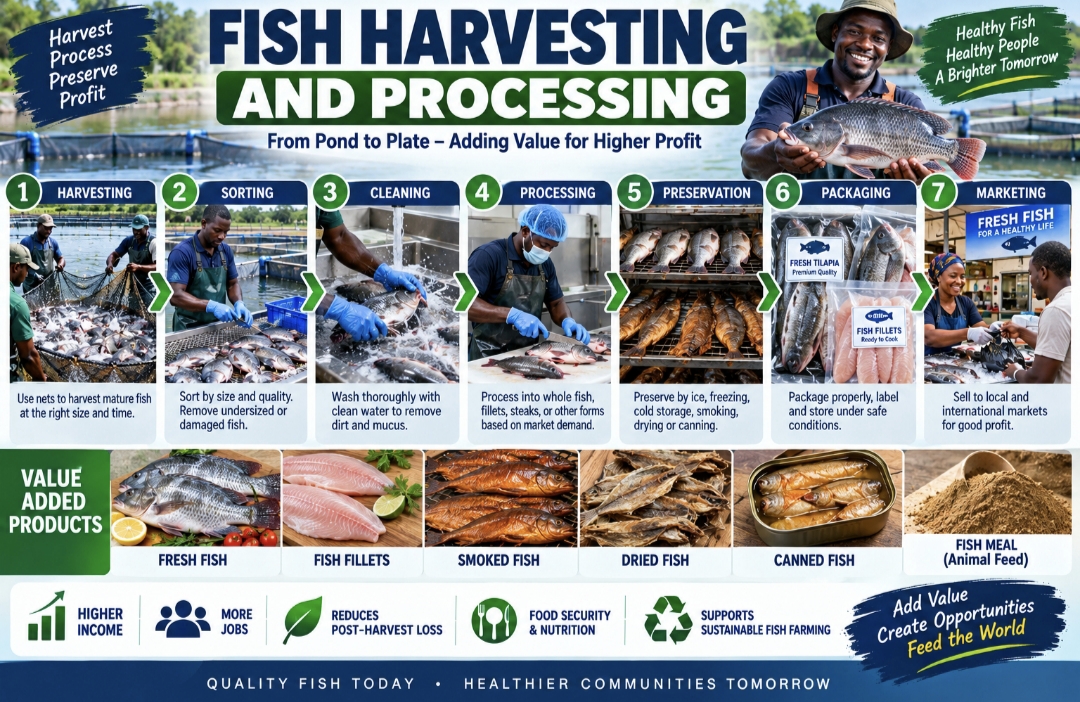
Fish harvesting and processing are critical stages of aquaculture production. Producing healthy fish is only part of the business; farmers must also harvest, handle, preserve, process and transport their fish properly to maintain quality and obtain good market value.
Poor harvesting practices can cause physical injuries, stress, contamination, spoilage and financial losses. On the other hand, efficient harvesting and processing can improve product quality, extend shelf life, create additional revenue opportunities and help fish farmers reach different markets.
Whether you operate a small pond, commercial fish farm, hatchery, tank-based production system, cage farm or intensive aquaculture facility, understanding proper fish harvesting and post-harvest handling is essential.
This comprehensive guide explains the principles of fish harvesting, preparation, handling, chilling, cleaning, processing, packaging, storage, transportation, value addition, marketing and quality control.
What Is Fish Harvesting?
Fish harvesting is the process of removing mature or marketable fish from a production system for sale, consumption, processing or further distribution.
Harvesting can be:
- Partial
- Selective
- Complete
- Scheduled
- Emergency
A partial harvest removes only some fish while allowing the remaining population to continue growing.
A complete harvest removes most or all fish from a pond, tank or production unit.
The method chosen depends on the production system, fish size, market requirements and farm management strategy.
Why Fish Harvesting Matters
Harvesting is more than simply catching fish.
Proper harvesting helps farmers:
- Reduce losses
- Maintain fish quality
- Minimize physical damage
- Improve shelf life
- Meet customer specifications
- Control stocking density
- Generate revenue
- Prepare production units for another cycle
A poorly managed harvest can reduce the value of an otherwise successful production cycle.
When Should Fish Be Harvested?
Fish should generally be harvested when they reach the target market size or when market conditions make harvesting economically appropriate.
Factors affecting harvest timing include:
- Fish size
- Growth rate
- Feed costs
- Market demand
- Selling price
- Water quality
- Production costs
- Available storage
- Customer requirements
- Farm capacity
Farmers should avoid keeping fish longer simply because they can grow larger.
The additional feed and management costs may not always justify the additional weight.
Market Size and Harvest Planning
Different markets may prefer different fish sizes.
Some customers may prefer smaller fish for household consumption, while restaurants, processors or wholesalers may prefer larger fish.
Before stocking fish, farmers should ideally identify their target market and determine the size buyers want.
This allows production to be planned around actual demand.
Partial Fish Harvesting
Partial harvesting involves removing a portion of the fish population before the entire production cycle ends.
It can be useful when:
- Some fish have reached market size
- The pond is becoming overcrowded
- Fish sizes vary significantly
- Market demand is strong
- The farmer needs cash flow
- Biomass needs to be reduced
Partial harvesting can also create additional space for the remaining fish.
Complete Fish Harvesting
Complete harvesting is common at the end of a production cycle.
The objective is to remove the fish efficiently while minimizing:
- Stress
- Injury
- Mortality
- Contamination
- Product deterioration
After harvesting, the production unit can be cleaned, inspected and prepared for the next cycle.
Preparing for Fish Harvest
Good preparation can make harvesting faster and safer.
Before harvesting, farmers should prepare:
- Harvesting equipment
- Containers
- Weighing scale
- Ice or chilling equipment
- Clean water
- Gloves
- Clean processing surfaces
- Packaging materials
- Transport containers
- Record sheets
- Labour
The harvesting area should be clean and organized.
Harvesting Equipment
The equipment required depends on the production system.
Common equipment includes:
- Seine nets
- Scoop nets
- Cast nets where appropriate
- Harvesting baskets
- Fish crates
- Plastic containers
- Food-grade tubs
- Weighing scales
- Knives
- Cutting boards
- Ice boxes
- Insulated containers
Equipment should be clean and maintained before use.
Seine Net Harvesting
Seine nets are commonly used in ponds.
A seine net is pulled through the water to gather fish into a concentrated area.
The method can be useful for:
- Partial harvesting
- Complete harvesting
- Size selection
Farmers should avoid excessive dragging that can unnecessarily injure fish or damage pond structures.
Scoop Net Harvesting
Scoop nets can be useful for tanks, ponds and holding systems.
They allow farmers to remove fish individually or in small groups.
This can be useful when selecting fish according to size.
Harvesting Fish From Tanks
Tank-based systems can often be harvested by:
- Lowering water levels
- Using nets
- Moving fish into collection containers
- Using appropriate drainage systems
- Transferring fish into holding units
The method should be designed to minimize unnecessary handling.
Harvesting Cage-Farmed Fish
Cage harvesting may involve:
- Concentrating fish within the cage
- Using appropriate nets
- Transferring fish to boats or containers
- Sorting and chilling the catch
Safety is particularly important when harvesting cages in open water.
Fish Handling Immediately After Harvest
With good harvesting procedures, proper processing, reliable storage, effective marketing and accurate financial records, fish farmers can strengthen the entire aquaculture value chain and build a more sustainable commercial fish-farming business.
The period immediately after harvesting is critical.
Fish are highly perishable because microorganisms and natural enzymes continue to affect the product after death.
Rapid cooling can slow deterioration.
The general principle is:
Harvest → Handle carefully → Chill quickly → Process or sell promptly
Why Chilling Fish Is Important
Ultimately, the objective is not simply to harvest as many fish as possible. The objective is to produce high-quality fish, preserve that quality after harvest, minimize waste and deliver the product to customers in a safe, attractive and profitable form.
Fresh fish should generally be cooled as soon as practical after harvest.
Chilling can:
- Slow bacterial growth
- Reduce deterioration
- Maintain texture
- Preserve freshness
- Extend usable shelf life
Ice is one of the most common methods used for small and medium-scale fish operations.
Ice Handling
A fish farmer can invest heavily in quality fingerlings, good feed, excellent water management and modern infrastructure, but poor harvesting or post-harvest handling can still reduce the final value of the production cycle.
Ice used for fish should be clean and suitable for food handling.
Fish should be protected from contamination during icing.
A common practice is to layer fish and ice in an insulated container.
The exact quantity of ice required depends on:
- Ambient temperature
- Transport duration
- Container insulation
- Fish quantity
- Distance to market
Chilled Versus Frozen Fish
Chilled fish are kept at temperatures around the melting point of ice without being completely frozen.
Frozen fish are stored at much lower temperatures.
Freezing can provide substantially longer storage than simple chilling, but requires appropriate equipment and reliable temperature control.
Cleaning Fish After Harvest
Depending on the market, fish may be sold:
- Whole
- Whole and gutted
- Head-on
- Head-off
- Filleted
- Cut into portions
- Smoked
- Dried
- Frozen
- Cooked or otherwise processed
The processing method should match customer demand.
Gutting Fish
Gutting involves removing the internal organs.
It can improve product presentation and may reduce contamination from intestinal contents.
Gutting should be performed carefully to avoid damaging the edible portion.
Washing Fish
Fish should be washed using clean water appropriate for food handling.
Dirty or contaminated water can introduce microorganisms and reduce product quality.
Processing surfaces should also be cleaned regularly.
Fish Filleting
Filleting involves removing the edible flesh from the bones.
Fillets can provide additional convenience to customers.
However, filleting requires:
- Sharp knives
- Skilled workers
- Clean work surfaces
- Proper hygiene
- Appropriate packaging
- Cold storage
The amount of usable flesh obtained depends on fish species, size and processing method.
Fish Portioning
Some customers prefer fish cut into specific portions.
Portioning can be useful for:
- Restaurants
- Retail customers
- Catering businesses
- Supermarkets
- Food-service companies
Standardized portion sizes can make pricing and packaging easier.
Fish Sorting and Grading
After harvest, fish can be sorted according to:
- Weight
- Size
- Species
- Quality
- Processing requirements
Grading makes it easier to supply different customer segments.
For example, larger fish can be sold separately from smaller fish.
Fish Quality Assessment
Before sale, farmers should inspect fish for:
- Fresh appearance
- Firm flesh
- Clean surface
- Proper chilling
- Absence of abnormal odour
- Physical damage
- Signs of spoilage
Quality-control procedures should be consistent throughout the operation.
Hygiene in Fish Processing
Hygiene is one of the most important aspects of fish processing.
Workers should:
- Wash hands
- Wear clean protective clothing
- Keep processing surfaces clean
- Use clean equipment
- Prevent contact with contaminants
- Keep raw fish appropriately chilled
- Protect finished products from contamination
Good hygiene protects consumers and the reputation of the farm.
Preventing Cross-Contamination
Cross-contamination occurs when microorganisms or contaminants are transferred from one surface, product or person to another.
It can occur through:
- Dirty knives
- Unclean tables
- Contaminated water
- Dirty containers
- Hands
- Clothing
- Transport equipment
Separate clean and dirty processing areas where possible.
Fish Processing Area Design
A commercial fish-processing area should ideally be designed for efficient workflow.
A basic flow may be:
Receiving → Sorting → Washing → Processing → Chilling → Packaging → Storage → Distribution
The objective is to reduce unnecessary movement and prevent contamination between different stages.
Value Addition in Fish Farming
Value addition means processing fish into products that may provide greater convenience, longer shelf life or higher market value.
Examples include:
- Smoked fish
- Dried fish
- Frozen fish
- Fillets
- Fish portions
- Vacuum-packed fish
- Seasoned fish
- Ready-to-cook fish
- Fish products for restaurants
Value addition can diversify farm revenue.
Smoked Fish Processing
Smoking is a traditional preservation method used in many parts of the world.
It can:
- Reduce moisture
- Add flavour
- Improve shelf life
- Create a different market product
Modern smoking systems can provide greater control over:
- Temperature
- Smoke exposure
- Drying
- Hygiene
- Product consistency
Traditional and Modern Fish Smoking
Traditional smoking may use simple structures and locally available fuel.
Modern smoking facilities may use improved kilns designed to provide:
- Better temperature control
- Reduced smoke exposure for workers
- More consistent drying
- Improved hygiene
- Better fuel efficiency
The choice depends on scale and available resources.
Dried Fish Processing
Drying reduces the water content of fish, making it less favourable for microbial growth.
Drying methods can include:
- Sun drying
- Solar drying
- Mechanical drying
- Controlled dehydrators
The product should be adequately dried and protected from moisture afterward.
Frozen Fish Processing
Freezing is widely used for extending fish shelf life.
A good freezing operation requires:
- Appropriate freezing equipment
- Consistent low temperatures
- Suitable packaging
- Temperature monitoring
- Reliable electricity or backup systems
Freezing should be followed by proper cold storage.
Packaging Fresh Fish
Packaging protects fish from:
- Physical damage
- Contamination
- Moisture loss
- Dehydration
- Unwanted odours
Packaging should be suitable for the intended storage and transport conditions.
Packaging Fish Fillets
Fillets can be packaged in:
- Food-grade trays
- Plastic pouches
- Vacuum packaging
- Sealed bags
- Other appropriate food packaging
Packaging should clearly identify the product where required.
Vacuum Packaging
Vacuum packaging removes much of the air from the package before sealing.
It can improve product presentation and reduce exposure to oxygen.
However, vacuum packaging does not eliminate the need for proper refrigeration or food-safety controls.
Fish Storage
Fish storage conditions depend on whether the product is fresh, chilled, frozen, dried or smoked.
Fresh fish should be kept properly chilled.
Frozen fish should remain frozen throughout storage.
Dried and smoked products should be protected from moisture and contamination.
Cold Chain Management
The cold chain refers to maintaining appropriate temperature conditions from harvest through storage, transportation and final sale.
A typical cold chain includes:
Harvest → Chilling → Processing → Cold storage → Refrigerated transport → Retail → Consumer
Breaking the cold chain can accelerate deterioration.
Transporting Fresh Fish
Transportation should be planned according to:
- Distance
- Travel time
- Product type
- Ambient temperature
- Storage temperature
- Packaging
- Vehicle condition
Fresh fish should reach the customer as quickly as practical.
Transporting Fish With Ice
For short-distance distribution, insulated containers with sufficient clean ice may be appropriate.
The container should minimize exposure to external heat.
Fish should be protected from dirty water and other contaminants.
Refrigerated Fish Transport
Larger operations may use refrigerated vehicles.
Refrigerated transport is particularly useful for:
- Long-distance distribution
- Supermarkets
- Hotels
- Restaurants
- Wholesale markets
- Processed fish products
Fish Harvesting and Farm Records
Farmers should record important harvesting information.
Records may include:
- Harvest date
- Pond or tank
- Number harvested
- Total weight
- Average fish weight
- Mortality
- Feed used
- Selling price
- Customer
- Processing method
- Transportation cost
- Processing cost
These records help determine the actual profitability of each production cycle.
Calculating Harvest Yield
Harvest yield can be calculated by comparing harvested biomass with initial stocking and production inputs.
For example:
Initial stock:
10,000 fish
Final harvested fish:
8,500 fish
Survival rate:
8,500 ÷ 10,000 × 100 = 85%
If the harvested fish weigh an average of 0.8 kg:
8,500 × 0.8 = 6,800 kg
The estimated harvest biomass is therefore 6,800 kg.
Calculating Revenue From Fish Harvest
Revenue can be calculated as:
Total harvested weight × Selling price per kilogram
For example, if a farmer harvests 2,000 kg and sells the fish for an illustrative $3 per kg:
2,000 × $3 = $6,000
This is gross revenue before deducting production, processing, transportation and marketing costs.
Processing Costs
Fish processing may create additional costs such as:
- Labour
- Ice
- Electricity
- Fuel
- Packaging
- Water
- Equipment maintenance
- Transportation
- Cold storage
Farmers should calculate these expenses before deciding whether processing adds sufficient value.
Value-Added Profitability
Processing can increase selling price, but the additional revenue must be compared with additional costs.
For example, suppose fresh fish generates $5,000 in gross revenue.
A processed product generates $6,500.
Additional processing costs are $1,000.
Additional gross value:
$6,500 − $5,000 = $1,500
After the additional $1,000 processing cost:
$1,500 − $1,000 = $500
The example illustrates why farmers should calculate the complete economics of value addition rather than focusing only on the higher selling price.
These figures are illustrative and not a guaranteed market return.
Direct Fish Sales
Farmers can sell harvested fish directly to:
- Households
- Restaurants
- Hotels
- Food vendors
- Retailers
- Supermarkets
- Fish traders
- Wholesalers
- Processors
Direct sales may provide stronger margins in some circumstances, but they can require more marketing effort.
Wholesale Fish Sales
Wholesale buyers purchase larger quantities.
Advantages may include:
- Faster movement of inventory
- Lower marketing effort
- Large-volume sales
Potential disadvantages include:
- Negotiated prices
- Lower price per kilogram
- Dependence on a small number of buyers
Restaurant and Hotel Markets
Restaurants and hotels may provide valuable markets for consistent-quality fish.
Farmers should be prepared to meet requirements concerning:
- Fish size
- Quality
- Packaging
- Delivery schedule
- Quantity
- Processing style
Retail Fish Market
Retail customers may purchase:
- Whole fish
- Cleaned fish
- Fillets
- Frozen fish
- Smoked fish
- Dried fish
- Portions
Packaging and presentation become especially important in retail markets.
Building a Fish Brand
A fish farm can create a recognizable brand around:
- Freshness
- Quality
- Hygiene
- Farm-raised production
- Reliable supply
- Consistent sizing
- Convenient packaging
A professional brand can help differentiate a farm from informal competitors.
Digital Marketing for Fish Products
Fish farmers can use digital platforms to promote their products.
Marketing channels can include:
- Website
- Social media
- Messaging platforms
- Online marketplaces
- Local business directories
Useful content may include:
- Harvest videos
- Product photos
- Customer testimonials
- Processing demonstrations
- Farm updates
- Product availability
- Delivery information
Fish Photography and Product Presentation
Good product images can improve online marketing.
Images should show:
- Clean fish
- Proper packaging
- Attractive presentation
- Accurate product size
- Processing quality
Avoid misleading photographs or exaggerated product claims.
Food Safety Considerations
Fish is a highly perishable food.
Farmers and processors should follow applicable food-safety requirements in their jurisdiction.
Important principles include:
- Clean water
- Clean equipment
- Personal hygiene
- Temperature control
- Prevention of contamination
- Proper storage
- Traceability where required
Commercial processors should consult the relevant food-safety authorities and regulations in their market.
Harvesting Fish Without Excessive Stress
Stress can affect fish quality and handling.
Farmers should avoid unnecessary:
- Chasing
- Crowding
- Rough handling
- Exposure to excessive heat
- Long periods outside water
Efficient harvesting reduces handling time.
Reducing Physical Damage
Fish can lose market value when they are:
- Bruised
- Scratched
- Cut
- Crushed
- Dropped
- Improperly handled
Use appropriate nets and containers.
Avoid throwing fish into containers from excessive heights.
Managing Fish Waste
Fish processing generates waste such as:
- Heads
- Bones
- Scales
- Viscera
- Trimmings
Waste should be managed responsibly.
Depending on local regulations and appropriate processing methods, some fish by-products can potentially be converted into useful products such as fish meal, compost inputs or other value-added materials.
Fish By-Product Utilization
Fish-processing by-products may have economic value.
Potential applications include:
- Fish meal
- Animal-feed ingredients
- Fish oil
- Organic fertilizer inputs
- Pet-food ingredients
Any food or feed use should follow applicable safety and regulatory requirements.
Preparing Fish for Export Markets
Exporting fish requires much more than simply producing good-quality fish.
Depending on the destination, exporters may need to meet requirements involving:
- Food safety
- Processing facilities
- Packaging
- Labelling
- Traceability
- Veterinary certification
- Cold-chain management
- Import requirements
- Documentation
Farmers interested in export markets should research destination-country requirements before investing heavily in export-oriented production.
Common Fish Harvesting Mistakes
Harvesting During Excessive Heat
High temperatures can accelerate deterioration.
Delaying Chilling
Fish should be cooled as quickly as practical after harvest.
Using Dirty Containers
Dirty containers can contaminate fish.
Poor Handling
Rough handling can damage the product.
Overcrowding Harvest Containers
Too many fish in a container can cause physical damage and stress.
Poor Packaging
Inadequate packaging can reduce product quality during transportation.
Breaking the Cold Chain
Temperature abuse can shorten shelf life.
Poor Record Keeping
Without records, farmers may not know their actual harvest yield or processing profitability.
Processing Without a Market
Farmers should understand customer demand before investing heavily in value-added products.
Selling Without Calculating Costs
A high selling price does not necessarily mean a high profit.
Improving Fish Harvesting Efficiency
Farmers can improve harvesting by:
- Planning harvest dates
- Preparing equipment in advance
- Monitoring fish size
- Building buyer relationships
- Preparing ice before harvesting
- Organizing labour
- Maintaining clean equipment
- Reducing handling time
- Recording harvest results
- Improving transportation
Harvest Scheduling
Large farms can schedule harvests according to:
- Fish maturity
- Customer orders
- Market demand
- Storage capacity
- Labour availability
- Transport availability
Good scheduling can reduce congestion and improve product quality.
Fish Harvesting and Sustainability
Responsible harvesting supports sustainable aquaculture by reducing unnecessary waste and maximizing the value obtained from fish already produced.
Efficient processing can also help farmers use more of each fish rather than discarding potentially useful parts.
Modern Fish Processing Technology
Larger operations may use technologies such as:
- Automated grading
- Mechanical filleting
- Ice-making machines
- Blast freezers
- Cold rooms
- Vacuum packaging
- Temperature monitoring
- Digital traceability
- Automated weighing systems
Technology can improve consistency and efficiency, although investment should match production volume and market demand.
Small-Scale Fish Harvesting Strategy
Small farmers do not necessarily need expensive processing facilities.
A simple operation can focus on:
- Clean harvesting equipment
- Clean containers
- Good-quality ice
- Hygienic handling
- Accurate weighing
- Quick delivery
- Strong customer relationships
The priority should be quality and consistency.
Medium-Scale Fish Processing Strategy
Medium-sized farms can consider:
- Dedicated processing areas
- Improved smoking facilities
- Freezers
- Ice machines
- Better packaging
- Delivery systems
- Regular wholesale customers
Large-Scale Fish Processing Strategy
Large commercial farms may require:
- Dedicated processing plants
- Cold rooms
- Refrigerated transport
- Automated equipment
- Quality-control systems
- Traceability
- Formal food-safety procedures
- Multiple distribution channels
Fish Harvesting Business Opportunities
Fish harvesting and processing can create additional businesses beyond fish production.
Opportunities include:
- Fish processing services
- Smoked fish production
- Frozen fish distribution
- Fish transportation
- Cold storage
- Fish packaging
- Fish retail
- Fish wholesale
- Fish by-product processing
This means the aquaculture value chain can provide opportunities for multiple businesses.
Frequently Asked Questions About Fish Harvesting and Processing
What is the best time to harvest farmed fish?
The best harvest time depends on fish size, market requirements, production costs, water conditions and customer demand. Farmers should compare the economic benefit of additional growth with the cost of keeping fish longer.
How can I keep fish fresh after harvesting?
Rapid chilling, hygienic handling, suitable packaging and maintaining the appropriate cold chain are among the most important practices.
Can fish be harvested before reaching the final target size?
Yes. Partial harvesting can be useful when some fish have reached market size, when the farm needs to reduce biomass or when market demand makes early sales attractive.
Is smoking fish profitable?
Smoking can create an additional value-added product, but profitability depends on fish cost, processing expenses, fuel or energy costs, labour, packaging, market price and product demand.
How long can fresh fish be stored?
Storage life depends on species, initial quality, temperature, hygiene, packaging and handling conditions. Fish should be kept under appropriate cold conditions and sold or processed as quickly as practical.
What is the difference between chilled and frozen fish?
Chilled fish are kept cold without being completely frozen, while frozen fish are maintained at much lower temperatures. Frozen storage generally provides longer storage when properly managed.
Why should harvested fish be placed on ice?
Ice rapidly removes heat from the fish and helps slow deterioration and microbial growth.
Can fish farmers sell directly to consumers?
Yes. Direct sales can include farm-gate sales, home delivery, online orders, restaurants and retail customers.
Should fish be processed before selling?
Not necessarily. The best format depends on customer preferences, market requirements, available equipment and processing economics.
What records should a fish farmer keep after harvest?
Important records include total harvest weight, number of fish, average size, survival rate, selling price, processing costs, transportation costs and total revenue.
Final Thoughts
Fish harvesting and processing determine how successfully a farmer converts aquaculture production into a marketable food product.
Successful fish harvesting begins with proper planning. Farmers should know their target market, understand the preferred fish size, prepare harvesting equipment, organize labour and have appropriate storage or transportation arrangements ready before the harvest begins.
After harvest, speed and hygiene become extremely important. Fish should be handled carefully, chilled promptly when appropriate, processed under hygienic conditions and transported using a suitable cold chain.
Value addition provides another opportunity for fish farmers. Products such as smoked, dried, frozen, filleted and portioned fish can serve different customer groups and potentially diversify farm revenue.
Latest posts;
- Poultry Meat Benefits to Humanity: Complete Guide to Its Nutritional, Economic and Social Importance
- Tilapia Farming: Complete Guide to Raising Tilapia for Commercial Production

- Fish Pond Construction: Complete Guide to Designing and Building a Modern Fish Pond

- Grazing Livestock Farming Business: Complete Guide to Starting and Making Profit

- Commercial Cattle Farming: Complete Guide to Raising Cattle for Profit

- Goat Farming Business: Complete Guide to Meat and Breeding Production
- Sheep Farming: Complete Guide to Raising Sheep for Commercial Profit

- Modern Pasture Farming: How to Grow High-Quality Livestock Feed