Introduction
Onion farming is one of the most important vegetable farming businesses in Africa and many parts of the world. Onions are widely used in homes, restaurants, food processing businesses, markets, and the hospitality industry. Because onions are consumed almost every day, farmers can generate good income by producing quality bulbs and selling them at the right time.
For farmers in Nigeria, onion farming can be particularly attractive because of the strong demand for fresh onions across different states. However, successful onion production requires proper land preparation, quality seeds, suitable varieties, good irrigation, adequate fertilization, weed control, pest management, and proper harvesting and storage.
This comprehensive guide explains how to start onion farming, the best conditions for growing onions, planting methods, onion farm management, harvesting, storage, marketing, and the commercial benefits of onion production.
What Is Onion Farming?
Onion farming is the commercial or subsistence cultivation of onion plants for their edible bulbs, leaves, or both. The onion plant belongs to the genus Allium, which also includes garlic, leek, and shallots.
The bulb develops underground as the plant grows. Under suitable conditions, onions can produce large, firm, healthy bulbs that can be sold fresh or stored for later marketing.
Onions can be grown on small backyard gardens, medium-sized vegetable farms, or large commercial farms. With proper planning, even small-scale farmers can generate income from onion production.
Why Is Onion Farming Important?
Onions are an important food crop because they are used extensively in cooking. They provide flavor and are included in soups, sauces, stews, salads, fried foods, and processed food products.
The continuous demand for onions makes the crop commercially valuable. Farmers can sell onions directly to consumers, retailers, wholesalers, restaurants, food vendors, supermarkets, and food-processing businesses.
Other reasons onion farming is attractive include:
- Strong consumer demand
- Relatively short production cycle for many varieties
- Possibility of multiple production cycles where conditions permit
- Good market opportunities
- Ability to produce on relatively small farmland
- Possibility of storing properly cured bulbs
- High demand from restaurants and food businesses
- Potential for value addition and processing
Best Climate for Onion Farming
Climate plays an important role in onion production. Onions generally perform well under moderate temperatures, although specific varieties differ in their environmental requirements.
Cooler conditions are often suitable during the early stages of growth, while bulb formation generally requires appropriate temperatures and sufficient sunlight.
Excessive rainfall can create problems, particularly when the soil remains waterlogged. Heavy rainfall may increase fungal diseases, nutrient leaching, and bulb rot.
For successful onion farming, farmers should consider:
- Temperature
- Rainfall pattern
- Sunlight
- Humidity
- Soil moisture
- Wind conditions
In areas where rainfall is unreliable or excessive, irrigation can help farmers maintain better control over water supply.
Best Soil for Growing Onions
Onions grow best in fertile, well-drained soil. Sandy loam and loamy soils are commonly suitable because they allow the developing bulbs to expand easily.
Heavy clay soils can restrict bulb development and may retain excessive water. Waterlogged soil can increase the risk of root and bulb diseases.
Good onion soil should have:
- Good drainage
- Adequate organic matter
- Sufficient nutrients
- Good moisture-holding capacity
- Loose structure
- Suitable soil pH
Before establishing a commercial onion farm, farmers should consider conducting a soil test. Soil testing can help determine nutrient deficiencies and guide fertilizer application.
Selecting the Best Onion Variety
Choosing the right onion variety is one of the most important decisions in onion farming. Different varieties have different maturity periods, bulb sizes, colors, storage characteristics, and environmental requirements.
Common onion types include:
- Red onions
- White onions
- Yellow onions
- Sweet onions
- Shallots
For commercial production, farmers should select varieties that are well adapted to their local climate and have strong market demand.
Farmers should also consider whether consumers in their target market prefer red, white, or yellow onions.
How to Get Quality Onion Seeds
Quality seeds are essential for producing healthy and uniform onion bulbs.
Farmers should obtain seeds from reputable agricultural seed suppliers rather than relying on unknown sources. Poor-quality seeds can result in low germination, weak seedlings, uneven growth, and poor yields.
When purchasing onion seeds, check:
- Variety name
- Germination quality
- Seed packaging
- Expiry date
- Supplier reputation
- Recommended growing conditions
Avoid purchasing damaged, poorly stored, or suspiciously packaged seeds.
How to Prepare Land for Onion Farming
Proper land preparation helps onions establish strong roots and develop healthy bulbs.
Begin by clearing the farmland of weeds, grasses, and unwanted vegetation. Remove large roots and debris from the field.
The soil should then be properly tilled to create a fine and loose seedbed. Raised beds can be particularly useful in areas where drainage is a concern.
The beds should be level enough to support uniform irrigation while allowing excess water to drain away.
Where necessary, farmers can incorporate well-decomposed organic manure into the soil before planting.
How to Raise Onion Seedlings
Onion seedlings can be raised in a nursery before being transplanted to the main field.
Prepare a clean nursery bed with fertile, well-drained soil. Sow the seeds thinly in shallow rows and cover them lightly with soil.
Water the nursery gently to maintain adequate moisture without flooding it.
Protect young seedlings from excessive sunlight, heavy rain, weeds, and pests.
Seedlings should be monitored regularly until they become strong enough for transplanting.
Onion Transplanting
When onion seedlings are sufficiently established, they can be transplanted to the prepared field.
Transplanting should preferably be done when the weather is suitable and the soil has adequate moisture.
Carefully remove the seedlings from the nursery without causing excessive damage to their roots.
Plant each seedling at an appropriate spacing according to the variety and production system. Avoid burying the growing point too deeply because this can interfere with proper bulb development.
Water the plants after transplanting to help them establish.
Direct Seeding of Onions
Although transplanting is common, onions can also be established through direct seeding.
In direct seeding, seeds are planted directly into prepared beds or rows. The method can reduce transplanting labor but requires careful management of spacing, weeds, moisture, and seedling establishment.
Farmers using direct seeding should ensure that the soil is well prepared and free from large clods.
Onion Plant Spacing
Proper spacing is important because overcrowding can result in competition for sunlight, water, nutrients, and growing space.
The exact spacing depends on the variety, bulb size desired, production method, and local recommendations.
Closer spacing can produce smaller bulbs, while wider spacing may allow larger bulbs to develop.
Farmers should therefore follow the recommended spacing for the specific onion variety being cultivated.
Irrigation in Onion Farming
Water management is critical throughout onion production.
Onions have relatively shallow roots, so they require consistent access to moisture, especially during active growth and bulb formation.
However, excessive irrigation can be harmful. Waterlogged soil can encourage root diseases and bulb rot.
Irrigation methods that may be used include:
- Drip irrigation
- Sprinkler irrigation
- Watering cans
- Furrow irrigation
Drip irrigation can be particularly useful for commercial production because it delivers water directly to the root zone and can help reduce water wastage.
As the bulbs approach maturity, irrigation should be managed carefully according to weather and crop condition. Excess moisture close to harvest can increase the risk of disease and poor storage quality.
Fertilizer Application for Onion Farming
Onions require adequate nutrients for healthy leaves and bulb development.
Important nutrients include:
- Nitrogen
- Phosphorus
- Potassium
- Sulfur
- Calcium
- Magnesium
Nitrogen supports vegetative growth, while phosphorus contributes to root development. Potassium plays an important role in overall plant development and bulb quality.
However, excessive nitrogen can encourage excessive leaf growth and delay proper bulb maturation.
The best fertilizer program should be based on soil testing, the selected variety, soil fertility, and local agricultural recommendations.
Weed Management in Onion Farming
Weeds compete with onion plants for nutrients, water, sunlight, and space.
Because young onion plants grow slowly, they can be particularly vulnerable to weed competition.
Farmers should inspect the farm regularly and remove weeds before they become established.
Weed control methods include:
- Manual weeding
- Hoeing
- Mulching
- Appropriate herbicide use
- Good field sanitation
Care must be taken during hoeing because onion bulbs and roots can be damaged easily.
Common Onion Pests
Onion farms can be attacked by different insects and other pests.
Some common pests include:
- Thrips
- Onion maggots
- Cutworms
- Aphids
- Caterpillars
Thrips can be particularly problematic because they feed on onion leaves and can reduce plant vigor and yield.
Farmers should regularly inspect the leaves for discoloration, curling, feeding damage, or the presence of insects.
Integrated pest management is preferable. This can involve field sanitation, monitoring, cultural practices, biological methods, and properly selected pesticides where necessary.
Common Onion Diseases
Onions can be affected by fungal, bacterial, and other diseases.
Potential diseases include:
- Purple blotch
- Downy mildew
- Basal rot
- Neck rot
- Bulb rot
- Damping-off
Disease management begins with good farm hygiene and healthy planting materials.
Farmers should avoid excessive irrigation, improve field drainage, remove severely infected plants where appropriate, and avoid repeatedly planting onions in the same soil without considering crop rotation.
Where pesticides or fungicides are necessary, farmers should use products approved for onion production and follow the label instructions.
Crop Rotation in Onion Farming
Crop rotation can help reduce the buildup of certain pests and diseases in the soil.
Instead of planting onions repeatedly on the same land, farmers can rotate onions with suitable crops from different plant families.
Crop rotation can also contribute to better soil management and reduce pressure from specific crop pests and pathogens.
How Long Does Onion Take to Mature?
The maturity period of onions depends on the variety, climate, planting method, soil conditions, and farm management.
Some varieties can mature within a few months, while others require a longer growing period.
Farmers should always check the maturity information supplied for their particular seed variety.
Signs of maturity may include:
- Yellowing leaves
- Falling or bending tops
- Bulbs reaching their expected size
- Drying of the neck
- Reduction in new leaf growth
Harvesting too early can result in smaller bulbs, while harvesting too late can increase losses from disease, sprouting, or weather damage.
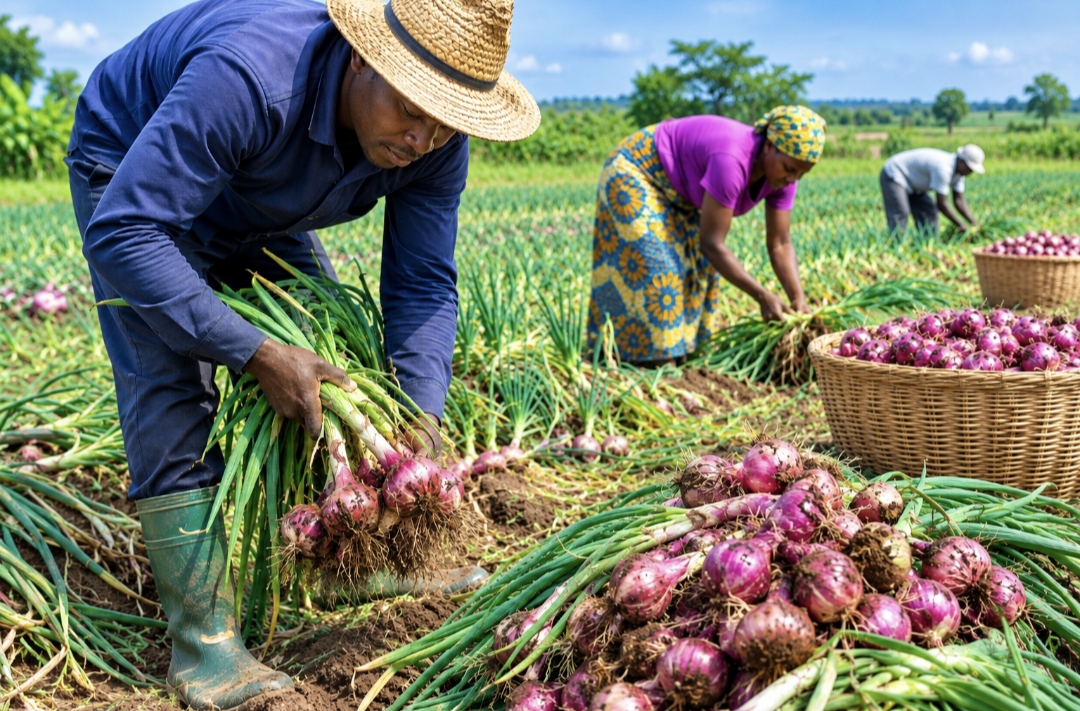
How to Harvest Onions
Onions should be harvested when the bulbs have reached suitable maturity.
Reduce irrigation as the crop approaches harvest where appropriate. Once the tops begin to fall and the bulbs are mature, the onions can be carefully lifted from the soil.
Avoid damaging the bulbs during harvesting because cuts and bruises can create entry points for microorganisms and reduce storage life.
After harvesting, onions should be allowed to cure properly.
Onion Curing
Curing is an important post-harvest process that helps onions develop dry outer skins and a properly dried neck.
Freshly harvested onions should be placed in a dry, well-ventilated environment protected from excessive rain and direct harsh weather.
Proper curing can help reduce moisture-related deterioration and improve storage life.
Do not store onions before they are properly cured.
How to Store Onions
Proper storage is essential for farmers who want to sell their onions later when market prices are more favorable.
Good onion storage conditions should be:
- Dry
- Cool
- Well ventilated
- Clean
- Protected from rain
- Free from excessive humidity
Remove damaged, diseased, or rotten bulbs before storage.
Onions can be stored in suitable mesh bags, crates, racks, or other structures that allow adequate airflow.
Onion Farming in Nigeria
Nigeria has significant potential for onion production because onions are widely consumed throughout the country.
Commercial onion production is particularly associated with areas where suitable temperatures, soils, irrigation facilities, and market access are available.
Farmers interested in onion farming in Nigeria should first study their local climate and identify suitable varieties.
Irrigation is especially important for farmers producing onions during periods when rainfall is insufficient.
Before investing heavily, farmers should also investigate local seed availability, input prices, labor costs, transportation expenses, storage options, and expected market prices.
Best Time to Plant Onions in Nigeria
The best planting period varies depending on location, variety, rainfall, temperature, and whether irrigation is available.
In many commercial production systems, onions are grown during periods when farmers can better control water supply and avoid excessive rainfall.
Because Nigeria has different climatic zones, farmers should not rely on one planting calendar for every location.
It is better to consult local agricultural extension officers, experienced onion farmers, and seed suppliers for recommendations specific to the production area.
Cost of Starting Onion Farming
The cost of starting an onion farm depends on the size of the farm and the production system.
Major expenses may include:
- Land preparation
- Onion seeds
- Nursery establishment
- Fertilizers
- Organic manure
- Irrigation
- Farm tools
- Pest and disease control
- Labor
- Harvesting
- Transportation
- Packaging
- Storage
Farmers should prepare a detailed budget before planting.
A good business plan should estimate total production costs and compare them with realistic expected revenue.
Profitability of Onion Farming
Onion farming can be profitable when farmers achieve good yields and sell quality bulbs at favorable prices.
Profit depends on several factors, including:
- Yield per hectare
- Seed quality
- Production costs
- Farm management
- Market price
- Transportation costs
- Post-harvest losses
- Storage capacity
- Timing of sales
Farmers who produce high-quality onions and have access to reliable markets may have better opportunities to improve profitability.
However, onion farming is not risk-free. Market prices can fluctuate, while pests, diseases, weather conditions, and post-harvest losses can reduce income.
How to Market Onions
Marketing should be planned before planting rather than after harvesting.
Potential buyers include:
- Local consumers
- Wholesalers
- Retailers
- Restaurants
- Hotels
- Food vendors
- Supermarkets
- Food processors
- Agricultural traders
Farmers can also develop relationships with bulk buyers who purchase large quantities.
Sorting onions according to size and quality can help farmers target different market segments.
How to Increase Onion Farm Yield
Farmers can improve onion production by combining good agronomic practices.
Important strategies include:
- Use quality seeds.
- Choose varieties adapted to the local environment.
- Prepare the soil properly.
- Maintain appropriate plant spacing.
- Provide adequate irrigation.
- Apply fertilizers based on crop requirements.
- Control weeds early.
- Monitor pests regularly.
- Manage diseases promptly.
- Harvest at the correct maturity stage.
- Cure bulbs properly.
- Reduce post-harvest damage.
Good record keeping can also help farmers identify which practices produce the best results.
Common Mistakes in Onion Farming
Beginners can make mistakes that reduce yield and profitability.
Common mistakes include:
- Using poor-quality seeds
- Planting unsuitable varieties
- Overwatering
- Poor drainage
- Excessive fertilizer application
- Delayed weed control
- Ignoring pest attacks
- Planting overcrowded seedlings
- Harvesting too early
- Poor curing
- Storing damaged bulbs
- Failing to research the market
Avoiding these mistakes can significantly improve the chances of successful onion production.
Onion Farming Business Plan
A commercial onion farming business plan should contain clear information about the proposed farm.
Important sections include:
- Business objectives
- Farm location
- Farm size
- Onion variety
- Production method
- Input requirements
- Labor requirements
- Irrigation plan
- Estimated production cost
- Expected yield
- Marketing strategy
- Storage plan
- Risk management
- Expected revenue
- Estimated profit
Farmers should use realistic local prices rather than assuming that onions will always sell at the highest market price.
Benefits of Onion Farming
Onion farming provides several potential benefits to farmers and the agricultural sector.
These include:
- Income generation
- Employment creation
- Food production
- Support for local markets
- Opportunities for small-scale farmers
- Opportunities for commercial agriculture
- Potential for value addition
- Support for restaurants and food-processing industries
The crop can therefore contribute to both household income and the wider agricultural economy.
Value Addition in Onion Farming
Farmers can increase the value of onions beyond selling fresh bulbs.
Potential value-added products include:
- Dried onions
- Onion powder
- Processed onion flakes
- Packaged cleaned onions
- Ready-to-use chopped onions
Value addition requires proper processing, hygiene, packaging, storage, and compliance with applicable food regulations.
Final Thoughts on Onion Farming
Onion farming can be a rewarding agricultural business when it is approached with proper planning and good farm management.
The key to successful onion production is not simply planting seeds and waiting for harvest. Farmers need to select suitable varieties, prepare fertile and well-drained soil, manage irrigation, control weeds, monitor pests and diseases, apply nutrients appropriately, and handle harvested bulbs carefully.
For commercial farmers, marketing should be considered from the beginning of the production cycle. Understanding local demand, production costs, expected yields, storage options, and market prices can help reduce financial risks.
With quality planting materials, good agronomic practices, effective irrigation, proper post-harvest handling, and a reliable marketing strategy, onion farming can become a viable source of income for small-scale and commercial farmers.
If you are planning to start onion farming, begin with a realistic production budget, learn the requirements of your chosen variety, and test your production system on a manageable scale before expanding.
Read more;
- Poultry Meat Benefits to Humanity: Complete Guide to Its Nutritional, Economic and Social Importance

- Tilapia Farming: Complete Guide to Raising Tilapia for Commercial Production

- Fish Pond Construction: Complete Guide to Designing and Building a Modern Fish Pond

- Grazing Livestock Farming Business: Complete Guide to Starting and Making Profit

- Commercial Cattle Farming: Complete Guide to Raising Cattle for Profit

- Goat Farming Business: Complete Guide to Meat and Breeding Production

- Sheep Farming: Complete Guide to Raising Sheep for Commercial Profit

- Modern Pasture Farming: How to Grow High-Quality Livestock Feed