Introduction
Yam is one of the most important root and tuber crops grown and consumed in Africa. It is a major food crop, a source of household income, an important raw material for food processing, and a valuable commodity in local, regional and international agricultural markets. Across West Africa in particular, yam plays an important role in food security and rural livelihoods.
Africa produces a large share of the world's yam, with Nigeria being one of the world's leading yam-producing countries. Other important yam-producing countries include Ghana, Côte d'Ivoire, Benin, Togo and Cameroon. Yam farming supports millions of farmers, traders, transporters, processors, retailers and other participants in the agricultural value chain.
Yam is highly valued because it can be prepared in many different ways. Depending on the variety, yam can be boiled, fried, roasted, pounded, mashed, processed into flour or used in other food products. Some yam varieties are particularly suitable for pounded yam, while others are preferred for frying, boiling, flour production or commercial processing.
There are also several species and varieties of yam cultivated across Africa. Some are indigenous to Africa, while others have been introduced and adapted to African farming conditions. Differences in variety influence yield, maturity period, tuber size, texture, taste, storability, disease resistance and market value.
For farmers and agricultural entrepreneurs, understanding the different types of yam is essential before investing in commercial yam production. Choosing the right variety can influence production costs, harvesting time, market demand, storage losses and profitability.
This comprehensive guide explains the major types of yam found in Africa, their characteristics, uses, cultivation potential and commercial benefits. It also examines yam value addition, marketing opportunities, challenges and practical strategies for making yam farming more profitable.
What Is Yam?
Yam is a group of tropical and subtropical tuber-producing plants belonging mainly to the genus Dioscorea. The plant produces underground tubers that serve as an important source of carbohydrates.
Yam should not be confused with sweet potato, even though both are underground food crops. They belong to different plant families and have different growth characteristics.
Yam plants generally develop climbing vines and require support during growth. Depending on the species and variety, the vines may grow several metres long. The underground tubers can vary significantly in shape, size, colour, texture and cooking characteristics.
In Africa, yam is commonly grown by smallholder farmers, although commercial production is also expanding because of increasing demand from urban consumers and food-processing businesses.
Importance of Yam in Africa
Yam has considerable economic and nutritional importance across Africa. It contributes to food availability and provides income for farming communities.
In many yam-producing communities, yam is more than a food crop. It is a commercial commodity that passes through several stages of the agricultural value chain.
Farmers sell fresh tubers to wholesalers, who transport them to urban markets. Retailers then sell the tubers to consumers, restaurants and food businesses. Some tubers are processed into flour, chips and other products.
Yam also provides seasonal employment. Labour is required for land preparation, mound or ridge construction, planting, staking, weeding, harvesting, sorting, transportation and marketing.
Because of this extensive value chain, commercial yam farming can create income opportunities beyond primary production.
Major Types of Yam in Africa
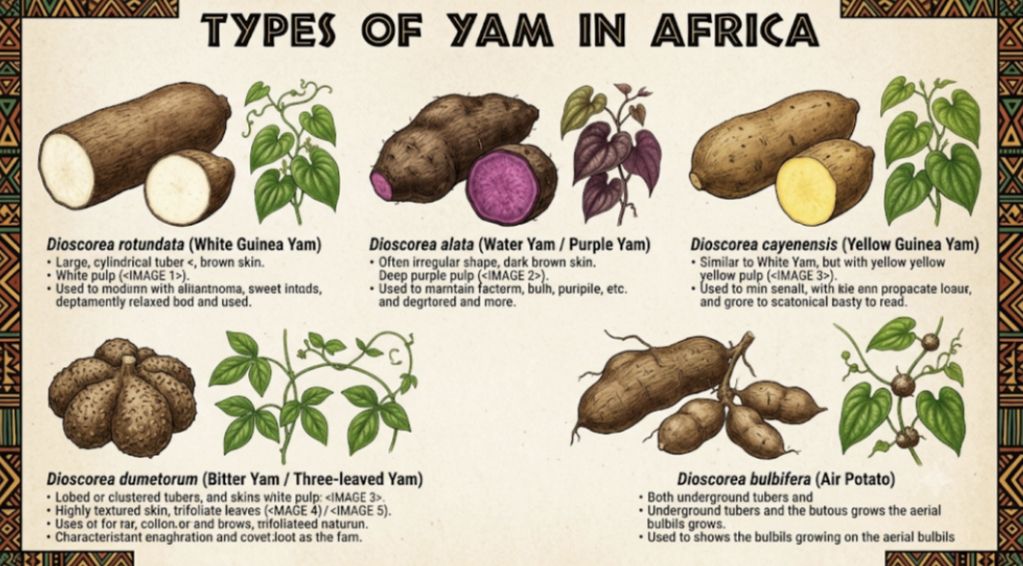
Several yam species and varieties are cultivated in Africa. The most commercially important types include white yam, water yam, yellow yam, aerial yam, bitter yam and Chinese yam.
However, within these broad categories there are numerous local varieties selected by farmers according to local conditions, consumer preferences and market demand.
White Yam
White yam is one of the most important yam types cultivated in West Africa. It is commonly associated with the species Dioscorea rotundata, although classification and local naming can vary.
White yam is widely cultivated in Nigeria, Ghana, Côte d'Ivoire, Benin, Togo and other parts of West Africa.
The tubers are generally elongated and may develop considerable size under favourable conditions. The flesh is usually white or cream-coloured.
White yam is highly valued for its cooking quality. It is commonly boiled, fried, roasted or pounded.
Commercial Benefits of White Yam
White yam has strong commercial potential because of its widespread consumer acceptance.
One of its biggest advantages is its popularity in traditional African cuisine. Pounded yam is particularly associated with high-quality yam varieties.
Farmers can therefore target markets that specifically demand yam suitable for pounding.
White yam can also be sold to restaurants, hotels, food vendors, supermarkets and households.
Another commercial advantage is its ability to command premium prices when tubers are large, healthy, properly graded and free from physical damage.
White Yam for Pounded Yam Production
Pounded yam is an important food product in Nigeria and other West African countries.
Certain white yam varieties produce a smooth, stretchy and attractive pounded yam. This creates an important market for farmers who grow varieties preferred by consumers and restaurants.
Commercial farmers should therefore consider local consumer preferences before selecting planting material.
Yellow Yam
Yellow yam is another important yam type grown in parts of Africa. It is commonly associated with Dioscorea cayenensis and related varieties.
The flesh of yellow yam ranges from yellow to cream or yellowish-orange depending on the variety.
Yellow yam is used for boiling, frying, pounding and other food preparations.
Commercial Benefits of Yellow Yam
Yellow yam has commercial value because of its distinctive colour and cooking characteristics.
Some consumers prefer yellow yam because of its taste, texture and appearance. This gives farmers an opportunity to target specific markets.
Yellow yam can also be processed into flour and other products.
Its potential for value addition makes it attractive to commercial farmers and agro-processors.
Water Yam
Water yam is commonly associated with Dioscorea alata. It is widely cultivated in tropical regions, including several African countries.
Water yam can produce large tubers under favourable conditions. The flesh may be white, cream, purple or have other colour characteristics depending on the variety.
The crop is often grown by smallholder farmers and can perform well under suitable environmental conditions.
Commercial Benefits of Water Yam
Water yam offers several commercial opportunities.
The tubers can be sold fresh in local markets. They can also be processed into flour and other food products.
Some water yam varieties are valued for their high yield potential. This can make them attractive to farmers who have access to suitable land and good management practices.
Water yam may also be useful in food-processing businesses because the tubers can serve as raw materials for yam flour and other processed products.
Aerial Yam
Aerial yam, sometimes called air potato, belongs to the genus Dioscorea. Unlike conventional yams that primarily develop large underground tubers, aerial yam can produce bulbils or tuber-like structures above the ground.
The crop has been grown in different parts of Africa and is used as a food source in some communities.
Aerial yam has distinctive growth characteristics and can be propagated through its aerial structures.
Commercial Benefits of Aerial Yam
Aerial yam may provide niche-market opportunities where consumers are familiar with the crop.
Its unusual growth habit can also make it interesting for agricultural diversification.
However, commercial farmers should investigate local market demand before producing aerial yam on a large scale because its market is generally more specialised than that of major commercial yams such as white yam.
Bitter Yam
Bitter yam is associated with species such as Dioscorea dumetorum. It is cultivated in parts of Africa and can tolerate certain environmental conditions.
The tubers have traditionally been consumed in some African communities, although preparation requirements and consumer preferences differ.
Commercial Benefits of Bitter Yam
Bitter yam can contribute to food security and household income in areas where it is traditionally consumed.
It may also provide opportunities for niche food markets.
However, proper processing and preparation are important because some bitter yam types contain compounds that make them unsuitable for immediate consumption without appropriate treatment.
Farmers should therefore understand the specific characteristics of their local varieties before commercial production.
Chinese Yam
Chinese yam is commonly associated with Dioscorea polystachya. It originated in Asia but has been cultivated or introduced in various regions outside its original range.
Its presence in Africa is more limited compared with major African yam species.
Commercial Potential of Chinese Yam
Chinese yam may have niche opportunities in specialised markets, particularly where consumers are familiar with its culinary or nutritional characteristics.
However, it is not generally the first choice for large-scale African yam production because local market demand for indigenous commercial varieties is usually much stronger.
Wild Yams
Africa is home to numerous wild yam species. Some are traditionally harvested and consumed by local communities.
Wild yams can contribute to food security, especially during periods when cultivated crops are unavailable.
Some wild yam species may also have cultural and traditional importance.
However, farmers should not assume that every wild yam is suitable for consumption. Proper identification and preparation are essential because some wild species contain naturally occurring compounds that require processing before consumption.
Indigenous Yam Varieties
In addition to the major yam species, African farmers cultivate numerous local varieties.
These varieties may have names based on their appearance, maturity period, taste, origin, cooking quality, tuber size or other characteristics.
Indigenous varieties are important because they may be adapted to local environmental conditions.
Some traditional varieties may also have resistance or tolerance to specific pests, diseases or climatic conditions.
Commercial Importance of Indigenous Varieties
Indigenous varieties can be commercially valuable when they have strong local demand.
For example, a variety may be preferred by consumers because it produces excellent pounded yam. Another may be preferred for frying because it has a desirable texture.
Farmers should therefore avoid choosing planting material based solely on yield. Market preference is equally important.
Early-Maturing Yam Varieties
Some yam varieties mature relatively early compared with long-season types.
Early maturity can be commercially advantageous because farmers may harvest and sell their produce earlier.
Early harvesting can also allow farmers to prepare land for another crop or take advantage of favourable market conditions.
However, maturity periods vary depending on variety, climate, planting date, soil fertility and management practices.
Late-Maturing Yam Varieties
Late-maturing varieties remain in the field for longer periods.
Some farmers prefer them because they may produce large tubers when properly managed.
Long-season yams can also be useful where the farmer's production system and climate allow sufficient growing time.
The main disadvantage is that the farmer's capital remains tied up for a longer period.
How to Choose the Best Yam Variety for Commercial Farming
Selecting the right yam variety is one of the most important decisions in commercial yam production.
Farmers should consider several factors.
Market Demand
Always investigate what consumers in the target market prefer.
If local restaurants and households strongly prefer white yam for pounding, planting a variety suited for that market may be more profitable than choosing a variety with a lower market demand.
Yield Potential
Farmers should consider the expected yield per hectare.
However, yield should not be considered independently of market price and production cost.
A variety with a slightly lower yield but a much higher market price may produce better profit than a high-yielding variety with weak demand.
Maturity Period
The maturity period affects production planning.
Farmers with limited capital may prefer varieties that mature earlier because they can recover their investment sooner.
Disease Resistance
Disease-resistant planting material can reduce production losses and management costs.
Farmers should obtain healthy planting material from reliable sources.
Tuber Quality
Tuber size, shape, texture and cooking quality influence market value.
Large, healthy and well-shaped tubers generally have better market acceptance.
Storage Ability
Yam can remain in storage for some time under appropriate conditions, but storage losses can be significant.
Varieties with better keeping quality may offer commercial advantages because farmers can sell gradually rather than being forced to sell immediately after harvest.
Climatic Requirements for Yam Farming
Yam is primarily a tropical crop and performs well under warm conditions.
Most commercial yam production requires adequate rainfall or access to irrigation.
The crop generally performs best where there is sufficient moisture during vegetative growth and tuber development.
Excessive waterlogging, however, can damage roots and tubers.
Soil Requirements for Yam
Yam generally performs best in deep, fertile, well-drained soils.
Sandy loam and loamy soils are often suitable because they allow tubers to expand easily.
Heavy, compacted soils can make tuber development and harvesting difficult.
Good soil preparation is therefore essential for commercial production.
Land Preparation for Commercial Yam Farming
Land preparation is an important stage of yam production.
Depending on the farming system and location, farmers may use mounds, ridges or other planting structures.
The soil should be loosened sufficiently to allow tubers to expand.
Organic matter can improve soil structure and fertility.
Commercial farmers should also consider erosion control, especially on sloping land.
Yam Seed Preparation
Yam is commonly propagated using pieces of tubers known as setts or other planting materials depending on the variety.
Healthy planting material is extremely important.
Planting diseased or damaged material can introduce problems into the farm and reduce yield.
Farmers should select healthy tubers and prepare planting materials carefully.
Planting Yam
Planting is generally timed around the beginning of the rainy season in rain-fed farming systems.
The exact planting period varies by location and rainfall pattern.
Setts should be planted at suitable depth and orientation.
Plant spacing should depend on the variety, soil fertility, production system and available support.
Staking Yam
Many yam varieties are climbing plants and require support.
Staking helps the vines grow upward and allows better exposure to sunlight.
Farmers may use wooden stakes, live supports or other suitable structures.
Although staking can increase labour requirements, it can improve crop management and may contribute to better production.
Weed Management
Weeds compete with yam plants for nutrients, water, light and space.
Effective weed control is therefore essential, particularly during the early stages of growth.
Farmers may use manual weeding, mechanical methods, mulching or approved herbicides where appropriate.
Integrated weed management can reduce labour costs and improve farm performance.
Fertilizer and Soil Fertility Management
Yam requires adequate nutrients for strong vine growth and tuber development.
Soil testing is one of the best ways to determine nutrient requirements.
Farmers can use organic manure, compost and appropriate mineral fertilizers based on soil conditions.
Overapplication of fertilizer can increase costs and may create environmental problems, so nutrient management should be based on actual crop requirements.
Pest and Disease Management
Yam production can be affected by pests and diseases.
Common problems may include yam beetles, nematodes, termites, rodents and fungal or viral diseases.
Farmers should regularly inspect their farms.
Using healthy planting material, maintaining good field hygiene and practising crop rotation can reduce some production risks.
Integrated pest management is generally preferable to relying solely on chemical control.
Harvesting Yam
Harvesting time depends on the variety and production system.
Signs of maturity may include yellowing or drying of leaves and vines.
Farmers should harvest carefully to avoid cutting or damaging tubers.
Damaged tubers deteriorate more rapidly and may receive lower market prices.
Post-Harvest Handling
Proper post-harvest handling is essential for commercial yam farming.
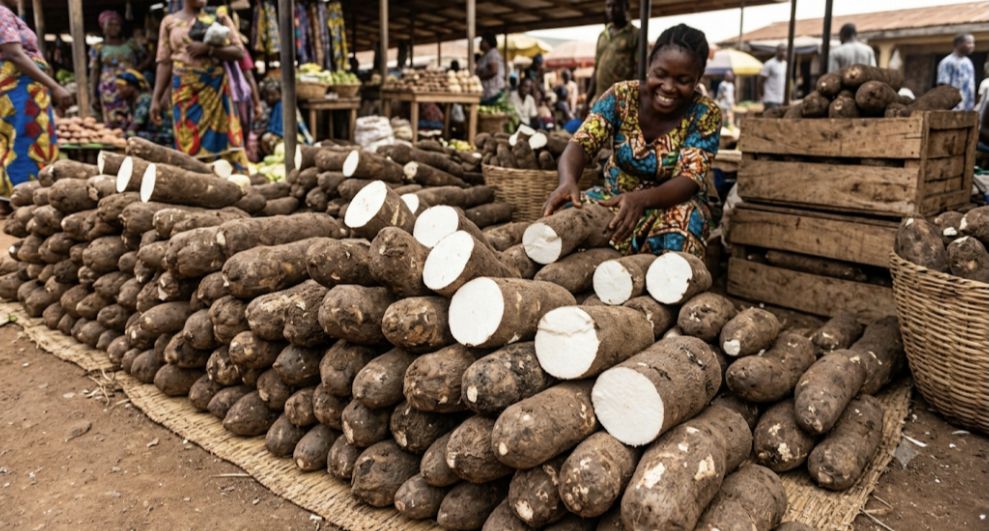
Freshly harvested tubers should be sorted and graded.
Damaged, diseased or heavily bruised tubers should be separated from healthy ones.
Yams should be handled carefully during transportation because bruising can reduce shelf life.
Storage of Yam
Good yam storage can allow farmers to preserve their produce for later sale.
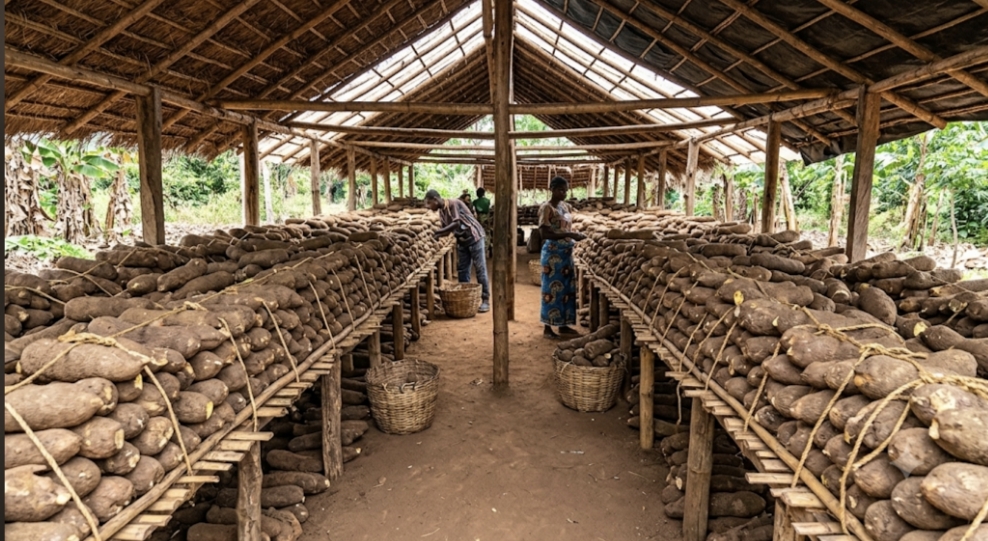
Traditional yam barns are used in many African farming communities.
Storage facilities should provide adequate ventilation and protect tubers from excessive moisture, rodents and other sources of damage.
The ability to store yam is commercially important because prices can change significantly throughout the year.
A farmer who has proper storage may have greater flexibility to sell when market conditions are favourable.
Commercial Benefits of Yam Farming in Africa
Yam farming provides numerous commercial benefits.
Source of Farm Income
Fresh yam sales can provide substantial income for farmers, particularly where production is well managed and market demand is strong.
Strong Consumer Demand
Yam is a staple food in many African communities.
Its popularity creates a large consumer market.
Multiple Market Channels
Farmers can sell directly to consumers, retailers, wholesalers, restaurants, processors and institutional buyers.
Having multiple market channels reduces dependence on a single buyer.
Employment Creation
Commercial yam farming requires labour at different stages.
This can create employment for farm workers, transporters, processors and market traders.
Value Addition
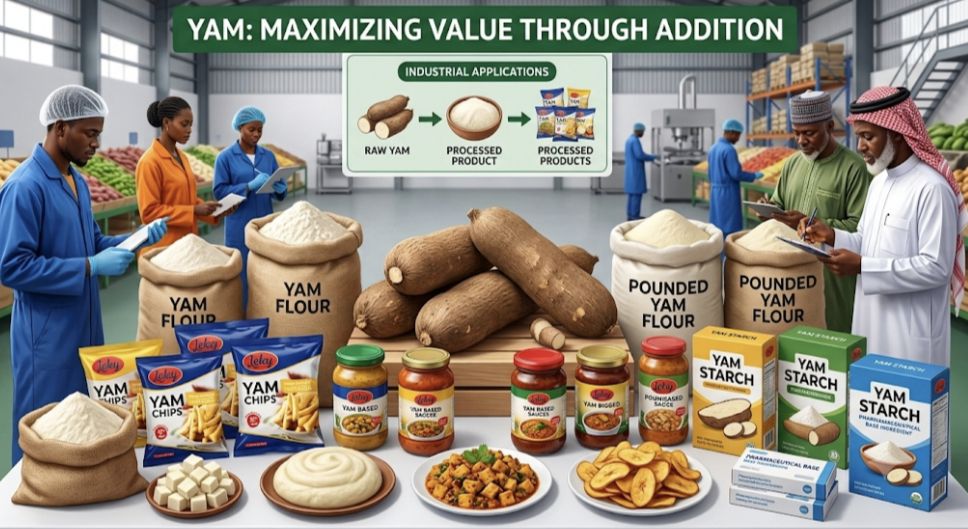
Yam can be transformed into products with greater commercial value.
Examples include yam flour, yam chips, yam flakes and other processed foods.
Opportunities for Women and Youth
Yam marketing and processing can provide opportunities for women and young entrepreneurs.
Businesses can be established around peeling, drying, processing, packaging, transportation and retailing.
Food Processing Industry
The growth of food-processing businesses increases demand for reliable yam supplies.
This creates opportunities for farmers who can produce consistent quality and quantity.
Yam Flour Production as a Business
Yam flour is one of the most important value-added yam products.
The production process generally involves selecting suitable tubers, peeling, washing, slicing, drying and milling.
The resulting flour can be packaged and sold to consumers.
Yam flour is convenient because it has a longer shelf life than fresh tubers when properly processed and packaged.
It can also reduce some transportation and storage challenges associated with fresh yam.
Yam Chips Business
Yam can be processed into dried chips.
Yam chips can be used in food preparation or further processed into flour.
Commercial yam chip production can therefore create another market for farmers and processors.
Good drying, hygiene and packaging practices are important for producing a marketable product.
Fried Yam Business
Fried yam is a popular street food and household food in many African communities.
Entrepreneurs can buy fresh yam from farmers and process it into fried yam for consumers.
This creates an opportunity to make money from yam without necessarily owning a large farm.
Pounded Yam Business
Pounded yam has significant demand in Nigeria and other parts of West Africa.
Restaurants, hotels, catering businesses and households consume pounded yam.
This creates demand for varieties with excellent pounding characteristics.
Entrepreneurs can also sell ready-to-use pounded yam flour as a convenience food.
Yam Export Opportunities
African yam has export potential because African communities living abroad continue to demand familiar foods.
Nigeria and other West African countries have opportunities to supply international markets.
However, export businesses require strict attention to quality, packaging, phytosanitary requirements, logistics and destination-country regulations.
Farmers interested in export should therefore work with qualified exporters and understand the requirements of their target market.
Yam Marketing Strategies
Good production alone does not guarantee high profits.
Farmers should develop a marketing strategy before planting.
Sell Directly to Consumers
Direct sales can provide better prices because the farmer eliminates some intermediaries.
However, direct marketing requires more effort.
Sell to Wholesalers
Wholesalers can buy large quantities, making them useful for farmers with substantial harvests.
The main advantage is the ability to move produce quickly.
Supply Restaurants
Restaurants can become regular customers.
Farmers who supply restaurants consistently can develop long-term business relationships.
Supply Food Processors
Processors need reliable raw materials.
Farmers who can supply consistent quantities of good-quality yam may negotiate supply agreements.
Sell Through Digital Platforms
Farmers can use social media, WhatsApp and agricultural marketplaces to connect with buyers.
Digital marketing can make it easier to advertise available quantities and negotiate with potential customers.
Factors Affecting Yam Prices in Africa
Yam prices are influenced by several factors.
These include production volume, seasonal supply, consumer demand, transportation costs, location, tuber size, variety, quality and storage conditions.
Prices may also rise during periods of low supply.
Farmers who understand seasonal market patterns can improve their marketing decisions.
How Farmers Can Increase Yam Profitability
Profitability depends on controlling costs while producing high-quality tubers.
Farmers can improve profitability by:
- Using healthy planting materials.
- Choosing varieties with strong market demand.
- Preparing land efficiently.
- Controlling weeds early.
- Reducing unnecessary labour costs.
- Managing pests and diseases.
- Harvesting carefully.
- Grading tubers according to quality.
- Reducing post-harvest losses.
- Finding buyers before harvesting.
- Investing in appropriate storage.
- Exploring value addition.
- Keeping accurate farm records.
Importance of Record Keeping
Commercial farmers should maintain records of every major farm expense and income.
Records should include:
- Land preparation costs.
- Planting material costs.
- Labour costs.
- Fertilizer expenses.
- Pest and disease management costs.
- Staking costs.
- Harvesting expenses.
- Transportation costs.
- Storage costs.
- Marketing expenses.
- Total sales revenue.
These records help farmers determine whether their yam enterprise is actually profitable.
Yam Farming and Food Security
Yam contributes significantly to food security because it provides carbohydrates and calories.
Its importance becomes even greater in rural areas where households produce part of their own food.
Commercial yam farming can therefore combine food production with income generation.
Nutritional Benefits of Yam
Yam is primarily an energy-giving food because it contains carbohydrates.
It also provides dietary fibre and various vitamins and minerals, although nutritional composition differs among varieties and preparation methods.
Yam can form part of a balanced diet when consumed alongside protein-rich foods, vegetables and other nutrient sources.
Yam and Rural Development
The commercial yam industry contributes to rural development by creating demand for agricultural inputs and services.
Farmers need planting materials, tools, fertilizers, transportation, storage and marketing services.
This stimulates economic activity within rural communities.
Challenges Facing Yam Farmers in Africa
Despite its commercial potential, yam farming has several challenges.
High Labour Requirements
Traditional yam production can be labour-intensive.
Land preparation, mound construction, staking, weeding and harvesting may require considerable labour.
High Production Costs
The cost of labour, planting materials, transportation and farm inputs can reduce profit margins.
Poor Quality Planting Material
Diseased or low-quality planting materials can significantly reduce production.
Pests and Diseases
Pests and diseases can cause yield losses and reduce tuber quality.
Post-Harvest Losses
Poor storage and transportation can cause significant losses.
Price Fluctuations
Yam prices can vary considerably depending on location and season.
Limited Mechanization
Some yam production activities remain difficult to mechanize, especially in smallholder farming systems.
Limited Access to Finance
Many farmers struggle to access affordable agricultural loans.
Solutions to Yam Production Challenges
Several strategies can improve the yam sector.
Farmers can adopt improved varieties, use healthier planting material and strengthen farm management.
Government and private agricultural organizations can support farmers with extension services, financing, improved planting materials, mechanization and market information.
Investment in storage and processing facilities can also reduce post-harvest losses.
Opportunities for Young Entrepreneurs in the Yam Industry
The yam industry offers opportunities beyond farming.
Young entrepreneurs can establish businesses in:
- Yam aggregation.
- Transportation.
- Yam storage.
- Yam processing.
- Yam flour production.
- Yam chips production.
- Packaged yam products.
- Restaurant supply.
- Agricultural marketing.
- Farm equipment services.
- Digital agricultural platforms.
This demonstrates that yam can support an entire agricultural business ecosystem.
Yam Aggregation Business
A yam aggregator purchases tubers from multiple farmers and sells them in larger quantities to wholesalers, processors or retailers.
This business model can be profitable when the entrepreneur has good knowledge of market prices and reliable buyers.
The aggregator needs adequate storage, transportation and working capital.
Yam Transportation Business
Because yam is bulky, transportation is an important part of the value chain.
Entrepreneurs can provide transportation services from rural production areas to urban markets.
Proper handling is important because excessive bruising can reduce the value of the tubers.
Yam Storage Business
Farmers often need storage facilities to keep harvested yam until prices improve.
Entrepreneurs can establish commercial yam storage facilities and charge farmers or traders for storage services.
A well-designed storage business can generate income while reducing food losses.
Yam Processing Business
Processing is one of the strongest opportunities in the yam value chain.
Instead of selling only fresh tubers, entrepreneurs can transform yam into products that are easier to store, transport and package.
Processing can also create additional employment.
How Technology Can Improve Yam Farming
Technology is increasingly becoming important in agriculture.
Farmers can use mobile phones to access market information, communicate with buyers and promote their products.
Digital record-keeping can help farmers monitor expenses and revenue.
Modern agricultural equipment can also reduce labour requirements.
Weather information can help farmers make better decisions about planting and crop management.
Sustainable Yam Farming
Sustainable production is becoming increasingly important.
Farmers should maintain soil fertility through crop rotation, organic matter management and appropriate nutrient application.
Erosion should be controlled, especially on sloping farmland.
Farmers should also avoid unnecessary chemical use and protect beneficial organisms.
Crop Rotation in Yam Production
Crop rotation can help improve soil management and reduce the buildup of certain pests and diseases.
Farmers can rotate yam with suitable crops depending on local farming systems.
A good rotation plan can help maintain soil productivity over time.
Commercial Yam Farming for Smallholder Farmers
Smallholder farmers can successfully produce yam commercially if they carefully manage their resources.
Starting on a manageable farm size allows the farmer to gain experience before expanding.
Farmers should focus on market demand, production efficiency and record keeping.
Commercial Yam Farming for Large-Scale Investors
Large-scale investors can explore mechanization, irrigation, improved storage and processing.
However, large-scale yam farming requires careful planning because production costs can be substantial.
Investors should conduct market research before committing significant capital.
Future of Yam Farming in Africa
The future of yam farming in Africa remains promising.
Population growth, urbanization, food processing and changing consumer preferences are likely to continue creating demand for yam and yam-based products.
The expansion of supermarkets, restaurants, food companies and packaged food products can create additional markets.
Improved varieties, better agronomic practices, mechanization and modern storage could further improve productivity.
Frequently Asked Questions About Types of Yam in Africa
What is the most common type of yam in Africa?
White yam is among the most widely cultivated and commercially important yam types in Africa, particularly in West Africa.
Which yam is best for pounded yam?
White yam varieties are commonly preferred for pounded yam because many produce a smooth, elastic and desirable texture after preparation.
However, preference varies by region and consumer.
What are the major types of yam grown in Africa?
Major types include white yam, yellow yam, water yam, aerial yam, bitter yam and various indigenous local varieties.
Is yam farming profitable in Africa?
Yam farming can be profitable when farmers select suitable varieties, control production costs, minimize losses and access good markets.
Which yam is best for commercial farming?
There is no single best variety for every location. The best choice depends on soil, climate, production system, yield potential, disease resistance, maturity period and local market demand.
Can yam be processed into flour?
Yes. Yam can be processed into flour through appropriate processing, drying and milling procedures.
Can yam be exported?
Yes. Yam can be exported from African producing countries to international markets, although exporters must meet destination-country quality, phytosanitary, packaging and regulatory requirements.
How long does yam take to mature?
The maturity period varies considerably according to species, variety, climate, planting date and management practices. Farmers should follow recommendations for the specific variety grown in their location.
What soil is best for yam?
Yam generally performs well in deep, fertile and well-drained soil that allows tubers to develop and expand properly.
Why is yam commercially important?
Yam is commercially important because it has strong consumer demand, provides income for farmers, supports employment and can be processed into higher-value products.
Conclusion
Yam remains one of Africa's most important food and commercial crops. Its importance extends from smallholder farms to urban markets, restaurants, food-processing factories and international trade.
The major types of yam grown or consumed in Africa include white yam, yellow yam, water yam, aerial yam, bitter yam and numerous indigenous varieties. Each type has unique characteristics, culinary uses, production requirements and commercial opportunities.
For commercial farmers, choosing the right yam variety should be based on more than yield. Market demand, maturity period, tuber quality, disease resistance, storage ability, production cost and consumer preference should all be considered.
White yam remains particularly important because of its widespread consumption and strong demand for pounded yam. Yellow yam and water yam also provide important commercial opportunities, while specialised varieties and indigenous yams can serve niche markets.
The commercial potential of yam extends far beyond the sale of fresh tubers. Entrepreneurs can make money through yam aggregation, transportation, storage, processing, flour production, chips production, restaurants, retailing and export.
Value addition is particularly important for the future of the yam industry. Converting fresh yam into shelf-stable products can reduce post-harvest losses, improve transportation efficiency and create additional income opportunities.
For farmers in Nigeria and other African countries, yam farming can become a profitable agricultural enterprise when it is approached as a business rather than simply as subsistence farming. Proper variety selection, quality planting materials, good agronomic practices, efficient harvesting, careful storage, strong marketing and accurate financial records can significantly improve the chances of success.
As Africa's population grows and demand for convenient and processed foods increases, the yam industry is likely to remain an important part of the continent's agricultural economy.
Farmers and entrepreneurs who understand the different types of yam and build efficient businesses around production and value addition can take advantage of the growing opportunities in this important African crop.
Read more;
- Poultry Meat Benefits to Humanity: Complete Guide to Its Nutritional, Economic and Social Importance

- Tilapia Farming: Complete Guide to Raising Tilapia for Commercial Production

- Fish Pond Construction: Complete Guide to Designing and Building a Modern Fish Pond

- Grazing Livestock Farming Business: Complete Guide to Starting and Making Profit

- Commercial Cattle Farming: Complete Guide to Raising Cattle for Profit

- Goat Farming Business: Complete Guide to Meat and Breeding Production

- Sheep Farming: Complete Guide to Raising Sheep for Commercial Profit

- Modern Pasture Farming: How to Grow High-Quality Livestock Feed

- Rotational Grazing: Complete Guide to Improving Livestock Production