Introduction
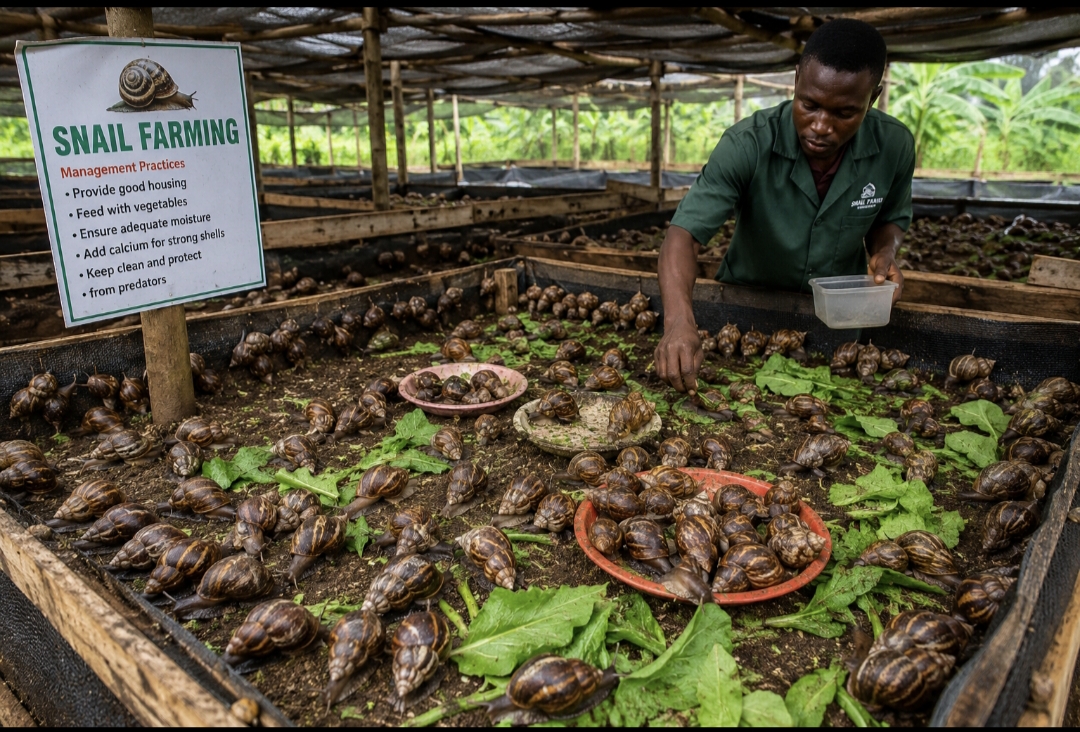
Snail farming is becoming an increasingly attractive agricultural business in Africa, particularly for farmers looking for a relatively small-scale livestock enterprise with strong market potential. Unlike many conventional livestock businesses, snail farming does not require enormous land areas, expensive machinery, or large quantities of feed. With proper management, farmers can raise snails in a controlled environment and sell them for food, breeding stock, processing, and other commercial purposes.
Snail meat is valued in many African communities because it is a source of animal protein and is commonly used in soups, sauces, and other traditional dishes. Demand from households, restaurants, hotels, food vendors, markets, and processors creates opportunities for commercial snail farmers.
This comprehensive guide explains how to start snail farming, choose suitable snail species, construct a snail farm, feed and manage snails, control pests and diseases, breed snails, harvest them, market the products, and build a profitable snail farming business.
What Is Snail Farming?
Snail farming is the controlled rearing and breeding of edible land snails for commercial purposes. It is also known as heliciculture.
Instead of allowing snails to grow naturally in forests, gardens, or farms, commercial farmers provide suitable housing, moisture, food, protection, and breeding conditions. The objective is to produce healthy snails of marketable size within a predictable period.
Snail farming can be practised on a small backyard scale or expanded into a commercial enterprise. A beginner can start with a relatively small number of breeding snails and gradually increase production as the snail population grows.
One major advantage of snail farming is that snails require considerably less space than large livestock such as cattle, goats, and sheep. This makes the enterprise suitable for farmers who have limited land.
Why Snail Farming Is Profitable in Africa
Snail farming has several characteristics that make it attractive as an agricultural business.
First, snails require relatively little space. A properly designed snail pen can accommodate a considerable number of snails compared with the amount of land needed for larger livestock.
Second, snails are generally quiet animals. They do not produce the noise associated with poultry or pigs, making them suitable for farms located close to residential areas when local regulations permit.
Third, snails can feed on many plant materials, vegetables, fruits, and other suitable feed resources. Farmers can therefore reduce feeding costs by incorporating safe and nutritious locally available materials.
Another important advantage is reproduction. Mature breeding snails can produce many eggs, allowing a well-managed farm to increase its population naturally.
There is also a growing market for fresh and processed snail meat. Restaurants, households, hotels, food vendors, supermarkets, and traders may purchase snails depending on location and consumer demand.
Best Snail Species for Farming
Choosing the right species is one of the most important decisions when establishing a snail farm.
Different snail species vary in growth rate, mature size, reproductive capacity, environmental requirements, and suitability for commercial production.
In West Africa, commonly discussed edible giant African land snails include species belonging to the genera Archachatina and Achatina. However, farmers should obtain breeding stock from reliable sources and verify the species and local regulations before starting production.
Giant African Land Snails
Giant African land snails are popular in commercial snail production because some species can attain large sizes and have good market value.
Farmers should not select breeding stock based on size alone. Healthy animals with good shell development, strong activity, and desirable reproductive characteristics are more valuable for establishing a productive breeding population.
Archachatina Species
Archachatina species are among the giant African land snails found in parts of Africa. Some can grow to substantial sizes and are used for food.
Their management requirements should be considered carefully because growth and reproduction can depend heavily on temperature, humidity, nutrition, housing, and seasonal conditions.
Achatina Species
Some Achatina species are also used in African snail production. They can be suitable for farming where environmental conditions and management practices are appropriate.
Because species identification can sometimes be difficult for beginners, it is advisable to obtain stock from an experienced breeder, agricultural institution, or reputable supplier.
How to Choose Healthy Snails for Breeding
The quality of your foundation stock can strongly influence the performance of your farm.
When purchasing breeding snails, avoid animals with cracked shells, damaged bodies, abnormal movement, foul-smelling discharge, or signs of weakness.
Select active and healthy mature snails with well-developed shells.
A good breeder should also keep records of the source of breeding animals and monitor their performance. Over time, poor-performing breeders can be removed from the breeding population.
Do not collect large numbers of wild snails from unknown locations without understanding the ecological, legal, and disease risks involved. Controlled sourcing is generally better for commercial production.
Site Selection for Snail Farming
The location of a snail farm can affect productivity significantly.
Snails prefer environments that provide adequate moisture and protection from excessive heat and direct sunlight. A good site should therefore have suitable shade and good environmental conditions.
The farm should be away from areas that are heavily polluted with chemicals, industrial waste, or pesticides.
A reliable water supply is also important because moisture management is essential in snail production.
The location should be accessible enough to allow the farmer to transport feed, breeding stock, equipment, and harvested snails to the market.
Security is another consideration. A snail farm should be protected against theft and predators.
Climate Requirements for Snail Farming
Snails generally perform best under warm and humid conditions. This is one reason snail farming is particularly suitable for many tropical and humid parts of Africa.
Extreme heat can cause stress and dehydration. Excessively dry conditions may reduce feeding and reproduction.
On the other hand, constantly waterlogged conditions can create problems, including poor sanitation, excessive mortality, and structural damage to the snail housing.
The goal is to maintain a balanced environment with adequate moisture, ventilation, shade, and drainage.
How to Construct a Snail Farm
A snail farm should be designed according to the scale of production.
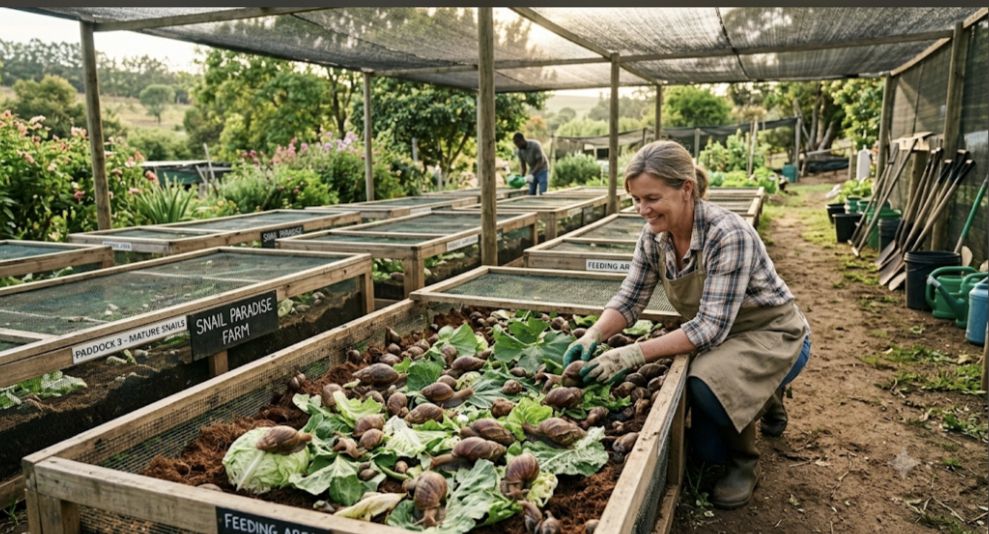
Common housing systems include:
- Wooden snail pens
- Concrete pens
- Box systems
- Trench pens
- Hutch boxes
- Free-range or semi-intensive systems
- Greenhouse-style or enclosed systems
For beginners, a simple covered pen can be an economical starting point.
The housing must prevent snails from escaping and should protect them from predators. The walls should be high enough and constructed in a way that prevents climbing and escape.
The pen should also have a suitable cover to protect snails from birds, rodents, reptiles, excessive sunlight, and other threats.
Important Features of a Good Snail Pen
A good snail pen should provide adequate space, shade, moisture, ventilation, drainage, security, and access for cleaning and feeding.
The structure should not expose snails to excessive direct sunlight.
The floor should be suitable for burrowing and egg laying where the production system requires it. Soil should be clean and free from dangerous chemicals.
The pen should be easy to inspect. Farmers need regular access to the snails so they can identify dead animals, collect eggs when appropriate, provide feed, control pests, and monitor growth.
Preparing the Soil for Snail Farming
Soil plays an important role in snail production because many land snails interact closely with the soil.
The soil should be relatively loose and suitable for burrowing and egg laying. It should not be heavily contaminated with pesticides, chemicals, oil, or industrial waste.
Avoid soil from areas where dangerous agricultural chemicals have recently been applied.
Good drainage is important. Waterlogged soil can create unhealthy conditions.
Farmers should periodically inspect and maintain the soil. Depending on the production system, soil may need to be replaced or refreshed.
Feeding Snails
Feed management is one of the most important parts of snail farming.
Snails consume a variety of plant materials, but farmers should not assume that every available plant is safe or nutritionally adequate.
Suitable feed resources can include vegetables, fruits, leaves, and formulated feeds designed for snails.
Examples of commonly used feed materials include:
- Pawpaw leaves
- Cocoyam leaves
- Waterleaf
- Lettuce
- Cabbage
- Carrots
- Cucumber
- Pumpkin leaves
- Sweet potato leaves
- Fruits such as pawpaw and banana
- Selected agricultural by-products
Feed should be clean and free from pesticides, mould, rot, and contaminants.
Importance of Calcium in Snail Production
Calcium is extremely important for shell development.
A calcium deficiency can contribute to poor shell development and weak shells.
Farmers may provide suitable calcium sources such as properly prepared oyster shell or other approved calcium supplements used in livestock production.
Calcium should be provided in a clean and safe form.
The exact nutritional requirements depend on species, age, production system, and other dietary factors. Commercial farmers should consider professional feed formulation where appropriate.
Feeding Young Snails
Young snails require careful management because they are more vulnerable than mature animals.
Their feed should be soft, fresh, nutritious, and easy to consume.
Feed should be supplied in suitable quantities to avoid excessive leftovers.
Rotting feed should be removed quickly because it can attract pests and contribute to poor hygiene.
Feeding Adult Snails
Adult snails can consume a wider range of plant materials. However, quality remains more important than simply providing large quantities of feed.
A balanced feeding programme should provide sufficient energy, protein, minerals, vitamins, and moisture.
Farmers should observe feeding behaviour and adjust feed quantities according to population size and age.
Water and Moisture Management
Snails require moisture, but farmers should avoid creating excessively wet or waterlogged conditions.
Depending on the production system, water may be provided through controlled spraying or suitable drinking arrangements.
Spraying the environment can help maintain humidity during dry conditions.
However, excessive spraying can create drainage problems and encourage unhealthy conditions.
The best approach is to monitor the environment and adjust moisture management according to weather conditions.
Snail Breeding
Breeding is one of the major reasons snail farming can expand quickly.
Many land snails are hermaphroditic, meaning an individual snail possesses both male and female reproductive organs. However, mating between individuals is still generally involved in reproduction.
After mating, eggs may be laid in suitable soil.
The farmer should provide appropriate nesting and soil conditions for reproduction.
Breeding performance can vary according to species, maturity, nutrition, environmental conditions, and farm management.
How to Manage Snail Eggs
Egg management requires careful attention.
Farmers should learn how their selected species lays eggs and establish procedures for protecting eggs from damage.
Eggs may be incubated in suitable soil under controlled environmental conditions, depending on the farming system.
Avoid excessive handling because fragile eggs can be damaged.
Egg areas should remain appropriately moist without becoming waterlogged.
Managing Hatchlings
Newly hatched snails are delicate and require suitable environmental conditions.
The nursery area should provide adequate moisture, shade, clean feed, and protection from predators.
Hatchlings should be monitored frequently.
Dead animals should be removed promptly to maintain hygiene.
Overcrowding should also be avoided because it can increase competition and make management more difficult.
Preventing Overcrowding
Overcrowding can negatively affect growth, feeding, sanitation, and general farm performance.
As snails grow, farmers should monitor population density and divide them into suitable groups where necessary.
Keeping too many snails in a small enclosure can increase competition for feed and space.
It can also make cleaning more difficult.
Proper stocking density should therefore be based on species, snail size, housing design, and management system.
Common Snail Pests and Predators
Snails have many natural predators.
Potential threats include:
- Rats
- Mice
- Birds
- Lizards
- Frogs
- Toads
- Ants
- Beetles
- Some insects
- Snakes
- Other small predators
A good snail farm should therefore be properly protected.
Wire mesh, suitable covers, secure fencing, clean surroundings, and regular inspection can reduce predator problems.
Ant Control in Snail Farms
Ants can be particularly dangerous to young snails and eggs.
Keeping the farm clean and reducing hiding places around the pen can help.
Farmers should avoid indiscriminately applying toxic pesticides inside snail pens because chemical exposure can kill snails or contaminate their environment.
Integrated pest management and physical exclusion methods are generally safer approaches.
Snail Farm Hygiene
Good hygiene is essential for successful snail farming.
Remove dead snails regularly.
Remove spoiled feed.
Keep feeding areas clean.
Prevent excessive accumulation of waste.
Inspect the soil and housing regularly.
Good hygiene reduces the likelihood of pest problems and creates a healthier environment for the snails.
Snail Diseases and Health Problems
Snails can experience health problems caused by poor nutrition, unsuitable environmental conditions, overcrowding, contamination, and parasites.
Many problems can be reduced through proper management.
Signs that should attract attention include:
- Unusual inactivity
- Poor feeding
- Damaged shells
- Weakness
- Abnormal body appearance
- Unexplained mortality
- Poor growth
When mortality increases unexpectedly, the farmer should investigate feed quality, moisture, hygiene, stocking density, predators, and possible disease problems.
Where a serious health problem occurs, consult an agricultural veterinarian or other qualified animal-health professional.
Common Mistakes in Snail Farming
Many beginners make avoidable mistakes.
One common mistake is buying poor-quality breeding stock.
Another is placing snails in an environment that is too dry, too hot, too wet, or poorly ventilated.
Overfeeding is another problem. Excess food that remains in the pen can rot and attract pests.
Overcrowding is also common among inexperienced farmers.
Some farmers fail to protect their pens against predators.
Others start production without researching their local market.
A profitable farm should be designed around both production and marketing.
How Long Does Snail Farming Take?
The time required to produce marketable snails varies considerably.
It depends on species, genetics, nutrition, environmental conditions, stocking density, and farm management.
Some snails may reach marketable size within several months under favourable conditions, while others may require longer.
Farmers should therefore avoid relying on a single universal production period.
Keeping growth records is a better way to determine how quickly your particular stock reaches the preferred market size.
How to Start Snail Farming With Small Capital
A beginner does not necessarily need a huge investment.
You can start with a small number of healthy breeding snails, construct a simple but secure pen, provide suitable soil, and gradually expand.
A basic startup budget may include:
- Breeding stock
- Housing materials
- Soil preparation
- Feed
- Calcium supplements
- Water supply
- Protective materials
- Labour
- Transportation
- Marketing
Starting small allows the farmer to learn the production process before investing heavily.
Commercial Snail Farming
Commercial snail farming requires more systematic management.
At commercial scale, farmers should maintain records for:
- Number of breeders
- Eggs produced
- Hatchlings
- Mortality
- Feed consumption
- Growth
- Sales
- Production costs
- Labour
- Customer orders
Good records help farmers determine whether the business is actually profitable.
How to Calculate Snail Farming Profit
Profit should not be estimated from sales alone.
Use the basic formula:
Profit = Total Revenue − Total Production Costs
Production costs may include breeding stock, housing, feed, labour, transportation, equipment, water, packaging, marketing, maintenance, and losses.
For example, if a farmer sells snails worth ₦1,000,000 but spends ₦700,000 on production and marketing, the approximate operating profit before other applicable costs would be ₦300,000.
Actual profitability varies widely depending on location, scale, mortality, production efficiency, market prices, and operating costs.
Marketing Snails
Marketing should begin before your snails reach market size.
Potential customers include:
- Local markets
- Restaurants
- Hotels
- Food vendors
- Supermarkets
- Individual consumers
- Snail traders
- Caterers
- Food processors
- Other snail farmers
Farmers can also build relationships with restaurants and food businesses that require regular supplies.
Selling Live Snails
Live snails are commonly sold by farmers and traders.
Selling live animals can reduce the need for processing equipment, but transportation and handling must be carefully managed.
Snails should be kept in suitable containers with adequate ventilation and protection from excessive heat.
Selling Processed Snail Meat
Value addition can create additional opportunities.
Depending on local food regulations and available facilities, farmers may explore products such as cleaned, packaged, chilled, frozen, or otherwise processed snail meat.
Processing requires strict attention to food hygiene, appropriate equipment, packaging, storage, and regulatory requirements.
Farmers should comply with applicable food safety laws before selling processed products.
Building a Snail Farming Brand
A professional brand can help differentiate your farm from competitors.
Choose a memorable farm name.
Create a simple logo.
Use clean packaging.
Provide accurate product information.
Maintain consistent quality.
Take clear photographs of your farm and products.
Social media platforms can also be used to showcase production activities, educate customers, announce availability, and attract wholesale buyers.
Using Social Media to Sell Snails
Social media can be a low-cost marketing tool.
Farmers can publish:
- Farm videos
- Feeding activities
- Snail growth updates
- Harvest photographs
- Customer testimonials
- Educational content
- Available stock
- Price information
- Farm tours
WhatsApp can also be useful for building a customer database and receiving orders.
However, farmers should avoid making unrealistic claims about production or health benefits.
Snail Farming and Food Security
Snail farming can contribute to food security by providing an additional source of animal protein.
It can also create employment and income opportunities.
Small farms can supply local markets, while larger operations can develop organized supply chains.
The enterprise can be particularly attractive where consumers already have cultural and culinary preferences for snail meat.
Environmental Considerations
Snail farming should be conducted responsibly.
Farmers should prevent farm waste from entering waterways.
Feed should be sourced responsibly.
The farm should avoid unnecessary chemical contamination.
Wild snail collection should be handled carefully to prevent environmental damage.
Farmers should also follow local regulations concerning the movement, breeding, sale, and introduction of snail species.
Snail Farming as a Youth Business
Snail farming can provide an entry point into agriculture for young entrepreneurs.
Because it can be started on a relatively small scale, beginners can gain practical experience before expanding.
Young farmers can combine snail production with digital marketing, online education, direct sales, and agricultural content creation.
This creates an opportunity to build multiple income streams around one agricultural enterprise.
Integrating Snail Farming With Other Agriculture
Snail farming can sometimes be integrated with crop production.
Vegetable residues and selected plant materials can potentially be used as snail feed, provided they are safe and free from harmful chemicals.
Farmers can also use certain crop-production activities to create a more diversified agricultural enterprise.
However, integration must be carefully planned to prevent pesticide exposure.
Never feed snails plant materials contaminated with agricultural chemicals.
Snail Farming Business Plan
A professional snail farming business plan should explain what you intend to produce, how you will produce it, who will buy it, and how much it will cost.
A basic business plan should include:
Executive Summary
Explain the purpose of the farm, the intended scale, target market, and major objectives.
Market Analysis
Identify potential buyers and estimate local demand.
Study competitors and current market conditions.
Production Plan
Explain the snail species, housing system, breeding programme, feeding strategy, expected production, and farm management practices.
Financial Plan
List startup costs, operating expenses, projected sales, cash flow, and expected profit.
Marketing Plan
Explain how you will attract customers and distribute your products.
Risk Management
Identify risks such as disease, predators, mortality, feed shortages, low prices, theft, extreme weather, and market changes.
Risks in Snail Farming
Although snail farming can be profitable, it is not a risk-free business.
Potential risks include high mortality, predators, poor breeding performance, unsuitable weather, poor-quality feed, theft, market fluctuations, and inadequate management.
Farmers should therefore avoid investing all their money without first understanding the production process and market.
Starting with a manageable scale can reduce financial risk.
How to Make Snail Farming More Profitable
Profitability can be improved through several strategies.
First, focus on quality breeding stock.
Second, reduce unnecessary feed waste.
Third, maintain appropriate stocking density.
Fourth, protect the farm from predators.
Fifth, maintain good hygiene.
Sixth, keep accurate production records.
Seventh, sell directly to customers where practical.
Eighth, develop relationships with restaurants and bulk buyers.
Ninth, consider value-added products where legally and economically feasible.
Finally, expand only after the existing production system is performing well.
Frequently Asked Questions About Snail Farming
Is snail farming profitable in Africa?
Snail farming can be profitable when production costs are controlled, mortality is minimized, suitable species are selected, and reliable markets are available. Profitability differs by location and farm scale.
How much money do I need to start snail farming?
There is no single startup amount because costs depend on farm size, housing materials, breeding stock, feed, labour, and local prices. A small backyard operation can require much less capital than a commercial farm.
What do snails eat?
Farmed snails can consume various suitable vegetables, fruits, leaves, and formulated feeds. Feed should be clean, nutritious, and free from pesticides and contaminants.
Do snails need water?
Snails require adequate moisture, but they should not be kept in permanently waterlogged conditions. Moisture should be carefully managed according to the production system and weather.
How often should snails be fed?
Feeding frequency depends on the species, age, stocking density, weather, and feeding system. Farmers should provide fresh feed appropriately and remove spoiled leftovers.
Can I raise snails at home?
Snail farming can be conducted on a small scale around a home where local conditions and regulations permit. The farm must be properly enclosed, hygienic, shaded, and protected from predators.
How do I prevent snails from escaping?
Use properly constructed housing with secure walls, covers, and appropriate barriers. Inspect the enclosure regularly for gaps or damaged sections.
What is the most important factor in snail farming?
There is no single factor. Good breeding stock, suitable housing, moisture management, nutrition, hygiene, predator control, and marketing all contribute to success.
Conclusion
Snail farming is a promising agricultural enterprise for farmers who want to enter livestock production without the land and infrastructure requirements associated with larger animals.
Successful production depends on more than simply putting snails inside a pen. Farmers need to select healthy breeding stock, provide appropriate housing, maintain suitable moisture and temperature conditions, supply nutritious feed and calcium, protect the animals from predators, manage breeding carefully, maintain hygiene, monitor growth, and develop reliable markets.
The most important principle for beginners is to start with a manageable scale and learn the production process before expanding. Proper record keeping is equally important because it allows farmers to understand feed costs, mortality, breeding performance, growth rates, sales, and profitability.
With good management, market research, quality breeding stock, and consistent attention to production, snail farming can become a valuable source of income while contributing to food supply and agricultural development in Africa.
Read more;
- Poultry Meat Benefits to Humanity: Complete Guide to Its Nutritional, Economic and Social Importance

- Tilapia Farming: Complete Guide to Raising Tilapia for Commercial Production

- Fish Pond Construction: Complete Guide to Designing and Building a Modern Fish Pond

- Grazing Livestock Farming Business: Complete Guide to Starting and Making Profit

- Commercial Cattle Farming: Complete Guide to Raising Cattle for Profit

- Goat Farming Business: Complete Guide to Meat and Breeding Production

- Sheep Farming: Complete Guide to Raising Sheep for Commercial Profit

- Modern Pasture Farming: How to Grow High-Quality Livestock Feed