Introduction
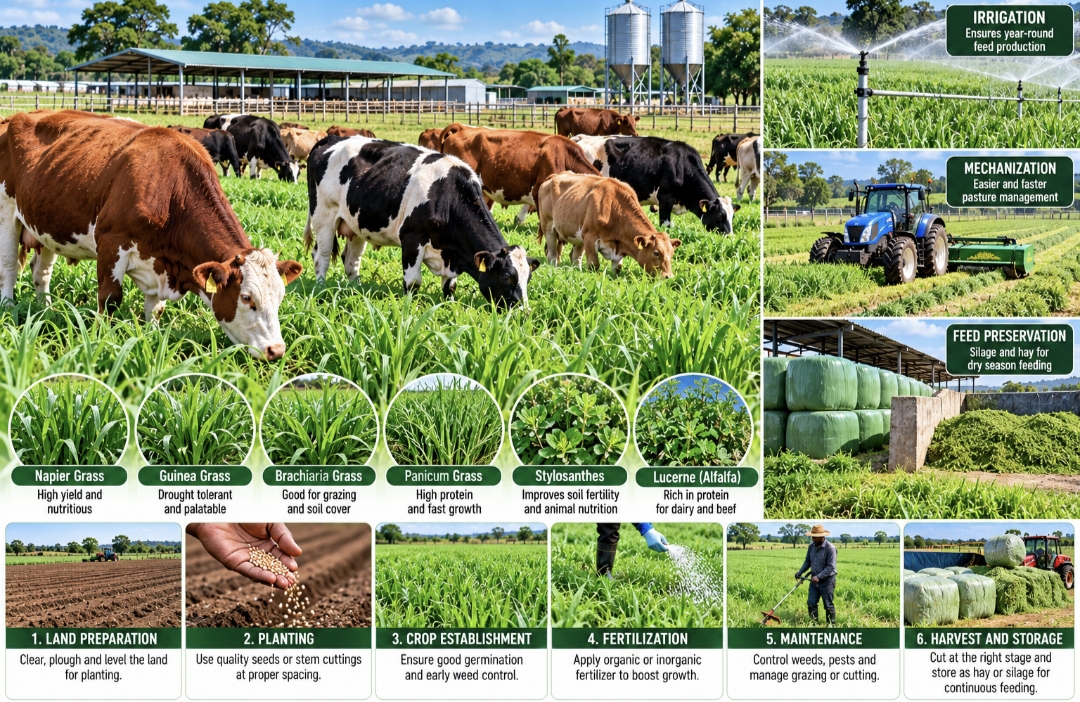
Modern pasture farming is becoming increasingly important as livestock producers look for reliable, nutritious and affordable sources of animal feed. Whether the farm focuses on cattle, sheep, goats, horses or other grazing livestock, the quality and availability of forage can have a major influence on animal growth, reproduction, milk production and overall farm profitability.
Pasture is more than simply grass growing on farmland. A well-managed pasture is a productive agricultural system designed to provide animals with nutritious forage while maintaining soil fertility, preventing erosion and allowing vegetation to recover after grazing.
Traditional livestock systems often depend heavily on natural vegetation. Modern pasture farming, however, involves deliberate selection of forage species, soil preparation, planting, fertilization, irrigation where necessary, weed management, rotational grazing and conservation of excess forage as hay or silage.
For commercial livestock farmers, developing productive pasture can reduce dependence on purchased feed and improve control over the farm's feeding program.
This comprehensive guide explains modern pasture farming, including how to establish a pasture, select suitable forage crops, manage grazing, improve soil fertility, produce hay and silage, maintain pasture productivity and create a sustainable livestock feeding system.
What Is Modern Pasture Farming?
Modern pasture farming is the planned cultivation and management of grasses, legumes and other forage plants primarily for feeding livestock.
Instead of allowing animals to graze randomly over a large area, farmers manage the pasture according to factors such as animal requirements, forage growth, soil conditions, rainfall, season and available land.
Modern pasture systems can be established specifically for:
- Cattle
- Dairy cows
- Beef cattle
- Goats
- Sheep
- Horses
- Buffalo
- Other grazing livestock
The pasture may be used for direct grazing or harvested and converted into conserved feeds such as hay and silage.
The objective is to produce sufficient quantities of nutritious forage while maintaining the long-term productivity of the land.
Why Pasture Is Important in Livestock Farming
Feed is one of the most important components of livestock production. Animals require energy, protein, minerals, vitamins, fiber and water to grow and perform properly.
High-quality pasture can provide a significant portion of these nutritional requirements.
A productive pasture can help farmers:
- Reduce feed costs
- Improve animal growth
- Support reproductive performance
- Increase milk production
- Improve body condition
- Reduce dependence on purchased feed
- Provide feed during different seasons
- Protect soil from erosion
- Improve soil organic matter
- Recycle animal manure
- Support sustainable livestock production
For grazing livestock businesses, pasture management can therefore be considered part of the farm's financial management.
Poor pasture can result in underfed animals, excessive grazing pressure, land degradation and higher feed expenses.
Main Types of Pasture Plants
Pasture plants can generally be divided into grasses, legumes and other forage plants.
Grasses are often the foundation of grazing systems because they can produce large quantities of forage and tolerate repeated grazing when properly managed.
Legumes are valuable because many contain relatively high levels of protein and can contribute nitrogen to the soil through biological nitrogen fixation.
Some pasture systems combine grasses and legumes to create a more balanced forage system.
Grasses for Livestock Pasture
Grasses are among the most widely used forage plants worldwide.
Depending on climate and farming conditions, farmers may use species such as:
- Napier grass
- Rhodes grass
- Guinea grass
- Brachiaria grasses
- Bermuda grass
- Signal grass
- Ryegrass
- Timothy
- Fescue
- Orchard grass
- Sorghum-sudangrass
The best grass depends on climate, soil, rainfall, livestock species, grazing intensity and management objectives.
Legumes for Pasture
Legumes can play an important role in improving the nutritional quality of pasture.
Examples include:
- Alfalfa
- Clover
- Cowpea
- Desmodium
- Stylo
- Lucerne
- Vetch
- Certain forage beans
Many legumes contain higher protein concentrations than mature grasses, although nutritional values vary according to species, maturity and growing conditions.
When compatible species are combined correctly, grass-legume pastures can provide complementary nutritional benefits.
Warm-Season and Cool-Season Forages
Climate is one of the most important factors when selecting pasture plants.
Warm-season grasses generally perform better under warmer growing conditions, while cool-season grasses are better adapted to cooler periods.
Farmers operating in regions with distinct seasons can sometimes combine forage species or establish different fields to provide more consistent feed availability throughout the year.
Understanding the local climate helps prevent expensive mistakes when establishing pasture.
Choosing the Right Pasture Species
The choice of forage species should not be based solely on popularity.
A farmer should consider:
- Climate
- Rainfall
- Temperature
- Soil type
- Soil fertility
- Drainage
- Grazing tolerance
- Drought tolerance
- Livestock species
- Expected animal numbers
- Availability of planting materials
- Seed cost
- Nutritional quality
- Regrowth speed
- Intended use
A forage that performs exceptionally well in one region may perform poorly in another.
Conduct a Soil Test Before Establishing Pasture
Soil testing is one of the most useful steps in pasture development.
A soil test can provide information about:
- Soil pH
- Nitrogen status
- Phosphorus
- Potassium
- Organic matter
- Other nutrients
The results help farmers determine whether soil amendments or fertilizers are necessary.
Applying fertilizer without understanding the soil can lead to unnecessary expenditure and nutrient imbalance.
Selecting Land for Pasture Farming
Good pasture begins with suitable land.
When selecting a site, consider:
- Soil quality
- Drainage
- Water availability
- Accessibility
- Topography
- Flood risk
- Existing vegetation
- Distance from livestock housing
- Fencing requirements
- Machinery access
Flat or gently sloping land is generally easier to manage mechanically, although pasture can also be established on suitable sloping land with appropriate soil conservation practices.
Land Preparation for Pasture
Land preparation depends on the existing vegetation and establishment method.
Possible activities include:
- Clearing unwanted vegetation
- Removing large roots and debris
- Controlling persistent weeds
- Preparing the seedbed
- Correcting soil problems
- Applying required nutrients
- Establishing drainage where necessary
Excessive soil disturbance should be avoided where it is unnecessary because intensive cultivation can increase erosion and reduce soil structure.
Choosing Quality Seeds and Planting Materials
High-quality planting material is essential.
Poor-quality seed can result in:
- Low germination
- Uneven establishment
- Weak plants
- Increased weed competition
- Lower pasture productivity
Farmers should obtain seeds or vegetative planting materials from reliable suppliers and select varieties suitable for their environment.
Planting material should be clean, viable and appropriate for the intended livestock production system.
Methods of Establishing Pasture
Pasture can be established through several methods.
Common methods include:
- Broadcasting
- Row planting
- Drilling
- Vegetative propagation
- Planting cuttings
- Establishing seedlings before transplanting
The appropriate method depends on the forage species, available equipment, soil conditions and farm scale.
Timing Pasture Establishment
Timing can strongly affect pasture establishment.
In rain-fed systems, planting is commonly scheduled around the beginning of a reliable growing period.
The objective is to provide adequate moisture during germination and early plant development.
Farmers should avoid establishing pasture immediately before prolonged dry conditions unless irrigation is available.
Fertilizer and Soil Fertility Management
Pasture plants remove nutrients from the soil as they grow.
When livestock continuously graze a field, nutrients are also redistributed through animal manure and urine, but this may not completely replace all nutrients removed from the system.
Soil fertility should therefore be monitored regularly.
Depending on soil-test results and forage requirements, farmers may use:
- Organic manure
- Compost
- Nitrogen fertilizers
- Phosphorus fertilizers
- Potassium fertilizers
- Lime where appropriate
- Other soil amendments
Fertilizer recommendations should ideally be based on soil tests and local agronomic guidance.
Managing Water for Pasture
Water is essential for pasture growth.
Rainfall may provide sufficient moisture in some regions, while irrigation may be useful in areas with seasonal or unreliable rainfall.
Possible irrigation systems include:
- Sprinkler irrigation
- Center pivot systems
- Drip irrigation for certain forage systems
- Surface irrigation where suitable
Irrigation decisions should consider water availability, installation costs, energy requirements and the economic value of additional forage production.
Weed Management in Pasture
Weeds compete with forage plants for:
- Water
- Nutrients
- Light
- Growing space
Effective weed management begins with proper pasture establishment.
Useful approaches include:
- Good seed quality
- Correct planting density
- Timely grazing
- Mechanical weed control
- Mowing
- Appropriate herbicide use where necessary
Herbicides should be selected and applied according to their labels and local regulations, particularly because some livestock may be sensitive to certain chemicals or residues.
Pasture Pest and Disease Management
Pasture plants can be affected by insects, fungal diseases and other biological problems.
Regular field inspection helps farmers identify problems early.
Signs to watch for include:
- Unusual leaf discoloration
- Stunted growth
- Leaf damage
- Bare patches
- Wilting
- Poor regrowth
- Unusual insect populations
Integrated pest management can combine resistant forage varieties, good field management, biological methods and carefully selected pesticides when necessary.
When Should Livestock Enter a New Pasture?
Livestock should not be introduced too early.
Newly established pasture needs time to develop a strong root system and sufficient plant growth.
If animals graze immature pasture too early, they can:
- Damage young plants
- Reduce root development
- Slow establishment
- Increase bare ground
- Reduce long-term productivity
The appropriate first grazing time depends on the forage species, establishment method and growing conditions.
Understanding Rotational Grazing
Rotational grazing involves dividing pasture into several grazing areas and moving livestock between them.
For example, a farm might divide pasture into several paddocks.
Animals graze one paddock while the others recover.
After the grazing period, livestock are moved to another paddock.
This system can help:
- Improve forage utilization
- Prevent continuous overgrazing
- Encourage plant recovery
- Distribute manure
- Protect soil
- Improve pasture persistence
Rotational grazing does not automatically guarantee better results. It must be properly managed according to forage growth and livestock demand.
Rest Periods in Pasture Management
Pasture needs adequate recovery after grazing.
The required rest period depends on:
- Plant species
- Temperature
- Rainfall
- Soil fertility
- Grazing intensity
- Season
- Irrigation
During periods of rapid growth, pasture may recover quickly.
During drought or cold periods, recovery can take considerably longer.
Farmers should therefore manage pasture according to plant growth rather than following a rigid calendar alone.
Avoiding Overgrazing
Overgrazing occurs when animals consume pasture faster than plants can recover.
Common signs include:
- Increasing bare soil
- Short or weak vegetation
- Declining forage production
- Increased weeds
- Soil erosion
- Poor livestock performance
Overgrazing can gradually reduce the productive capacity of land.
Reducing stocking pressure and allowing adequate recovery can help protect pasture.
Understanding Carrying Capacity
Carrying capacity refers to the number of animals that a particular area of land can support sustainably for a specified period.
It depends on:
- Forage production
- Rainfall
- Soil fertility
- Pasture species
- Animal size
- Grazing duration
- Season
- Pasture management
A farm should not determine animal numbers simply by land size.
Two farms with the same acreage can support very different numbers of animals depending on forage productivity.
Measuring Pasture Productivity
Farmers can improve management by monitoring forage production.
Useful measurements include:
- Forage yield
- Animal weight gain
- Milk production
- Grazing days
- Recovery time
- Pasture coverage
- Weed percentage
- Bare soil percentage
Record keeping makes it easier to determine whether pasture management is improving or declining.
Grass-Legume Pasture Systems
Combining grasses and legumes can create a productive pasture system.
Grass provides structural forage and energy, while suitable legumes can contribute additional protein and nitrogen fixation.
However, the mixture must be carefully managed because different plants have different growth patterns and grazing tolerances.
The objective is not simply to plant as many species as possible but to establish compatible species that perform well under the farm's conditions.
Pasture for Dairy Cattle
Dairy animals have substantial nutritional requirements.
High-quality pasture can contribute to their diet, particularly when forage is young, leafy and nutritious.
However, high-producing dairy animals may require additional concentrates, minerals or conserved forage depending on production level.
Pasture should therefore be considered as one component of the complete feeding program.
Pasture for Beef Cattle
Beef cattle can make excellent use of well-managed pasture.
Pasture-based beef systems can involve:
- Cow-calf production
- Growing cattle
- Backgrounding
- Fattening
- Breeding herds
The nutritional needs of cattle change with age, pregnancy, lactation and production stage.
Pasture planning should reflect these differences.
Pasture for Goats
Goats are browsing animals and can consume a wide variety of vegetation.
A goat pasture may therefore include:
- Grasses
- Legumes
- Shrubs
- Browse plants
- Forbs
However, poisonous plants should be excluded from livestock areas.
Goats can also contribute to vegetation management because they often consume plants that cattle do not prefer.
Pasture for Sheep
Sheep can efficiently utilize many grass and legume pastures.
Good pasture management is especially important because sheep can graze vegetation closely.
Rotational grazing can help reduce excessive pressure on pasture and support vegetation recovery.
Pasture for Horses
Horse pasture requires careful management because horses can graze selectively and repeatedly in preferred areas.
Pasture systems for horses should provide:
- Safe forage
- Adequate space
- Clean water
- Suitable fencing
- Shade or shelter
- Proper parasite management
Certain forage plants and pasture conditions may not be appropriate for every horse, so nutritional management should be adapted to the animals.
Producing Hay From Pasture
Hay is forage that has been harvested and dried sufficiently for storage.
Hay production allows farmers to preserve excess pasture during periods of abundant growth and use it when fresh forage becomes scarce.
Good hay-making involves:
- Growing suitable forage
- Harvesting at an appropriate maturity stage
- Drying efficiently
- Avoiding excessive leaf loss
- Protecting hay from rain
- Storing it in a dry location
When to Harvest Hay
Harvest timing affects both quantity and quality.
Very mature forage may produce more dry matter but generally becomes more fibrous and less digestible.
Younger forage may have higher nutritional value but can produce less total dry matter.
Farmers therefore need to balance yield and nutritional quality.
Hay Storage
Poor storage can destroy a large percentage of the value of hay.
Hay should be protected from:
- Rain
- Ground moisture
- Flooding
- Excessive humidity
- Fire
- Rodents
- Livestock contamination
A well-ventilated storage structure with protection from direct rainfall can significantly improve hay preservation.
Producing Silage
Silage is fermented forage preserved under oxygen-limited conditions.
Common silage crops include:
- Maize
- Sorghum
- Forage grasses
- Certain forage mixtures
The forage is harvested, chopped, packed tightly and sealed to create conditions that encourage desirable fermentation.
Successful silage production requires proper moisture management, good compaction and effective sealing.
Benefits of Silage Production
Silage can help livestock farmers:
- Preserve surplus forage
- Maintain feed supplies during dry periods
- Reduce dependence on fresh pasture
- Maintain more consistent feeding
- Improve utilization of seasonal forage production
Silage can be particularly useful for dairy and intensive livestock operations.
Dry-Season Pasture Management
Pasture availability can decline significantly during dry periods in seasonal climates.
Farmers can prepare by:
- Conserving hay
- Producing silage
- Establishing drought-tolerant forage
- Reducing stocking pressure
- Using crop residues
- Growing irrigated forage where economically viable
- Purchasing supplemental feed when necessary
The best strategy is usually to prepare before the feed shortage becomes severe.
Improving Pasture Nutritional Quality
Pasture quality is affected by plant species, plant maturity, soil fertility and environmental conditions.
Young leafy forage generally tends to be more digestible than highly mature, stemmy forage.
Farmers can improve forage quality by:
- Selecting suitable species
- Preventing excessive maturity
- Maintaining soil fertility
- Managing grazing intensity
- Harvesting at appropriate stages
- Using compatible legumes
- Conserving high-quality forage
Pasture Renovation
Pasture productivity can decline over time.
Reasons may include:
- Overgrazing
- Soil nutrient depletion
- Weed invasion
- Drought
- Poor drainage
- Soil compaction
- Pest damage
- Inappropriate species
Pasture renovation may involve:
- Soil testing
- Fertilization
- Weed control
- Reseeding
- Introducing improved forage species
- Improving drainage
- Adjusting stocking rates
Renovation can sometimes restore productivity without completely replacing the entire pasture.
Pasture and Soil Conservation
Healthy pasture can protect soil by maintaining vegetation cover.
Plant roots help stabilize soil, while plant residues can reduce the impact of rainfall on exposed soil.
Good pasture management can therefore contribute to:
- Reduced erosion
- Better water infiltration
- Improved soil structure
- Increased organic matter
- Better nutrient cycling
Avoiding excessive grazing pressure is particularly important on vulnerable land.
Integrating Livestock With Crop Farming
Pasture farming can be integrated with crop production.
For example, farmers may use:
- Crop residues as livestock feed
- Livestock manure as fertilizer
- Cover crops as forage
- Rotational crop-pasture systems
- Legume crops to improve soil fertility
This integrated approach can improve resource utilization and reduce waste.
Using Manure to Improve Pasture
Livestock manure contains nutrients that plants can use.
Instead of allowing manure to become an unmanaged waste product, farmers can incorporate it into a nutrient-management program.
However, manure should be handled appropriately to minimize nutrient losses, odors, pathogens and water contamination.
Application rates should reflect soil conditions and crop requirements.
Modern Technology in Pasture Farming
Technology is increasingly changing pasture management.
Farmers can use:
- GPS mapping
- Digital farm records
- Satellite imagery
- Drones
- Soil sensors
- Weather stations
- Mobile farm-management applications
- Automated water systems
- Electronic livestock identification
Technology can help farmers monitor pasture growth, animal movement and resource use.
Using Drones to Monitor Pasture
Drones can provide aerial images that help farmers identify:
- Bare areas
- Weed infestation
- Waterlogging
- Uneven pasture growth
- Fence problems
- Animal distribution
The information can support better farm-management decisions.
Digital Record Keeping
A simple pasture-management record can include:
- Paddock number
- Grazing date
- Livestock numbers
- Grazing duration
- Rest period
- Rainfall
- Fertilizer applications
- Pasture observations
- Hay production
- Animal performance
Even a basic spreadsheet or mobile application can provide useful information over time.
Water Management for Grazing Animals
A productive pasture is not enough if livestock cannot access clean water.
Water points should be strategically located so animals do not need to travel excessively.
Poorly designed watering areas can become muddy and damaged.
Farmers should regularly inspect:
- Water quality
- Pipes
- Tanks
- Pumps
- Troughs
- Natural water sources
Clean drinking water should always be available according to the needs of the livestock species and environmental conditions.
Pasture Fencing
Fencing is particularly important in rotational grazing systems.
Possible fencing options include:
- Permanent fencing
- Electric fencing
- Temporary fencing
- Wire fencing
- Mesh fencing
The appropriate system depends on livestock type, farm size, terrain and budget.
Temporary fencing can provide flexibility when moving animals between grazing areas.
Managing Livestock Density
Too many animals on too little pasture can quickly damage the land.
Stocking density should be adjusted according to forage availability.
During drought or poor growing conditions, farmers may need to:
- Reduce animal numbers
- Shorten grazing periods
- Increase rest periods
- Provide stored feed
- Move animals to alternative pasture
Economics of Modern Pasture Farming
The economics of pasture farming depend on land cost, forage species, establishment methods, fertilizer, irrigation, fencing, machinery, labor and livestock numbers.
Major expenses may include:
- Land preparation
- Seeds or planting materials
- Fertilizer
- Irrigation
- Fencing
- Water infrastructure
- Labor
- Weed control
- Harvesting
- Hay equipment
- Storage
However, the economic benefit can come from reduced purchased-feed costs and improved livestock productivity.
Simple Pasture Investment Example
Suppose a farmer spends $10,000 establishing and improving a pasture system.
If the pasture subsequently reduces purchased feed expenses by an average of $3,000 per year while also contributing to improved livestock performance, the direct feed-cost recovery could theoretically occur over several years.
This is only an illustrative example. Actual returns depend on local forage yields, livestock prices, feed costs, climate, management and infrastructure expenses.
Farmers should calculate their own projected cost per acre or hectare and compare it with expected feed production and livestock benefits.
How to Calculate Cost per Acre of Pasture
A simple calculation is:
Cost per acre = Total pasture establishment cost ÷ Number of acres
For example, if the total establishment cost is $8,000 for 20 acres:
$8,000 ÷ 20 = $400 per acre
This figure can then be compared with expected forage production and the cost of purchasing equivalent feed.
Measuring the Value of Pasture
Pasture value should not be measured only by the amount of grass produced.
Important indicators include:
- Cost per unit of forage
- Animal weight gain
- Milk production
- Reproductive performance
- Grazing days
- Feed purchased per animal
- Pasture persistence
- Soil improvement
- Hay or silage produced
A pasture producing slightly less forage but supporting better animal performance may be economically more valuable than a pasture producing large quantities of low-quality forage.
Common Pasture Farming Mistakes
Several mistakes can reduce pasture productivity.
Overgrazing
Keeping animals on pasture too long can prevent adequate recovery.
Poor Species Selection
Choosing forage that is poorly adapted to local climate or soil can result in weak growth.
Ignoring Soil Fertility
Pasture plants require nutrients to produce forage.
Poor Weed Management
Heavy weed pressure can reduce the amount of useful forage available.
Overstocking
Too many animals can destroy pasture faster than it can recover.
Grazing Immature Pasture
Young plants may be damaged before they establish strong root systems.
Delaying Dry-Season Preparation
Farmers who wait until pasture is exhausted may have to purchase expensive feed.
Poor Hay Storage
Moisture can cause mold, spoilage and nutrient losses.
Lack of Records
Without records, farmers may not know which paddocks or management practices are producing the best results.
Step-by-Step Guide to Starting a Modern Pasture Farm
A beginner can approach pasture establishment systematically.
Step 1: Define the livestock objective
Determine whether the pasture is for cattle, goats, sheep, horses or another livestock enterprise.
Step 2: Assess the land
Evaluate soil, drainage, rainfall, water availability and accessibility.
Step 3: Conduct soil testing
Determine soil fertility and pH.
Step 4: Select forage species
Choose species adapted to the local environment and livestock requirements.
Step 5: Prepare the land
Control unwanted vegetation and prepare the planting area.
Step 6: Establish the pasture
Plant using the appropriate method and timing.
Step 7: Manage fertility
Apply nutrients according to soil-test recommendations.
Step 8: Protect young pasture
Prevent premature grazing and control weeds.
Step 9: Introduce livestock carefully
Begin grazing when the pasture is adequately established.
Step 10: Implement rotational grazing
Divide the pasture into manageable grazing units where practical.
Step 11: Monitor pasture recovery
Observe how quickly plants recover after grazing.
Step 12: Prepare conserved feed
Produce hay or silage during periods of abundant forage.
Step 13: Maintain records
Record grazing dates, livestock numbers, pasture performance and costs.
Step 14: Adjust stocking rates
Increase or reduce animal numbers according to available forage.
How to Make Pasture Farming More Profitable
Pasture farming can become more economically efficient when farmers focus on producing forage at the right quality and time.
Useful strategies include:
- Selecting productive forage species
- Improving soil fertility
- Preventing overgrazing
- Using rotational grazing
- Producing hay
- Producing silage
- Reducing unnecessary feed purchases
- Integrating livestock and crop production
- Monitoring animal performance
- Maintaining accurate records
- Using technology where economically justified
Pasture Farming as a Commercial Business
Pasture farming can also become a business separate from livestock production.
A farmer may produce and sell:
- Hay
- Silage
- Forage seed
- Planting materials
- Fresh forage
- Dried forage
- Forage bales
Potential customers can include livestock farmers, dairy operations, horse owners, animal feed businesses and agricultural institutions.
This creates an additional opportunity for farmers located near livestock-producing regions.
Sustainable Pasture Farming
Sustainable pasture farming aims to maintain productivity without degrading natural resources.
Important practices include:
- Maintaining soil cover
- Avoiding overgrazing
- Rotating grazing areas
- Protecting water sources
- Managing manure responsibly
- Using fertilizer efficiently
- Maintaining forage diversity
- Conserving water
- Preventing erosion
- Protecting biodiversity
Sustainability is not only an environmental concept. It can also protect the long-term economic productivity of the farm.
Future of Modern Pasture Farming
The future of pasture farming is likely to involve greater use of data, improved forage genetics, precision agriculture and better integration between livestock and crop systems.
Farmers may increasingly use technology to estimate forage availability, monitor livestock movement and make decisions about when and where animals should graze.
Improved forage varieties may also help livestock producers cope with challenges such as drought, heat and changing rainfall patterns.
Frequently Asked Questions About Modern Pasture Farming
What is pasture farming?
Pasture farming is the planned cultivation and management of grasses, legumes and other forage plants for livestock feeding.
What animals can be raised on pasture?
Cattle, sheep, goats, horses, buffalo and several other grazing livestock can use pasture, although forage requirements differ between species.
Is pasture farming profitable?
Pasture farming can be economically valuable because productive forage can reduce purchased-feed expenses and support better livestock performance. Profitability depends on establishment costs, land productivity, livestock numbers, management and market conditions.
What is the best grass for livestock?
There is no single best grass for every location. The appropriate species depends on climate, soil, rainfall, livestock type, grazing pressure and management system.
Can pasture be used throughout the year?
In some regions, pasture can provide forage for much of the year. In strongly seasonal environments, farmers may need hay, silage, irrigation, alternative forage or other feed reserves.
How can farmers prevent overgrazing?
Farmers can prevent overgrazing by controlling stocking rates, rotating livestock between paddocks and allowing adequate pasture recovery.
What is rotational grazing?
Rotational grazing is a system in which livestock are moved between different pasture areas while previously grazed areas recover.
What is the difference between hay and silage?
Hay is forage preserved primarily through drying, while silage is forage preserved through controlled fermentation under oxygen-limited conditions.
How often should pasture be fertilized?
There is no universal schedule. Fertilizer requirements depend on soil-test results, forage species, yield targets, rainfall and nutrient removal.
Can pasture farming be combined with crop farming?
Yes. Crop residues can be used as livestock feed, while manure can contribute nutrients to crop fields. Certain crop rotations can also incorporate forage production.
Is irrigation necessary for pasture farming?
Not always. Many pasture systems depend on rainfall. Irrigation can be useful where water is available and the additional forage production justifies the investment.
How can I improve poor pasture?
Start by identifying the cause. Soil testing, weed control, improved forage species, fertilizer, better grazing management and reseeding may all be useful depending on the problem.
What is the most important factor in pasture management?
Effective pasture management requires several factors to work together. Proper forage selection, soil fertility, stocking rate, grazing timing, water availability and recovery periods are all important.
Final Thoughts on Modern Pasture Farming
Modern pasture farming is much more than allowing livestock to eat grass. It is a planned production system that combines forage selection, soil management, water management, grazing control, livestock nutrition and conservation.
A well-managed pasture can become one of the most valuable assets on a livestock farm because it continuously produces feed while also contributing to soil protection and nutrient cycling.
Farmers who understand pasture growth and livestock nutritional requirements can make better decisions about stocking rates, grazing periods, hay production and supplemental feeding.
The most successful pasture systems are generally those managed according to actual field conditions rather than fixed assumptions. Monitoring forage availability, animal performance, soil condition and seasonal changes allows farmers to adjust their management strategy.
For anyone planning to establish a commercial livestock enterprise, investing in productive pasture can provide a foundation for more efficient and sustainable animal production.
Latest posts;
- Types of Yam in Africa and Their Commercial Benefits: A Complete Guide to Yam Production, Uses and Business Opportunities
- Types of Potato: Complete Guide to Potato Varieties, Uses, Characteristics and Best Types for Farming.
- Types of Pepper Widely Known and Used in Africa: A Comprehensive Guide to Pepper Varieties, Uses, Cultivation and Economic Importance
- Transforming Agriculture: How an Effective Website Can Boost Your Agro Business

- Transforming Agriculture with Cutting-Edge Web Solutions

- Tilapia Farming: Complete Guide to Raising Tilapia for Commercial Production

- SUCCESSFUL WATERMELON FARMING: A Complete Guide to Growing Watermelon for Profit.
- Soybean Farming: Complete Guide to Growing Soybeans for Profit
- Sheep Farming: Complete Guide to Raising Sheep for Commercial Profit