Introduction
Coffee farming has evolved significantly from traditional cultivation methods into a modern, technology-driven agricultural business. Today, coffee producers can use improved varieties, precision irrigation, soil testing, mechanization, digital farm management, integrated pest management, improved processing systems, and better post-harvest practices to increase productivity and improve bean quality.
Modern coffee farming is not simply about planting coffee trees and harvesting the cherries. Successful commercial production requires careful planning from land selection and nursery management to planting, nutrition, pest control, harvesting, processing, storage, marketing, and value addition.
Coffee remains one of the world's most important agricultural commodities. Millions of farmers and workers depend on coffee production, while consumers across the world drink coffee in homes, offices, restaurants, cafés, hotels, and commercial establishments.
For farmers interested in entering commercial agriculture, coffee farming can provide a long-term source of income when the right production system is used. Although coffee trees require several years before reaching full production, properly managed plantations can remain productive for many years.
This comprehensive guide explains modern coffee farming, including coffee varieties, climate requirements, land preparation, nursery management, planting, irrigation, fertilization, pruning, weed management, pest and disease control, harvesting, processing, storage, marketing, profitability, sustainability, and modern technologies.
What Is Modern Coffee Farming?
Modern coffee farming is the systematic production of coffee using improved agricultural practices, high-performing varieties, scientific crop management, efficient water management, appropriate mechanization, improved harvesting methods, modern processing, and market-oriented farm planning.
Traditional coffee farming may depend heavily on manual labor and experience-based decisions. Modern coffee production combines farmer knowledge with scientific information, farm records, technology, soil analysis, weather information, improved planting materials, and efficient farm management.
The objective is not only to produce more coffee but also to produce consistent, high-quality coffee while using land, water, fertilizer, labor, and other resources efficiently.
Modern coffee farms may range from small family-owned plantations to large commercial estates. The principles can be adapted to different farm sizes and production environments.
Why Coffee Farming Is an Important Agricultural Business
Coffee is one of the world's most commercially important agricultural crops. Its global demand has created opportunities for farmers, processors, exporters, wholesalers, retailers, cafés, and other businesses throughout the coffee value chain.
The crop also has an important advantage for farmers: coffee is a perennial plant. Unlike annual crops that must be replanted every season, coffee trees can continue producing for many years when properly managed.
Coffee farming can also generate employment through nursery production, field management, harvesting, processing, transportation, storage, roasting, packaging, and marketing.
Another advantage is the possibility of value addition. Farmers do not necessarily have to sell raw coffee cherries. Depending on their resources and market access, they can participate in processing, drying, grading, roasting, packaging, or direct marketing.
Major Types of Coffee Grown Commercially
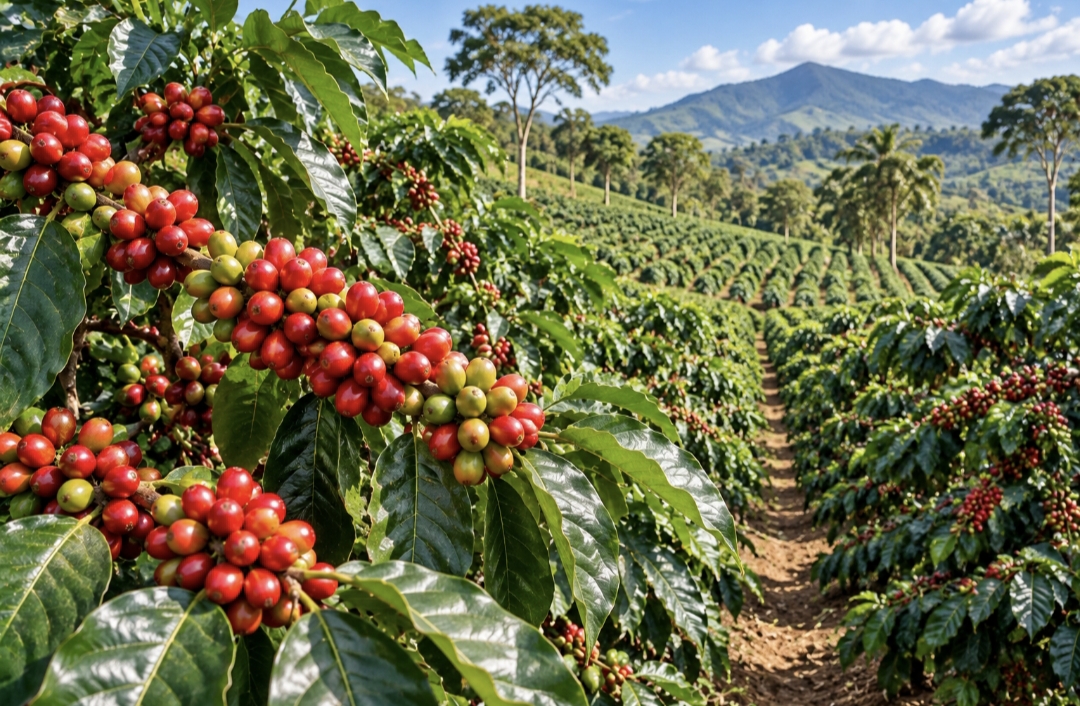
Several coffee species exist, but two are particularly important in commercial production: Arabica and Robusta.
Arabica coffee is widely valued for its quality and flavor characteristics. It generally performs well in suitable highland and cooler environments and is often associated with specialty coffee production.
Robusta coffee is known for its hardiness and ability to tolerate warmer conditions. It generally contains more caffeine than Arabica and is widely used in instant coffee and blends.
There are also other coffee species and varieties grown in specific regions, but commercial farmers should select planting material based on local climate, soil, disease pressure, market demand, and expected quality.
Arabica Coffee Farming
Arabica coffee is scientifically known as Coffea arabica. It is one of the most commercially valuable coffee species and is widely associated with specialty and premium coffee markets.
Arabica generally prefers moderate temperatures, suitable elevation, well-drained soils, and adequate moisture.
The quality of Arabica coffee can be strongly influenced by altitude, temperature, rainfall, soil conditions, variety, farm management, harvesting practices, and post-harvest processing.
Farmers producing Arabica should pay particular attention to disease management and environmental conditions.
Robusta Coffee Farming
Robusta coffee, scientifically known as Coffea canephora, is another major commercial coffee species.
It is generally more tolerant of higher temperatures and certain production conditions than Arabica. Robusta can be an attractive option for farmers operating in warmer coffee-growing environments.
The crop is widely used by the coffee industry for instant coffee and blends.
Modern Robusta production can benefit from improved planting materials, proper spacing, balanced nutrition, irrigation, pruning, pest management, and improved harvesting and processing.
Selecting the Right Coffee Variety
Choosing the correct variety is one of the most important decisions in commercial coffee farming.
Farmers should not select a coffee variety simply because it produces high yields in another country or region. A variety that performs well in one environment may perform poorly elsewhere.
Important factors to consider include:
- Local temperature
- Rainfall pattern
- Elevation
- Soil type
- Disease resistance
- Drought tolerance
- Yield potential
- Bean quality
- Maturity period
- Market demand
- Availability of certified seedlings
- Suitability for mechanization
Where possible, farmers should obtain planting materials from reputable nurseries, research institutions, agricultural organizations, or certified suppliers.
Climate Requirements for Modern Coffee Farming
Climate is one of the most important factors affecting coffee production.
Coffee generally performs best in environments where temperatures, rainfall, humidity, and sunlight fall within the requirements of the selected species and variety.
Arabica generally prefers cooler conditions than Robusta. Excessive heat can reduce flowering, affect bean development, increase water stress, and reduce quality.
Extreme weather can also damage coffee plantations. Heavy rainfall can cause erosion, nutrient loss, waterlogging, and disease problems, while prolonged drought can reduce flowering and fruit development.
Modern farmers should therefore consider climate carefully before establishing a plantation.
Importance of Rainfall in Coffee Production
Coffee requires sufficient water for vegetative growth, flowering, fruit development, and bean filling.
However, excessive rainfall can be equally problematic. Poor drainage may lead to waterlogging and root problems.
The distribution of rainfall is often more important than the annual total alone. Coffee plants need moisture during important stages of development, while excessive rain during harvesting and drying can create post-harvest problems.
Where rainfall is unreliable, irrigation can help stabilize production.
Choosing Suitable Land for Coffee Farming
Good land selection can significantly influence the long-term performance of a coffee plantation.
The ideal site should have suitable soil, good drainage, adequate water availability, appropriate climate, and reasonable access to roads and markets.
Avoid locations that remain waterlogged for long periods unless effective drainage can be established.
Farmers should also consider the slope of the land. Coffee can be grown on sloping terrain, but erosion control becomes extremely important.
Before purchasing or developing land, farmers should investigate the area's climate, soil characteristics, water resources, labor availability, infrastructure, security, and market access.
Soil Requirements for Coffee Farming
Coffee plants require fertile and well-drained soil with adequate organic matter and nutrients.
Soil testing should be carried out before establishing a commercial plantation whenever possible.
A soil test can provide information about pH, organic matter, phosphorus, potassium, calcium, magnesium, and other important characteristics.
Instead of applying fertilizer blindly, modern farmers should use soil test results and crop requirements to develop a nutrient management program.
Soil Testing Before Planting Coffee
Soil testing is an important part of precision coffee farming.
A farmer can collect representative soil samples from different sections of the proposed plantation and submit them to a qualified agricultural laboratory.
The results can help identify nutrient deficiencies, acidity problems, salinity concerns, and other soil limitations.
Correcting soil problems before planting is often easier and cheaper than trying to correct serious deficiencies after the plantation has been established.
Land Preparation for Coffee Farming
Land preparation depends on the existing vegetation, terrain, soil condition, and production system.
The objective is to create a favorable environment for young coffee plants without unnecessarily destroying soil structure.
Farmers should avoid excessive soil disturbance, particularly on sloping land.
Where appropriate, conservation practices such as contour planting, mulching, cover crops, grass strips, terraces, and erosion barriers can protect the soil.
Coffee Nursery Management
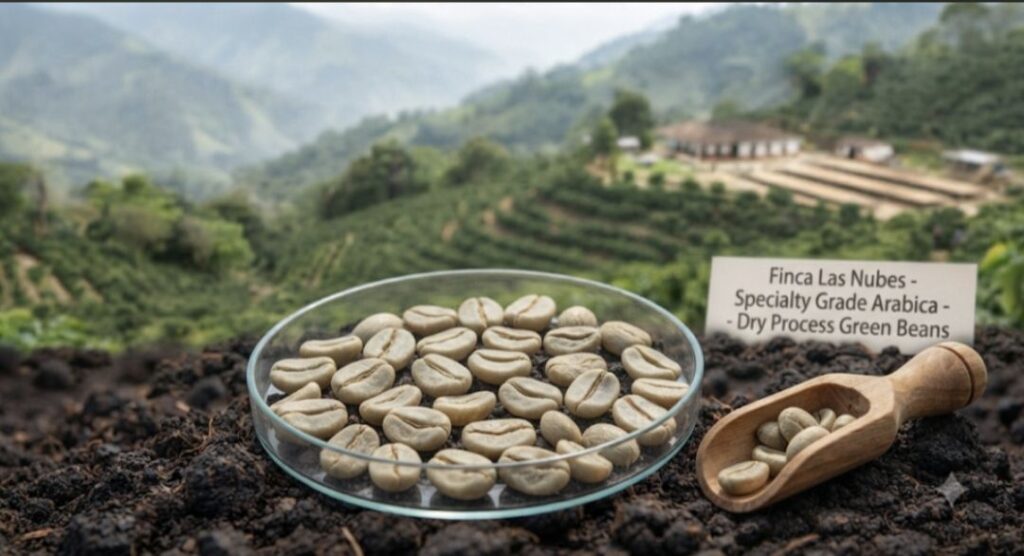
Producing healthy seedlings is one of the foundations of a successful coffee plantation.
Coffee seedlings may be produced from seeds or through vegetative propagation depending on the variety and production system.
A good nursery should have clean planting materials, suitable growing media, adequate drainage, sufficient water, appropriate shade, and protection from pests and diseases.
Weak or diseased seedlings should not be transferred to the main field.
Selecting Quality Coffee Seeds
If seed propagation is used, farmers should obtain seeds from reliable sources.
Seeds should come from healthy plants with desirable characteristics.
Using random seeds collected from unknown sources can produce inconsistent plantations.
Modern commercial farming places greater emphasis on genetic quality and uniformity because the performance of the entire plantation can depend on the quality of the planting material.
Raising Coffee Seedlings
Coffee seeds can be established in nursery beds or suitable containers.
The growing medium should provide good drainage while retaining enough moisture.
Young seedlings require careful watering and protection from excessive sunlight, weeds, pests, and diseases.
Nursery management should focus on producing strong seedlings with healthy roots and vigorous shoots.
Shade Management in Coffee Farming
Shade can play an important role in coffee production, particularly in systems designed around agroforestry.
Shade trees can moderate temperatures, reduce evaporation, provide organic matter, and create habitat for beneficial organisms.
However, excessive shade can reduce light availability, increase humidity, encourage some diseases, and reduce productivity.
Modern coffee farms should therefore manage shade strategically rather than simply allowing trees to grow without control.
Planting Coffee Seedlings
Coffee seedlings should generally be planted at the beginning of a reliable rainy period where irrigation is not available.
Planting holes should be prepared in advance.
The recommended spacing depends on the coffee species, variety, soil fertility, climate, pruning system, shade system, and whether the plantation is intended for manual or mechanized management.
The objective is to provide enough space for each tree to develop while maintaining efficient use of land.
Coffee Plant Spacing
Plant spacing affects yield, airflow, sunlight penetration, weed control, harvesting, and disease management.
Very wide spacing may result in inefficient land use, while excessively close spacing can create competition and excessive humidity.
Farmers should follow locally recommended spacing for their specific variety and production system.
High-density systems may increase production per unit of land but require more intensive pruning, nutrition, irrigation, and pest management.
Irrigation in Modern Coffee Farming
Modern irrigation can significantly improve coffee production in areas where rainfall is insufficient or unpredictable.
Drip irrigation is particularly useful because it can deliver water directly to the root zone.
Efficient irrigation can reduce water waste and improve plant growth during critical periods.
Farmers should avoid over-irrigation because waterlogged soil can damage coffee roots.
Fertilizer Management for Coffee
Coffee plants require several essential nutrients throughout their growth cycle.
Nitrogen is important for vegetative growth, while phosphorus supports root development and reproductive processes. Potassium plays an important role in plant strength, water regulation, fruit development, and overall crop performance.
Other nutrients, including calcium, magnesium, sulfur, iron, zinc, boron, and manganese, may also be important depending on soil conditions.
Fertilizer programs should be based on soil analysis, plant age, production level, and local recommendations.
Organic Matter and Compost in Coffee Farms
Organic matter is important for maintaining healthy soils.
Compost, properly processed manure, coffee pulp, pruned plant materials, leaves, and other organic resources can contribute to soil organic matter when properly managed.
Organic amendments can improve soil structure, water-holding capacity, microbial activity, and nutrient cycling.
However, organic materials should be properly composted before application when necessary to reduce potential problems with pathogens, pests, or excessive nutrient concentrations.
Weed Management in Coffee Plantations
Weeds compete with coffee plants for water, nutrients, sunlight, and space.
Modern weed management uses a combination of methods rather than relying exclusively on herbicides.
These methods may include mulching, manual control, mechanical mowing, cover crops, selective herbicides where appropriate, and good plantation design.
Young coffee plants are particularly vulnerable to weed competition.
Mulching Coffee Plants
Mulching can help conserve soil moisture and suppress weeds.
Organic mulch may be made from plant residues, leaves, grass, or other suitable materials.
Mulch should not be piled directly against the trunk because excessive moisture around the stem can encourage disease.
Properly managed mulch can also contribute organic matter as it decomposes.
Pruning Coffee Trees
Pruning is an essential component of modern coffee management.
Coffee trees can become overcrowded and unproductive if they are allowed to grow without proper management.
Pruning helps control plant height, remove unproductive branches, improve airflow, increase light penetration, and stimulate productive growth.
The specific pruning system depends on coffee species, variety, climate, planting density, and farm objectives.
Rejuvenating Old Coffee Trees
Older coffee plantations may experience declining productivity.
Instead of immediately replacing the entire plantation, farmers can sometimes rejuvenate trees through appropriate pruning or stumping.
Rejuvenation should be carefully planned because severely pruned trees may require time to recover.
Where genetic material is poor or disease problems are severe, complete replanting may be more appropriate.
Flowering and Fruit Development in Coffee
Coffee production depends on successful flowering followed by fruit development.
Environmental conditions influence flowering. In many production systems, rainfall after a dry period can stimulate flowering.
Poor nutrition, drought, excessive heat, or other stress factors can negatively affect flowering and fruit development.
Good water and nutrient management can help the crop reach its productive potential.
Coffee Pollination
Pollination varies according to coffee species and variety.
Arabica is generally self-compatible, while Robusta relies more heavily on cross-pollination.
In Robusta production, bees and other pollinators can contribute to successful pollination.
Maintaining biodiversity and avoiding unnecessary destruction of pollinator habitats can therefore support coffee production.
Pest Management in Modern Coffee Farming
Coffee can be affected by insects and other pests.
The importance of specific pests varies according to location and production system.
Modern pest management focuses on integrated pest management rather than relying entirely on chemical pesticides.
Farmers should regularly inspect plants, identify pests correctly, monitor population levels, and use appropriate control methods.
Coffee Berry Borer
Coffee berry borer is one of the most important pests affecting coffee production in many regions.
The insect attacks coffee berries and can damage the beans.
Good field sanitation, timely harvesting, monitoring, biological control where available, and appropriate integrated pest management practices can reduce damage.
Leaving overripe and fallen coffee cherries in the field can contribute to pest persistence.
Coffee Leaf Rust
Coffee leaf rust is a major disease affecting coffee, particularly Arabica under suitable environmental conditions.
The disease causes characteristic leaf symptoms and can result in premature leaf loss and reduced productivity.
Management may include resistant varieties, proper shade management, balanced nutrition, good airflow, monitoring, and appropriate fungicide programs where recommended.
Coffee Disease Prevention
Disease prevention should begin before symptoms appear.
Farmers should use healthy planting materials, maintain appropriate spacing, manage shade, control weeds, improve drainage, prune correctly, and remove severely affected plant material when recommended.
Regular field scouting helps farmers detect problems early.
Integrated Pest and Disease Management
Integrated pest management combines multiple strategies to reduce pest and disease pressure.
These strategies may include:
- Resistant varieties
- Field sanitation
- Biological control
- Cultural practices
- Monitoring
- Proper nutrition
- Appropriate irrigation
- Pruning
- Targeted pesticide use
The objective is to protect crops while reducing unnecessary chemical use and production costs.
Modern Technology in Coffee Farming
Technology is transforming coffee production.
Modern farmers can use smartphones, GPS mapping, weather stations, satellite imagery, farm management software, sensors, drones, and digital marketplaces to improve decision-making.
Technology can help farmers monitor crop health, track field activities, record expenses, monitor weather conditions, plan irrigation, and identify production problems.
Precision Agriculture for Coffee
Precision agriculture involves using data to manage different parts of a farm according to their specific needs.
For example, soil fertility may vary across a plantation. Instead of applying the same amount of fertilizer everywhere, a farmer may use soil maps and field data to identify areas requiring more or less fertilizer.
Precision agriculture can reduce waste and improve resource efficiency.
Using Drones in Coffee Farming
Drones can be useful for monitoring large coffee plantations.
A drone equipped with appropriate cameras can capture aerial images that help farmers identify gaps in planting, areas affected by drought, drainage problems, erosion, or unusual vegetation patterns.
Drones should be considered a management tool rather than a replacement for field inspection.
Weather Monitoring on Coffee Farms
Weather stations can provide valuable information about rainfall, temperature, humidity, and other conditions.
Farmers can use this information to improve irrigation decisions, disease monitoring, fertilizer application, harvesting plans, and overall farm management.
Weather data becomes particularly valuable when combined with historical farm records.
Digital Farm Records
Modern commercial coffee farmers should maintain detailed farm records.
Records can include:
- Seedling purchases
- Planting dates
- Fertilizer applications
- Pesticide applications
- Labor costs
- Irrigation costs
- Harvest quantities
- Processing losses
- Sales
- Equipment expenses
Accurate records make it easier to determine whether the farm is profitable.
Coffee Harvesting
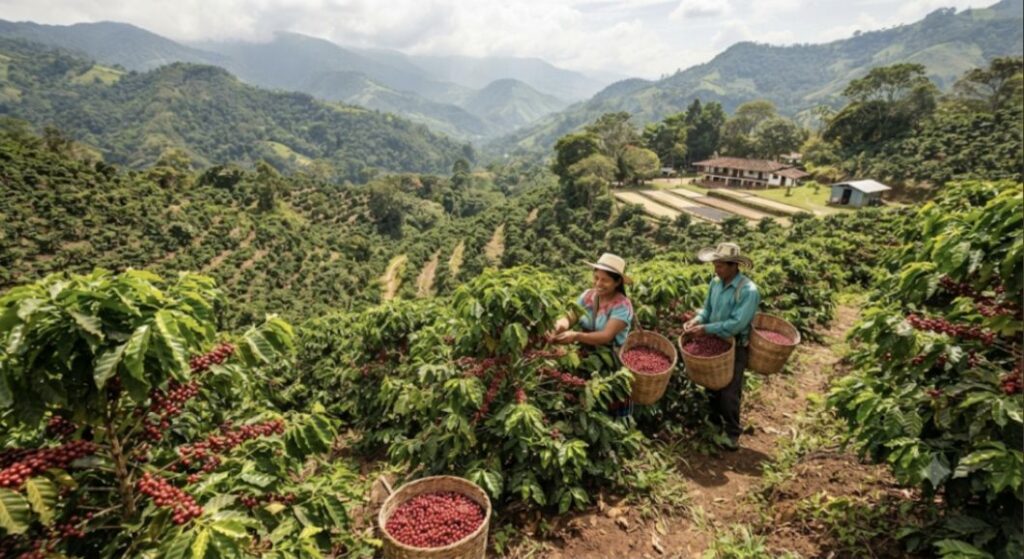
Harvesting is one of the most important stages in coffee production.
Coffee cherries should ideally be harvested at the appropriate level of ripeness.
Ripe cherries generally provide better raw material for producing high-quality coffee than immature or damaged cherries.
Selective harvesting may involve picking ripe cherries while leaving unripe fruits to mature.
Selective Coffee Picking
Selective picking is commonly associated with quality-oriented coffee production.
Workers pick ripe cherries and leave green cherries on the tree.
Although this method can require more labor, it can improve the consistency of the harvested crop.
In some commercial systems, mechanical harvesting is used to reduce labor requirements.
Mechanical Coffee Harvesting
Mechanical harvesting can be useful on suitable plantations.
Mechanical harvesters can reduce labor requirements and increase harvesting speed.
However, mechanization requires appropriate farm design, terrain, tree architecture, spacing, and investment.
Machines may also collect a mixture of ripe and unripe cherries, requiring effective sorting.
Coffee Cherry Sorting
Sorting is essential for quality management.
Harvested cherries should be separated according to quality and maturity where possible.
Damaged, diseased, immature, overripe, and foreign materials should be removed.
Good sorting improves processing efficiency and final coffee quality.
Coffee Processing Methods
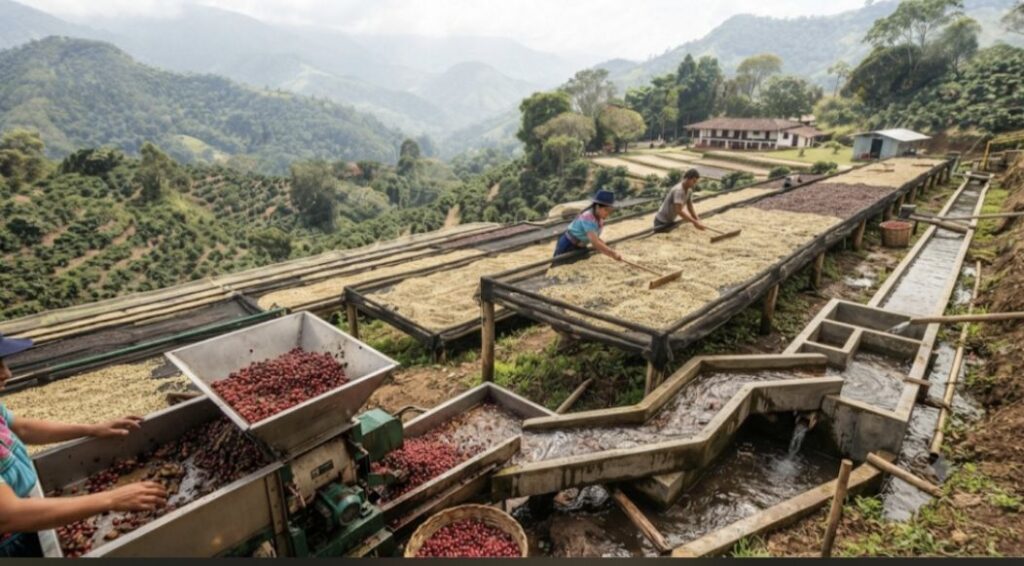
Coffee processing determines how the harvested cherries are transformed into dried green coffee beans.
The major processing approaches include natural processing, washed processing, and honey or pulped-natural processing.
Each method can influence the flavor, aroma, body, acidity, and overall characteristics of the finished coffee.
Natural Coffee Processing
In natural processing, whole coffee cherries are dried with the fruit surrounding the seed.
The cherries must be properly managed during drying to prevent unwanted fermentation, mold, and contamination.
Natural processing can produce distinctive flavor characteristics and is used in many coffee-producing regions.
Washed Coffee Processing
Washed processing removes the fruit from the coffee beans before drying.
The cherries are pulped, and the remaining mucilage is removed through appropriate processing.
Washed coffee can produce a cleaner and more consistent flavor profile when properly processed.
However, it may require more water and careful management of wastewater.
Honey Coffee Processing
Honey processing involves removing the skin while leaving some or most of the mucilage attached to the beans during drying.
Different levels of mucilage removal can create different processing styles.
Proper drying is extremely important because excessive moisture or poor airflow can result in quality problems.
Coffee Drying
Drying is a critical post-harvest stage.
Coffee beans must be dried to a safe moisture level suitable for storage.
Drying can be performed on raised beds, patios, mechanical dryers, or other appropriate systems.
The beans should be protected from rain, dirt, animals, and other contaminants.
Modern Coffee Drying Systems
Modern coffee farms can use controlled drying systems to improve consistency.
Mechanical dryers can be useful during periods of high humidity or rainfall.
However, excessive drying temperatures can damage coffee quality.
The drying system should therefore be carefully controlled according to the type of coffee being processed.
Coffee Storage
Proper storage protects coffee from moisture, pests, odors, and contamination.
Green coffee should be stored in clean, dry, well-ventilated facilities.
Storage conditions should remain stable as much as possible.
Coffee should not be stored directly on a wet floor or exposed to excessive humidity.
Coffee Grading and Quality Control
Coffee grading evaluates characteristics such as bean size, defects, moisture, appearance, cup quality, and other quality indicators.
Quality control should begin at the farm and continue through processing, storage, transportation, roasting, and packaging.
Farmers producing higher-quality coffee may have access to premium markets when they can consistently meet buyer requirements.
Coffee Roasting as a Value-Addition Opportunity
Roasting transforms green coffee beans into the roasted coffee consumed by customers.
Farmers or cooperatives can potentially increase their share of the coffee value chain by investing in roasting and packaging.
However, roasting requires equipment, quality control, branding, packaging, food safety compliance, and effective marketing.
Coffee Packaging
Packaging protects roasted coffee from oxygen, moisture, light, and contamination.
Modern coffee brands often use packaging designed to preserve freshness.
Farmers entering the retail market should consider professional packaging and clear product information.
Coffee Value Addition
Coffee value addition can include:
- Roasting
- Grinding
- Packaging
- Specialty coffee production
- Ready-to-drink coffee
- Coffee concentrates
- Coffee-based beverages
- Coffee gift products
- Coffee subscriptions
Value addition can potentially increase revenue, but it also introduces additional costs and business requirements.
Coffee Marketing Strategies
Marketing is essential for commercial coffee farming.
Farmers should understand their target customers and identify appropriate markets before increasing production.
Possible buyers include:
- Local traders
- Coffee processors
- Cooperatives
- Exporters
- Roasters
- Cafés
- Hotels
- Supermarkets
- Specialty coffee companies
- Direct consumers
Direct-to-Consumer Coffee Marketing
Direct-to-consumer marketing can allow farmers or coffee brands to build relationships directly with customers.
A farmer can potentially sell roasted and packaged coffee through physical stores, websites, social media, online marketplaces, subscription programs, cafés, or local distribution networks.
However, success depends on product quality, branding, consistency, customer service, packaging, and marketing.
Coffee Farm Branding
Branding can differentiate one coffee business from another.
A strong coffee brand can communicate information about the farm, production region, variety, processing method, flavor characteristics, sustainability practices, and producer story.
Professional photography, packaging, website content, social media, and customer reviews can support brand development.
Organic Coffee Production
Organic coffee farming focuses on production systems that minimize synthetic inputs and emphasize ecological soil and pest management.
Farmers interested in organic certification must follow the standards applicable to their target market and certification system.
Organic production can provide access to certain premium markets, but certification and compliance involve costs and documentation.
Sustainable Coffee Farming
Sustainable coffee farming seeks to balance economic profitability, environmental protection, and social responsibility.
Sustainable practices can include:
- Soil conservation
- Water conservation
- Agroforestry
- Biodiversity protection
- Responsible fertilizer use
- Integrated pest management
- Proper waste management
- Worker safety
- Efficient energy use
Sustainability is increasingly important in global agricultural supply chains.
Agroforestry Coffee Farming
Agroforestry involves growing coffee alongside trees and other crops.
A well-designed agroforestry system can provide shade, improve biodiversity, reduce erosion, and diversify farm income.
Farmers must carefully select compatible trees because excessive shade or competition for water and nutrients can reduce coffee productivity.
Intercropping in Young Coffee Plantations
During the early years of coffee production, farmers may be able to grow compatible short-duration crops between young coffee plants.
This can provide additional income while coffee trees are developing.
However, intercrops should not compete excessively with coffee plants for water, nutrients, and sunlight.
Managing Soil Erosion
Erosion can remove fertile topsoil and reduce long-term productivity.
Coffee farmers on sloping land should consider contour planting, mulching, cover crops, terraces, grass strips, and other conservation methods.
Maintaining ground cover is one of the simplest ways to reduce the impact of heavy rainfall.
Water Conservation on Coffee Farms
Water conservation is becoming increasingly important as climate patterns change.
Farmers can conserve water through mulching, efficient irrigation, rainwater harvesting, soil organic matter management, shade management, and erosion control.
Drip irrigation can reduce unnecessary water loss compared with less efficient irrigation systems.
Climate-Smart Coffee Farming
Climate-smart coffee production focuses on adapting farms to changing climate conditions while improving productivity and reducing environmental impacts.
Practices may include drought-tolerant varieties, shade management, efficient irrigation, soil conservation, agroforestry, improved water management, and diversification.
Farmers should assess the climate risks specific to their location before selecting a production system.
Coffee Farm Labor Management
Labor can represent a significant proportion of coffee production costs, particularly during harvesting.
Good labor planning is therefore essential.
Farmers should estimate labor requirements for nursery operations, planting, pruning, weeding, fertilization, pest management, harvesting, processing, drying, and transportation.
Mechanization may reduce labor pressure where appropriate.
Mechanizing Modern Coffee Farming
Mechanization can be introduced gradually.
Possible equipment includes:
- Brush cutters
- Mowers
- Pruning tools
- Sprayers
- Irrigation equipment
- Coffee pulpers
- Drying equipment
- Sorting equipment
- Harvesting machines
- Transport equipment
The best equipment depends on farm size and available capital.
Coffee Farm Infrastructure
Commercial coffee farms may require infrastructure such as:
- Nursery structures
- Storage buildings
- Processing facilities
- Drying areas
- Water tanks
- Irrigation systems
- Farm roads
- Worker facilities
- Equipment storage
- Security systems
Infrastructure should be designed according to the expected production volume.
Coffee Farming Business Planning
Before establishing a coffee farm, farmers should prepare a business plan.
The plan should include land preparation costs, seedlings, labor, irrigation, fertilizer, crop protection, equipment, processing, transportation, administration, and marketing.
Because coffee is a long-term crop, the farmer should also calculate how operating expenses will be financed before the plantation reaches full production.
Coffee Farming Startup Costs
The cost of establishing a coffee farm varies significantly by location, farm size, land condition, labor costs, planting density, irrigation requirements, infrastructure, and level of mechanization.
A small plantation may require relatively limited capital, while a large commercial estate can require substantial investment.
Farmers should obtain local prices before preparing a final budget.
Coffee Farm Profitability
Coffee profitability depends on several factors.
These include:
- Yield per hectare
- Coffee quality
- Farm-gate price
- Processing efficiency
- Labor costs
- Fertilizer costs
- Irrigation costs
- Pest and disease losses
- Transportation costs
- Equipment costs
- Market access
A high-yielding farm is not automatically profitable if production costs are too high.
Example of Coffee Farm Revenue Calculation
A simple revenue estimate can be calculated as:
Estimated Revenue = Quantity of Marketable Coffee × Selling Price
For example, if a farm eventually produces 2,000 kilograms of marketable green coffee and the average selling price is $4 per kilogram:
2,000 kg × $4 = $8,000 estimated gross revenue
This is gross revenue, not profit.
To calculate estimated profit:
Estimated Profit = Gross Revenue − Total Production and Operating Costs
Actual prices and yields vary significantly by country, quality grade, market, and season.
Improving Coffee Farm Profitability
Farmers can improve profitability by increasing yield, reducing unnecessary costs, improving quality, reducing post-harvest losses, improving market access, and adding value.
Selling higher-quality coffee can sometimes generate better returns than simply increasing production.
Farmers should therefore focus on both productivity and quality.
Coffee Cooperatives
Small-scale farmers can benefit from forming or joining cooperatives.
Cooperatives can help farmers collectively purchase inputs, access training, organize processing, improve bargaining power, and reach larger buyers.
Strong management and transparent financial systems are important for successful cooperatives.
Coffee Export Business
Coffee is widely traded internationally.
Farmers or businesses interested in exporting must understand the requirements of their target market, including quality standards, documentation, food safety requirements, packaging, logistics, customs procedures, and buyer specifications.
Exporting should be approached as a separate business operation rather than simply selling farm produce to an overseas buyer.
Post-Harvest Loss Reduction
Post-harvest losses can reduce farm profitability.
Losses may occur through poor harvesting, delayed processing, contamination, poor drying, excessive moisture, pests, poor storage, and transportation damage.
Investing in good post-harvest management can therefore improve returns without necessarily increasing farm size.
Common Mistakes in Coffee Farming
New coffee farmers often make mistakes such as:
- Planting unsuitable varieties
- Using poor-quality seedlings
- Ignoring soil testing
- Planting in poorly drained areas
- Using incorrect spacing
- Neglecting weed control
- Overusing fertilizer
- Ignoring pests and diseases
- Poor pruning
- Harvesting immature cherries
- Poor drying
- Poor storage
- Failing to keep farm records
- Establishing large farms without adequate capital
Avoiding these mistakes can significantly improve the chances of success.
How to Start a Modern Coffee Farm
A practical process for starting a coffee farm can include the following steps:
- Research the local coffee market.
- Select a suitable production location.
- Conduct soil and climate assessment.
- Choose an appropriate coffee species and variety.
- Obtain quality planting materials.
- Establish a well-managed nursery.
- Prepare the land.
- Install irrigation where necessary.
- Plant seedlings using appropriate spacing.
- Apply a nutrient management program.
- Control weeds.
- Monitor pests and diseases.
- Prune and train the trees.
- Maintain soil and water conservation practices.
- Harvest ripe cherries properly.
- Process the coffee correctly.
- Dry and store the beans safely.
- Grade and market the coffee.
- Maintain accurate farm records.
- Reinvest profits into productivity and quality improvements.
How Long Does Coffee Take to Produce?
Coffee is a long-term crop.
Depending on species, variety, climate, planting material, management, and location, coffee plants may begin producing commercial quantities of cherries several years after planting.
The first harvest may be relatively small, while production increases as the trees mature.
Farmers should therefore have sufficient financial resources to maintain the plantation during its establishment period.
How Long Can a Coffee Tree Produce?
A healthy coffee tree can remain productive for many years when properly managed.
However, productivity can decline due to age, disease, poor nutrition, unfavorable environmental conditions, and inadequate pruning.
Farmers can maintain productivity through pruning, rejuvenation, good nutrition, pest and disease management, and replacement of unproductive trees.
Coffee Farm Record Keeping
Good record keeping is essential for commercial agriculture.
Farmers should record:
- Number of trees planted
- Variety
- Planting dates
- Fertilizer use
- Labor
- Irrigation
- Crop protection
- Harvest quantity
- Processing yield
- Selling prices
- Customer information
- Operating expenses
These records help identify profitable and unprofitable areas of the farm.
Using Artificial Intelligence in Coffee Farming
Artificial intelligence is increasingly being used in agriculture.
AI-powered systems can analyze farm images, weather information, soil data, satellite imagery, and historical records.
Potential applications include crop monitoring, disease detection, yield estimation, irrigation planning, and farm decision support.
However, AI tools should complement rather than completely replace experienced agricultural professionals and field observations.
Smart Sensors on Coffee Farms
Sensors can monitor soil moisture, temperature, humidity, and other environmental conditions.
A farmer can use sensor data to determine when irrigation may be needed.
This can improve water efficiency and reduce the risk of overwatering.
Large commercial farms can integrate sensors with automated irrigation systems.
Future of Modern Coffee Farming
The future of coffee production is likely to involve greater use of technology, improved genetics, climate adaptation, precision agriculture, better processing, digital marketing, traceability, and sustainable farming practices.
Consumers are increasingly interested in knowing where their coffee comes from and how it was produced.
Traceability can therefore become an important competitive advantage.
Traceability in Coffee Production
Traceability means being able to track coffee from its origin through processing and supply.
A traceable coffee product may provide information about the farm, producer, region, variety, processing method, and supply chain.
Digital records and QR-based systems can help businesses provide this information to customers.
Specialty Coffee Farming
Specialty coffee production focuses heavily on quality.
Farmers producing specialty coffee must pay attention to variety, farm location, harvesting maturity, processing, drying, storage, and consistency.
Small improvements at multiple stages can significantly influence final cup quality.
Importance of Farmer Training
Modern coffee farming requires continuous learning.
Farmers should stay informed about improved varieties, disease management, fertilizer practices, climate adaptation, processing techniques, market trends, and new technologies.
Training can come from agricultural extension services, research organizations, universities, cooperatives, private companies, experienced producers, and reputable agricultural resources.
Coffee Farming and Rural Development
Coffee farming can contribute to rural economic development by creating employment and stimulating businesses.
Nurseries, transportation companies, equipment suppliers, processing facilities, packaging businesses, cafés, traders, and exporters can all participate in the coffee value chain.
A strong coffee industry can therefore create economic opportunities beyond the farm itself.
Environmental Benefits of Responsible Coffee Farming
Responsible coffee farming can support soil conservation, biodiversity, carbon storage, and watershed protection, particularly when coffee is integrated into well-managed agroforestry systems.
However, poorly planned plantations can cause environmental damage through deforestation, erosion, excessive chemical use, and water pollution.
Sustainable management is therefore essential.
Economic Diversification on Coffee Farms
Farmers should consider diversification to reduce dependence on a single commodity.
Depending on local conditions, coffee farms may integrate fruit trees, timber trees, spices, livestock, beekeeping, vegetables, or other compatible agricultural enterprises.
Diversification can provide additional income and improve resilience.
Coffee Farm Tourism
Coffee tourism is another potential value-addition opportunity.
Some farms can offer visitors tours, coffee tasting, farm experiences, processing demonstrations, cafés, accommodation, or educational programs.
This approach can create additional revenue while promoting the farm's brand.
Building a Successful Coffee Business
Successful coffee farming requires more than planting trees.
Farmers must think like agricultural entrepreneurs.
The most successful operations typically combine good agronomy with careful financial management, quality control, efficient processing, market research, branding, customer relationships, and continuous improvement.
Final Guide to Modern Coffee Farming
Modern coffee farming combines traditional agricultural knowledge with science, technology, improved planting materials, efficient resource management, quality control, and market intelligence.
The foundation of a profitable coffee plantation begins with choosing the right location and suitable variety. This should be followed by good nursery management, proper planting, soil fertility management, irrigation where necessary, weed control, pruning, pest and disease management, and effective harvesting.
Post-harvest management is equally important. Proper sorting, processing, drying, storage, grading, and transportation can determine whether a farmer sells ordinary coffee or a higher-value product.
Technology can further improve modern coffee production. Soil testing, weather monitoring, digital farm records, precision agriculture, sensors, drones, satellite imagery, and AI-based tools can help farmers make better decisions and use resources more efficiently.
Farmers should also think beyond primary production. Coffee roasting, packaging, branding, direct marketing, specialty coffee, tourism, and other forms of value addition can create additional business opportunities.
The coffee industry will continue to evolve as producers respond to climate change, changing consumer preferences, labor challenges, technology, sustainability requirements, and global market conditions.
For anyone planning to establish a commercial coffee plantation, the best approach is to begin with careful research, conduct a detailed farm feasibility assessment, choose appropriate planting material, develop a realistic financial plan, and build a management system capable of supporting the farm for many years.
Modern coffee farming is therefore not simply about growing coffee trees. It is about building an efficient agricultural enterprise that produces quality coffee, protects natural resources, manages costs, responds to market opportunities, and creates sustainable long-term value.
Frequently Asked Questions About Coffee Farming
How long does coffee take to start producing?
Coffee plants generally require several years after planting before they begin producing meaningful commercial harvests. The exact period depends on the coffee species, variety, climate, planting material, and farm management practices.
How many years can a coffee tree produce?
A well-managed coffee tree can remain productive for many years. Productivity depends on the variety, soil fertility, pruning, pest and disease management, climate, and overall farm care.
What are the main types of coffee grown commercially?
The two most important commercial coffee species are Arabica and Robusta. Arabica is widely associated with specialty and premium coffee, while Robusta is valued for its hardiness and is commonly used in instant coffee and coffee blends.
What climate is best for coffee farming?
Coffee generally performs best in warm, humid environments without extreme temperatures. Arabica usually prefers cooler conditions, while Robusta generally tolerates warmer conditions better. Adequate rainfall or irrigation is also important for healthy growth and fruit development.
Does coffee farming require shade?
Some coffee production systems benefit from shade trees, particularly agroforestry systems. However, excessive shade can reduce productivity and increase humidity. Proper shade management is therefore important.
What type of soil is best for coffee farming?
Coffee generally performs well in fertile, well-drained soils with good organic matter. Soil testing is recommended before establishing a commercial plantation so that nutrient deficiencies and other soil problems can be identified and corrected.
How often should coffee plants be watered?
Water requirements depend on rainfall, soil type, temperature, plant age, and production system. In areas with insufficient rainfall, irrigation can help maintain consistent growth, flowering, and fruit development.
What fertilizer is best for coffee?
There is no single fertilizer that is best for every coffee farm. Fertilizer selection should be based on soil test results, plant age, yield level, and local agricultural recommendations. Coffee may require nitrogen, phosphorus, potassium, and several secondary and micronutrients.
What are the major pests of coffee?
Important coffee pests vary by region but can include coffee berry borer, coffee leaf miners, scale insects, and other insect pests. Regular monitoring and integrated pest management can help reduce crop damage.
What is coffee leaf rust?
Coffee leaf rust is a fungal disease that can cause yellow or orange lesions on coffee leaves and lead to premature leaf loss. Management can include resistant varieties, good farm sanitation, appropriate shade management, balanced nutrition, and recommended disease-control measures.
When should coffee cherries be harvested?
Coffee cherries are generally harvested when they reach the appropriate level of maturity. Selective harvesting of ripe cherries can improve consistency and quality, although harvesting practices vary according to the production system.
What happens after coffee cherries are harvested?
After harvesting, coffee cherries are sorted and processed using methods such as natural, washed, or honey processing. The beans are then dried, stored, graded, transported, and eventually roasted.
Can coffee farming be profitable?
Yes, coffee farming can be profitable when production is properly managed. Profitability depends on yield, coffee quality, selling price, labor costs, fertilizer expenses, processing costs, farm size, and market access.
How can coffee farmers increase their profits?
Farmers can improve profitability by using quality planting materials, increasing yields, reducing post-harvest losses, producing higher-quality coffee, controlling production costs, improving market access, and exploring value addition such as roasting, grinding, and packaging.
Can coffee be grown organically?
Yes. Coffee can be produced using organic farming systems. However, farmers seeking organic certification must comply with the applicable organic standards and certification requirements for their target market.
Can coffee farming be done on a small farm?
Yes. Coffee can be grown successfully on small farms. Small-scale farmers can improve profitability by focusing on quality, efficient production, cooperative marketing, specialty coffee, direct sales, and value addition.
Is modern coffee farming different from traditional coffee farming?
Yes. Modern coffee farming uses improved varieties, soil testing, efficient irrigation, precision agriculture, digital record keeping, improved pest management, mechanization, modern processing, and data-driven farm management.
Can technology improve coffee farming?
Yes. Technologies such as weather stations, soil sensors, GPS, drones, satellite imagery, farm management software, and artificial intelligence can help farmers monitor crops, manage resources, detect problems, and make better farming decisions.
What is the best way to start a commercial coffee farm?
Start by researching the local climate and coffee market, selecting suitable land, testing the soil, choosing an appropriate coffee variety, sourcing quality seedlings, preparing a detailed business plan, establishing the plantation properly, and developing a long-term production and marketing strategy.
What is the difference between Arabica and Robusta coffee?
Arabica and Robusta are two major commercially cultivated coffee species. Arabica is generally associated with smoother and more complex flavor profiles and often performs better in cooler growing conditions. Robusta is generally more tolerant of warmer conditions and is known for its stronger flavor and higher caffeine content.
How can farmers improve coffee bean quality?
Coffee quality can be improved by selecting suitable varieties, maintaining healthy plants, harvesting properly ripe cherries, sorting the harvest, using appropriate processing methods, controlling drying conditions, storing beans correctly, and maintaining good traceability throughout the production process.
What is the best processing method for coffee?
There is no single processing method that is best for every coffee farm. Natural, washed, and honey processing methods can all produce excellent coffee when properly managed. The best choice depends on the desired quality characteristics, available resources, water availability, climate, and target market.
Is coffee farming a good long-term agricultural investment?
Coffee can be a potentially attractive long-term agricultural investment because coffee trees can remain productive for many years. However, the crop requires patience, proper management, sufficient establishment capital, and reliable market access because meaningful commercial production takes time to develop.
Read more;
- Charcoal Business in Nigeria: A Complete Guide to Starting, Producing, Buying, Selling and Exporting Charcoal
- Poultry Meat Benefits to Humanity: Complete Guide to Its Nutritional, Economic and Social Importance

- Tilapia Farming: Complete Guide to Raising Tilapia for Commercial Production

- Fish Pond Construction: Complete Guide to Designing and Building a Modern Fish Pond

- Grazing Livestock Farming Business: Complete Guide to Starting and Making Profit

- Commercial Cattle Farming: Complete Guide to Raising Cattle for Profit

- Goat Farming Business: Complete Guide to Meat and Breeding Production

- Sheep Farming: Complete Guide to Raising Sheep for Commercial Profit

- Modern Pasture Farming: How to Grow High-Quality Livestock Feed
- Rotational Grazing: Complete Guide to Improving Livestock Production