Overview
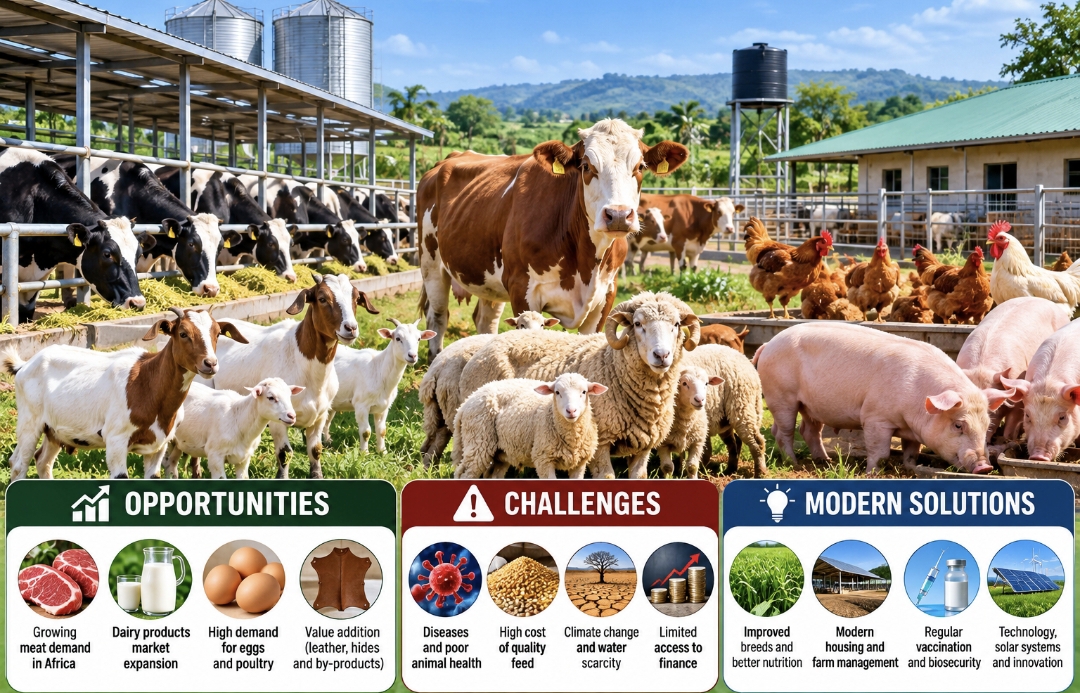
Livestock farming in Africa is one of the most important agricultural activities on the continent. Millions of households depend directly or indirectly on cattle, goats, sheep, poultry, pigs, camels, rabbits and other livestock for food, income, employment, transportation, manure, savings and business opportunities.
The livestock sector also contributes to food security by supplying meat, milk, eggs and other animal products to rapidly growing populations. At the same time, livestock farming creates opportunities for entrepreneurs, commercial farmers, feed manufacturers, processors, traders, veterinarians, transporters and agricultural service providers.
However, livestock production in Africa faces several challenges. These include feed shortages, animal diseases, inadequate infrastructure, climate variability, limited access to finance, weak market systems, high input costs, poor genetics in some production systems and insufficient access to modern technology.
The good news is that many of these challenges can be addressed through improved management, better genetics, pasture development, modern feeding systems, veterinary services, improved infrastructure, digital agriculture and stronger value chains.
This comprehensive guide explores livestock farming in Africa, its major opportunities, production systems, challenges and practical modern solutions for building more productive and sustainable livestock businesses.
What Is Livestock Farming?
Livestock farming is the raising, breeding and management of domesticated animals for agricultural and commercial purposes.
Major livestock species raised across Africa include:
- Cattle
- Goats
- Sheep
- Chickens
- Pigs
- Rabbits
- Camels
- Ducks
- Turkeys
- Guinea fowl
- Bees
- Other locally important livestock
Farmers may raise livestock for meat, milk, eggs, breeding stock, hides, skins, wool, manure and other products.
Some livestock enterprises specialize in one product, while others combine several activities.
Why Livestock Farming Is Important in Africa
Livestock contributes to African agriculture in several ways.
It provides food through:
- Meat
- Milk
- Eggs
- Other animal products
It also provides income through the sale of:
- Live animals
- Meat
- Milk
- Eggs
- Breeding stock
- Hides and skins
- Manure
- Processed livestock products
For many rural households, livestock can also function as a form of financial reserve. Animals can sometimes be sold when farmers need money for education, household expenses, farm inputs or emergencies.
Major Types of Livestock Farming in Africa
Livestock production varies significantly across the continent.
Important systems include:
- Pastoral livestock farming
- Agro-pastoral farming
- Smallholder livestock farming
- Commercial ranching
- Intensive livestock farming
- Semi-intensive production
- Feedlot operations
- Dairy farming
- Poultry farming
- Goat farming
- Sheep farming
- Pig farming
- Rabbit farming
- Integrated crop-livestock farming
The appropriate system depends on climate, land availability, animal species, capital and market conditions.
Cattle Farming in Africa
Cattle are among the most economically important livestock species in Africa.
They are raised for:
- Beef
- Milk
- Breeding
- Hides
- Draft power in some areas
- Manure
Cattle production ranges from extensive pastoral systems to highly managed commercial ranches and dairy farms.
Modern cattle farming increasingly emphasizes:
- Better genetics
- Improved pasture
- Supplementary feeding
- Disease prevention
- Reproductive management
- Record keeping
- Weight monitoring
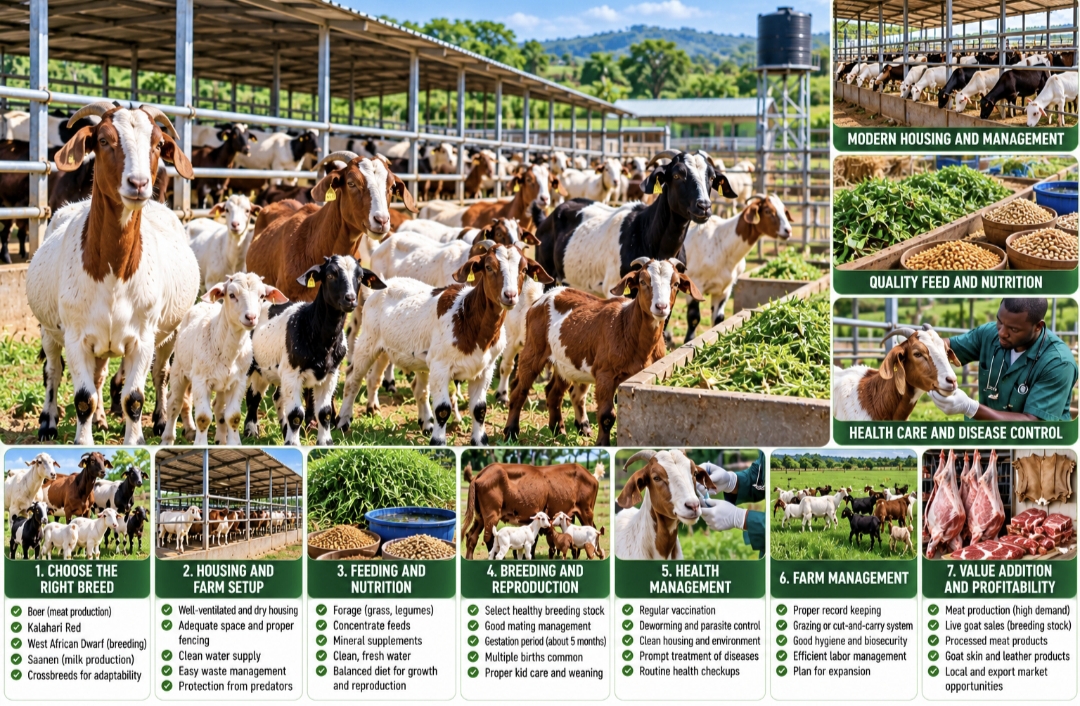
Goat Farming in Africa
Goats are widely raised because many breeds can adapt to diverse environments and production systems.
Goats may be raised for:
- Meat
- Milk
- Breeding
- Hides and skins
Commercial goat production can range from small household herds to specialized meat or dairy operations.
Good management includes appropriate nutrition, parasite control, breeding selection, housing and market planning.
Sheep Farming in Africa
Sheep are raised primarily for meat, breeding and, in some production systems, wool or milk.
Commercial sheep farming can benefit from:
- Good breeding stock
- Adequate pasture
- Supplementary feeding
- Proper lamb management
- Disease prevention
- Strategic marketing
Farmers should select breeds according to their environment and production objectives.
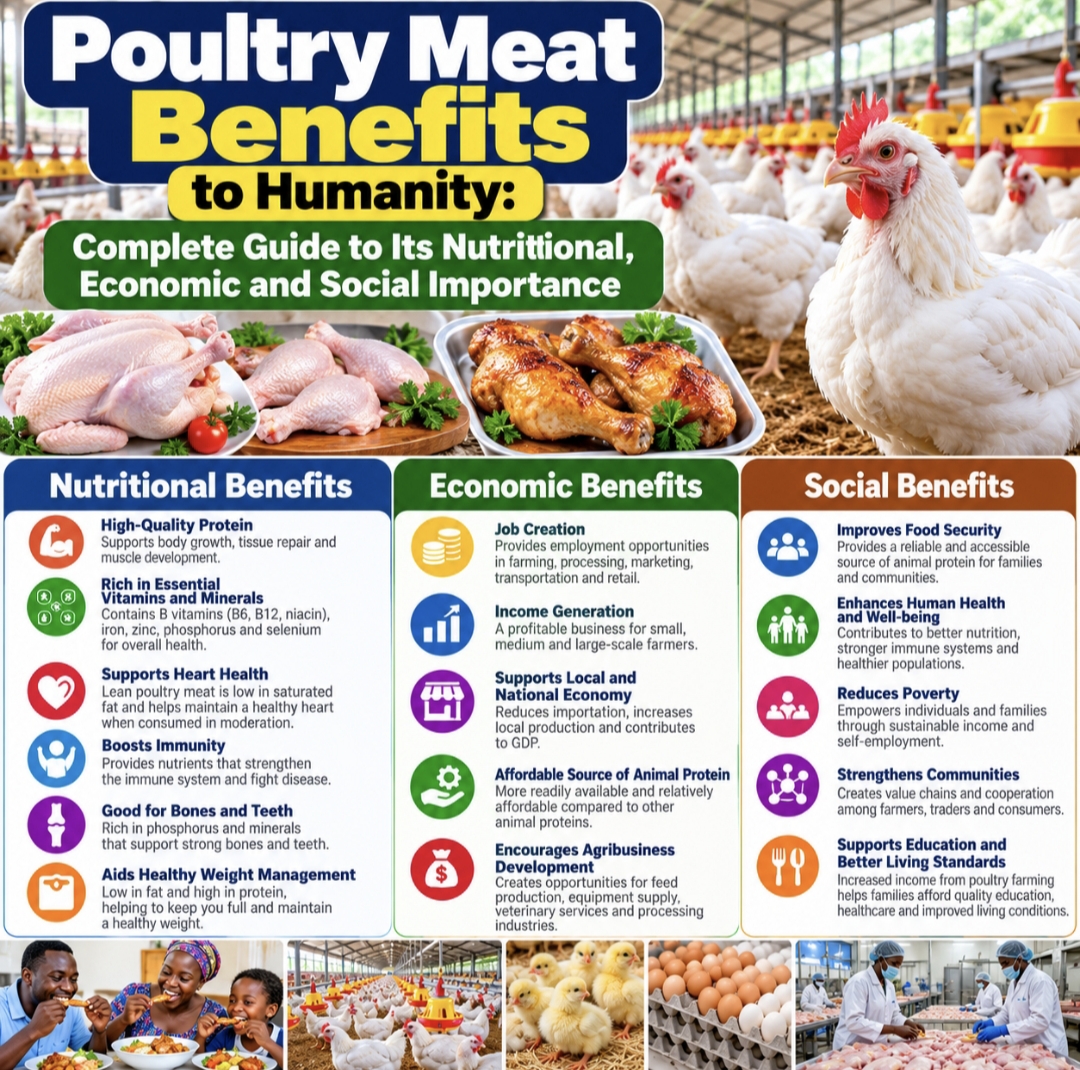
Poultry Farming in Africa
Poultry farming is one of the most accessible livestock businesses for many entrepreneurs.
Common poultry enterprises include:
- Broiler production
- Layer farming
- Chick production
- Breeding
- Turkey farming
- Duck farming
- Guinea fowl production
Poultry has a relatively short production cycle compared with many larger livestock species, allowing farmers to potentially generate revenue more frequently.
However, poultry production requires careful attention to feed quality, biosecurity, vaccination, ventilation, stocking density and market conditions.
Pig Farming in Africa
Pig farming is commercially important in many African markets.
Pigs can convert feed into body weight relatively efficiently when managed properly.
Commercial pig production requires:
- Good genetics
- Quality feed
- Clean water
- Suitable housing
- Disease control
- Proper waste management
- Good market access
Farmers should also consider cultural, religious and market factors when selecting pig production as a business.
Rabbit Farming
Rabbit production can be operated on relatively small areas compared with many large-livestock enterprises.
Rabbits can provide:
- Meat
- Breeding stock
- Manure
Successful rabbit production depends on good housing, ventilation, nutrition, hygiene, breeding management and reliable markets.
Camel Farming
Camels are particularly important in dry and semi-arid regions.
They are valued for:
- Milk
- Meat
- Transport
- Breeding
Their adaptation to harsh environments makes them important livestock in areas where other species may face severe environmental challenges.
Pastoral Livestock Farming
Pastoralism involves livestock production based heavily on natural grazing and animal movement.
It has historically played an important role in many dryland regions.
Pastoral systems can utilize vegetation that is not directly suitable for human food production.
However, pastoral production can be affected by:
- Drought
- Water shortages
- Pasture degradation
- Land-use changes
- Livestock disease
- Market access
- Conflict over resources
Improving access to water, veterinary services, markets and sustainable grazing management can strengthen pastoral livelihoods.
Commercial Ranching
Commercial ranching involves managing livestock on designated land with a planned production system.
A ranch may use:
- Fencing
- Pasture improvement
- Rotational grazing
- Water infrastructure
- Breeding programs
- Herd health programs
- Record keeping
Commercial ranching can support large-scale beef or breeding enterprises when land, infrastructure and management are appropriate.
Intensive Livestock Farming
Intensive systems rely more heavily on purchased or produced feed and controlled housing.
Examples include:
- Feedlots
- Intensive poultry houses
- Dairy units
- Pig farms
These systems can achieve high productivity per unit of land but require stronger management and higher levels of investment.
Semi-Intensive Livestock Farming
Semi-intensive systems combine grazing or outdoor access with supplementary feeding and managed housing.
This approach can be useful for farmers who have some pasture but also want greater control over animal nutrition.
Integrated Crop and Livestock Farming
Crop and livestock production can complement one another.
Crop residues can sometimes be used as livestock feed after appropriate treatment or processing.
Livestock manure can be returned to crop fields as organic fertilizer.
This creates a nutrient cycle that can improve resource efficiency.
Examples include:
- Maize and cattle
- Sorghum and sheep
- Cassava and goats
- Vegetable farming and poultry manure
- Grain production and livestock
Proper management is necessary to prevent nutrient loss, contamination and disease transmission.
Livestock Feed: A Major Opportunity
Feed is one of the most important components of livestock production.
Growing demand for meat, milk and eggs creates opportunities for businesses producing:
- Animal feed
- Forage
- Hay
- Silage
- Feed concentrates
- Mineral supplements
- Feed ingredients
Entrepreneurs can serve farmers by producing reliable, nutritionally appropriate feeds.
Commercial Pasture Production
Pasture production is another major opportunity.
Farmers can establish forage crops suitable for their environment.
Potential forage resources include:
- Improved grasses
- Legumes
- Hay
- Silage crops
- Browse plants
- Crop residues
The exact species should be selected according to soil, rainfall, livestock species and management system.
Livestock Breeding Business
Breeding is an important livestock opportunity because farmers need productive replacement animals.
A breeding enterprise can specialize in producing:
- Breeding bulls
- Breeding cows
- Rams
- Ewes
- Bucks
- Does
- Piglets
- Chicks
- Other replacement stock
Successful breeding businesses require careful selection, health management and accurate records.
Cattle Fattening
Cattle fattening involves purchasing or raising cattle and feeding them to improve body condition and market value.
Farmers may use:
- Pasture
- Crop residues
- Concentrates
- By-products
- Silage
- Hay
Profitability depends on purchase price, feed costs, weight gain, mortality, management and selling price.
Dairy Farming
Dairy production provides milk for:
- Household consumption
- Local markets
- Processing
- Cheese
- Yogurt
- Other dairy products
Commercial dairy farms require careful attention to:
- Genetics
- Nutrition
- Milking hygiene
- Reproduction
- Mastitis prevention
- Water
- Housing
- Cooling and milk handling
Meat Processing Opportunity
Livestock farming creates opportunities beyond selling live animals.
Businesses can process meat into:
- Chilled meat
- Frozen meat
- Sausages
- Minced meat
- Dried meat
- Smoked products
- Packaged cuts
Value addition can potentially increase revenue, but processing requires appropriate food-safety systems, equipment, licensing and market access.
Milk Processing Opportunity
Milk can be processed into products such as:
- Yogurt
- Cheese
- Fermented milk
- Powdered products
- Butter
Processing can extend shelf life and create additional markets.
Egg Production and Processing
Egg businesses can generate income through:
- Table eggs
- Hatching eggs
- Chicks
- Processed egg products
Proper grading, packaging, storage and distribution can improve product quality and marketability.
Hides and Skins
Cattle hides and small-ruminant skins can have commercial value.
Value chains can include:
- Collection
- Preservation
- Processing
- Tanning
- Leather production
- Manufacturing
Improving post-slaughter handling can help preserve product quality.
Livestock Manure Business
Manure is often treated as waste, but it can be a valuable agricultural input.
Properly managed manure can be used for:
- Compost
- Organic fertilizer
- Soil improvement
- Crop production
Some farms can create additional revenue by selling processed manure or compost to crop farmers and gardeners.
Major Challenge: Feed Costs
Feed is one of the largest expenses in many intensive livestock enterprises.
Feed prices can rise because of:
- Grain prices
- Transport costs
- Seasonal shortages
- Exchange-rate changes
- Energy costs
- Competition for ingredients
Farmers can reduce risk by:
- Producing forage
- Storing feed
- Using suitable local feed resources
- Improving feed efficiency
- Reducing wastage
- Formulating balanced rations
- Buying strategically
Cheap feed is not necessarily good feed. Nutritional quality must be considered alongside price.
Seasonal Feed Shortages
Many livestock producers experience seasonal fluctuations in forage availability.
During rainy periods, pasture may be abundant.
During dry periods, forage quality and quantity can decline.
Farmers can prepare by producing and storing:
- Hay
- Silage
- Crop residues
- Other suitable feed resources
Feed conservation can help reduce seasonal production losses.
Animal Disease
Disease is one of the most serious risks facing livestock businesses.
Diseases can cause:
- Mortality
- Reduced growth
- Poor fertility
- Lower milk production
- Higher veterinary expenses
- Market restrictions
- Loss of breeding stock
Prevention is generally more sustainable than relying entirely on treatment after disease occurs.
Veterinary Services
Access to professional veterinary services is important for commercial livestock development.
Veterinary professionals can support:
- Vaccination
- Diagnosis
- Disease control
- Reproductive management
- Nutrition-related problems
- Herd health planning
- Biosecurity
Farmers should establish relationships with qualified veterinary professionals rather than waiting until emergencies occur.
Parasite Management
Internal and external parasites can reduce livestock productivity.
They may cause:
- Weight loss
- Anemia
- Poor growth
- Reduced fertility
- Skin damage
- Reduced production
Parasite-control programs should be based on the livestock species, local parasite risks and veterinary recommendations.
Climate Change and Livestock
Climate variability can affect livestock production through:
- Drought
- Heat stress
- Flooding
- Pasture changes
- Water shortages
- Changing disease patterns
Climate-resilient livestock systems can include:
- Adapted breeds
- Improved water systems
- Shade
- Better pasture management
- Feed conservation
- Diversification
- Improved housing
Heat Stress
High temperatures can reduce livestock performance.
Heat stress can affect:
- Feed intake
- Growth
- Fertility
- Milk production
- Egg production
- Animal welfare
Farmers can reduce heat stress through:
- Shade
- Ventilation
- Adequate water
- Lower stocking density where necessary
- Adjusted feeding schedules
- Heat-tolerant genetics
Water Availability
Water is fundamental to livestock production.
A farm needs reliable access to clean water for:
- Drinking
- Cleaning
- Milking
- Processing
- Cooling
- Other management activities
Water planning should account for seasonal shortages and future expansion.
Poor Infrastructure
Some livestock businesses struggle because of inadequate:
- Roads
- Storage
- Abattoirs
- Cold chains
- Veterinary facilities
- Markets
- Water infrastructure
- Electricity
Infrastructure development can improve the efficiency of the entire livestock value chain.
Access to Finance
Livestock enterprises can require significant capital.
Farmers may need money for:
- Animals
- Housing
- Fencing
- Feed
- Water systems
- Equipment
- Veterinary care
- Transportation
Before borrowing money, farmers should prepare realistic budgets and cash-flow projections.
Market Access
Producing livestock is only one part of the business.
Farmers must also know:
- Who will buy?
- What quality do they require?
- When do they buy?
- What quantity do they need?
- What price structure applies?
- How will animals or products be transported?
Market research should be conducted before major investment.
Livestock Cooperatives
Farmers can benefit from organizing into cooperatives or producer groups.
Collective action may improve access to:
- Feed
- Veterinary services
- Training
- Finance
- Equipment
- Markets
- Transportation
Cooperatives can also improve bargaining power in some markets.
Digital Agriculture and Livestock
Technology is becoming increasingly useful in African livestock production.
Farmers can use mobile technology for:
- Record keeping
- Market information
- Weather information
- Farm accounting
- Veterinary communication
- Animal identification
- Feed management
Larger farms may also use sensors, cameras, electronic identification and automated systems.
Livestock Record Keeping
Good records can improve profitability.
Important records include:
- Number of animals
- Births
- Deaths
- Sales
- Purchases
- Feed expenses
- Veterinary expenses
- Weight
- Reproductive performance
- Milk production
- Egg production
Farmers cannot effectively improve what they do not measure.
Genetic Improvement
Improved genetics can increase productivity over time.
Selection should consider:
- Growth
- Fertility
- Adaptability
- Disease resistance
- Feed efficiency
- Production
- Product quality
Farmers should avoid selecting animals solely on appearance.
Local Adaptation
Genetic improvement should not focus exclusively on maximum production.
Animals must also be able to survive and reproduce under local environmental conditions.
An adapted animal may perform more consistently under heat, disease pressure, poor-quality forage or other local challenges.
Improving Animal Nutrition
Nutrition programs should be based on the requirements of the animal.
A balanced diet generally needs appropriate levels of:
- Energy
- Protein
- Fiber
- Minerals
- Vitamins
- Water
Requirements vary by species and production stage.
For example, growing animals have different requirements from mature maintenance animals, while pregnant and lactating animals generally require additional nutritional support.
Reducing Feed Waste
Feed that is purchased but never consumed represents lost money.
Farmers can reduce waste by:
- Using appropriate feeders
- Protecting feed from rain
- Storing feed correctly
- Avoiding overfilling feeders
- Monitoring leftovers
- Maintaining clean feeding areas
Improving feed utilization can have a direct effect on profitability.
Improving Livestock Housing
Good housing should protect animals without unnecessarily increasing construction costs.
Important considerations include:
- Ventilation
- Drainage
- Space
- Cleanliness
- Safety
- Temperature control
- Ease of cleaning
Housing should be designed according to the livestock species and local climate.
Livestock Transport
Transportation can affect animal welfare and product quality.
Animals should be transported using suitable vehicles and appropriate loading densities.
Long journeys require careful planning around:
- Water
- Rest
- Weather
- Handling
- Road conditions
Improper transportation can cause injuries, stress and economic losses.
Slaughter and Post-Harvest Handling
Proper handling after animals leave the farm is essential for food safety and product quality.
Meat businesses require appropriate systems for:
- Humane handling
- Hygienic slaughter
- Carcass inspection
- Chilling
- Processing
- Storage
- Transportation
Farmers interested in meat processing should comply with applicable local regulations.
Livestock Business Diversification
Farmers can reduce dependence on a single income source by combining related activities.
For example, a cattle farmer might combine:
- Breeding
- Fattening
- Manure production
- Forage production
A poultry farmer could combine:
- Broiler production
- Layer farming
- Chick production
- Manure sales
Diversification should be based on available resources and actual market opportunities.
Illustrative Livestock Profit Calculation
Consider an illustrative livestock enterprise that purchases 50 young animals.
Suppose:
- Purchase cost per animal = $250
- Total purchase cost = 50 × $250 = $12,500
Assume feeding, veterinary care, labor, transportation and other operating costs total $8,000.
Total investment:
$12,500 + $8,000 = $20,500
Suppose the animals are later sold for an average of $500 each.
Gross sales:
50 × $500 = $25,000
Illustrative gross margin before fixed costs and other adjustments:
$25,000 − $20,500 = $4,500
This is only an example. Real profitability depends on local prices, mortality, feed costs, animal performance, labor, infrastructure, financing and market conditions.
Improving Livestock Profitability
Farmers can improve profitability by focusing on several areas simultaneously.
These include:
- Lowering avoidable feed waste
- Improving animal survival
- Increasing reproductive efficiency
- Selecting productive genetics
- Reducing disease losses
- Selling at appropriate market periods
- Adding value
- Keeping records
- Controlling overhead costs
Increasing sales alone is not enough if production costs rise even faster.
Young Farmers and Livestock Entrepreneurship
Livestock farming offers opportunities for young entrepreneurs.
A new entrepreneur can begin with a manageable enterprise such as:
- Broilers
- Layers
- Goats
- Sheep
- Rabbits
- Small cattle operations
The important principle is to begin at a scale that can be managed effectively.
Women in Livestock Farming
Women play important roles throughout livestock value chains.
These may include:
- Animal management
- Milk processing
- Poultry production
- Trading
- Feed production
- Food processing
- Marketing
Access to training, finance, equipment and markets can help expand participation and economic opportunities.
Youth Employment Opportunities
Livestock creates employment beyond farming.
Potential jobs include:
- Veterinary services
- Animal nutrition
- Feed manufacturing
- Farm management
- Meat processing
- Milk processing
- Transportation
- Marketing
- Equipment maintenance
- Agricultural consulting
- Digital livestock services
The sector can therefore contribute to broader rural economic development.
Sustainable Livestock Farming
Sustainability means producing livestock in ways that maintain productive resources and support long-term economic viability.
Important practices include:
- Sustainable grazing
- Soil conservation
- Water management
- Manure recycling
- Efficient feed use
- Appropriate stocking rates
- Animal welfare
- Disease prevention
Rotational Grazing
Rotational grazing involves moving livestock between pasture areas to allow grazed areas time to recover.
Potential benefits include:
- Better forage utilization
- Improved pasture recovery
- Reduced overgrazing
- More controlled livestock movement
The success of rotational grazing depends on stocking rate, pasture species, rainfall, soil, fencing and management.
Manure Management
Poorly managed manure can create environmental problems.
Proper manure management can involve:
- Composting
- Storage
- Controlled application to crops
- Biogas production
- Fertilizer production
The method should reduce pollution while recovering useful nutrients.
Biogas From Livestock Waste
Livestock manure can sometimes be used in anaerobic digesters to produce biogas.
Biogas can potentially provide energy for:
- Cooking
- Heating
- Farm operations
The remaining digestate may also be used as a fertilizer input when appropriately managed.
The Future of Livestock Farming in Africa
The future of African livestock farming will likely involve a combination of traditional knowledge and modern agricultural technologies.
Important areas of development include:
- Improved genetics
- Better animal nutrition
- Digital record keeping
- Veterinary technologies
- Climate adaptation
- Improved processing
- Cold-chain development
- Better market information
- Feed production
- Sustainable pasture management
Farmers who understand both production and business management can position themselves to take advantage of changing markets.
Step-by-Step Plan for Starting a Livestock Business
A practical approach is to follow these steps.
Step 1: Select your livestock enterprise
Choose cattle, goats, sheep, poultry, pigs, rabbits or another species.
Step 2: Study your market
Identify buyers, prices, demand, competitors and preferred animal types.
Step 3: Prepare a business plan
Estimate startup costs, operating expenses, expected revenue and cash flow.
Step 4: Choose a suitable location
Consider land, water, roads, security, markets and environmental conditions.
Step 5: Build infrastructure
Provide appropriate housing, fencing, feeding areas, water systems and storage.
Step 6: Purchase quality animals
Buy healthy animals from reliable sources.
Step 7: Establish a health program
Work with qualified veterinary professionals.
Step 8: Develop a feeding plan
Plan both normal feeding and seasonal feed shortages.
Step 9: Keep records
Record production, health, breeding and financial information.
Step 10: Monitor performance
Track growth, fertility, mortality and other relevant indicators.
Step 11: Build market relationships
Develop relationships with buyers, processors, retailers and other customers.
Step 12: Expand gradually
Reinvest profits into productive improvements instead of expanding faster than the farm can manage.
Frequently Asked Questions About Livestock Farming in Africa
Is livestock farming profitable in Africa?
Livestock farming can generate income, but profitability varies widely according to species, location, production system, feed costs, animal health, management and market prices.
Which livestock business is easiest to start?
Small-scale poultry, rabbit, goat and sheep enterprises can sometimes be started with relatively modest resources. However, the easiest option depends on local conditions, experience and market demand.
What is the biggest challenge in African livestock farming?
There is no single challenge across the entire continent. Common constraints include feed availability, animal disease, climate variability, water shortages, infrastructure, finance and market access.
How can livestock farmers reduce feed costs?
Farmers can produce forage, conserve hay or silage, reduce feed waste, use suitable locally available ingredients and formulate nutritionally balanced diets.
Is cattle farming profitable?
Cattle farming can be profitable through breeding, beef production, dairy production, fattening and other value chains. Profitability depends heavily on production costs and market prices.
Is goat farming a good business?
Goat farming can provide opportunities for meat, milk and breeding businesses. Success depends on suitable genetics, nutrition, disease control, housing and marketing.
How important is veterinary care?
Veterinary care is essential for disease prevention, diagnosis, reproductive management and maintaining animal health.
Can livestock farming be combined with crop farming?
Yes. Integrated crop-livestock systems can recycle nutrients and use resources more efficiently when properly managed.
How can technology help livestock farmers?
Technology can improve record keeping, animal identification, market information, reproductive monitoring, health management and farm decision-making.
What should a beginner do before buying livestock?
A beginner should first study the market, prepare a budget, establish housing and water systems, develop a feeding and health plan, and identify reliable sources of healthy animals.
How can livestock farmers make more money?
Farmers can potentially improve income by increasing productivity, reducing unnecessary costs, improving survival, selling quality animals, adding value and developing reliable markets.
Final Thoughts
Livestock farming in Africa is a diverse agricultural sector with opportunities ranging from smallholder production to sophisticated commercial enterprises.
The most successful livestock businesses are generally not built simply by purchasing large numbers of animals. They are built through good genetics, adequate nutrition, disease prevention, responsible animal management, accurate records, market knowledge and financial discipline.
Africa's livestock sector has significant room for development through better feed production, improved breeding, modern pasture management, veterinary services, processing, cold-chain infrastructure, digital agriculture and stronger connections between farmers and markets.
For new entrepreneurs, the most important step is to start with a realistic business model. Understand the animals, understand the market, calculate your costs, manage risk and expand only when the existing operation is performing efficiently.
Livestock farming can become more productive and sustainable when farmers combine practical experience with modern agricultural knowledge and technologies.
Latest posts;
- Types of Yam in Africa and Their Commercial Benefits: A Complete Guide to Yam Production, Uses and Business Opportunities
- Types of Potato: Complete Guide to Potato Varieties, Uses, Characteristics and Best Types for Farming.
- Types of Pepper Widely Known and Used in Africa: A Comprehensive Guide to Pepper Varieties, Uses, Cultivation and Economic Importance
- Transforming Agriculture: How an Effective Website Can Boost Your Agro Business

- Transforming Agriculture with Cutting-Edge Web Solutions

- Tilapia Farming: Complete Guide to Raising Tilapia for Commercial Production

- SUCCESSFUL WATERMELON FARMING: A Complete Guide to Growing Watermelon for Profit.
- Soybean Farming: Complete Guide to Growing Soybeans for Profit