Introduction
Groundnut, scientifically known as Arachis hypogaea, is one of the most important leguminous crops cultivated and consumed in Nigeria. It is widely grown for its nutritious seeds, edible oil, animal feed potential, and economic value. Groundnut is known by different names across Nigeria, including peanut, earthnut, and locally recognized names in various communities.
Nigeria has a long history of groundnut production, and the crop remains an important source of food and income for millions of farmers, traders, processors, and consumers. From the famous groundnut pyramids of Northern Nigeria to modern commercial peanut processing industries, groundnut continues to play an important role in Nigeria's agricultural economy.
There are different types and varieties of groundnut grown in Nigeria. These varieties differ in seed size, growth pattern, maturity period, yield potential, disease tolerance, oil content, and suitability for different ecological zones.
Understanding the popular types of groundnut in Nigeria is important for farmers who want to select the right variety for commercial production. It is also useful for processors, researchers, students, agricultural entrepreneurs, and home gardeners.
This guide explores the popular types of groundnut grown in Nigeria, their characteristics, uses, growing requirements, and economic importance.
Understanding Groundnut Classification
Groundnut varieties can be classified in different ways. Farmers and agricultural researchers often classify them based on their growth habit, maturity period, seed characteristics, and botanical groups.
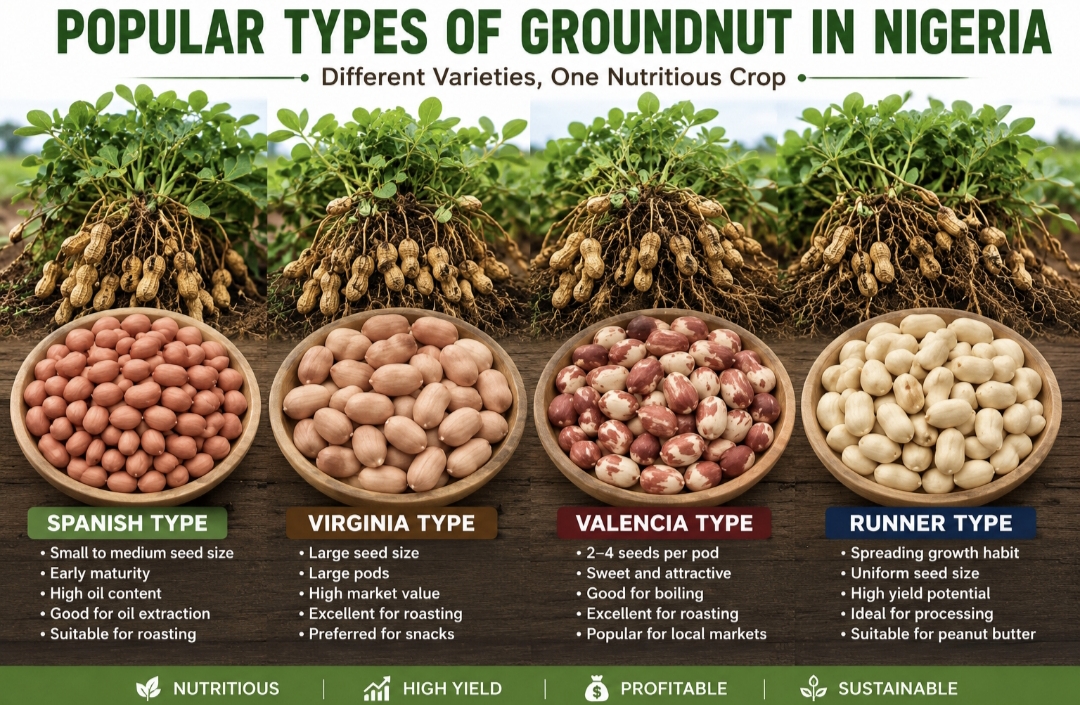
The major market types of groundnut commonly recognized globally include:
It is commonly produced by grinding groundnut kernels into paste and frying or processing the mixture.
- Spanish type
- Virginia type
- Valencia type
- Runner type
Improved groundnut varieties cultivated in Nigeria may belong to or share characteristics with these major groups. Nigerian agricultural research institutions have also developed and promoted improved varieties adapted to local conditions.
When selecting a groundnut variety, farmers should consider local climate, rainfall pattern, soil conditions, market demand, maturity period, and resistance to pests and diseases.
Spanish Type Groundnut
Spanish-type groundnuts are among the popular types used for cultivation and consumption. They are generally known for their relatively small kernels and compact growth habit.
Spanish groundnut varieties often have a shorter maturity period compared with some larger-seeded types. This makes them suitable for farmers who want early-maturing crops.
Common characteristics include:
- Relatively small seeds
- Early maturity
- Compact plant growth
- Good oil content
- Suitable for processing
- Often suitable for roasting
Spanish-type groundnuts are widely valued by processors because of their potential oil content. They can be used for producing groundnut oil, peanut butter, roasted groundnuts, and other food products.
Early maturity also makes this type useful in areas with shorter rainy seasons.
Virginia Type Groundnut
Virginia-type groundnuts are generally recognized for producing relatively large pods and large seeds.
This type is often preferred for markets where large attractive kernels are required.
Virginia groundnuts are commonly associated with:
- Large seed size
- Large pods
- Good appearance
- High market value
- Suitability for roasting
- Suitability for snack production
Because consumers often prefer large and attractive groundnut kernels for direct consumption, Virginia-type groundnuts can have strong commercial potential.
However, some varieties may require a longer growing period than early-maturing Spanish types.
Farmers should select varieties based on the length of the rainy season in their location.
Valencia Type Groundnut
Valencia groundnuts are another important type known for their distinctive pod characteristics.
A Valencia pod can contain multiple seeds, making it different from some other common groundnut types.
Characteristics often associated with Valencia groundnuts include:
- Multiple kernels per pod
- Attractive seed appearance
- Sweet flavour
- Suitable for boiling
- Suitable for roasting
- Good for direct consumption
Valencia-type groundnuts are often popular for fresh consumption, boiled groundnuts, and roasted snacks.
Their attractive appearance and flavour can make them valuable in local markets.
Runner Type Groundnut
Runner-type groundnuts have a spreading growth habit, which is different from more upright varieties.
They are widely known internationally for commercial processing because they can produce relatively uniform kernels.
Important characteristics include:
- Spreading growth habit
- Uniform seed size
- Good yield potential
- Suitable for processing
- Suitable for peanut butter production
Runner groundnuts can be useful for large-scale commercial production where uniformity is important.
Good farm management is necessary to achieve high productivity.
SAMNUT Groundnut Varieties in Nigeria
One of the most recognized groups of improved groundnut varieties in Nigeria is the SAMNUT series.
SAMNUT varieties were developed and promoted to improve groundnut production through characteristics such as improved yield, early maturity, adaptation, and tolerance to certain production challenges.
Different SAMNUT varieties have different characteristics. Farmers should obtain certified information about specific varieties before planting.
Improved varieties can offer advantages such as:
- Higher yield potential
- Better adaptation
- Early maturity
- Improved seed quality
- Better market potential
- Resistance or tolerance to some diseases
The availability of specific SAMNUT varieties may vary depending on location and seed suppliers.
SAMNUT 21 Groundnut Variety
SAMNUT 21 is one of the improved groundnut varieties associated with Nigerian groundnut production.
It is recognized among improved varieties promoted for better agricultural productivity.
Like other improved varieties, its performance depends on factors such as:
- Soil fertility
- Rainfall
- Seed quality
- Planting time
- Weed control
- Pest management
Farmers interested in planting SAMNUT varieties should purchase certified seeds from reputable agricultural seed suppliers.
Using certified seeds helps reduce the risk of planting mixed, diseased, or low-quality seeds.
SAMNUT 22 Groundnut Variety
SAMNUT 22 is another improved variety known among Nigerian groundnut farmers.
Improved varieties such as SAMNUT 22 are selected to support better production under suitable management conditions.
Farmers should always consider the maturity period and adaptation of a variety before selecting it.
The right variety should match the local growing season.
Important factors to consider include:
- Rainfall duration
- Soil type
- Expected planting date
- Market preference
- Intended use
For example, a variety suitable for oil processing may not necessarily be the best choice for consumers who prefer large kernels for roasting.
SAMNUT 23 Groundnut Variety
SAMNUT 23 is another name commonly mentioned among improved groundnut varieties in Nigeria.
Improved groundnut varieties are important because they help farmers move away from repeated planting of unidentified local seeds.
Quality seeds can contribute significantly to improved production.
However, farmers should remember that good seeds alone cannot guarantee high yields. Other management practices such as proper spacing, weed control, fertilizer application, and pest management are equally important.
SAMNUT 24 Groundnut Variety
SAMNUT 24 is among the improved groundnut varieties recognized in Nigerian agriculture.
Different improved varieties may have advantages in areas such as:
- Yield potential
- Maturity period
- Seed quality
- Disease tolerance
- Drought adaptation
The suitability of a variety depends on environmental conditions.
Before purchasing seeds, farmers should ask agricultural extension officers or reputable seed companies about varieties suitable for their specific location.
SAMNUT 25 Groundnut Variety
SAMNUT 25 is another improved groundnut variety associated with groundnut production in Nigeria.
Improved varieties can support commercial farmers by providing more predictable characteristics than unidentified recycled seeds.
When selecting seeds, farmers should inspect the packaging and ensure that the seeds are properly stored.
Avoid planting seeds that show signs of:
- Mould
- Insect damage
- Shrivelling
- Discolouration
- Poor germination
Healthy seeds provide the foundation for a productive groundnut farm.
Local Groundnut Varieties in Nigeria
Apart from officially named improved varieties, many farmers across Nigeria cultivate local groundnut varieties.
These varieties have been grown and preserved by farming communities for generations.
Local varieties often differ from one region to another.
Some may be valued for:
- Local adaptation
- Unique taste
- Early maturity
- Seed colour
- Large kernel size
- Market preference
However, local varieties may have lower yield potential compared with properly managed improved varieties.
This does not mean that all local varieties are unproductive. Some local varieties can perform very well under favourable conditions.
The main challenge is that their characteristics may not always be consistent because seeds are often recycled over many years.
Red Groundnut Varieties
Red-skinned groundnuts are popular in many Nigerian markets.
They are recognized by the reddish or reddish-brown colour of the thin skin covering the kernel.
Red groundnuts are commonly used for:
- Roasting
- Boiling
- Snacking
- Groundnut cake production
- Local food preparation
The red skin contains natural plant compounds and is often retained when groundnuts are roasted.
Market demand for red groundnuts varies across different regions of Nigeria.
White or Cream-Coloured Groundnut Varieties
Some groundnut varieties produce kernels with lighter-coloured skins.
These varieties may be preferred for certain processing activities and consumer markets.
Cream-coloured groundnuts are commonly used for:
- Peanut butter
- Groundnut oil
- Roasted groundnuts
- Food processing
Seed colour alone should not be used as the only criterion for selecting a variety.
Farmers should also consider yield potential, maturity period, disease resistance, and market demand.
Early-Maturing Groundnut Varieties
Early-maturing groundnut varieties are particularly important in areas with shorter rainy seasons.
Depending on the specific variety and environmental conditions, early varieties can mature significantly faster than late-maturing types.
Benefits of early-maturing groundnuts include:
- Reduced exposure to late-season drought
- Faster return on investment
- Possibility of fitting into crop rotation systems
- Earlier market supply
- Suitable for areas with short rainfall periods
Early maturity is an important consideration for farmers in regions where rainfall may end earlier.
Medium-Maturing Groundnut Varieties
Medium-maturing varieties require a moderate growing period.
These varieties can provide a balance between early production and yield potential.
They are suitable for areas with relatively reliable rainfall.
Farmers should plant at the correct time to ensure that the crop receives sufficient moisture throughout its growth cycle.
Late planting can reduce yield, especially when the crop approaches maturity during dry conditions.
Large-Seeded Groundnut Varieties
Large-seeded groundnut varieties are particularly valuable for direct consumption.
Consumers often prefer large kernels for:
- Roasting
- Packaging
- Snacks
- Export markets
- Confectionery
Large-seeded varieties can sometimes attract premium prices, especially when the kernels are uniform, clean, and properly dried.
However, farmers should not select a variety based only on seed size.
A slightly smaller variety with higher yield and disease resistance may sometimes provide better overall profitability.
Small-Seeded Groundnut Varieties
Small-seeded groundnut varieties can also be commercially valuable.
They are often suitable for:
- Oil extraction
- Groundnut paste
- Peanut butter
- Groundnut cake
- Food processing
Some small-seeded varieties mature earlier and can fit well into certain farming systems.
Their suitability depends largely on the target market.
High-Yielding Groundnut Varieties
High-yielding varieties are developed or selected for their ability to produce more pods and kernels under favourable conditions.
However, high yield potential does not automatically guarantee high farm production.
A high-yielding variety still requires:
- Good soil preparation
- Quality seeds
- Proper planting
- Correct spacing
- Timely weeding
- Pest management
- Adequate moisture
- Good harvesting practices
Farmers should combine improved genetics with good agronomic practices.
Drought-Tolerant Groundnut Varieties
Nigeria experiences variations in rainfall across different regions.
In areas where rainfall is irregular, drought-tolerant groundnut varieties can be particularly useful.
These varieties may have better ability to continue growing under periods of moisture stress.
Drought tolerance is important because water shortage can affect:
- Flowering
- Peg development
- Pod formation
- Kernel filling
However, even drought-tolerant varieties require adequate moisture to achieve good yields.
Farmers should combine drought-tolerant varieties with moisture conservation practices such as mulching and proper soil management where appropriate.
Disease-Tolerant Groundnut Varieties
Groundnut production can be affected by diseases that attack leaves, stems, pods, and roots.
Disease-tolerant varieties can help reduce production losses.
However, tolerance does not mean complete immunity.
Farmers should still practice good farm hygiene by:
- Using healthy seeds
- Rotating crops
- Removing infected plant materials
- Avoiding continuous groundnut cultivation on the same land
- Controlling insect pests
- Maintaining proper field sanitation
Integrated crop management provides better protection than depending only on resistant varieties.
Best Groundnut Types for Oil Production
Groundnut is an important oilseed crop.
Varieties with good oil content can be suitable for commercial processing.
Groundnut oil is widely used for:
- Cooking
- Food processing
- Industrial applications
After oil extraction, the remaining groundnut cake can be used as an ingredient in animal feed or processed for other purposes.
Farmers targeting oil processors should consider varieties that combine good yield with desirable oil characteristics.
Best Groundnut Types for Roasting
For roasted groundnut production, kernel size, taste, appearance, and uniformity are important.
Large-seeded varieties are often preferred for premium snack markets.
However, smaller varieties can also be successfully roasted and sold.
For commercial roasting, processors often prefer groundnuts that are:
- Clean
- Uniform in size
- Properly dried
- Free from mould
- Free from insect damage
Post-harvest handling is just as important as variety selection.
Best Groundnut Types for Peanut Butter Production
Groundnut butter, commonly called peanut butter, is becoming increasingly popular in Nigeria.
Suitable varieties should produce kernels with desirable:
- Oil content
- Flavour
- Texture
- Uniformity
Both small and medium-sized kernels can be used for peanut butter production.
The most important factors include kernel quality and proper processing.
Best Groundnut Types for Groundnut Cake Production
Groundnut cake is a popular food product in Nigeria.
Good-quality groundnuts are essential for producing attractive and safe groundnut cake.
The kernels should be:
- Fresh
- Properly dried
- Free from mould
- Free from unpleasant odours
Avoid using mouldy groundnuts because they may contain harmful contaminants.
How to Choose the Best Groundnut Variety in Nigeria
Choosing the right variety can significantly influence the success of a groundnut farm.
Before selecting a variety, consider the following factors.
Climate: Select varieties adapted to your rainfall and temperature conditions.
Maturity period: Choose early varieties for areas with shorter rainy seasons.
Soil type: Groundnut generally performs best in loose, well-drained soils.
Market demand: Grow varieties preferred by your target buyers.
Yield potential: Consider varieties capable of producing good yields under proper management.
Disease tolerance: Select varieties with tolerance to common diseases in your area.
Seed availability: Purchase seeds from reliable suppliers.
Where Groundnut Is Commonly Grown in Nigeria
Groundnut is cultivated in many parts of Nigeria, particularly in the northern regions.
The crop is important in states and agricultural zones with suitable warm temperatures and seasonal rainfall.
Groundnut farming contributes to:
- Food security
- Rural employment
- Household income
- Agricultural processing
- Livestock feed production
- Local and international trade
The crop can also be integrated into crop rotation systems because, as a legume, it can contribute to soil fertility through its relationship with nitrogen-fixing bacteria.
Economic Importance of Groundnut in Nigeria
Groundnut remains an economically important crop because almost every part of the value chain creates business opportunities.
The major economic products include:
- Raw groundnut kernels
- Roasted groundnut
- Groundnut oil
- Groundnut cake
- Peanut butter
- Animal feed ingredients
- Confectionery products
Groundnut production creates employment opportunities for farmers, transporters, traders, processors, packaging businesses, and retailers.
Value addition can significantly increase the income earned from groundnut production.
Instead of selling only raw groundnuts, entrepreneurs can process them into higher-value products.
Tips for Successful Groundnut Farming in Nigeria
To achieve good results regardless of the variety selected, farmers should follow good agricultural practices.
Important tips include:
- Use certified or high-quality seeds.
- Plant at the appropriate time.
- Select well-drained soil.
- Avoid waterlogged fields.
- Maintain proper spacing.
- Control weeds early.
- Monitor for pests and diseases.
- Harvest at the correct maturity stage.
- Dry groundnuts properly before storage.
- Store in clean and dry conditions.
Proper drying and storage are particularly important because groundnuts can develop mould when stored with excessive moisture.
Frequently Asked Questions About Types of Groundnut in Nigeria
What are the major types of groundnut?
The major market types commonly recognized include Spanish, Virginia, Valencia, and Runner groundnuts.
Which groundnut is best for farming in Nigeria?
The best variety depends on your location, rainfall pattern, maturity requirement, soil condition, and target market. Improved varieties suitable for your ecological zone are often recommended.
Which groundnut type matures early?
Spanish-type and some improved varieties are known for relatively early maturity, although the exact maturity period depends on the specific variety.
Which groundnut is best for roasting?
Large and attractive kernels are often preferred for roasting, although different varieties can be used successfully.
Can groundnut be grown throughout Nigeria?
Groundnut can be grown in many parts of Nigeria, but productivity depends on climate, soil conditions, rainfall, and farm management.
Are improved groundnut varieties better than local varieties?
Improved varieties may offer advantages such as higher yield potential, early maturity, and better tolerance to some production challenges. However, successful production still depends on proper farm management.
Conclusion
Nigeria has a wide range of groundnut types and varieties suitable for different purposes. From Spanish, Virginia, Valencia, and Runner types to improved varieties such as the SAMNUT series and locally adapted varieties, farmers have several options to choose from.
The best groundnut variety depends on the farmer's location, climate, rainfall pattern, soil condition, intended market, and production objectives.
Farmers targeting early harvest may prefer early-maturing varieties, while those producing for premium snack markets may focus on large-seeded varieties. Groundnut processors may prioritize varieties with desirable oil content, flavour, and kernel quality.
Regardless of the variety selected, successful groundnut production requires quality seeds, good soil preparation, timely planting, proper weed management, pest and disease control, and careful post-harvest handling.
Groundnut remains one of Nigeria's most valuable agricultural crops, offering opportunities not only for farmers but also for processors and agribusiness entrepreneurs. By selecting the right variety and applying good agricultural practices, Nigerian farmers can improve productivity, increase income, and contribute to food security and agricultural development.
Read more;
- Poultry Meat Benefits to Humanity: Complete Guide to Its Nutritional, Economic and Social Importance

- Tilapia Farming: Complete Guide to Raising Tilapia for Commercial Production

- Fish Pond Construction: Complete Guide to Designing and Building a Modern Fish Pond

- Grazing Livestock Farming Business: Complete Guide to Starting and Making Profit

- Commercial Cattle Farming: Complete Guide to Raising Cattle for Profit

- Goat Farming Business: Complete Guide to Meat and Breeding Production

- Sheep Farming: Complete Guide to Raising Sheep for Commercial Profit