Preamble
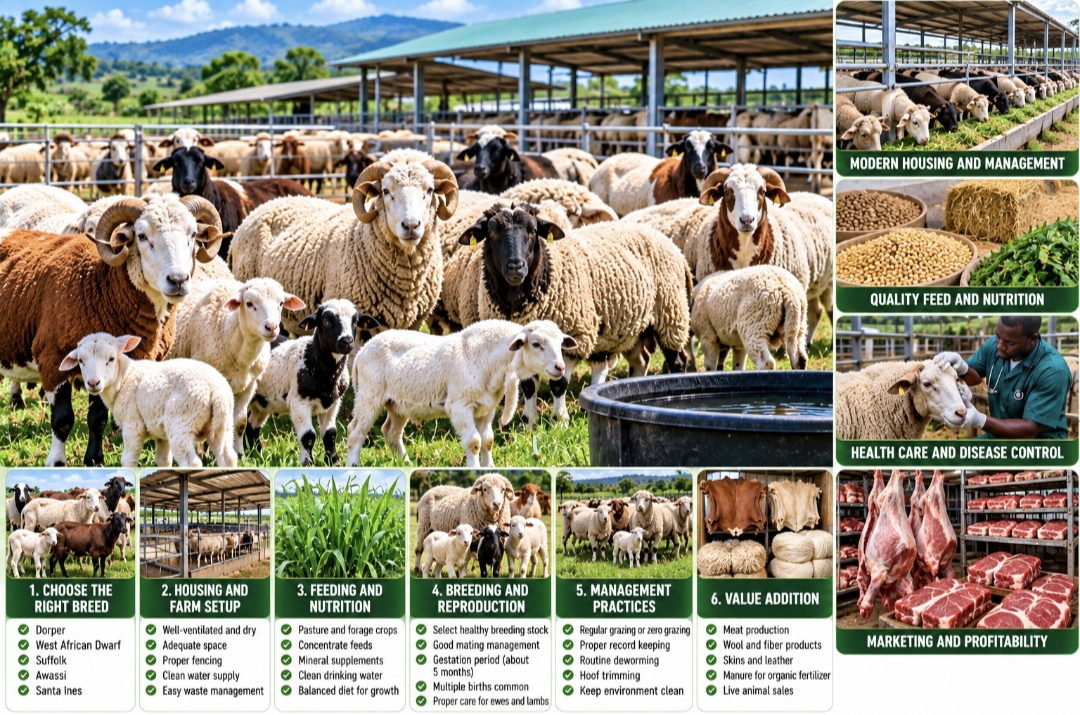
Sheep farming is an important livestock enterprise that involves raising sheep for meat, breeding, wool, milk, skins and manure. Depending on the production system, sheep can be kept on pasture, in semi-intensive systems or under more intensive management.
Commercial sheep farming can be started on a small scale and expanded gradually. However, successful production requires more than simply purchasing sheep. Farmers need to carefully manage breed selection, pasture, nutrition, water, housing, breeding, disease prevention, lamb survival, record keeping and marketing.
Sheep are grazing animals that can efficiently utilize grasses and other forage. They can also complement cattle production because sheep and cattle do not always utilize vegetation in exactly the same way.
This comprehensive guide explains how to start and manage a commercial sheep farming business, from selecting animals and preparing the farm to breeding, feeding, health management, marketing and profitability.
What Is Commercial Sheep Farming?
Commercial sheep farming is the planned production of sheep for economic purposes.
Depending on the farm, sheep may be raised for:
- Meat
- Wool
- Milk
- Breeding stock
- Lamb production
- Skins
- Manure
Some farmers specialize in one product, while others operate a diversified sheep enterprise.
The appropriate production model depends on the local environment, market demand, available land and available capital.
Why Start a Sheep Farming Business?
Sheep farming can provide several business opportunities.
Potential advantages include:
- Meat production
- Breeding-stock sales
- Wool production in suitable breeds
- Milk production in specialized systems
- Manure
- Multiple marketing channels
- Compatibility with some crop-livestock systems
However, profitability depends on proper management rather than simply owning sheep.
Major Types of Sheep Farming
Sheep production can be divided into several categories.
Meat Sheep Farming
Meat sheep are raised primarily for lamb or mutton production.
The production cycle generally involves:
Breeding → lambing → lamb growth → finishing → marketing
The farmer's objective is to produce healthy animals with good growth and suitable carcass characteristics.
Wool Sheep Farming
Wool production is important in regions where suitable sheep breeds and markets exist.
Wool production requires appropriate breeds, good nutrition and proper shearing and handling systems.
Dairy Sheep Farming
Some specialized sheep breeds are raised for milk.
Dairy sheep production requires:
- Appropriate genetics
- Good nutrition
- Careful milking
- Udder health
- Hygiene
- Reliable markets
Breeding Sheep Farming
Breeding farms produce sheep with desirable genetic and production characteristics for other farmers.
Such farms require careful selection and detailed breeding records.
Choosing the Right Sheep Breed
Breed selection is one of the first major decisions a sheep farmer must make.
Consider:
- Climate
- Disease pressure
- Pasture quality
- Growth rate
- Meat production
- Wool production
- Milk production
- Reproductive performance
- Adaptability
- Market demand
A breed that performs well in a cool environment may not perform equally well in a hot environment.
Local adaptation should therefore be considered carefully.
Locally Adapted Sheep
Locally adapted sheep can be valuable because they may already be suited to the environmental conditions where they are raised.
They may tolerate local climate, forage conditions and management systems better than animals that are poorly adapted.
Improved Breeds and Crossbreeding
Farmers can use improved breeds or controlled crossbreeding to introduce desirable characteristics.
Potential objectives include:
- Faster growth
- Larger mature size
- Better meat production
- Improved reproductive performance
- Better wool production
- Improved milk production
Crossbreeding should have a defined objective rather than being done randomly.
Selecting Healthy Sheep
When buying sheep, inspect each animal carefully.
Important characteristics include:
- Bright eyes
- Normal movement
- Good body condition
- Healthy coat
- Good appetite
- Sound legs and feet
- Normal breathing
- No obvious wounds
- No visible signs of disease
Where possible, purchase animals from reputable producers with known health-management practices.
Selecting Breeding Ewes
Breeding females should be selected for:
- Good health
- Good reproductive history
- Sound structure
- Good body condition
- Mothering ability
- Appropriate breed characteristics
Detailed records make it easier to identify productive females.
Selecting Breeding Rams
The ram can influence a large number of lambs.
A breeding ram should ideally have:
- Good health
- Strong legs
- Sound feet
- Appropriate body structure
- Healthy reproductive organs
- Good body condition
- Suitable breed characteristics
Professional breeding advice can be useful when establishing a commercial flock.
Land Requirements
The amount of land required depends on:
- Number of sheep
- Pasture productivity
- Rainfall
- Soil fertility
- Grazing system
- Supplementary feeding
- Breed
- Season
Instead of relying on a universal acreage figure, farmers should estimate the carrying capacity of their available pasture.
Sheep Pasture Management
Good pasture is essential for grazing sheep.
Suitable forage should provide:
- Energy
- Protein
- Fibre
- Minerals
- Adequate dry matter
Pasture quality changes throughout the year, so farmers should prepare for periods when natural forage declines.
Rotational Grazing
Rotational grazing divides pasture into multiple areas.
Sheep graze one section while other sections recover.
A simple system might involve:
Paddock A → B → C → D → back to A
The exact rotation depends on forage growth and animal numbers.
Rotational grazing can help reduce excessive grazing pressure when properly managed.
Water Requirements
Sheep need regular access to clean water.
Water requirements vary according to:
- Body size
- Temperature
- Diet
- Pregnancy
- Lactation
- Activity
Water troughs should be kept clean and easily accessible.
Sheep Housing
Sheep require shelter from excessive weather conditions.
A suitable sheep house should provide:
- Good ventilation
- Dry flooring
- Good drainage
- Protection from heavy rain
- Shade
- Adequate space
- Easy cleaning
Wet and dirty environments can increase disease and foot problems.
Fencing
Sheep fencing should be strong enough to prevent escape and protect the animals.
Fencing can also help:
- Divide grazing paddocks
- Protect crops
- Control breeding
- Improve security
- Manage pasture
Feeding Sheep
Sheep can obtain nutrition from pasture, but commercial production may require supplementary feed.
Potential feeds include:
- Pasture
- Hay
- Silage
- Forage legumes
- Crop residues
- Grains
- Commercial concentrates
- Mineral supplements
The appropriate diet depends on the production stage.
Feeding Lambs
Growing lambs have important nutritional requirements.
Good nutrition supports:
- Growth
- Muscle development
- Disease resistance
- Reproductive development
Farmers should monitor lamb growth rather than relying only on visual assessment.
Dry-Season Feed Management
When pasture declines, farmers may use conserved forage.
Useful resources include:
- Hay
- Silage
- Dried forage
- Suitable crop residues
Preparing feed reserves ahead of shortages can help stabilize production.
Mineral Nutrition
Minerals are important for:
- Bone development
- Growth
- Reproduction
- General health
Mineral requirements vary, so supplementation should be appropriate for the animals and local feed resources.
Sheep Breeding
Breeding is one of the most important components of a commercial sheep enterprise.
A productive flock should aim for:
- Good conception
- Healthy pregnancies
- Successful lambing
- High lamb survival
- Good lamb growth
Nutrition and health strongly influence reproductive performance.
Breeding Ewes
Ewes should enter breeding in appropriate body condition.
Poor nutrition can reduce reproductive performance, while excessive condition can also create management problems.
Farmers should monitor body condition and adjust feeding accordingly.
Ram Management
Rams should be healthy before breeding.
They should have:
- Good body condition
- Sound feet and legs
- Good reproductive health
- Appropriate nutrition
Farmers should avoid using unhealthy or structurally unsound rams.
Lambing Management
Lambing is a critical period.
Farmers should provide:
- Clean lambing areas
- Adequate nutrition
- Observation
- Appropriate assistance when necessary
- Protection from severe weather
Newborn lambs require rapid access to adequate colostrum.
Lamb Survival
Lamb mortality can significantly reduce farm profitability.
Important management practices include:
- Good maternal nutrition
- Clean lambing areas
- Adequate colostrum
- Protection from extreme weather
- Disease prevention
- Early detection of weak lambs
Sheep Health Management
A good health programme should include:
- Vaccination where appropriate
- Parasite control
- Foot care
- Quarantine
- Clean water
- Proper nutrition
- Regular observation
- Veterinary support
Health programmes should reflect the diseases and parasites present in the local production environment.
Internal Parasites
Internal parasites can affect sheep productivity.
Possible signs include:
- Weight loss
- Poor growth
- Weakness
- Anaemia
- Diarrhoea
- Poor body condition
Farmers should develop parasite-control programmes with veterinary guidance.
Foot Health
Foot problems can reduce grazing ability and growth.
Farmers should regularly inspect sheep feet and address environmental or management factors that contribute to foot disease.
Quarantine New Sheep
New sheep should preferably be isolated from the existing flock for an appropriate period.
This allows health observation and appropriate veterinary procedures before introduction.
Sheep Identification
Individual identification can be achieved using:
- Ear tags
- Electronic identification
- Other appropriate identification systems
Identification is especially important for breeding farms.
Sheep Record Keeping
Commercial sheep farmers should record:
- Animal identification
- Birth dates
- Parentage
- Breeding dates
- Lambing
- Number of lambs
- Weaning
- Treatments
- Vaccinations
- Deaths
- Feed expenses
- Sales
Records help farmers identify productive and unproductive animals.
Sheep Marketing
Potential buyers include:
- Livestock traders
- Butchers
- Restaurants
- Meat processors
- Direct consumers
- Breeding farms
- Other farmers
Market requirements vary by location.
Farmers should study local demand before expanding the flock.
Selling Sheep for Meat
The ideal selling point depends on:
- Growth rate
- Body condition
- Feed cost
- Market demand
- Selling price
- Production objectives
Keeping animals longer is not automatically more profitable because additional feeding has a cost.
Sheep Fattening
Sheep fattening involves buying or selecting animals and feeding them intensively or semi-intensively for a defined period.
The basic model is:
Purchase → quarantine → feeding → health management → growth monitoring → sale
Profit should be calculated before starting the cycle.
Sheep Fattening Profit Calculation
A simplified formula is:
Profit = Selling price − purchase cost − feed cost − health costs − labour − transport − other costs
Accurate records are necessary for meaningful results.
Value Addition
Sheep can support several value chains.
These may include:
- Live animals
- Meat
- Breeding stock
- Wool where applicable
- Milk in specialized systems
- Skins
- Manure
Value addition can create additional revenue but may require extra infrastructure and regulatory compliance.
Sheep Manure
Sheep manure can be valuable for agriculture.
It can be:
- Composted
- Applied to fields
- Incorporated into organic fertilizer production
Proper handling is important.
Integrated Sheep and Crop Farming
Sheep can be integrated with crop production.
Suitable crop residues may contribute to feed, while manure can be returned to crop fields.
This creates a circular agricultural system:
Crops → suitable residues → sheep
and:
Sheep → manure → crops
Starting a Sheep Farm With Limited Capital
Beginners should not spend all available money on sheep.
Capital should also be allocated to:
- Housing
- Fencing
- Water
- Feed
- Veterinary care
- Labour
- Transportation
- Emergency expenses
Infrastructure should be established before herd expansion.
Example Budget Structure
An illustrative business allocation could be: Expense Example allocation Sheep purchase 45–55% Housing 10–15% Fencing 8–12% Feed reserve 8–12% Water 5–8% Veterinary care 3–5% Labour and transport 5–8% Emergency reserve 3–5%
These are planning percentages rather than fixed market prices.
How to Calculate Sheep Farming Profit
Use:
Profit = Total Revenue − Total Costs
Revenue can come from:
- Sheep sales
- Lamb sales
- Breeding stock
- Wool where applicable
- Milk
- Manure
- Other products
Costs can include:
- Animal purchases
- Feed
- Veterinary care
- Housing
- Labour
- Water
- Transport
- Marketing
- Mortality
Important Sheep Farming Performance Indicators
Farmers should monitor:
Lambing rate
Number of lambs produced relative to breeding females.
Lamb survival rate
Number of lambs surviving ÷ number born × 100.
Mortality rate
Number of sheep deaths ÷ total sheep × 100.
Average growth rate
Change in body weight over a defined period.
Revenue per sheep sold
Total sales revenue ÷ number sold.
These indicators help farmers measure production efficiency.
Major Risks in Sheep Farming
Important risks include:
- Disease
- Internal parasites
- Foot problems
- Lamb mortality
- Poor nutrition
- Theft
- Predators
- Drought
- Pasture shortages
- Market-price fluctuations
Good planning can reduce but not completely eliminate these risks.
How to Make Sheep Farming More Profitable
Farmers can improve profitability by:
- Selecting healthy breeding stock
- Improving lamb survival
- Producing quality forage
- Reducing feed waste
- Maintaining good animal health
- Monitoring growth
- Keeping detailed records
- Developing reliable markets
- Selling strategically
- Reinvesting in productive infrastructure
Modern Technology in Sheep Farming
Technology can improve flock management.
Examples include:
- Digital records
- Electronic identification
- Livestock weighing
- Mobile farm-management applications
- Automated water systems
- Remote monitoring
Even simple record systems can substantially improve decision-making.
Sustainable Sheep Farming
Sustainable sheep farming protects both the animals and the land.
Important practices include:
- Appropriate stocking rates
- Rotational grazing
- Soil protection
- Water conservation
- Pasture improvement
- Manure management
- Disease prevention
Sustainable management protects the farm's future productive capacity.
Common Mistakes Beginners Should Avoid
Overstocking
Too many sheep can exceed pasture carrying capacity.
Poor housing
Wet and poorly ventilated housing can increase health problems.
Buying animals without inspection
Poor-quality animals can reduce productivity.
Ignoring lamb mortality
Losses during the early life of lambs can seriously affect profitability.
Poor breeding records
Without records, it becomes difficult to improve the flock.
No feed reserve
Pasture shortages can create expensive feeding problems.
Ignoring the market
Farmers need to know who will buy their animals and what characteristics buyers require.
Step-by-Step Plan for Starting a Sheep Farm
Step 1: Decide whether you want meat, breeding, wool, milk or a combination.
Step 2: Select suitable sheep.
Step 3: Assess your land and pasture.
Step 4: Determine carrying capacity.
Step 5: Build suitable housing.
Step 6: Install fencing.
Step 7: Establish reliable water.
Step 8: Develop pasture and feed reserves.
Step 9: Purchase healthy sheep.
Step 10: Quarantine new animals.
Step 11: Establish a veterinary programme.
Step 12: Begin breeding and production records.
Step 13: Identify buyers.
Step 14: Monitor growth and reproductive performance.
Step 15: Sell animals according to your production plan.
Step 16: Reinvest and expand gradually.
Frequently Asked Questions About Sheep Farming
Is sheep farming profitable?
Sheep farming can be profitable when production costs are controlled and animals have good health, growth and reproductive performance. Actual returns vary according to the production system and market conditions.
How many sheep should a beginner start with?
The appropriate number depends on available capital, land, feed, housing, labour and experience.
What do sheep eat?
Sheep can eat suitable pasture grasses, forage legumes, hay, silage, appropriate crop residues and supplementary feeds.
Do sheep need shelter?
Yes. Proper shelter protects sheep from excessive rain, heat and other environmental conditions.
Can sheep and cattle graze together?
They can sometimes be integrated under a controlled grazing system, provided stocking rates, nutrition, disease management and pasture availability are appropriate.
What is the difference between sheep farming and goat farming?
Both are ruminant livestock enterprises, but sheep generally prefer grazing grasses and other low vegetation, while goats are more inclined to browse shrubs and higher vegetation.
Can sheep manure be used as fertilizer?
Yes. Properly managed sheep manure can provide nutrients and organic matter for crop production.
Final Thoughts
Sheep farming can become a productive commercial enterprise when it is managed systematically.
The foundation of a successful flock is healthy breeding stock, adequate nutrition, reliable water, suitable housing, good pasture, effective disease prevention, careful lamb management, accurate records and dependable markets.
Farmers should start at a manageable scale and expand as their production system becomes more efficient.
The objective should not simply be to own a large number of sheep. The objective is to develop a flock that produces healthy lambs, grows efficiently, reproduces consistently and generates sustainable returns.
With proper planning and disciplined management, sheep farming can contribute significantly to meat production, rural livelihoods, agricultural employment and the wider livestock economy.
Latest posts;
- Beans Farming: A Complete Guide to Different Types of Beans, Their Uses, Nutrition, and Farming
- Cassava Farming in Africa: A Complete Guide to Planting, Growing, Harvesting and Making Profit from Cassava
- CATFISH FARMING(HYBRID): THE COMPLETE STEP-BY-STEP GUIDE FOR BEGINNERS AND COMMERCIAL FARMERS (2026 EDITION)

- Cattle Fattening Business: Complete Guide to Raising Beef Cattle for Profit
- COCOA FARMING IN AFRICA: A Complete Professional Guide (Part 1)
- COCOA FARMING IN AFRICA: A Complete Professional Guide (Part 2)
- Commercial Carrot Farming: A Complete Guide to Growing Carrots for Profit
- Commercial Cashew Farming: A Complete Guide to Growing Cashew for Profit
- Commercial Cattle Farming: Complete Guide to Raising Cattle for Profit