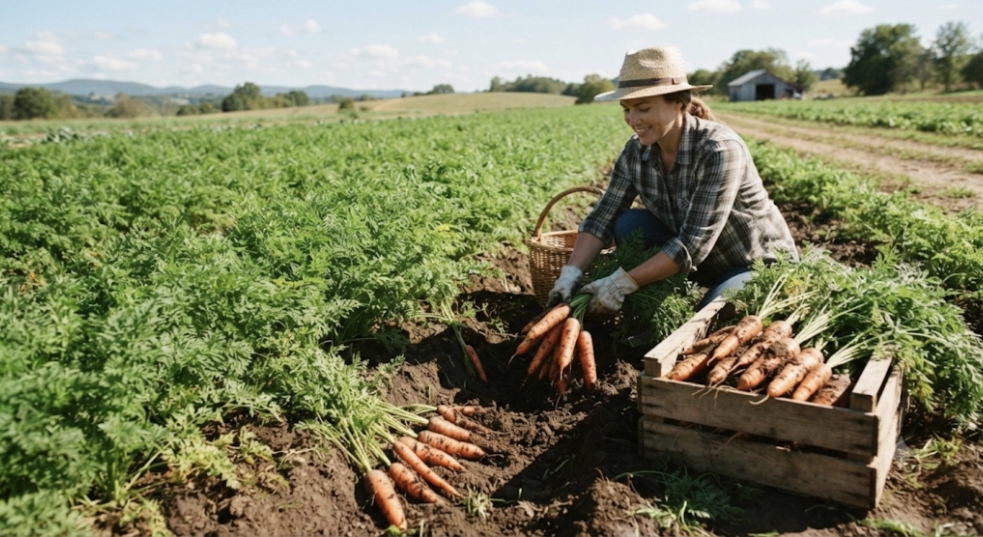
Introduction
Commercial carrot farming is a profitable agricultural business when properly planned and managed. Carrots are highly nutritious root vegetables with strong demand from households, restaurants, supermarkets, food processors, hotels, and fresh vegetable markets. Their relatively short production cycle also makes carrots attractive to farmers who want to generate income from vegetable production.
With the right variety, suitable soil, adequate water supply, proper land preparation, quality seeds, good spacing, effective weed management, and appropriate pest and disease control, farmers can achieve excellent carrot yields.
This comprehensive guide explains how to start commercial carrot farming, from selecting a suitable site and preparing the soil to planting, irrigation, fertilization, pest management, harvesting, storage, marketing, and profitability.
What Is Commercial Carrot Farming?
Commercial carrot farming is the large-scale or profit-oriented cultivation of carrots for sale rather than primarily for household consumption.
Carrots belong to the Apiaceae family and are commonly cultivated for their edible roots. Depending on the variety and growing conditions, carrots can be orange, red, yellow, purple, or white.
Commercial carrot production requires more planning than backyard gardening because the farmer must consider production costs, market demand, seed quality, irrigation, labour, transportation, storage, and selling prices.
The main objective is to produce healthy, uniform, attractive carrots at a cost that allows the farmer to make a reasonable profit.
Why Carrot Farming Is Profitable
Carrot farming can be profitable because carrots are widely consumed and have multiple markets.
Some important reasons to consider commercial carrot production include:
- Strong demand for fresh carrots
- Relatively short production period
- High nutritional value
- Multiple varieties available
- Suitable for small, medium, and large-scale production
- Can be cultivated in many regions with proper irrigation
- Can be sold directly to consumers or wholesalers
- Demand from restaurants and food businesses
- Possibility of year-round production where water is available
- Can be integrated with other vegetable crops
Carrots are also used in salads, soups, stews, juices, baby foods, frozen vegetable products, and other processed foods.
Best Climate for Commercial Carrot Farming
Carrots generally perform best under cool to moderately warm conditions.
The crop prefers moderate temperatures, particularly during root development. Extremely high temperatures can negatively affect root quality, colour, shape, and size.
For commercial production, farmers should choose a planting period when temperatures are favourable for carrot development.
In warmer regions such as parts of Nigeria, successful production may require careful selection of varieties and reliable irrigation. Planting during a cooler period can improve root development and quality.
Good sunlight is also important because carrots require adequate light for healthy growth.
Best Soil for Carrot Farming
Soil selection is one of the most important factors in commercial carrot production.
Carrots develop their edible roots underground, so the soil must allow the roots to grow freely without excessive resistance.
The ideal soil is:
- Loose
- Deep
- Fertile
- Well-drained
- Free from stones and large roots
- Rich in organic matter
- Able to retain adequate moisture
Sandy loam and loamy soils are generally suitable for carrot production because they allow the roots to expand easily.
Heavy clay soils can cause problems because they may restrict root development and produce short, forked, twisted, or deformed carrots.
Soil pH for Carrot Production
Carrots generally perform well in slightly acidic to neutral soil.
A soil pH of approximately 6.0 to 7.0 is generally suitable.
Farmers should conduct a soil test before establishing a commercial carrot farm. Soil testing can reveal important information about soil pH and nutrient levels and can help determine whether amendments or fertilizers are required.
Avoid applying large quantities of fertilizer blindly because excessive nutrients can create production problems and increase unnecessary costs.
Choosing the Best Carrot Variety
Choosing the appropriate carrot variety is important because different varieties have different maturity periods, root shapes, colours, sizes, disease tolerance, and environmental requirements.
For commercial production, farmers should select varieties based on:
- Local climate
- Soil type
- Expected maturity period
- Market preference
- Root size
- Root colour
- Yield potential
- Disease tolerance
- Consumer demand
- Availability of quality seed
Popular commercial carrot types include Nantes, Chantenay, Imperator, Danvers, and other improved varieties.
Before purchasing seeds, farmers should confirm that the variety performs well in their production environment and has a market.
How to Select Quality Carrot Seeds
Quality seed is the foundation of successful carrot farming.
Farmers should purchase seeds from reputable agricultural seed suppliers rather than using unknown or poorly stored seeds.
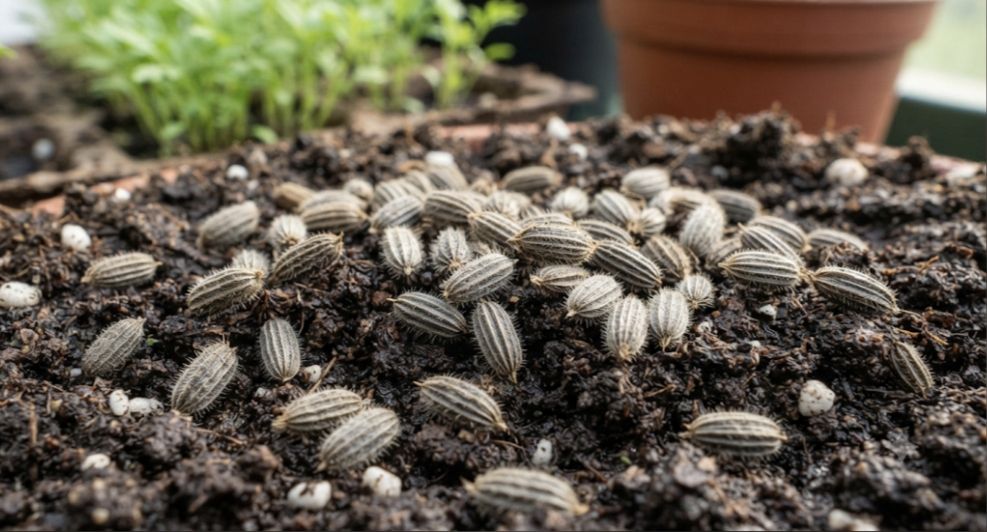
Good carrot seeds should have:
- High germination potential
- Good genetic quality
- Appropriate variety characteristics
- Proper packaging
- Reliable source information
- Good storage condition
Farmers should also check the seed packaging for important information such as variety, batch details, recommended planting conditions, and expiration or validity information where applicable.
Poor-quality seeds can result in low germination, uneven crop establishment, and poor yields.
Land Preparation for Carrot Farming
Proper land preparation is essential because carrots develop underground.
Clear the farm of weeds, grasses, stones, roots, and other materials that can interfere with root growth.
Plough or dig the soil thoroughly and break large soil clods.
The soil should be fine and loose enough to allow the developing roots to penetrate easily.
For commercial production, raised beds can be particularly useful, especially in areas where drainage is a concern.
The beds should be properly levelled and prepared before planting.
Why Raised Beds Are Important for Carrots
Raised beds can improve drainage, soil structure, root development, and farm management.
They are particularly useful where the soil tends to retain too much water.
Good drainage helps reduce problems associated with waterlogging and root diseases.
Raised beds can also make irrigation, weeding, harvesting, and general crop management easier.
The exact bed dimensions can vary depending on the farmer's production system, available equipment, and irrigation method.
How to Plant Carrot Seeds
Carrots are usually established directly from seed rather than transplanted.
Make shallow planting rows in the prepared soil and distribute the seeds carefully.
Because carrot seeds are small, avoid planting them too deeply.
Cover the seeds lightly with fine soil and irrigate gently.
Strong water pressure should be avoided immediately after planting because it can wash away seeds or expose them on the soil surface.
Keeping the soil consistently moist during germination is very important.
Carrot Planting Spacing
Proper spacing allows carrot roots to develop properly and reduces unnecessary competition between plants.
Spacing recommendations depend on the variety and desired root size.
A common commercial approach is to establish relatively close rows and later thin the seedlings to provide adequate space between individual plants.
Farmers should follow the spacing recommendation supplied for the selected variety whenever available.
Overcrowding can result in small roots, while excessive spacing may reduce the number of marketable roots per unit of land.
Germination of Carrots
Carrot seeds can take several days to germinate, depending on seed quality, soil moisture, temperature, and environmental conditions.
The soil should remain consistently moist during this period.
Do not allow the seedbed to dry out immediately after planting.
At the same time, avoid excessive irrigation that causes waterlogging.
Uniform germination is important because uneven establishment can result in carrots reaching maturity at different times.
Thinning Carrot Seedlings
Thinning involves removing excess seedlings so that the remaining plants have enough space to develop properly.
If carrots are planted too densely, the roots may compete for water, nutrients, and space.
Thin the seedlings carefully after establishment while trying to avoid disturbing neighbouring plants.
Proper thinning can contribute to better root size and more uniform carrots.
Irrigation for Commercial Carrot Farming
Water management is critical in carrot production.
Carrots require adequate and consistent moisture, particularly during germination and root development.
Insufficient water can cause slow growth, poor root development, cracking, or reduced yield.
Excessive water, however, can cause waterlogging and increase the risk of root diseases.
The best irrigation schedule depends on soil type, weather conditions, crop growth stage, and rainfall.
Drip irrigation can be an efficient option for commercial farmers because it delivers water close to the root zone while reducing unnecessary water loss.
Fertilizer Application in Carrot Farming
Carrots require nutrients for healthy leaf growth and root development.
However, fertilizer application should be based on soil fertility and crop requirements.
Important nutrients include:
- Nitrogen
- Phosphorus
- Potassium
- Calcium
- Magnesium
- Sulfur
- Micronutrients
Excessive nitrogen can encourage excessive foliage and may negatively affect root development and quality.
Potassium is particularly important for overall crop development and can contribute to healthy root production.
The most reliable approach is to conduct a soil test and follow an appropriate fertilizer recommendation.
Organic Manure for Carrot Production
Well-decomposed organic manure or compost can improve soil structure and fertility.
Organic matter can help improve moisture retention and soil biological activity while making the soil easier for carrot roots to penetrate.
Fresh manure should not be incorporated immediately before planting because it can contribute to root deformation and other problems.
Well-composted organic material is preferable.
Weed Management in Carrot Farming
Weeds compete with carrots for sunlight, water, nutrients, and growing space.
Early weed control is particularly important because young carrot seedlings grow slowly and can be easily suppressed by aggressive weeds.
Farmers can manage weeds through:
- Hand weeding
- Shallow cultivation
- Mulching
- Proper crop spacing
- Appropriate weed-control products where legally registered and correctly used
Care must be taken during cultivation because carrot roots are close to the soil surface and can be damaged by deep hoeing.
Common Pests That Attack Carrots
Carrots can be affected by several pests depending on the production environment.
Potential pests include:
- Aphids
- Cutworms
- Caterpillars
- Root-feeding insects
- Leaf-feeding insects
- Nematodes
Farmers should regularly inspect their farms for signs of pest infestation.
Integrated pest management is preferable to unnecessary pesticide application.
This involves monitoring the crop, maintaining farm hygiene, using suitable varieties, controlling weeds, encouraging beneficial organisms, and using approved crop-protection products when necessary.
Common Diseases of Carrots
Carrot production can be affected by fungal, bacterial, and other diseases.
Some problems may cause:
- Leaf spots
- Leaf blight
- Root rot
- Seedling damping-off
- Root discoloration
- Poor root development
Good farm sanitation, proper drainage, quality seed, adequate spacing, crop rotation, and careful irrigation can help reduce disease pressure.
Farmers should seek professional agricultural advice when serious disease symptoms appear.
Crop Rotation in Carrot Farming
Crop rotation is an important management practice for commercial vegetable farms.
Growing carrots continuously on the same land can increase the risk of certain soil-related pests and diseases.
Farmers can rotate carrots with crops from different plant families.
Crop rotation can help maintain soil health and reduce the buildup of certain pests and pathogens.
How Long Does Carrot Take to Mature?
The maturity period of carrots depends on the variety and environmental conditions.
Many commercial carrot varieties can mature within roughly 60 to 100 days after planting, although some varieties may require more or less time.
Farmers should monitor the size and development of the roots rather than relying solely on the calendar.
Harvesting at the correct maturity stage helps produce carrots with good size, colour, texture, and market value.
How to Know When Carrots Are Ready for Harvest
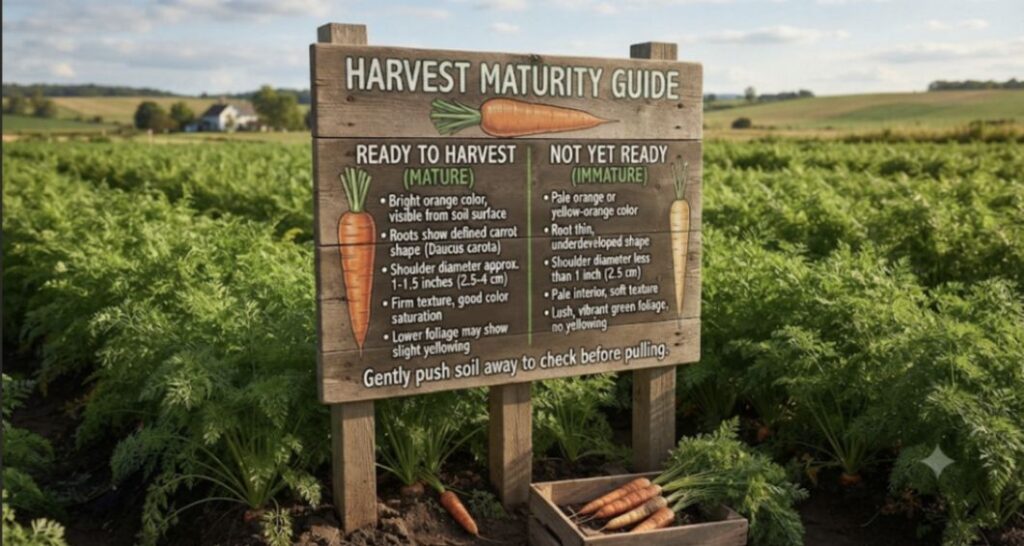
Carrots are generally ready for harvest when their roots have reached the desired market size.
Farmers can carefully expose part of the soil around the upper root to check its diameter.
Signs of maturity may include:
- Proper root size
- Strong colour development
- Firm roots
- Healthy foliage
- Market-preferred shape
Do not leave mature carrots in the soil unnecessarily if doing so could reduce quality or expose them to cracking, pests, or disease.
How to Harvest Carrots
Carrots can be harvested manually using suitable farm tools.
Before harvesting, irrigating lightly can make the soil easier to work with, particularly when the soil is dry.
Loosen the soil around the roots and carefully pull the carrots to avoid breaking them.
Handle harvested carrots gently because bruises, cuts, and broken roots can reduce their market value and shorten storage life.
Cleaning and Grading Carrots
After harvesting, remove excess soil and separate damaged roots from healthy marketable carrots.
Carrots can be graded according to:
- Size
- Shape
- Colour
- Freshness
- Damage level
- Overall appearance
Uniform carrots are generally more attractive to buyers.
Poor-quality, cracked, diseased, or severely damaged roots should be separated from premium produce.
Post-Harvest Handling of Carrots
Good post-harvest handling can significantly reduce losses.
Avoid leaving harvested carrots exposed to excessive heat and direct sunlight for long periods.
Sort and package the carrots as quickly as practical.
Proper storage conditions can help maintain freshness and reduce moisture loss.
Where cold storage is available, carrots can be stored under suitable temperature and humidity conditions for longer periods than under ordinary ambient conditions.
How to Store Carrots
Carrots are best stored in cool and humid conditions that reduce moisture loss while avoiding excessive condensation and decay.
Commercial farmers who produce large quantities may consider cold storage where economically justified.
For smaller producers, quick marketing can reduce storage expenses and post-harvest losses.
The best storage strategy depends on production volume, market distance, available facilities, and expected selling period.
Carrot Marketing Strategies
Producing carrots is only one part of the business. Finding profitable markets is equally important.
Potential customers include:
- Local vegetable markets
- Supermarkets
- Restaurants
- Hotels
- Caterers
- Food processors
- Juice producers
- Vegetable wholesalers
- Retail vegetable sellers
- Direct household consumers
Farmers should identify potential buyers before planting on a large scale.
Knowing the expected market size and price range can help determine how much to plant.
How to Sell Carrots for Higher Profit
Farmers can improve profitability by reducing unnecessary middlemen and building direct relationships with buyers.
Some strategies include:
- Selling directly to supermarkets
- Supplying restaurants
- Creating relationships with wholesalers
- Selling cleaned and graded carrots
- Packaging carrots attractively
- Supplying customers consistently
- Using social media marketing
- Selling through agricultural marketplaces
- Establishing contracts with institutional buyers
Quality, reliability, attractive packaging, and consistent supply can help a farmer build long-term customers.
Cost of Starting Commercial Carrot Farming
The cost of carrot farming varies considerably depending on the size of the farm, location, land preparation method, irrigation system, seed prices, labour costs, fertilizer requirements, transportation, and market conditions.
Major expenses may include:
- Land preparation
- Quality carrot seeds
- Fertilizer
- Organic manure
- Irrigation equipment
- Water
- Labour
- Weed management
- Pest and disease management
- Harvesting
- Packaging
- Transportation
- Marketing
Farmers should prepare a detailed production budget before planting.
Carrot Farming Profitability
Profitability depends on yield, production costs, selling price, market demand, and post-harvest losses.
A simple way to calculate potential profit is:
Total Revenue = Total Quantity Sold × Selling Price
Gross Profit = Total Revenue − Total Production Cost
For example, if a farmer produces 5,000 kg of marketable carrots and sells them at an average price of ₦500 per kg:
5,000 kg × ₦500 = ₦2,500,000
If the total production and marketing cost is ₦1,200,000:
₦2,500,000 − ₦1,200,000 = ₦1,300,000 gross profit
These figures are only an illustration. Actual carrot prices, yields, and production costs vary by location and season.
How to Increase Carrot Yield
Farmers can improve carrot production by focusing on several important factors.
Use quality seeds, select suitable varieties, prepare the soil properly, maintain adequate moisture, control weeds early, provide appropriate nutrients, monitor pests and diseases, and harvest at the right time.
The most important objective should not simply be producing a large quantity of carrots but producing a high percentage of healthy, uniform, marketable roots.
Common Mistakes in Commercial Carrot Farming
Several mistakes can reduce carrot yields and profitability.
Common mistakes include:
- Using poor-quality seeds
- Planting in compacted soil
- Planting seeds too deeply
- Poor irrigation management
- Allowing weeds to compete with young plants
- Overcrowding seedlings
- Excessive fertilizer application
- Using fresh manure immediately before planting
- Ignoring pests and diseases
- Harvesting too early
- Leaving mature carrots in the soil too long
- Failing to identify a market before planting
- Poor post-harvest handling
Avoiding these mistakes can significantly improve production results.
Best Time to Grow Carrots in Nigeria
The best planting period for carrots in Nigeria depends on the location, temperature, variety, rainfall pattern, and availability of irrigation.
In warmer areas, farmers may achieve better results by producing carrots during relatively cooler periods.
Irrigation allows commercial farmers to have greater control over water supply and can make production possible beyond the traditional rainy season.
Before establishing a large farm, farmers should conduct a small trial to determine which planting period and variety perform best in their specific location.
Commercial Carrot Farming in Nigeria
Carrot farming has commercial potential in Nigeria because carrots are consumed across many parts of the country.
Major vegetable markets, supermarkets, restaurants, hotels, caterers, and households create opportunities for carrot producers.
Farmers in areas with suitable soil and access to reliable water can consider commercial production.
However, farmers should not assume that high demand automatically guarantees profit. Production costs, seasonal price changes, transportation, spoilage, competition, and market access must all be considered.
How to Start a Carrot Farm Step by Step
To establish a commercial carrot farm, follow these basic steps:

- Research the local carrot market.
- Identify potential buyers.
- Select suitable farmland.
- Test the soil.
- Choose an appropriate carrot variety.
- Purchase quality seeds.
- Prepare the land properly.
- Establish suitable beds.
- Plant the seeds at the recommended depth.
- Maintain adequate soil moisture.
- Thin overcrowded seedlings.
- Control weeds.
- Apply fertilizer based on soil and crop requirements.
- Monitor pests and diseases.
- Maintain proper irrigation.
- Monitor root development.
- Harvest mature carrots carefully.
- Grade and clean the produce.
- Package and transport the carrots properly.
- Sell to targeted buyers.
Is Commercial Carrot Farming Worth It?
Commercial carrot farming can be a worthwhile agricultural business for farmers who have access to suitable land, reliable water, quality seeds, labour, and a dependable market.
The crop has multiple uses and can generate good returns when production and marketing are properly managed.
However, profitability is not guaranteed. Farmers should prepare a realistic business plan, calculate production costs, research local prices, and begin with a manageable farm size before expanding.
Conclusion
Commercial carrot farming can provide an attractive opportunity for farmers interested in profitable vegetable production. Successful carrot production depends on selecting suitable varieties, preparing loose and fertile soil, using quality seeds, maintaining proper spacing, providing consistent moisture, managing weeds and pests, and harvesting at the right maturity stage.
Marketing should be considered before planting because the profitability of the farm depends not only on yield but also on how efficiently the harvested carrots are sold.
With proper planning, good agronomic practices, reliable irrigation, effective post-harvest handling, and access to profitable markets, carrot farming can become a sustainable source of agricultural income.
Farmers should start with a realistic production budget, keep accurate records of expenses and sales, learn from each production cycle, and gradually expand as their knowledge, market access, and profitability improve.
Read more;
- Poultry Meat Benefits to Humanity: Complete Guide to Its Nutritional, Economic and Social Importance

- Tilapia Farming: Complete Guide to Raising Tilapia for Commercial Production

- Fish Pond Construction: Complete Guide to Designing and Building a Modern Fish Pond

- Grazing Livestock Farming Business: Complete Guide to Starting and Making Profit

- Commercial Cattle Farming: Complete Guide to Raising Cattle for Profit

- Goat Farming Business: Complete Guide to Meat and Breeding Production

- Sheep Farming: Complete Guide to Raising Sheep for Commercial Profit

- Modern Pasture Farming: How to Grow High-Quality Livestock Feed

- Rotational Grazing: Complete Guide to Improving Livestock Production