Preface
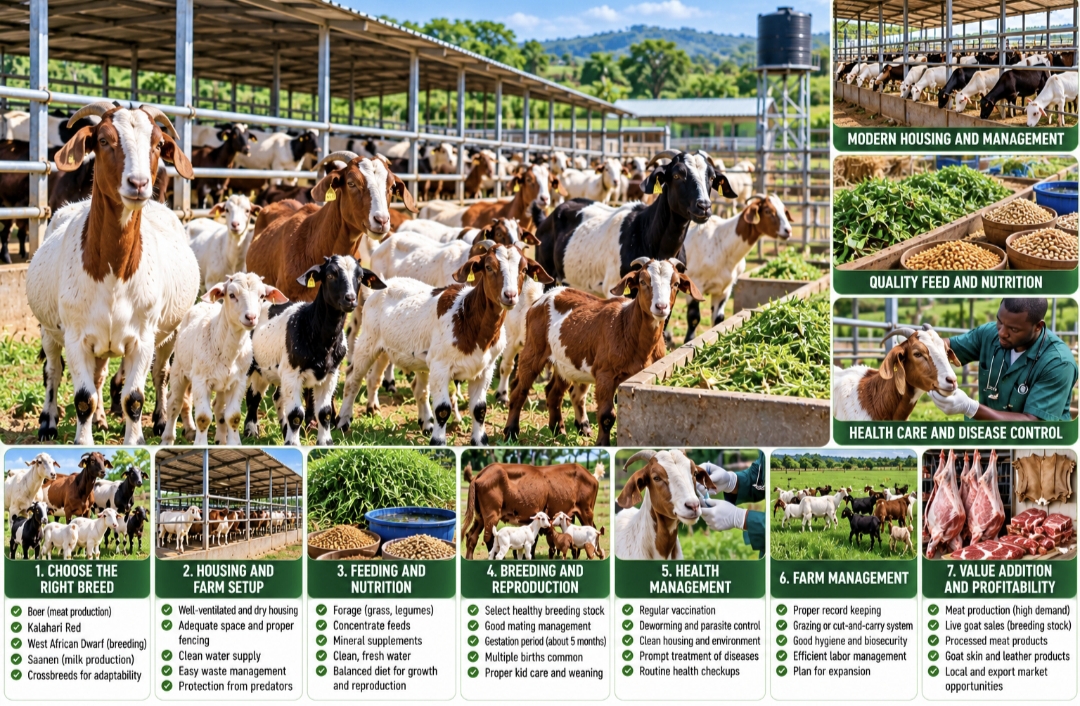
Goat farming is an important branch of livestock agriculture practiced by farmers in many parts of the world. Goats are valued for meat, milk, breeding stock, hides and skins, manure and other agricultural products.
Commercial goat farming can be operated on a small, medium or large scale. Farmers can raise goats under free-range, grazing, semi-intensive or intensive systems, depending on land availability, climate, available feed, labour, capital and market demand.
One of the advantages of goats is their ability to utilize a wide range of vegetation. They can browse shrubs and other plants that may not be fully utilized by cattle. However, successful commercial production still requires proper nutrition, clean water, housing, breeding, disease prevention, security and good financial management.
This guide explains how to establish and manage a commercial goat farm, select suitable goats, develop feeding systems, manage breeding, prevent disease, reduce mortality and market goats profitably.
What Is Commercial Goat Farming?
Commercial goat farming is the planned production of goats for income.
Depending on the enterprise, farmers may focus on:
- Meat production
- Milk production
- Breeding stock
- Kid production
- Fattening
- Hides and skins
- Manure
A commercial goat farm should be managed as a business rather than simply as a collection of animals.
The farmer should know how much each animal costs to maintain, how quickly it grows, how often breeding females reproduce, how many animals survive and how much revenue the farm generates.
Why Start a Goat Farming Business?
Goats can be attractive to farmers because they are adaptable animals and can utilize different types of forage.
Potential advantages include:
- Relatively flexible production systems
- Multiple market opportunities
- Meat demand in many regions
- Ability to utilize browse and forage
- Reproductive potential
- Manure production
- Opportunities for breeding-stock sales
However, profitability is not automatic. Good management remains essential.
Major Types of Goat Farming
Goat farming can be divided into several production categories.
Meat Goat Farming
Meat goat farming focuses on producing goats for meat.
The farmer may maintain breeding females, produce kids and raise them until they reach suitable market condition.
Another model is purchasing young goats and fattening them for sale.
Dairy Goat Farming
Dairy goats are raised primarily for milk.
A dairy operation requires careful attention to:
- Breed selection
- Feeding
- Clean water
- Milking hygiene
- Reproduction
- Udder health
- Milk marketing
Breeding Goat Farming
Breeding farms focus on producing healthy goats with desirable characteristics.
Breeding animals may be sold to other farmers who want to improve their herds.
Goat Fattening
Goat fattening involves purchasing goats at a suitable stage, providing adequate nutrition and selling them after they reach the desired condition.
Profit depends on:
- Purchase price
- Feed cost
- Growth rate
- Health
- Labour
- Selling price
Choosing a Goat Breed
Breed selection should be based on the purpose of the farm.
Consider:
- Climate
- Disease resistance
- Growth rate
- Mature size
- Meat production
- Milk production
- Reproductive performance
- Adaptability
- Availability
- Market demand
There is no single goat breed that is automatically suitable for every farm.
Indigenous Goats
Locally adapted goats can have valuable characteristics because they have evolved or been selected under local environmental conditions.
They may be suitable for farmers who prioritize adaptability and relatively low-input production.
Improved Goats and Crossbreeding
Improved breeds and carefully planned crossbreeding can increase production potential.
Crossbreeding can combine characteristics such as:
- Adaptability
- Growth
- Meat production
- Milk production
- Reproductive performance
However, breeding decisions should be based on clear production objectives.
Selecting Healthy Goats
When purchasing goats, examine the animals carefully.
Look for:
- Bright eyes
- Normal movement
- Healthy coat
- Good appetite
- Appropriate body condition
- Normal breathing
- No obvious wounds
- No visible signs of disease
- Sound legs and feet
Avoid purchasing animals simply because they are cheap.
Male and Female Goat Selection
Breeding females should be healthy and reproductively sound.
Breeding males should have:
- Good body structure
- Healthy reproductive organs
- Strong legs
- Good body condition
- Desirable growth characteristics
- Good health
A single breeding male can influence many offspring, so selection is important.
Land Requirements
Goat land requirements vary considerably.
The amount of land required depends on:
- Goat numbers
- Pasture quality
- Browse availability
- Rainfall
- Soil fertility
- Grazing system
- Supplementary feeding
A farm should determine its carrying capacity before expanding the herd.
Goat Housing
Goats need protection from excessive rain, heat, predators and other environmental stresses.
A good goat house should provide:
- Adequate ventilation
- Good drainage
- Dry flooring
- Protection from rain
- Shade
- Easy cleaning
- Adequate space
Because goats can be sensitive to wet conditions, keeping housing dry is particularly important.
Raised Goat Housing
In some production systems, goats are kept in raised structures.
Raised housing can improve ventilation and help separate animals from wet or contaminated ground.
However, the design should be appropriate for the local climate and goat breed.
Goat Fencing
Goats are active animals and can escape through weak fencing.
Fencing should be strong enough to prevent animals from leaving the production area.
Good fencing can also:
- Protect crops
- Create grazing paddocks
- Improve pasture management
- Reduce theft
- Control breeding
Goat Feeding
Goats can consume a wide range of vegetation, but commercial production requires adequate nutrition.
Feed may include:
- Pasture
- Browse
- Forage legumes
- Hay
- Silage
- Crop residues
- Commercial concentrates
- Mineral supplements
The diet should be adjusted according to age and production stage.
Browse Feeding
Goats are natural browsers and often consume leaves, shrubs and other vegetation.
This behaviour can be useful when managing land containing suitable browse plants.
However, farmers must ensure that plants offered to goats are safe and non-toxic.
Supplementary Feeding
Supplementary feed may be required when:
- Pasture is poor
- Animals are growing rapidly
- Females are pregnant
- Females are producing milk
- Kids are being raised
- Goats are being fattened
The goal should be to provide a balanced diet rather than simply increasing the quantity of feed.
Water Requirements
Clean water should be available regularly.
Water requirements vary according to:
- Body size
- Temperature
- Diet
- Pregnancy
- Milk production
- Activity
Water troughs should be kept clean and positioned where animals can access them easily.
Mineral Nutrition
Minerals contribute to:
- Bone development
- Growth
- Reproduction
- Milk production
- General health
Appropriate mineral supplementation may be necessary depending on the quality of available feed.
Goat Breeding
Breeding is central to a commercial goat enterprise.
A good breeding programme aims to produce:
- Healthy kids
- Good growth
- Strong reproductive performance
- Suitable market characteristics
Farmers should maintain breeding records to identify productive and unproductive animals.
Choosing Breeding Females
Good breeding females should generally have:
- Good health
- Sound body structure
- Good reproductive history
- Adequate body condition
- Good mothering ability
- Appropriate breed characteristics
Females with repeated reproductive problems should be evaluated carefully.
Choosing Breeding Bucks
A breeding buck should be healthy, fertile and structurally sound.
Important considerations include:
- Legs and feet
- Body condition
- Reproductive organs
- Growth characteristics
- Breed characteristics
- Health history
Using unrelated breeding stock can also help avoid excessive inbreeding.
Kid Management
Newborn kids require careful management.
Important practices include:
- Ensuring adequate colostrum intake
- Keeping the environment clean and dry
- Monitoring feeding
- Protecting against cold and wet conditions
- Appropriate vaccination
- Parasite control
- Regular growth monitoring
Kid mortality can significantly affect the profitability of a breeding enterprise.
Goat Health Management
Disease prevention should be a priority.
A health programme can include:
- Vaccination where appropriate
- Parasite control
- Regular observation
- Quarantine
- Good nutrition
- Clean water
- Hygiene
- Veterinary care
Local disease risks vary, so farmers should work with qualified veterinary professionals.
Common Goat Health Problems
Goats can suffer from various diseases, parasites and nutritional problems.
Potential problems include:
- Internal parasites
- External parasites
- Respiratory diseases
- Digestive disorders
- Foot problems
- Reproductive problems
- Nutritional deficiencies
Early detection is important.
Farmers should regularly observe animals for changes in:
- Appetite
- Movement
- Droppings
- Breathing
- Body condition
- Behaviour
Parasite Management
Parasites can reduce growth and productivity.
Signs of parasite problems may include:
- Weight loss
- Poor growth
- Anaemia
- Weakness
- Diarrhoea
- Poor body condition
Parasite control should be based on local conditions and veterinary recommendations rather than indiscriminate use of medicines.
Quarantine
Newly purchased goats should be separated from the existing herd for an appropriate quarantine period.
During this time, farmers can:
- Observe the animals
- Conduct health checks
- Treat identified problems
- Apply appropriate preventive measures
This reduces the risk of introducing disease to the established herd.
Goat Record Keeping
Commercial goat farmers should maintain records of:
- Animal identification
- Purchase price
- Birth dates
- Parentage
- Breeding
- Kidding
- Vaccination
- Treatment
- Weight
- Mortality
- Feed expenses
- Sales
Records help farmers identify the most productive animals.
Goat Identification
Goats can be identified using:
- Ear tags
- Electronic identification
- Other suitable farm identification methods
Individual identification makes breeding and health records more accurate.
Goat Marketing
Potential buyers include:
- Livestock traders
- Butchers
- Restaurants
- Consumers
- Breeding farmers
- Meat processors
- Wholesalers
Farmers should identify potential buyers before significantly expanding production.
Seasonal Goat Markets
Demand for goats can vary throughout the year.
Farmers should study local market patterns rather than assuming prices will always remain constant.
Planning production around predictable periods of increased demand can sometimes improve marketing opportunities.
Goat Fattening Business Model
A basic fattening operation can follow this structure:
Purchase goats → quarantine → feed → monitor growth → sell
The farmer should calculate the total cost per goat.
For example:
Total cost = Purchase price + feed + health + labour + transport + other costs
Then:
Profit = Selling price − total cost
This calculation should be performed before purchasing animals.
Value Addition
Goat farming can support several value chains.
These include:
- Live goats
- Meat
- Milk
- Breeding animals
- Manure
- Hides and skins
Farmers can gradually move into value-added production as their market and infrastructure develop.
Goat Manure
Goat manure can be useful in crop production.
It can be:
- Composted
- Applied to farmland
- Used in organic fertilizer production
Proper handling is important to reduce contamination and nutrient losses.
Integrated Goat and Crop Farming
Goats can be integrated with crop production.
For example:
Crop residues → suitable goat feed
and:
Goat manure → crop fields
This can improve resource utilization and diversify farm income.
Starting a Goat Farm With Limited Capital
A beginner should avoid spending the entire budget on goats.
A reasonable business plan should allocate resources for:
- Goats
- Housing
- Fencing
- Water
- Feed
- Veterinary care
- Labour
- Transport
- Emergency expenses
Infrastructure can be just as important as the animals themselves.
Example Budget Structure
An illustrative allocation could look like this: Expense Example allocation Goat purchase 45–55% Housing 10–15% Fencing 8–12% Feed reserve 8–12% Water 5–8% Veterinary care 3–5% Labour and transport 5–8% Emergency reserve 3–5%
These percentages are planning examples, not fixed prices.
Actual costs vary by location, breed, age, season and market conditions.
How to Calculate Goat Farming Profit
The basic formula is:
Profit = Total Revenue − Total Costs
Revenue may come from:
- Goat sales
- Kid sales
- Breeding stock
- Milk
- Manure
- Other products
Costs include:
- Animal purchase
- Feed
- Veterinary care
- Housing
- Labour
- Water
- Transport
- Marketing
- Mortality losses
Farmers should evaluate profitability over an entire production cycle.
Important Goat Farming Performance Indicators
Monitor:
Kid survival rate
Number of surviving kids ÷ total kids born × 100
Mortality rate
Number of deaths ÷ total animals × 100
Average growth
Change in body weight over a specified period.
Revenue per goat
Total sales revenue ÷ number of goats sold.
Feed cost per goat
Total feed expenditure ÷ number of goats.
These indicators can reveal where improvements are needed.
Major Risks in Goat Farming
Important risks include:
- Disease
- Parasites
- Kid mortality
- Poor nutrition
- Theft
- Predators
- Feed shortages
- Drought
- Market-price changes
- Poor breeding
Risk management should be incorporated into the farm plan.
How to Make Goat Farming More Profitable
Farmers can improve profitability by:
- Selecting productive breeding animals
- Improving kid survival
- Reducing feed waste
- Producing quality forage
- Maintaining good health
- Keeping accurate records
- Building reliable markets
- Selling animals strategically
- Reducing unnecessary expenses
- Reinvesting in productive infrastructure
Modern Technology in Goat Farming
Technology can improve goat farm management.
Useful tools include:
- Digital records
- Electronic identification
- Weighing equipment
- Farm-management applications
- Automated water systems
- Remote monitoring
Even a simple spreadsheet or well-organized notebook can make a major difference in farm management.
Sustainable Goat Farming
Sustainable goat production involves protecting both animals and the land.
Important practices include:
- Avoiding overgrazing
- Rotating grazing areas
- Protecting soil
- Maintaining pasture
- Managing manure
- Conserving water
- Preventing unnecessary chemical use
- Maintaining appropriate stocking rates
Common Mistakes Beginners Should Avoid
Buying unhealthy goats
Cheap goats may become expensive if they require extensive treatment or have poor productivity.
Overstocking
Keeping too many goats can destroy available pasture and increase feeding costs.
Poor housing
Wet, dirty and poorly ventilated housing can increase disease problems.
Ignoring breeding records
Without records, it becomes difficult to identify productive females and males.
Waiting until feed runs out
Feed reserves should be prepared before pasture shortages occur.
Ignoring the market
The farm should have a clear marketing strategy.
Step-by-Step Plan for Starting a Goat Farm
Step 1: Choose your production objective.
Step 2: Select the appropriate goat type.
Step 3: Assess your land and carrying capacity.
Step 4: Establish housing.
Step 5: Install fencing.
Step 6: Provide reliable water.
Step 7: Establish pasture and forage resources.
Step 8: Identify reputable goat suppliers.
Step 9: Purchase healthy animals.
Step 10: Quarantine new goats.
Step 11: Establish a veterinary programme.
Step 12: Start breeding and production records.
Step 13: Identify buyers.
Step 14: Monitor growth and reproduction.
Step 15: Sell goats according to the business plan.
Step 16: Reinvest and expand gradually.
Frequently Asked Questions About Goat Farming
Is goat farming profitable?
Goat farming can generate profit when feed, health, breeding, labour and marketing are properly managed. Actual profitability varies according to production costs and market conditions.
How many goats should a beginner start with?
There is no universal number. The appropriate starting herd depends on available capital, land, housing, labour, feed and experience.
What do goats eat?
Goats can eat suitable grasses, browse, forage plants, hay, silage, crop residues and appropriately formulated supplementary feeds.
Do goats need shelter?
Yes. Good shelter protects goats from excessive rain, heat, predators and poor environmental conditions.
How often do goats reproduce?
Reproductive performance varies by breed, nutrition, health and management. Farmers should use local breeding information and maintain individual records rather than assuming every goat follows the same reproductive pattern.
Can goats and cattle graze together?
They can sometimes be integrated because goats and cattle have different feeding preferences, but stocking density, pasture availability, disease management and animal behaviour must be considered.
Can goat manure be used as fertilizer?
Yes. Properly managed goat manure can be used as an organic nutrient source for crops.
Final Thoughts
Commercial goat farming can become a sustainable agricultural business when it is managed as a complete production system.
The foundation of the enterprise is healthy breeding stock, appropriate nutrition, reliable water, good housing, effective disease prevention, proper breeding management, accurate records and dependable markets.
Farmers should avoid the temptation to expand too quickly. A smaller, well-managed herd can provide a stronger foundation for future expansion than a large herd that exceeds the farm's feed, water and management capacity.
The long-term objective should be to develop a goat enterprise that efficiently converts available forage and farm resources into valuable livestock products while maintaining healthy animals and productive land.
With careful planning, disciplined management and a clear market strategy, goat farming can become an important source of income and contribute to the wider livestock value chain.
Latest posts;
- Types of Yam in Africa and Their Commercial Benefits: A Complete Guide to Yam Production, Uses and Business Opportunities
- Types of Potato: Complete Guide to Potato Varieties, Uses, Characteristics and Best Types for Farming.
- Types of Pepper Widely Known and Used in Africa: A Comprehensive Guide to Pepper Varieties, Uses, Cultivation and Economic Importance

- Transforming Agriculture: How an Effective Website Can Boost Your Agro Business

- Transforming Agriculture with Cutting-Edge Web Solutions

- Tilapia Farming: Complete Guide to Raising Tilapia for Commercial Production

- SUCCESSFUL WATERMELON FARMING: A Complete Guide to Growing Watermelon for Profit.
- Soybean Farming: Complete Guide to Growing Soybeans for Profit
- Sheep Farming: Complete Guide to Raising Sheep for Commercial Profit