Preface
Fish pond construction is one of the most important investments in commercial aquaculture. A properly designed pond provides fish with a suitable environment for feeding, growth, water management and harvesting, while a poorly constructed pond can lead to water leakage, flooding, fish escape, poor water quality and unnecessary operating costs.
Whether you are planning a small backyard fish farm or a large commercial aquaculture project, pond construction should begin with proper planning rather than immediately digging or building. The type of pond, location, soil, water source, drainage system, stocking density, target fish species and available budget should all be considered before construction begins.
Modern fish ponds can be constructed using several materials and designs, including earthen ponds, concrete ponds, lined ponds, tarpaulin tanks, fiberglass tanks, plastic tanks and specialized intensive aquaculture systems. Each system has advantages and limitations.
This comprehensive guide explains how to choose a suitable fish pond site, select the right pond type, calculate pond size, design water inlet and drainage systems, construct an earthen or concrete pond, install essential equipment, manage water quality and avoid common construction mistakes.
What Is a Fish Pond?
A fish pond is a constructed or modified water body designed for raising fish under controlled conditions.
Fish ponds can range from small tanks used by household producers to large commercial ponds capable of holding thousands or millions of fish.
The primary purpose is to provide a controlled environment where farmers can manage:
- Fish stocking
- Feeding
- Water quality
- Growth
- Disease prevention
- Harvesting
- Production costs
A good pond should make these activities easier rather than more difficult.
Why Fish Pond Construction Matters
Pond construction directly affects the performance of a fish farm.
A well-designed pond can provide:
- Efficient water management
- Easier feeding
- Better fish monitoring
- Easier harvesting
- Reduced water loss
- Improved biosecurity
- Better use of available land
- Lower maintenance costs
Poor construction can create:
- Leakage
- Erosion
- Flooding
- Fish escape
- Difficult harvesting
- Stagnant water
- Poor drainage
- Structural failure
Construction should therefore be considered a long-term farm investment.
Types of Fish Ponds
The most common fish production systems include:
- Earthen ponds
- Concrete ponds
- Lined ponds
- Tarpaulin ponds
- Plastic tanks
- Fiberglass tanks
- Raceways
- Circular tanks
- Recirculating aquaculture systems
The appropriate choice depends on fish species, available land, water supply, production intensity and investment capacity.
Earthen Fish Ponds
Earthen ponds are excavated directly into suitable soil.
They are widely used because they can provide relatively large production areas and may support natural biological productivity.
Advantages include:
- Suitable for large areas
- Potentially lower construction cost per unit of area
- Natural pond environment
- Suitable for several freshwater species
- Can support extensive or semi-intensive production
However, they require suitable soil and careful engineering.
Concrete Fish Ponds
Concrete ponds use reinforced concrete or concrete blocks to create a permanent structure.
Advantages include:
- Long service life when properly constructed
- Easy cleaning
- Good control of water levels
- Easier harvesting
- Suitable for intensive production
- Can be built in relatively small spaces
Disadvantages may include:
- Higher initial construction cost
- Greater heat exposure in some environments
- Requirement for proper drainage
- Cracking if poorly constructed
Lined Fish Ponds
Lined ponds use materials such as geomembranes to prevent water from contacting unsuitable soil.
Liners can be useful where the soil has poor water-retention properties.
Advantages include:
- Reduced seepage
- Suitable for sandy soils
- Easier cleaning
- Greater control over pond structure
- Flexible design
However, liners must be installed correctly to prevent punctures and damage.
Tarpaulin Fish Ponds
Tarpaulin tanks are often used for small-scale or intensive aquaculture.
They may be installed relatively quickly and can be useful where land is limited.
However, the supporting frame must be strong enough to withstand water pressure.
Choosing the Best Fish Pond Type
There is no single pond type that is best for every fish farmer.
Consider:
- Available land
- Soil characteristics
- Budget
- Fish species
- Production target
- Water supply
- Expected farm lifespan
- Maintenance capacity
- Local construction materials
- Harvesting requirements
A small urban fish farm may prefer tanks, while a large rural farm may find earthen ponds more practical.
Choosing a Suitable Fish Pond Location
Location is one of the first decisions to make.
A suitable site should ideally have:
- Reliable water supply
- Appropriate soil
- Good drainage
- Low flood risk
- Road access
- Security
- Sufficient sunlight
- Reasonable proximity to markets
- Adequate space for expansion
Avoid areas that regularly flood unless the pond is specifically engineered to withstand such conditions.
Importance of Soil Testing
Soil is particularly important for earthen ponds.
The soil should be tested for its ability to retain water and support the pond structure.
Clay-rich soils generally retain water better than highly sandy soils.
Very sandy or gravelly soil can cause excessive seepage.
A professional soil assessment is recommended for significant commercial projects.
Testing Soil for an Earthen Pond
A simple preliminary assessment can involve examining soil from several points across the proposed site.
Look for:
- Soil texture
- Clay content
- Gravel
- Organic matter
- Hardpan layers
- Water-table conditions
For commercial projects, laboratory testing and professional engineering advice provide much greater confidence.
Land Slope and Fish Pond Construction
A moderate natural slope can help with drainage.
However, excessive slopes may increase excavation costs and erosion risk.
The site should be surveyed before construction so the farmer understands elevation differences and can plan water flow.
Water Source for a Fish Pond
Possible water sources include:
- Boreholes
- Wells
- Springs
- Rivers
- Reservoirs
- Rainwater
- Treated water
Water should be tested before being introduced into the fish production system.
Potential problems include:
- Excessive acidity or alkalinity
- Contamination
- Agricultural chemicals
- Heavy metals
- Pathogens
- High salinity
- Low oxygen
The suitability of a water source depends on the target species.
Pond Size and Fish Production
Pond size should be based on the intended production system.
A small pond may be easier to manage but may have limited production capacity.
A large pond can produce more fish but may require:
- More water
- More feed
- More labor
- Better aeration
- More sophisticated harvesting equipment
Bigger is not automatically better.
How to Calculate Pond Area
For a rectangular pond:
Area = Length × Width
For example, a pond measuring 20 meters by 10 meters has:
20 × 10 = 200 square meters
If the average water depth is 1.2 meters:
Volume ≈ 200 × 1.2 = 240 cubic meters
This basic calculation helps estimate water requirements.
Fish Pond Water Volume
Water volume is important for estimating stocking capacity, water exchange and treatment requirements.
For a rectangular pond:
Volume = Length × Width × Average Depth
Suppose a pond is:
- 15 m long
- 8 m wide
- 1.2 m average depth
Volume:
15 × 8 × 1.2 = 144 cubic meters
One cubic meter equals approximately 1,000 liters, so the pond contains approximately:
144,000 liters
This is an estimate because the actual volume depends on pond shape and water level.
Recommended Fish Pond Depth
Pond depth depends on species, climate, production system and design.
Many freshwater grow-out ponds are designed with sufficient depth to maintain stable environmental conditions without making harvesting unnecessarily difficult.
A pond that is too shallow may experience excessive temperature fluctuations and weed growth.
A pond that is excessively deep can increase excavation and construction costs.
The exact depth should therefore be determined by the species and production method.
Pond Shape
Common pond shapes include:
- Rectangular
- Square
- Circular
- Oval
- Irregular natural shapes
Rectangular ponds are often convenient for commercial farming because they make feeding, netting and harvesting easier.
Circular tanks can provide useful water circulation in intensive systems.
Pond Bottom Design
The pond bottom should not be completely flat when drainage and harvesting are important.
A gentle slope toward the drainage point can help:
- Remove water
- Collect fish
- Remove settled waste
- Simplify cleaning
The exact slope should be determined during professional design.
Fish Pond Embankments
Earthen ponds require strong embankments.
Embankments should be constructed from suitable compacted material.
Weak embankments can collapse because of:
- Poor compaction
- Erosion
- Heavy rainfall
- Animal activity
- Water seepage
- Poor slope design
The top of the embankment should be wide and stable enough for inspection and maintenance.
Pond Freeboard
Freeboard is the vertical distance between the normal water surface and the top of the pond embankment.
Adequate freeboard reduces the risk of water overflowing during rainfall, wave action or sudden inflow.
The required freeboard depends on pond size, rainfall, site conditions and engineering design.
Fish Pond Inlet System
The inlet allows water to enter the pond.
It should be designed so that:
- Water enters safely
- Soil erosion is minimized
- Fish cannot easily escape
- Unwanted organisms are excluded where possible
- Water flow can be controlled
An inlet screen or filter can help prevent unwanted fish and debris from entering.
Fish Pond Outlet System
The outlet controls water removal.
A well-designed outlet is essential for:
- Partial water exchange
- Emergency drainage
- Harvesting
- Pond maintenance
Possible outlet designs include:
- Standpipes
- Monk outlets
- Drain pipes
- Sluice systems
The appropriate system depends on pond type and scale.
Complete Drainage Is Important
A pond that cannot be properly drained can make harvesting and maintenance difficult.
Before construction, ask:
Can this pond be completely or sufficiently drained when required?
This question should be answered during the design stage, not after construction.
Fish Escape Prevention
Fish escape represents both financial loss and environmental risk.
Escape can occur through:
- Overflow
- Inlet pipes
- Outlet pipes
- Damaged liners
- Cracked walls
- Weak embankments
Install suitable screens and maintain all structures regularly.
Pond Overflow Protection
Every pond should have a plan for excess water.
This is particularly important in areas receiving heavy rainfall.
Overflow systems should safely direct excess water away from the pond without damaging embankments.
An emergency spillway may be appropriate for larger earthen ponds.
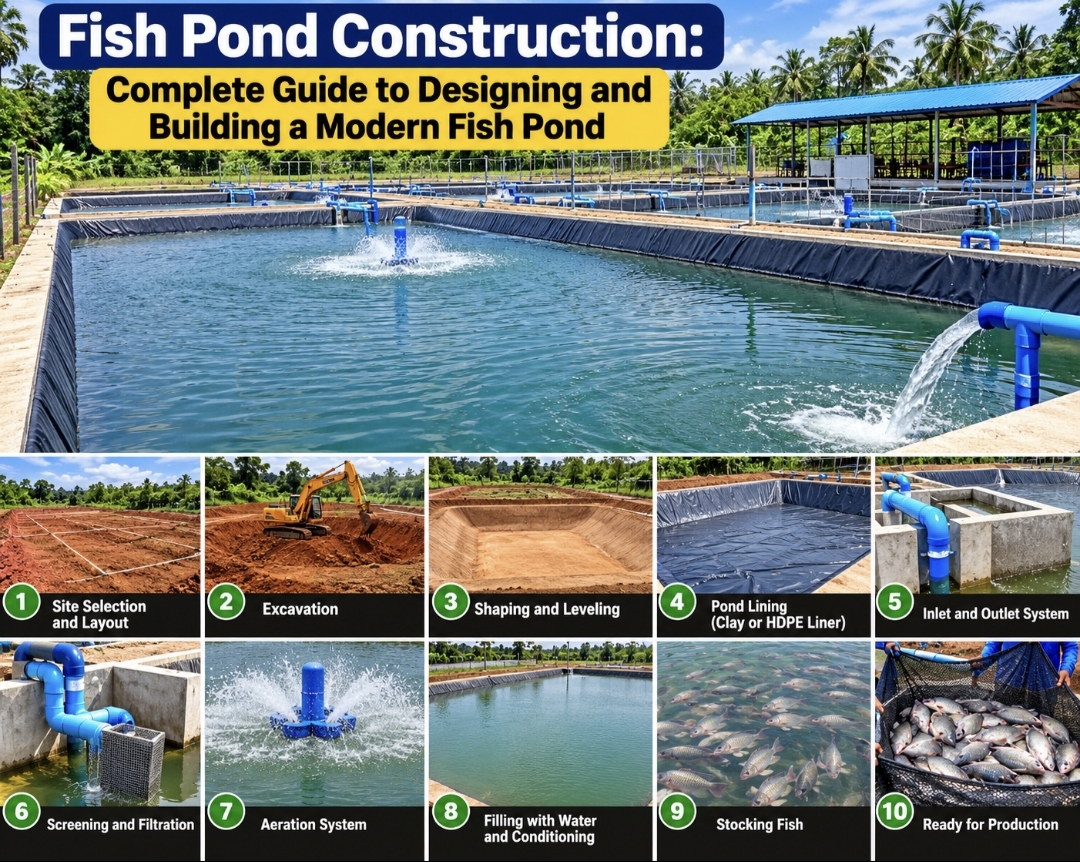
Fish Pond Construction Steps
A general construction process includes:
Step 1: Select the site.
Step 2: Conduct soil and water assessments.
Step 3: Survey the land.
Step 4: Determine pond dimensions.
Step 5: Design inlet and outlet systems.
Step 6: Clear vegetation.
Step 7: Excavate or construct the pond.
Step 8: Build and compact embankments.
Step 9: Install plumbing.
Step 10: Install screens and drainage structures.
Step 11: Complete the pond bottom.
Step 12: Test for leakage.
Step 13: Fill gradually.
Step 14: Test water quality.
Step 15: Prepare the pond for stocking.
Clearing the Construction Site
Remove:
- Trees where appropriate
- Large roots
- Bushes
- Organic debris
- Construction waste
Roots left beneath an earthen embankment can create pathways for water leakage.
However, vegetation should be removed responsibly and in compliance with applicable environmental requirements.
Excavation
Excavation should follow the planned dimensions.
Avoid simply digging until the desired amount of soil has been removed without considering:
- Pond depth
- Bottom slope
- Embankment height
- Drainage
- Water level
- Overflow
Professional surveying can greatly improve accuracy.
Compacting Earthen Pond Walls
Compaction is critical.
Loose soil can allow water to pass through embankments.
Proper compaction reduces:
- Seepage
- Erosion
- Structural weakness
Heavy machinery may be required for larger commercial ponds.
Concrete Pond Construction
Concrete ponds require a properly prepared foundation.
Typical considerations include:
- Ground stability
- Reinforcement
- Wall thickness
- Floor design
- Drainage
- Water pressure
- Concrete quality
- Curing
Concrete construction should be carried out by qualified builders or engineers for commercial installations.
Waterproofing Concrete Fish Ponds
Freshly constructed concrete surfaces may affect water chemistry.
The pond should be properly cured and prepared before fish are introduced.
Any coatings or waterproofing materials must be suitable for aquatic use and fully cured according to manufacturer requirements.
Pond Liner Installation
When using a liner:
- Prepare the surface
- Remove sharp stones
- Eliminate roots
- Create appropriate slopes
- Use suitable underlayment where required
- Install the liner carefully
- Secure edges properly
- Inspect for punctures
A small puncture can result in significant water loss.
Fish Pond Plumbing
Plumbing should be sized according to expected water flow.
The system may include:
- Inlet pipes
- Outlet pipes
- Valves
- Overflow pipes
- Drainage pipes
- Aeration lines
- Water-return pipes
Poorly sized plumbing can make water management inefficient.
Installing Pumps
Pumps may be necessary when water cannot move by gravity.
Before selecting a pump, calculate:
- Required flow rate
- Vertical lift
- Pipe distance
- Pipe diameter
- Operating hours
- Energy source
A pump should be selected based on the actual hydraulic requirements rather than simply purchasing the most powerful model.
Aeration in Fish Ponds
Aeration adds oxygen and can improve water circulation.
Aeration may become especially important when:
- Stocking density is high
- Feeding rates are high
- Water is warm
- Natural oxygen production is insufficient
- Organic loading is high
Possible systems include:
- Paddlewheel aerators
- Diffused-air systems
- Blowers
- Air stones
- Surface aerators
Do All Fish Ponds Need Aerators?
Not necessarily.
Extensive ponds with low stocking densities may receive adequate oxygen from natural processes.
Intensive systems, however, often benefit significantly from mechanical aeration.
The decision should be based on stocking density, water quality and production objectives.
Fish Pond Water Quality
A properly constructed pond should allow the farmer to maintain suitable water quality.
Important parameters include:
- Temperature
- Dissolved oxygen
- pH
- Ammonia
- Nitrite
- Alkalinity
- Turbidity
Water quality should be monitored regularly.
Pond Preparation Before Stocking
Before introducing fish:
- Check for leaks
- Test water quality
- Verify drainage
- Inspect screens
- Confirm aeration
- Remove harmful debris
- Ensure the water source is safe
New ponds may require conditioning before stocking.
Fish Stocking
Fish should be stocked only after the pond is ready.
Important factors include:
- Species
- Fingerling quality
- Fish size
- Stocking density
- Water temperature
- Oxygen
- Acclimatization
Healthy fingerlings generally perform better than weak or stressed stock.
Stocking Density and Pond Design
Pond construction should be based on the planned stocking density.
A pond designed for low-density production may not be suitable for intensive production without additional infrastructure.
High-density production may require:
- Aeration
- Better filtration
- More frequent water exchange
- Stronger drainage
- Better feeding management
Pond Fencing and Security
Security is often overlooked.
A commercial pond can contain significant financial value.
Consider:
- Perimeter fencing
- Gates
- Lighting
- Security personnel where necessary
- Cameras
- Controlled access
Fencing can also reduce livestock access and prevent damage to pond structures.
Protecting Fish Ponds From Predators
Potential predators include:
- Birds
- Snakes
- Frogs
- Mammals
- Larger wild fish
Predator management should prioritize safe, legal and environmentally responsible methods.
Pond screens and appropriate barriers can reduce some risks.
Fish Pond Maintenance
Construction is only the beginning.
Maintenance may include:
- Removing debris
- Checking embankments
- Inspecting pipes
- Cleaning screens
- Monitoring water quality
- Repairing leaks
- Controlling vegetation
- Maintaining pumps
- Maintaining aerators
Regular inspection is cheaper than waiting for structural failure.
Controlling Vegetation Around Fish Ponds
Vegetation can stabilize some pond areas, but excessive vegetation can:
- Obstruct access
- Harbor pests
- Consume oxygen when decomposing
- Interfere with harvesting
Vegetation should therefore be managed rather than allowed to grow uncontrolled.
Fish Pond Leakage
Leakage can occur through:
- Porous soil
- Cracks
- Poor compaction
- Damaged liners
- Pipe joints
- Animal burrows
The cause should be identified before attempting repairs.
Repairing an Earthen Pond
Small leaks may sometimes be addressed by compacting suitable soil.
Larger structural problems may require professional assessment.
Do not simply add more water to compensate for severe leakage because this increases operating costs without solving the underlying problem.
Repairing Concrete Ponds
Concrete cracks should be investigated carefully.
Possible causes include:
- Ground movement
- Poor reinforcement
- Poor construction
- Thermal movement
- Water pressure
A qualified professional should assess significant structural cracks.
Fish Pond Cost Calculation
Fish pond construction costs vary enormously by location, materials, labor, dimensions and design.
Suppose a farmer plans a pond with a total construction budget of $8,000.
A simplified allocation might be:
- Excavation and earthworks: $2,500
- Pond structure/liner: $2,000
- Plumbing: $900
- Pumping and water system: $700
- Aeration: $600
- Drainage and overflow: $500
- Electrical/backup system: $400
- Contingency: $400
Total:
$8,000
This is only an illustrative budgeting framework. Actual construction prices should be obtained locally before investment.
Importance of Construction Contingency
Construction projects frequently encounter unexpected costs.
A contingency reserve can cover:
- Extra excavation
- Soil problems
- Additional pipes
- Structural reinforcement
- Material price changes
- Drainage modifications
- Repairs
Without a contingency budget, construction can stop before completion.
Cost Per Cubic Meter of Pond Capacity
Another useful calculation is construction cost relative to pond capacity.
Suppose:
- Construction cost = $12,000
- Pond volume = 600 cubic meters
Approximate construction cost per cubic meter:
$12,000 ÷ 600 = $20 per cubic meter
This can help compare alternative designs, although land, equipment and other infrastructure should be considered separately.
Return on Fish Pond Investment
A pond should be evaluated based on its ability to generate productive output.
For example, if a pond and associated infrastructure cost $15,000 and generates an additional annual operating profit of $5,000:
Simple payback period = $15,000 ÷ $5,000 = 3 years
This is a simplified calculation and does not account for financing costs, depreciation, taxes, inflation or changing production conditions.
Choosing Between Earthen and Concrete Ponds
Earthen ponds may be preferable when:
- Large land is available
- Soil retains water
- Production is extensive or semi-intensive
- Construction costs must be controlled
Concrete ponds may be preferable when:
- Land is limited
- Intensive production is desired
- Easy cleaning is important
- Water control is critical
The decision should be based on the complete production system.
Modern Fish Pond Design
Modern fish pond design increasingly focuses on:
- Water efficiency
- Automated monitoring
- Efficient drainage
- Better aeration
- Biosecurity
- Easy harvesting
- Reduced labor
- Energy efficiency
A modern pond should be designed around the entire production process.
Smart Fish Ponds
Technology can be incorporated into pond systems using:
- Digital temperature sensors
- Dissolved oxygen sensors
- pH monitoring
- Automatic feeders
- Remote cameras
- Water-level sensors
- Automated pumps
- Alarm systems
These technologies can help farmers identify problems earlier.
Solar Power for Fish Ponds
Solar energy can support:
- Pumps
- Aerators
- Lighting
- Monitoring equipment
Solar systems can be particularly useful where grid electricity is unreliable.
The system should be properly sized according to daily energy requirements.
Rainwater and Fish Pond Management
Rain can provide useful water, but heavy rainfall can also create problems.
Rainfall may:
- Dilute water chemistry
- Reduce temperature
- Cause overflow
- Wash contaminants into ponds
- Damage embankments
Ponds should therefore be designed with appropriate drainage and overflow protection.
Flood Risk Management
Flooding can destroy fish stocks and pond structures.
Risk-reduction measures include:
- Choosing elevated sites where appropriate
- Constructing strong embankments
- Installing spillways
- Maintaining drainage channels
- Avoiding flood-prone locations
- Monitoring weather conditions
Large commercial farms should consider professional hydrological and engineering assessments.
Common Fish Pond Construction Mistakes
Avoid these mistakes:
Building without a site assessment.
A beautiful pond in an unsuitable location can become expensive to maintain.
Ignoring soil quality.
Poor soil can cause severe leakage.
Poor drainage design.
A pond must be able to release water safely.
No overflow system.
Heavy rainfall can cause catastrophic flooding.
Weak embankments.
Poor compaction can result in structural failure.
Improper plumbing.
Inadequate pipe sizing can restrict water flow.
No fish escape protection.
Fish can escape through inlets and outlets.
Constructing too many ponds initially.
It is often better to build a manageable system and expand based on demand.
Ignoring harvesting requirements.
A pond should be designed with harvesting in mind.
Underestimating maintenance.
Every pond requires ongoing inspection.
How to Build a Profitable Fish Pond System
A profitable pond should be designed around economics as well as construction.
Before building, estimate:
- Construction cost
- Fish stocking cost
- Feed requirement
- Labor
- Electricity
- Water
- Maintenance
- Expected survival
- Expected harvest
- Selling price
- Expected revenue
Then calculate whether the project is financially viable.
Designing a Pond for Easy Harvesting
Harvesting should be considered from the beginning.
Useful design features can include:
- Appropriate drainage
- Suitable pond shape
- Harvesting areas
- Accessible pond edges
- Proper water depth
- Strong embankments
- Appropriate nets and equipment
A pond that is difficult to harvest can increase labor costs and fish stress.
Fish Pond and Biosecurity
Pond design can support biosecurity.
For example:
- Separate production units
- Controlled water sources
- Inlet screens
- Dedicated equipment
- Quarantine areas
- Proper drainage
Waste water from one production unit should not unnecessarily contaminate another.
Environmental Considerations
Fish pond construction can affect surrounding ecosystems.
Responsible development should consider:
- Wetlands
- Natural waterways
- Soil erosion
- Wastewater
- Chemical use
- Wildlife
- Flood patterns
Local environmental and land-use requirements should be checked before construction.
How to Expand a Fish Farm
When expansion is planned, leave space for:
- Additional ponds
- Nursery facilities
- Feed storage
- Processing
- Water storage
- Equipment
- Roads
- Drainage
- Staff facilities
Planning for expansion can be much cheaper than rebuilding the farm later.
Final Thoughts on Fish Pond Construction
Fish pond construction is the physical foundation of a successful aquaculture business. A well-designed pond can make feeding, water management, fish monitoring and harvesting easier while reducing unnecessary operating costs.
The best pond is not necessarily the largest or most expensive one. It is the pond that matches the farmer's species, production goals, available resources and management capacity.
Before construction, carefully evaluate the site, soil, water supply, drainage, flood risk and expected stocking density. Then select an appropriate pond type and design the inlet, outlet, overflow, aeration and harvesting systems as one integrated unit.
For commercial projects, professional surveying, engineering and construction advice can prevent expensive mistakes.
Once construction is complete, the farmer's responsibility continues through water-quality management, maintenance, biosecurity, feeding and regular inspection.
A properly planned fish pond can serve the farm for many years and become one of the most valuable assets in a profitable aquaculture operation.
Frequently Asked Questions About Fish Pond Construction
What is the best type of fish pond?
The best type depends on land, soil, water supply, fish species, budget and production intensity. Earthen ponds are useful for many larger operations, while concrete, lined and tank systems can provide greater control in intensive production.
How deep should a fish pond be?
There is no universal depth. Pond depth should be determined by the fish species, climate, production system, water management and harvesting requirements.
Is an earthen pond cheaper than a concrete pond?
Earthen ponds can be less expensive per unit of production area when suitable land and soil are available. However, actual costs depend on excavation, soil conditions, labor, drainage and local material prices.
Can fish be raised in a concrete pond?
Yes. Concrete ponds are widely used for intensive fish production, provided that the structure, drainage, water quality and stocking density are properly managed.
Can I build a fish pond on sandy soil?
It is possible, but highly permeable sandy soil may cause excessive water loss. A suitable liner or engineered soil treatment may be necessary.
What is the best shape for a fish pond?
Rectangular ponds are commonly convenient for commercial production because feeding, netting and harvesting can be easier. Other shapes may be suitable for specific intensive systems.
Does a fish pond need an inlet and outlet?
A properly designed production pond should have controlled water entry and drainage. These systems help manage water levels, improve maintenance and reduce the risk of uncontrolled overflow.
Does a fish pond need an aerator?
Not every pond requires mechanical aeration. The need depends on stocking density, feeding rate, pond size, water quality and production intensity.
How can I prevent fish from escaping?
Use properly designed inlet and outlet screens, maintain embankments, install overflow protection and inspect pipes and liners regularly.
What causes fish pond leakage?
Common causes include permeable soil, cracks, poor compaction, damaged liners, poorly sealed pipes and animal burrows.
How much does it cost to build a fish pond?
There is no universal price. Costs depend on dimensions, pond type, materials, labor, soil, plumbing, water systems and location. A detailed local quotation is needed for accurate budgeting.
Can a small fish pond be profitable?
Yes. Profitability depends on stocking, fish survival, feed efficiency, selling prices, construction costs and operating expenses.
How do I calculate fish pond volume?
For a simple rectangular pond:
Volume = Length × Width × Average Depth
For example, 10 m × 5 m × 1.2 m gives approximately 60 cubic meters of water.
How do I choose a fish pond location?
Choose a site with reliable water, suitable soil, good drainage, low flood risk, road access, security and reasonable proximity to your market.
Should I build the pond before finding customers?
It is better to understand your target market and production plan before investing heavily in infrastructure. Market demand should influence the size and number of ponds you build.
What is the most important part of fish pond construction?
There is no single component. Site selection, soil suitability, structural integrity, water supply, drainage and overflow management all play critical roles.
Can a fish pond be powered by solar energy?
Yes. Solar systems can support pumps, aerators, monitoring devices and other equipment when appropriately sized.
How long can a fish pond last?
The lifespan varies according to construction quality, materials, soil, maintenance and environmental conditions. Properly constructed and maintained ponds can remain productive for many years.
What should I do before stocking fish?
Inspect the pond, test water quality, verify the water inlet and outlet, check aeration, ensure escape protection and confirm that the pond environment is suitable for the selected fish species.
Is professional engineering necessary?
For small simple systems, experienced local construction expertise may be sufficient. For large commercial ponds, complex drainage, high embankments or intensive systems, professional engineering and surveying are strongly recommended.
Latest posts
- Beans Farming: A Complete Guide to Different Types of Beans, Their Uses, Nutrition, and Farming

- Cassava Farming in Africa: A Complete Guide to Planting, Growing, Harvesting and Making Profit from Cassava

- CATFISH FARMING(HYBRID): THE COMPLETE STEP-BY-STEP GUIDE FOR BEGINNERS AND COMMERCIAL FARMERS (2026 EDITION)
- Cattle Fattening Business: Complete Guide to Raising Beef Cattle for Profit

- COCOA FARMING IN AFRICA: A Complete Professional Guide (Part 1)

- COCOA FARMING IN AFRICA: A Complete Professional Guide (Part 2)

- Commercial Carrot Farming: A Complete Guide to Growing Carrots for Profit

- Commercial Cashew Farming: A Complete Guide to Growing Cashew for Profit