Introduction
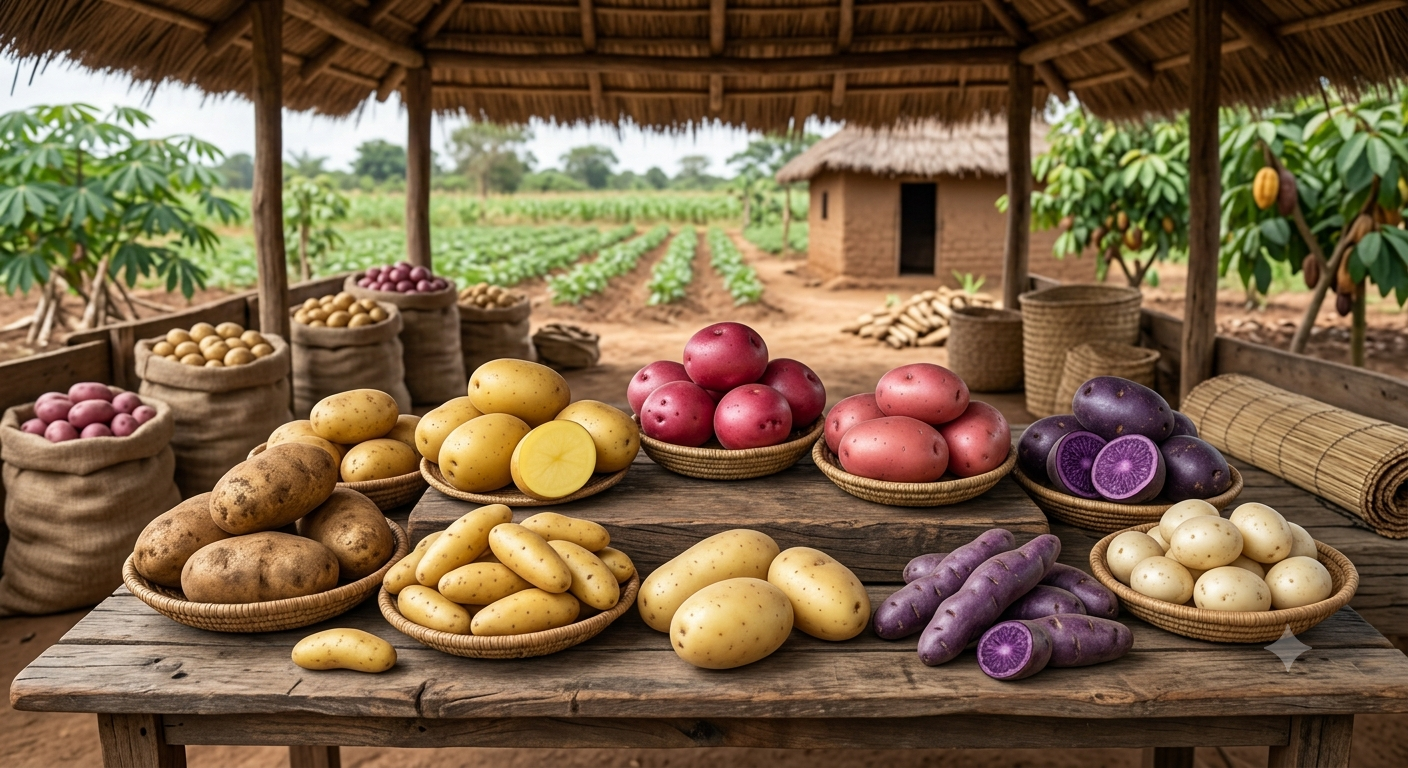
Potato is one of the world's most important food crops and is widely grown and consumed in Africa, Europe, Asia, and the Americas. It is valued for its versatility, relatively short production cycle, nutritional contribution, and strong demand in both local and commercial markets. From fresh table potatoes to French fries, chips, crisps, mashed potatoes, starch, flour, and processed foods, different types of potatoes serve different purposes.
Although many people refer to all potatoes simply as "potatoes," there are actually thousands of potato varieties and cultivars. They differ in skin colour, flesh colour, shape, size, maturity period, texture, yield potential, disease resistance, storage ability, and suitability for particular foods.
Understanding the different types of potato is important for farmers, consumers, food processors, traders, restaurants, and agricultural investors. A variety that performs exceptionally well for French fries may not be the best choice for boiling, while a potato that produces excellent yields in one region may perform poorly under another climate.
For African farmers, choosing the right potato type is particularly important because production conditions vary considerably across the continent. Factors such as altitude, temperature, rainfall, soil type, irrigation, disease pressure, market demand, and access to quality seed potatoes can significantly influence production.
This comprehensive guide explains the major types of potatoes, their characteristics, common uses, popular varieties, differences between potato groups, and important considerations when choosing potatoes for farming and food processing.
What Is a Potato?
Potato is a starchy tuber crop belonging to the nightshade family, Solanaceae. Its scientific name is Solanum tuberosum. The part commonly eaten is an underground storage tuber that develops from the plant's stems.
Potatoes originated in the Andean region of South America, particularly areas around present-day Peru and Bolivia. Indigenous communities cultivated potatoes for thousands of years before the crop spread to other parts of the world.
Today, potatoes are cultivated commercially in many countries and have become an important component of global food systems.
The potato plant develops green leaves and stems above the soil while underground stems called stolons produce tubers. Depending on the variety and growing conditions, the tubers may have white, yellow, cream, red, purple, or brown skin and flesh ranging from white and cream to yellow, pink, or purple.
Potatoes can be classified in several ways, including by skin colour, flesh colour, maturity period, starch content, texture, shape, and culinary purpose.
Major Types of Potatoes
There is no single classification system that covers every potato variety. However, potatoes can broadly be grouped according to their skin colour, flesh colour, starch characteristics, maturity period, and intended use.
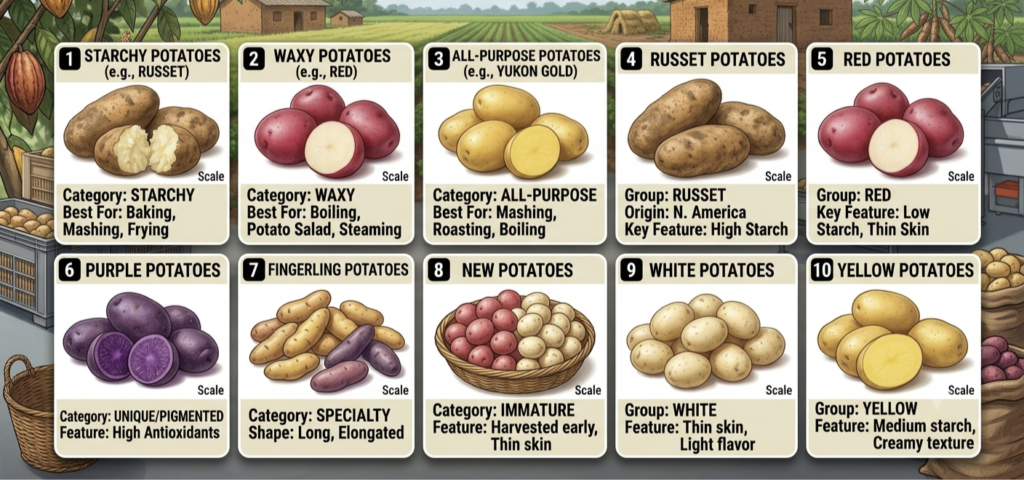
The major types commonly recognized include:
- White potatoes
- Yellow or golden potatoes
- Red potatoes
- Russet potatoes
- Purple or blue potatoes
- Fingerling potatoes
- New potatoes
- Waxy potatoes
- Starchy potatoes
- All-purpose potatoes
Within these groups are numerous individual varieties developed for different growing conditions and markets.
White Potatoes
White potatoes are among the most commonly consumed potato types. They generally have light brown, cream, or pale skin and white flesh.
They are often medium-sized to large and may have round, oval, or slightly elongated shapes depending on the variety.
White potatoes are popular because they are versatile and can be prepared in many ways. They can be boiled, fried, baked, mashed, roasted, steamed, or used in soups and stews.
Their texture can range from moderately waxy to moderately starchy depending on the specific cultivar.
For farmers, white potato varieties can be attractive where consumers and traders have a strong preference for traditional white-fleshed potatoes.
Common Uses of White Potatoes
White potatoes are suitable for:
- Boiling
- Frying
- Mashed potatoes
- Roasting
- Soups
- Stews
- Potato salads
- Home cooking
- Some forms of processing
Because "white potato" describes a broad group rather than one specific cultivar, farmers should always check the characteristics of the particular seed variety before planting.
Yellow and Golden Potatoes
Yellow potatoes have yellow, golden, or cream-coloured flesh. Some varieties have yellowish-brown skin, while others have lighter skin.
They are appreciated for their naturally rich flavour and creamy texture. Many yellow-fleshed varieties have a relatively smooth mouthfeel when cooked.
Yellow potatoes are suitable for roasting, boiling, baking, grilling, mashing, and frying.
Some varieties are also attractive to consumers because of their distinctive golden flesh.
Advantages of Yellow Potatoes
Yellow-fleshed potatoes may offer several market advantages:
- Attractive appearance
- Good flavour
- Creamy cooked texture
- Versatility
- Strong appeal for fresh-food markets
- Suitability for roasting and mashing
Farmers targeting premium fresh markets may consider yellow-fleshed varieties where consumers are willing to pay for them.
Red Potatoes
Red potatoes are recognized by their red or reddish skin. Their flesh is usually white, cream, or slightly yellow.
Many red-skinned potatoes have relatively thin skins, which means they can often be cooked with the skin intact. This makes them popular for roasting, boiling, salads, and other dishes where appearance matters.
Red potatoes are generally associated with waxier textures, although characteristics vary considerably among varieties.
Common Uses of Red Potatoes
Red potatoes can be used for:
- Potato salads
- Boiling
- Roasting
- Steaming
- Soups
- Stews
- Grilling
- General household cooking
The attractive red skin can also give them a marketing advantage in fresh produce markets.
Russet Potatoes
Russet potatoes are particularly important in commercial potato production, especially in markets where French fries and baked potatoes are popular.
They usually have rough, brown, netted skin and white to cream-coloured flesh. Many russet varieties are relatively large and elongated.
Russet potatoes are commonly associated with high dry-matter content and relatively high starch levels. These properties can make certain russet varieties particularly suitable for baking and French fries.
Common Uses of Russet Potatoes
Russet potatoes are commonly used for:
- French fries
- Baking
- Roasting
- Mashed potatoes
- Potato wedges
- Commercial processing
For processors, however, not every russet potato is automatically suitable for every processing application. Specific cultivar characteristics, dry matter, sugar levels, tuber size, and storage conditions all matter.
Purple and Blue Potatoes
Purple and blue potatoes have distinctive coloured skin and flesh. Their colours result from natural pigments called anthocyanins.
These potatoes can range from partially purple-fleshed to deeply purple throughout the flesh.
Their unusual appearance makes them attractive for specialty food markets, restaurants, premium grocery stores, and consumers interested in colourful vegetables.
Purple potatoes can be boiled, roasted, baked, fried, or incorporated into salads and other dishes.
Why Purple Potatoes Are Popular
Purple potatoes are increasingly recognized because:
- They have distinctive colour.
- They provide culinary variety.
- They are attractive in premium food markets.
- Their pigments contain antioxidant compounds.
- They can be used in both traditional and modern recipes.
Farmers should nevertheless evaluate local demand before planting large quantities of specialty-colour potatoes.
Fingerling Potatoes
Fingerling potatoes are small, elongated potatoes that naturally develop a finger-like shape.
They are considered specialty potatoes and are often sold at higher prices than conventional potatoes in some markets.
Fingerlings come in different skin and flesh colours, including yellow, red, purple, and cream.
They are particularly popular for roasting, grilling, steaming, and gourmet cooking.
Characteristics of Fingerling Potatoes
Typical characteristics include:
- Small tuber size
- Elongated shape
- Distinctive appearance
- Rich flavour
- Firm texture
- Specialty-market appeal
They may be suitable for farmers targeting restaurants, hotels, supermarkets, and specialty food consumers.
New Potatoes
"New potato" does not necessarily refer to a specific variety. It usually describes potatoes harvested while they are still young and before the skins have fully matured.
New potatoes generally have thin skins, high moisture content, and a tender texture.
They are often boiled, steamed, roasted, or used in salads.
New Potatoes Versus Mature Potatoes
The main difference is harvest stage.
New potatoes are harvested early, while mature potatoes are allowed to develop fully and usually have firmer skins and better storage characteristics.
New potatoes generally have a shorter storage life and should be handled carefully after harvest.
Waxy Potatoes
Waxy potatoes are potatoes with relatively low starch and higher moisture content. When cooked, they tend to retain their shape rather than breaking apart.
This characteristic makes them suitable for dishes where the potato needs to remain firm.
Waxy potatoes are commonly used for:
- Potato salads
- Boiling
- Steaming
- Soups
- Stews
- Roasting
Their firm texture makes them particularly useful in recipes requiring intact potato pieces.
Starchy Potatoes
Starchy potatoes contain relatively high levels of starch and generally have lower moisture compared with waxy potatoes.
When cooked, they tend to become fluffy and may break apart more easily.
They are commonly preferred for:
- Mashed potatoes
- Baking
- French fries
- Crispy roasted potatoes
- Potato cakes
Russet-type potatoes are well-known examples of potatoes frequently associated with starchy characteristics.
All-Purpose Potatoes
All-purpose potatoes fall between waxy and starchy types. They provide a balance between moisture, starch, firmness, and fluffiness.
This makes them highly versatile.
A good all-purpose potato can be boiled, fried, roasted, baked, mashed, or used in soups.
For households and general fresh markets, all-purpose potatoes can be particularly useful because one variety can serve multiple culinary purposes.
Popular Potato Varieties
Beyond broad potato types, there are numerous named varieties and cultivars. Their availability differs by country and agricultural region.
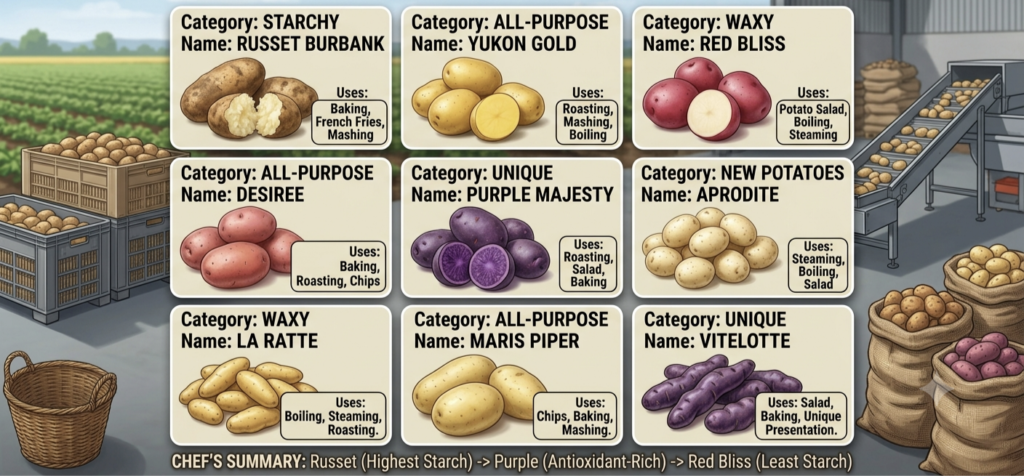
Some internationally recognized potato varieties include:
- Russet Burbank
- Russet Norkotah
- Yukon Gold
- Red Pontiac
- Kennebec
- Desiree
- Maris Piper
- King Edward
- Nicola
- Charlotte
- Agria
- Markies
- Spunta
- Atlantic
- Shepody
- Innovator
- Lady Rosetta
- Hermes
The performance of each variety depends on local environmental conditions and production systems.
Farmers should therefore avoid selecting a variety simply because it is popular in another country. A variety should be evaluated for its suitability to the local climate, soil, disease conditions, market, and available seed supply.
Russet Burbank
Russet Burbank is a well-known russet potato associated with processing and fresh markets.
It produces elongated tubers with russeted brown skin and pale flesh.
It has traditionally been important for French fries and baking.
However, its production requirements can differ from those of other varieties, and farmers should obtain reliable agronomic recommendations before planting it commercially.
Yukon Gold
Yukon Gold is a well-known yellow-fleshed potato variety.
It has yellow skin and golden flesh and is popular because of its creamy texture and versatility.
It can be boiled, mashed, roasted, baked, or fried.
Its attractive colour has also made it popular in fresh-food markets.
Red Pontiac
Red Pontiac is a red-skinned potato known for its attractive appearance and versatility.
It can be used for boiling, roasting, baking, and other household cooking applications.
Its red skin may appeal to consumers looking for visually distinctive potatoes.
Kennebec
Kennebec is a potato variety known for its broad culinary applications.
It has traditionally been used for fresh consumption and processing.
Its characteristics can make it useful for farmers and markets requiring versatile potatoes.
Desiree
Desiree is a red-skinned potato variety widely known in various potato-growing regions.
It generally produces attractive tubers and can be used for multiple cooking purposes.
Because variety availability varies by country, farmers should confirm whether certified Desiree seed is officially available and recommended in their production region.
Maris Piper
Maris Piper is a popular potato variety, particularly associated with the United Kingdom and European markets.
It is widely used for chips, roasting, baking, and other cooking applications.
It is often appreciated for its versatile cooking characteristics.
King Edward
King Edward is another well-known potato variety associated with European production.
It has traditionally been valued for roasting and other culinary uses.
Its attractive appearance and cooking qualities have contributed to its popularity.
Nicola
Nicola is a yellow-skinned, yellow-fleshed potato variety known for its smooth texture and versatile culinary applications.
It is often used for boiling, salads, roasting, and general cooking.
Charlotte
Charlotte is commonly classified as a salad or waxy potato type.
It has a firm texture and is well suited to boiling, steaming, and salad preparation.
Its relatively small, elongated tubers can be attractive in premium fresh markets.
Agria
Agria is a widely recognized potato variety used for both fresh consumption and processing.
It is particularly associated with frying and chips in some production systems.
Its suitability for processing makes varieties with similar characteristics attractive to commercial potato farmers supplying processors.
Markies
Markies is a potato variety associated with processing, particularly French fries and chips.
It is valued in commercial production systems where processing characteristics are important.
Spunta
Spunta is a widely cultivated potato variety in different parts of the world.
It typically produces elongated tubers and can be used for fresh consumption and various culinary applications.
It has been grown in regions with different production conditions, but local recommendations remain important.
Atlantic Potatoes
Atlantic is a potato variety commonly associated with potato chip production.
It has been used by processors because of its characteristics for chipping.
Farmers growing potatoes for industrial processing should select varieties based on the specifications of their target processor rather than simply choosing a popular table potato.
Lady Rosetta
Lady Rosetta is particularly known in the potato-processing industry and is widely associated with crisp and snack production.
Its processing characteristics have made it valuable to industrial potato markets.
Innovator
Innovator is another variety known for processing, especially French fries.
Its elongated tubers can be attractive to processors looking for suitable raw materials for French-fry production.
Types of Potato Based on Culinary Use
Potatoes can also be grouped according to what they are best used for.
Potatoes for French Fries
French-fry production requires potatoes with suitable dry matter, shape, size, sugar levels, and frying characteristics.
Long, uniform tubers are often preferred because they produce longer fries and reduce processing waste.
Common varieties used in French-fry production include certain russet and processing cultivars such as Russet Burbank, Innovator, Markies, and other regionally recommended varieties.
The best choice depends on the processor and local conditions.
Potatoes for Crisps and Chips
Potato chips require varieties that can produce attractive colour and texture after frying.
Low levels of reducing sugars are important because excessive sugar can cause chips to become too dark during frying.
Processing varieties such as Lady Rosetta and Atlantic are associated with crisp production in different markets.
Potatoes for Baking
Baking potatoes are generally selected for their ability to become fluffy and soft internally when cooked.
High-starch varieties are commonly suitable.
Russet-type potatoes are widely used for baked potatoes.
Potatoes for Mashing
Potatoes used for mashing should generally produce a soft, fluffy, creamy, or smooth texture.
Starchy and some all-purpose varieties are commonly suitable.
Yellow-fleshed varieties can also produce attractive and creamy mashed potatoes.
Potatoes for Salads
Potato salads often require potatoes that retain their shape after cooking.
Waxy varieties are therefore frequently preferred.
Red potatoes and fingerling potatoes can be excellent choices for certain salad recipes.
Types of Potato Based on Maturity
Potato varieties can also be grouped according to how quickly they mature.
Early-Maturing Potatoes
Early varieties mature relatively quickly and can allow farmers to harvest sooner.
They can be useful where farmers want to:
- Reduce time in the field
- Fit potatoes into short growing seasons
- Supply early markets
- Rotate crops efficiently
- Reduce exposure to certain late-season risks
However, early maturity does not automatically mean higher profit. Farmers should consider yield, market price, seed cost, disease resistance, and quality.
Medium-Maturing Potatoes
Medium-maturing varieties require more time than early types but may offer a balance between maturity period and yield.
They can be useful in areas with suitable growing seasons and stable market demand.
Late-Maturing Potatoes
Late-maturing varieties generally require a longer growing period.
Some can produce high yields under appropriate conditions and may be suitable for particular processing or storage markets.
However, they require careful management because prolonged exposure to drought, excessive heat, disease, or pests can reduce production.
Potato Types Suitable for African Farming
Potato production is expanding in several African countries, particularly in highland and cooler production zones.
Countries with significant potato production include Nigeria, Kenya, Rwanda, Ethiopia, Egypt, South Africa, Algeria, Morocco, Tanzania, Uganda, and other countries.
However, Africa is not one uniform potato-growing environment. Temperature, altitude, rainfall, soil, disease pressure, and market conditions differ significantly.
Potatoes in Nigeria
Potato production in Nigeria is particularly associated with cooler highland areas, including parts of Plateau State and other suitable regions.
Irish potato production can also occur in other parts of the country when farmers have appropriate temperatures, planting seasons, irrigation, and suitable varieties.
For Nigerian farmers, variety selection should be based on:
- Local climate
- Planting season
- Soil condition
- Irrigation availability
- Disease resistance
- Market demand
- Yield potential
- Seed availability
- Processing requirements
Farmers should obtain certified seed potatoes from reliable agricultural suppliers rather than planting poor-quality or diseased tubers.
Potatoes in Kenya
Kenya is one of Africa's important potato-producing countries.
Potatoes are grown extensively in highland areas where temperatures are suitable.
Kenyan farmers grow several improved potato varieties, including varieties developed or recommended for specific production and market conditions.
Farmers should select varieties based on whether their target market is fresh consumption, processing, chips, crisps, or household use.
Potatoes in Rwanda
Rwanda has a strong potato-growing sector, particularly in highland areas.
Potatoes contribute to food security and household income.
Improved varieties, good-quality seed, disease management, soil fertility, and proper agronomic practices are important for achieving good yields.
Potatoes in Ethiopia
Ethiopia has significant potential for potato production because of its highland environments.
Potatoes are grown by smallholder farmers and commercial producers.
The crop is important for food security and income generation, particularly where climatic conditions are favourable.
Potatoes in Egypt
Egypt has become an important potato producer and exporter.
The country's potato sector includes fresh consumption and processing markets.
Egypt's production conditions differ considerably from African highland systems, demonstrating why potato variety selection must always consider the local environment.
How to Choose the Best Potato Variety for Farming
Choosing a potato variety should never be based only on appearance.
A farmer should consider several factors before purchasing seed.
Climate
Potatoes generally perform best under relatively cool growing conditions.
High temperatures can interfere with tuber formation and development.
Before planting, farmers should determine whether the selected variety is appropriate for their local temperature conditions.
Soil
Potatoes generally perform well in loose, fertile, well-drained soils.
Heavy waterlogged soils can encourage disease and interfere with tuber development and harvesting.
Sandy loam and well-structured soils are often suitable when properly managed.
Disease Resistance
Disease resistance is one of the most important factors in potato production.
Common potato diseases include:
- Late blight
- Early blight
- Bacterial wilt
- Black scurf
- Common scab
- Viral diseases
- Fusarium-related diseases
A variety with resistance or tolerance to important local diseases can reduce production risk.
Yield Potential
Farmers should compare the expected yield potential of different varieties.
However, high genetic yield potential does not guarantee high farm yield.
Actual yield depends on:
- Seed quality
- Soil fertility
- Rainfall
- Irrigation
- Temperature
- Weed control
- Disease management
- Pest management
- Plant population
- Fertilizer management
- Harvest timing
Market Demand
Market demand should influence variety selection.
A farmer producing potatoes for household consumption may choose a different variety from a farmer supplying a French-fry processor.
Before planting commercially, identify the intended buyer.
Processing Requirements
Processors may have specific requirements concerning:
- Tuber size
- Shape
- Dry matter
- Sugar content
- Fry colour
- Defect levels
- Skin quality
- Storage characteristics
Farmers supplying processors should obtain the processor's variety specifications before production.
Difference Between Irish Potatoes and Sweet Potatoes
One common source of confusion is the difference between Irish potatoes and sweet potatoes.
Irish potato refers to the common potato, Solanum tuberosum.
Sweet potato belongs to a completely different botanical family and is scientifically known as Ipomoea batatas.
Despite both being called potatoes, they are not the same crop.
Irish potatoes are starchy tubers produced underground by the potato plant, while sweet potatoes develop as storage roots.
They also differ in taste, texture, nutritional composition, plant structure, and cultivation practices.
Nutritional Value of Potatoes
Potatoes are an important source of carbohydrates and can contribute several nutrients to the diet.
They provide:
- Carbohydrates
- Dietary fibre, especially when eaten with the skin
- Potassium
- Vitamin C
- Vitamin B6
- Other vitamins and minerals
The nutritional profile depends on the variety, growing conditions, preparation method, and whether the skin is consumed.
Boiling, baking, frying, and other cooking methods can significantly influence the final nutritional characteristics of a potato meal.
Are Coloured Potatoes Nutritious?
Purple, blue, red, and yellow potatoes contain natural pigments and plant compounds that contribute to their distinctive colours.
Purple and blue varieties are particularly notable for anthocyanin pigments.
However, the presence of a particular colour does not automatically make one potato universally healthier than another. Overall dietary pattern, preparation method, and portion size are also important.
Potato Processing and Value Addition
Potatoes provide significant opportunities for value addition.
Instead of selling only raw tubers, farmers, entrepreneurs, cooperatives, and processors can develop products such as:
- French fries
- Potato chips
- Crisps
- Frozen fries
- Potato flour
- Potato starch
- Mashed potato products
- Dehydrated potatoes
- Potato flakes
- Potato snacks
- Seasoned potato products
Value addition can potentially increase revenue and reduce dependence on raw produce markets.
French Fries Production
French fries are among the most commercially important potato products.
Processing generally involves sorting, washing, peeling or trimming, cutting, blanching where applicable, drying, frying or freezing, and packaging.
The potato variety used has a major influence on the final product.
Potato Chips
Potato chips are thin slices of potato fried or otherwise processed until crisp.
Commercial chip production requires suitable raw materials with appropriate processing characteristics.
Uniform slicing, frying temperature, oil management, moisture control, and packaging are important for quality.
Potato Flour
Potatoes can be processed into dried potato products and flour.
Potato flour can be used in food manufacturing, bakery products, thickening applications, and specialty recipes.
The processing method should ensure adequate drying and hygienic handling.
Importance of Quality Seed Potatoes
One of the most important factors affecting potato production is seed quality.
Farmers commonly propagate potatoes vegetatively using seed tubers or other planting materials.
Poor-quality seed can introduce diseases and produce weak plants and low yields.
Certified or quality-assured seed potatoes can provide important advantages, including:
- Better emergence
- Improved plant vigour
- Reduced disease risk
- More uniform crop establishment
- Better yield potential
- Improved tuber quality
Farmers should purchase planting material from reputable and authorized sources whenever possible.
Why Farmers Should Avoid Unknown Seed
Using potatoes purchased from an ordinary food market as planting material can create significant risks.
Such tubers may:
- Carry diseases
- Have poor physiological quality
- Produce weak plants
- Have unknown variety identity
- Have poor yield potential
- Be unsuitable for the local environment
Food potatoes and certified seed potatoes serve different purposes.
Potato Storage
Proper storage is essential because potatoes can lose quality after harvest.
Storage conditions should protect tubers from:
- Excessive heat
- Freezing temperatures
- Excessive moisture
- Direct sunlight
- Mechanical damage
- Pests
- Disease
Potatoes exposed to light may develop green coloration. Green potatoes should be handled carefully because green areas can contain elevated levels of glycoalkaloids.
Commercial storage systems require careful control of temperature, humidity, ventilation, and sprout management.
Potato Diseases Farmers Should Know
Potato production can be affected by several diseases.
Late Blight
Late blight is one of the most destructive potato diseases.
It can cause dark lesions on leaves and stems and may severely damage tubers.
Cool, humid conditions can favour disease development.
Farmers should use appropriate resistant varieties where available and follow recommended disease-management practices.
Early Blight
Early blight can produce characteristic lesions on leaves and may reduce photosynthetic activity.
Good crop management, balanced nutrition, crop rotation, and appropriate fungicide use where recommended can help manage the disease.
Bacterial Wilt
Bacterial wilt is particularly serious in some tropical and subtropical potato-growing areas.
It can cause rapid wilting and plant death.
Farmers should use clean seed, practice good field hygiene, avoid contaminated planting material, and follow local disease-management recommendations.
Potato Pests
Potatoes can also be attacked by insects and other pests.
Potential pests include:
- Aphids
- Potato tuber moth
- Cutworms
- Whiteflies
- Beetles
- Nematodes
- Other soil-dwelling pests
Integrated pest management is generally preferable to relying on one control method.
Farmers should monitor their fields regularly and use only agricultural chemicals approved for potatoes in their country.
Best Potato Type for Commercial Farming
There is no single "best" potato type for every farmer.
The best potato variety depends on the target market and environment.
For fresh markets, farmers may prioritize:
- Attractive skin
- Good size
- Smooth appearance
- Good taste
- Good storage
- Consumer preference
For French fries, processors may prioritize:
- Suitable tuber length
- High dry matter
- Appropriate sugar levels
- Good frying colour
- Low defect rate
For crisps, processors may prioritize:
- Appropriate dry matter
- Suitable sugar levels
- Good frying quality
- Uniform tubers
- Good storage characteristics
Therefore, the best commercial potato is the variety that matches the farmer's production environment and buyer requirements.
Potato Farming Business Opportunities
Potato production offers opportunities beyond simply growing and selling fresh tubers.
Entrepreneurs can participate in:
- Seed potato multiplication
- Commercial potato farming
- Potato aggregation
- Wholesale trading
- Cold storage
- French-fry production
- Potato chips production
- Potato flour production
- Potato packaging
- Transportation
- Food processing
- Restaurant supply
- Supermarket supply
This makes potatoes an important crop for agricultural value chains.
Selling Fresh Potatoes
The simplest business model is producing potatoes and selling them fresh.
However, profitability depends on production costs, yield, market price, transportation, post-harvest losses, and timing.
Farmers should identify buyers before planting large areas.
Supplying Restaurants
Restaurants, fast-food businesses, hotels, and catering companies may require consistent potato supplies.
Farmers who can provide uniform tubers consistently may develop direct supply relationships.
Supplying Potato Processors
Processing companies may require large quantities of specific varieties.
This market can provide opportunities for commercial farmers but may have stricter quality requirements.
Factors That Affect Potato Yield
Potato yield varies considerably from farm to farm.
Important factors include:
Seed Quality
High-quality seed provides better crop establishment and can reduce disease-related losses.
Planting Time
Correct planting time helps the crop develop under favourable temperature and moisture conditions.
Soil Fertility
Potatoes require adequate nutrients for strong vegetative growth and tuber development.
Water Management
Both drought and excessive water can damage production.
Where rainfall is inadequate, irrigation can improve crop performance.
Disease Management
Diseases can drastically reduce yields if not detected and managed early.
Weed Management
Weeds compete with potatoes for nutrients, water, light, and space.
Hilling and Earthing Up
Proper earthing up can support tuber development and protect developing tubers from sunlight.
How Farmers Can Improve Potato Production
Farmers seeking better potato yields should consider an integrated approach.
First, select a variety recommended for the local environment.
Second, obtain quality planting material.
Third, prepare the soil properly and ensure good drainage.
Fourth, plant at the recommended spacing and depth.
Fifth, maintain adequate soil moisture.
Sixth, apply fertilizer based on soil fertility and crop requirements rather than guessing.
Seventh, monitor the field regularly for diseases and pests.
Eighth, control weeds before they become severe.
Ninth, harvest at the appropriate maturity stage.
Finally, handle and store the harvested potatoes carefully to minimize losses.
Frequently Asked Questions About Types of Potatoes
How many types of potatoes are there?
There are thousands of potato varieties and cultivars around the world. They differ in colour, shape, maturity, yield, disease resistance, texture, and culinary or processing characteristics.
What are the main types of potatoes?
Major groups include white potatoes, yellow potatoes, red potatoes, russet potatoes, purple potatoes, fingerling potatoes, waxy potatoes, starchy potatoes, new potatoes, and all-purpose potatoes.
Which potato is best for French fries?
Potatoes with suitable dry matter, shape, sugar levels, and frying characteristics are generally preferred for French fries. Specific russet and processing varieties are widely used, but the best choice depends on the processor and production region.
Which potato is best for boiling?
Waxy or moderately waxy potatoes are often suitable for boiling because they tend to retain their shape after cooking.
Which potato is best for mashed potatoes?
Starchy and some all-purpose potatoes are commonly suitable for mashed potatoes because they can produce a fluffy or creamy texture.
Which potato is best for chips?
Specific processing varieties are preferred for crisps because they are selected for frying characteristics, dry matter, and sugar levels.
Are red potatoes different from white potatoes?
Yes. Red potatoes generally have red skin, while white potatoes usually have pale or light-coloured skin. They can also differ in texture and culinary characteristics depending on the specific variety.
Are purple potatoes real?
Yes. Purple and blue potatoes are genuine potato varieties. Their distinctive colour comes from natural pigments, particularly anthocyanins.
Can potatoes grow in Africa?
Yes. Potatoes are commercially grown in several African countries. Production is particularly important in cooler highland environments, although suitable production is also possible in other areas when temperature, planting time, irrigation, and variety selection are appropriate.
What is the best potato variety for Nigeria?
There is no single variety that is best for every location in Nigeria. Farmers should select varieties based on their local climate, planting season, soil, disease pressure, market demand, and availability of quality seed.
What is the difference between Irish potato and sweet potato?
Irish potato is Solanum tuberosum, while sweet potato is Ipomoea batatas. They are botanically different crops and have different growth habits, nutritional profiles, and production requirements.
Conclusion
Potatoes are far more diverse than their simple appearance may suggest. From white and yellow potatoes to red, russet, purple, fingerling, waxy, and starchy types, each group has characteristics that make it suitable for particular markets and cooking methods.
Some varieties are primarily valued for fresh consumption, while others are specifically suited to French fries, crisps, chips, baking, mashing, or industrial processing. For farmers, the choice of variety can have a major influence on yield, quality, production costs, disease risk, storage performance, and profitability.
In Africa, potato farming continues to provide opportunities for food production, income generation, employment, and agricultural value addition. However, successful production requires more than simply planting any available potato tuber. Farmers should select varieties adapted to their production environment and intended market, obtain quality seed, maintain good soil fertility, manage water carefully, control diseases and pests, and handle harvested tubers properly.
For commercial farmers, the most important question is not simply "Which potato is the best?" but rather "Which potato variety is best for my climate, farm, market, and intended use?"
Once this question is answered correctly, farmers can make better decisions about seed selection, production, marketing, and value addition.
Potato production can become significantly more profitable when farmers move beyond the traditional practice of selling whatever variety is available and instead produce varieties specifically demanded by consumers, restaurants, supermarkets, and processing companies.
Whether the goal is fresh-market production, French-fry production, crisp manufacturing, seed production, household consumption, or commercial agribusiness, understanding the different types of potatoes is the first step toward making better production decisions.
For farmers and agricultural entrepreneurs, the future of potato farming lies not only in producing more potatoes but in producing the right potato variety, at the right time, with the right quality, for the right market.
Read more;
- Poultry Meat Benefits to Humanity: Complete Guide to Its Nutritional, Economic and Social Importance

- Tilapia Farming: Complete Guide to Raising Tilapia for Commercial Production

- Fish Pond Construction: Complete Guide to Designing and Building a Modern Fish Pond

- Grazing Livestock Farming Business: Complete Guide to Starting and Making Profit

- Commercial Cattle Farming: Complete Guide to Raising Cattle for Profit

- Goat Farming Business: Complete Guide to Meat and Breeding Production

- Sheep Farming: Complete Guide to Raising Sheep for Commercial Profit

- Modern Pasture Farming: How to Grow High-Quality Livestock Feed