Overview
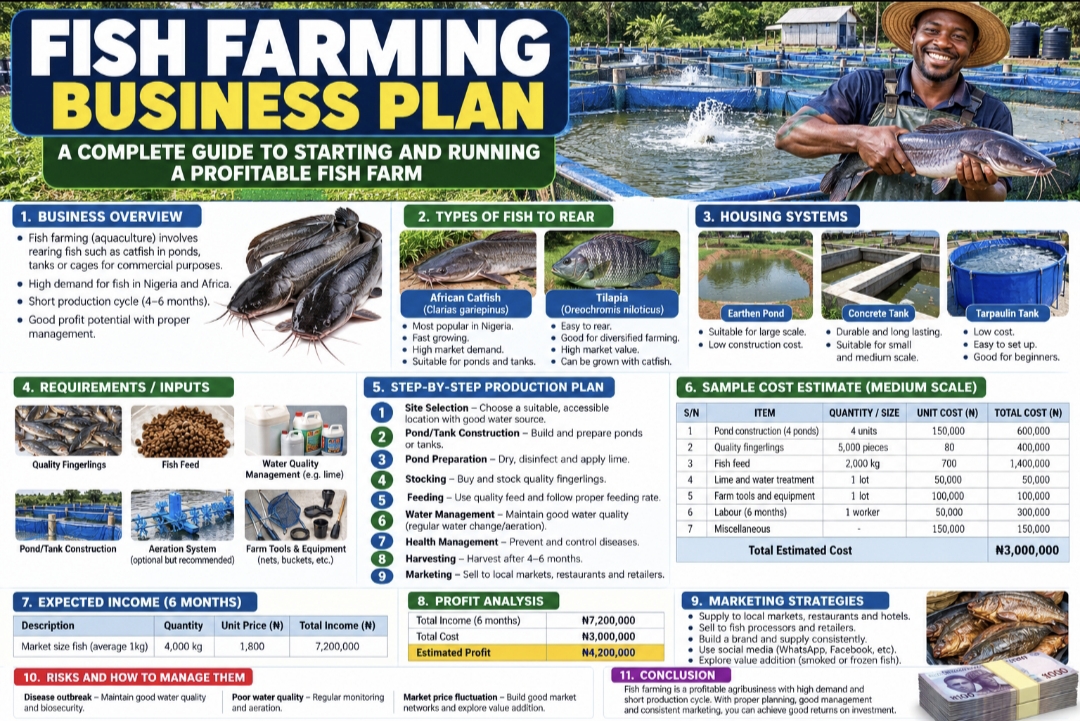
A fish farming business plan is one of the most important tools for anyone who wants to establish, expand or professionally manage an aquaculture enterprise. Fish farming can generate income from table fish, fingerlings, broodstock, processed fish and other aquaculture products, but success depends heavily on proper planning.
Many fish farms struggle not because fish cannot be produced successfully, but because the business was started without a clear understanding of production costs, market demand, working capital, water requirements, fish health, feeding expenses and expected revenue.
A well-prepared fish farming business plan helps transform an idea into an organized business. It provides a roadmap for deciding what species to raise, how many fish to stock, where to locate the farm, what infrastructure to build, how much capital is required, how fish will be marketed and how financial performance will be measured.
This comprehensive guide explains how to create a professional fish farming business plan from the initial idea through production, marketing, financial planning and expansion.
What Is a Fish Farming Business Plan?
A fish farming business plan is a structured document that explains how a fish farming enterprise will be established, operated, financed and developed.
It normally describes:
- The type of fish farming business
- The target market
- Production system
- Farm location
- Infrastructure
- Equipment
- Stocking strategy
- Feeding program
- Fish-health management
- Labor requirements
- Marketing strategy
- Startup costs
- Operating costs
- Revenue projections
- Profitability
- Risks
- Expansion plans
The document can be used by the farmer as an internal management guide or presented to potential investors, lenders or business partners.
Why a Fish Farming Business Plan Is Important
Starting a fish farm without a plan can result in unnecessary spending and poor resource allocation.
A business plan helps answer important questions such as:
- How much money is required?
- What species should be produced?
- How many fish should be stocked?
- What will the fish eat?
- Who will buy the fish?
- How much will production cost?
- What selling price is required?
- When will the business generate revenue?
- How much working capital is needed?
- What could go wrong?
Planning does not eliminate risk, but it can make risks easier to identify and manage.
Executive Summary
The executive summary provides a brief overview of the entire business plan.
It should explain:
- Business name
- Business location
- Type of fish farming
- Species to be produced
- Production scale
- Target customers
- Main products
- Competitive strategy
- Estimated investment
- Revenue model
- Long-term objectives
Although the executive summary appears first, it is often easier to write it after completing the rest of the business plan.
Example of a Fish Farm Business Concept
A hypothetical business might be described as follows:
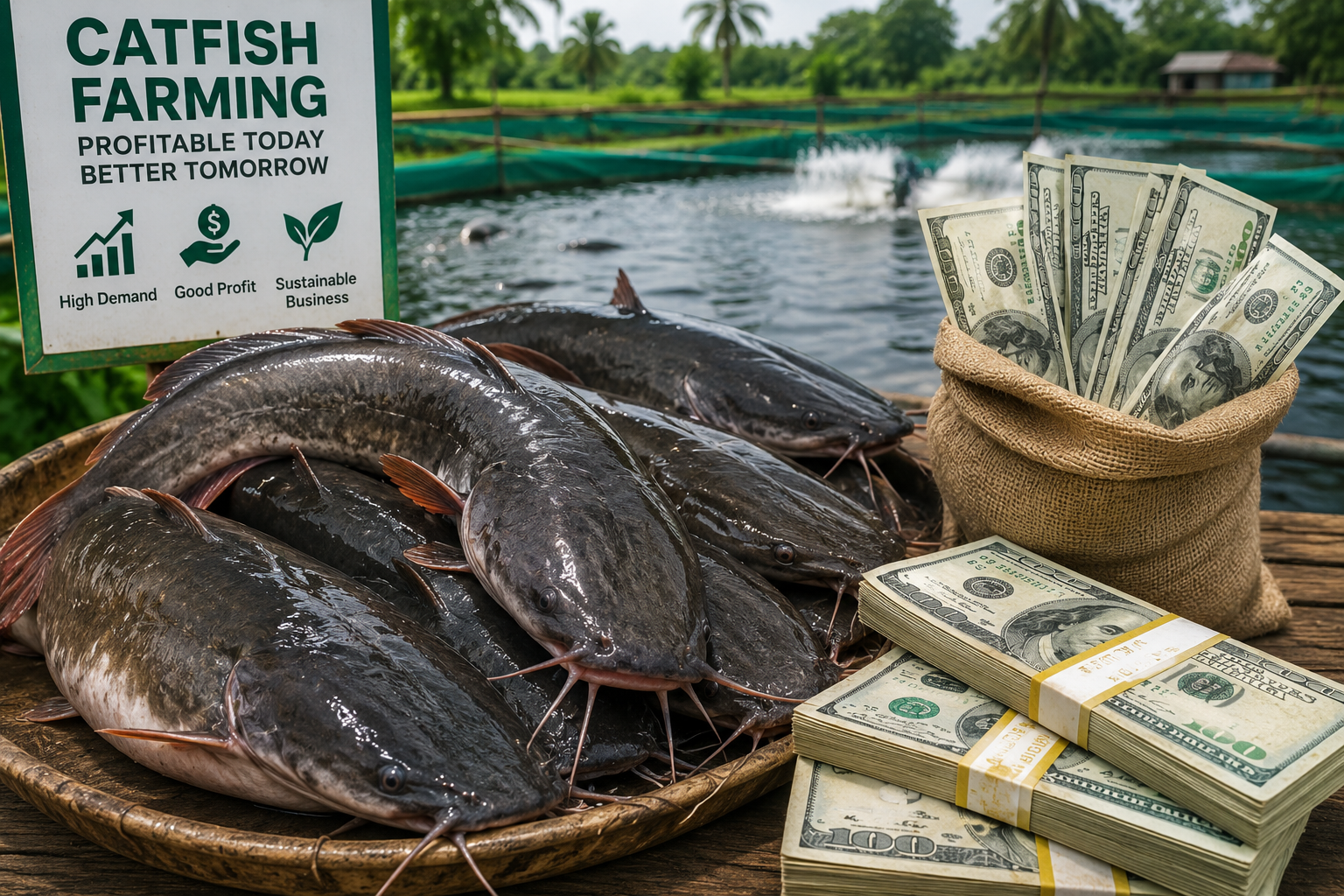
A commercial aquaculture enterprise producing high-quality table-size catfish for households, restaurants, retailers and food-service businesses.
The farm may use a combination of tanks and ponds and operate several production cycles annually.
Additional revenue may eventually come from processed fish and fingerling production.
This type of description gives investors and managers a clear understanding of the business model.
Choosing the Fish Species
Species selection is one of the first major decisions.
Possible commercial species include:
- Catfish
- Tilapia
- Carp
- Trout
- Salmon
- Barramundi
- Other locally suitable species
The appropriate species depends on:
- Local climate
- Water availability
- Consumer demand
- Feed availability
- Growth characteristics
- Regulations
- Technical expertise
- Market price
A species should not be selected simply because another farmer is producing it successfully.
Catfish Farming Business Model
Catfish can be produced in:
- Earthen ponds
- Concrete tanks
- Plastic tanks
- Tarpaulin tanks
- Recirculating systems
- Other controlled systems
The business model may focus on table fish, fingerlings, broodstock or a combination.
Farmers should determine their preferred market size before beginning production.
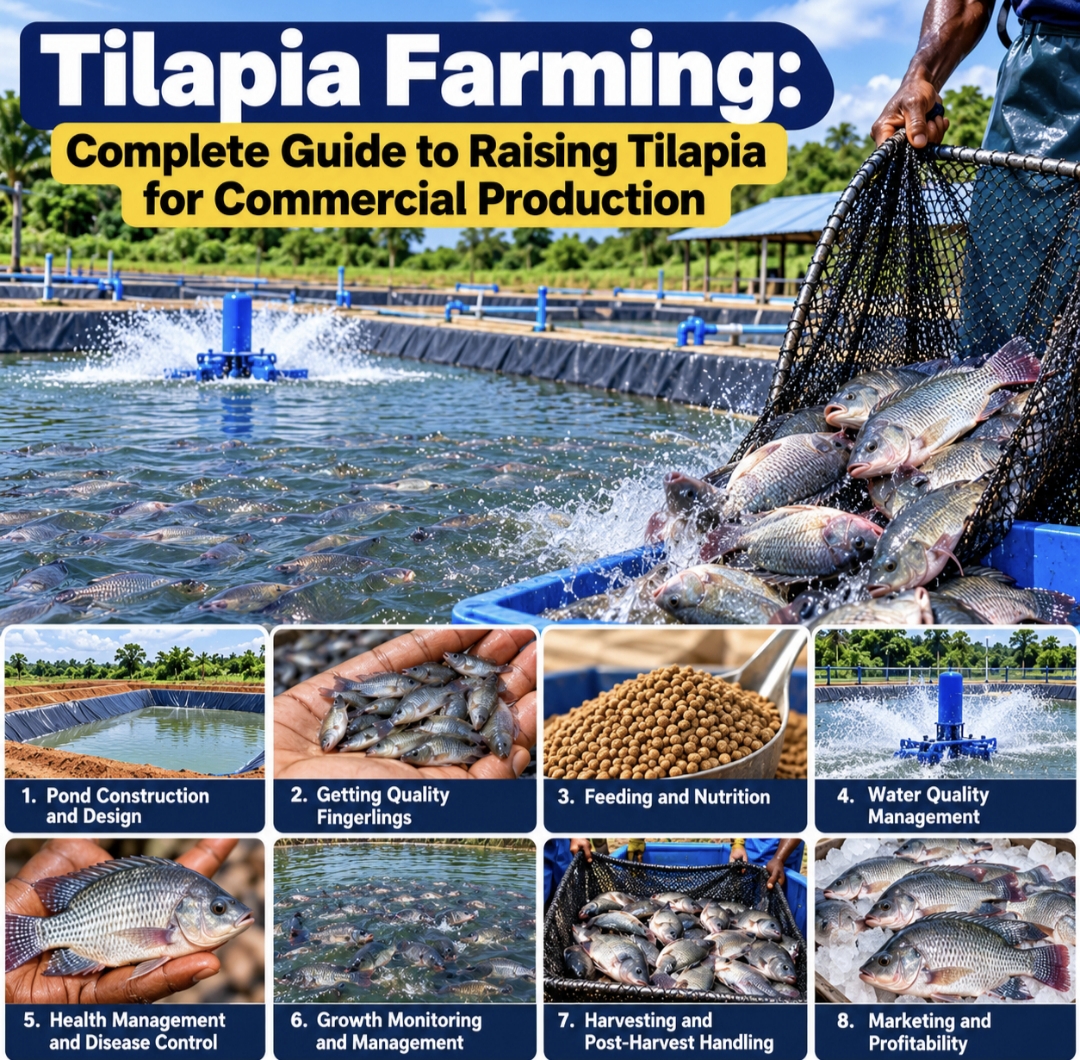
Tilapia Farming Business Model
Tilapia is widely farmed in many parts of the world.
Commercial production may use:
- Ponds
- Tanks
- Cages
- Recirculating systems
Market demand, water temperature and production technology should be considered when planning a tilapia enterprise.
Fingerling Production Business
Instead of producing table-size fish, a farmer can specialize in producing fingerlings.
Revenue is generated from selling young fish to other farmers.
This business requires specialized knowledge of:
- Broodstock
- Breeding
- Egg management
- Larval care
- Nursery management
- Grading
- Transportation
Broodstock Business
Broodstock production focuses on maintaining high-quality breeding fish.
The business may supply:
- Hatcheries
- Fish farms
- Research facilities
- Aquaculture businesses
This requires careful genetic and health management.
Defining the Target Market
A fish farm should identify its customers before investing heavily in production.
Potential customers include:
- Households
- Restaurants
- Hotels
- Supermarkets
- Fish retailers
- Wholesalers
- Caterers
- Food processors
- Institutions
Different customers may have different requirements.
A restaurant may prefer consistent fish sizes, while a wholesaler may focus more heavily on price and volume.
Conducting Market Research
Market research should investigate:
- Fish prices
- Preferred species
- Preferred sizes
- Seasonal demand
- Competitors
- Customer locations
- Distribution channels
- Transportation costs
- Processing preferences
Farmers should collect actual local market information rather than relying entirely on general internet estimates.
Competitor Analysis
A business plan should identify competitors.
Study:
- Their products
- Their prices
- Production scale
- Customer base
- Location
- Distribution methods
- Processing options
- Strengths
- Weaknesses
The objective is not necessarily to copy competitors but to understand the market environment.
Identifying a Competitive Advantage
A fish farm needs a reason customers should choose its products.
Possible competitive advantages include:
- Consistent fish size
- Reliable supply
- Good quality
- Clean processing
- Convenient delivery
- Direct sales
- Strong customer service
- Specialty products
- Sustainable production practices
A competitive advantage should be practical and sustainable.
Choosing a Fish Farm Location
Location affects both production and marketing.
Important considerations include:
- Water availability
- Water quality
- Land suitability
- Drainage
- Road access
- Electricity
- Security
- Proximity to customers
- Expansion space
- Environmental conditions
A cheap piece of land may become expensive if it requires excessive infrastructure to provide water and transportation.
Water Availability
Water is one of the most important resources in aquaculture.
Before establishing a farm, determine:
- Water source
- Water quality
- Seasonal availability
- Pumping requirements
- Storage requirements
- Treatment requirements
- Drainage
The water source should be suitable for the intended species and production system.
Farm Infrastructure
Infrastructure requirements vary according to the type of farm.
Possible facilities include:
- Fish ponds
- Tanks
- Hatchery
- Nursery area
- Water reservoir
- Pump house
- Feed store
- Processing area
- Cold storage
- Office
- Security facility
- Equipment storage
A business plan should identify which facilities are required immediately and which can be added later.
Fish Pond Construction
Ponds may be constructed from:
- Earth
- Concrete
- Fiberglass
- Plastic
- Tarpaulin
- Other appropriate materials
The choice depends on budget, land, species, production intensity and water-management requirements.
Tank-Based Fish Farming
Tank systems may offer greater control over fish production.
Potential advantages include:
- Efficient use of land
- Easier monitoring
- Controlled water management
- Easier harvesting
Potential disadvantages include:
- Higher infrastructure costs
- Dependence on pumps
- Higher energy requirements
- Greater equipment maintenance
Recirculating Aquaculture Systems
Recirculating aquaculture systems reuse treated water.
They can support intensive production but require technical expertise and reliable equipment.
A business plan for a RAS farm should include:
- Filtration
- Aeration
- Pumps
- Backup systems
- Monitoring
- Electricity
- Maintenance
- Emergency procedures
Cage Fish Farming
Cage systems allow fish to be raised within cages placed in suitable water bodies.
Planning should consider:
- Water depth
- Water movement
- Security
- Cage durability
- Environmental conditions
- Access
- Feed logistics
- Harvesting
All relevant environmental and legal requirements should be investigated before establishing cages.
Determining Farm Capacity
The business plan should state the intended production capacity.
For example:
- Number of ponds
- Number of tanks
- Number of cages
- Stocking density
- Number of fish stocked
- Expected survival
- Expected average harvest weight
- Number of production cycles
Capacity should be based on actual infrastructure rather than ambition alone.
Calculating Expected Fish Production
A simplified calculation is:
Expected harvest = Number stocked × Survival rate × Average harvest weight
For example:
Suppose:
- 10,000 fish are stocked
- Expected survival = 90%
- Average harvest weight = 1 kg
Expected harvest:
10,000 × 90% × 1 kg = 9,000 kg
This is a projection, not a guarantee.
Setting a Realistic Survival Rate
Survival rates depend on:
- Species
- Fingerling quality
- Water quality
- Stocking density
- Disease management
- Feeding
- Handling
- Production system
Farmers should use realistic assumptions based on their own records or credible local production data.
Fish Feeding Plan
Feed is often one of the largest operating costs.
A business plan should specify:
- Feed type
- Feed sizes
- Estimated feed quantity
- Feed suppliers
- Estimated feed price
- Feeding frequency
- Feed storage
Feed requirements should be updated as fish grow.
Feed Conversion Ratio in the Business Plan
FCR should be included in financial projections.
For example, if projected fish biomass gain is 5,000 kg and the expected FCR is 1.3:
Estimated feed requirement:
5,000 × 1.3 = 6,500 kg feed
If feed costs $1 per kg:
Estimated feed cost:
6,500 × $1 = $6,500
Actual FCR and feed prices may differ.
Fish Health Management Plan
A professional business plan should include a health-management strategy.
It may cover:
- Quarantine
- Water-quality monitoring
- Biosecurity
- Disease surveillance
- Proper stocking
- Sanitation
- Veterinary or aquatic-health support
- Safe handling of sick or dead fish
Prevention should be a central part of the plan.
Biosecurity Plan
Biosecurity helps reduce the introduction and spread of pathogens.
Measures can include:
- Controlling visitors
- Cleaning equipment
- Disinfecting equipment where appropriate
- Quarantining new stock
- Preventing contaminated water movement
- Controlling pests
- Removing dead fish promptly
Farm Personnel
A business plan should identify labor requirements.
Small farms may be operated by the owner with limited assistance.
Larger farms may require:
- Farm manager
- Aquaculture technician
- Fish-health specialist
- Workers
- Security personnel
- Sales personnel
- Drivers
- Processing staff
Labor requirements should be included in the financial model.
Farm Management Structure
A simple organizational structure could be:
Owner/Investor
↓
Farm Manager
↓
Production Workers
↓
Marketing and Distribution
As the business grows, specialized departments can be added.
Fish Farm Equipment
Potential equipment includes:
- Nets
- Buckets
- Weighing scales
- Water-testing kits
- Pumps
- Aerators
- Feeders
- Tanks
- Pipes
- Harvesting equipment
- Fish crates
- Refrigeration equipment
Equipment requirements should match production scale.
Startup Cost Categories
Startup costs may include:
- Land
- Construction
- Water infrastructure
- Tanks or ponds
- Pumps
- Aerators
- Equipment
- Storage
- Electricity
- Security
- Initial fingerlings
- Initial feed
- Working capital
The business plan should separate one-time investment from recurring expenses.
Operating Costs
Recurring costs can include:
- Feed
- Fingerlings
- Labor
- Electricity
- Water
- Maintenance
- Health management
- Transportation
- Packaging
- Marketing
- Security
Operating costs should be projected for each production cycle.
Working Capital
Working capital is money available to keep the business operating before sales revenue arrives.
This is particularly important because a fish farm may spend money for several months before harvesting and selling fish.
Working capital can cover:
- Feed
- Labor
- Utilities
- Repairs
- Transportation
- Health management
- Unexpected expenses
Revenue Model
A fish farm can generate revenue from several sources.
These include:
- Table fish
- Fingerlings
- Broodstock
- Processed fish
- Smoked fish
- Frozen fish
- Fish fillets
- By-products
Diversification can reduce dependence on a single source of income.
Calculating Fish Sales Revenue
A basic formula is:
Revenue = Harvest quantity × Selling price
Suppose a farm produces 8,000 kg of fish and sells them for an illustrative $3 per kg.
Revenue:
8,000 × $3 = $24,000
This represents gross sales revenue.
Illustrative Fish Farm Financial Projection
Consider a hypothetical farm with the following assumptions:
- Fish stocked: 10,000
- Survival rate: 90%
- Average harvest weight: 1 kg
- Expected harvest: 9,000 kg
- Selling price: $3 per kg
Estimated revenue:
9,000 × $3 = $27,000
Assume projected operating costs are:
- Fingerlings: $1,200
- Feed: $11,000
- Labor: $2,000
- Water and electricity: $800
- Health management: $400
- Harvesting: $600
- Transportation: $700
- Maintenance: $500
- Other expenses: $400
Total operating costs:
$17,600
Illustrative operating profit:
$27,000 − $17,600 = $9,400
These figures are purely illustrative. Actual fish-farming economics vary by species, location, production system, input prices and market conditions.
Calculating Cost Per Kilogram
Using the example above:
$17,600 ÷ 9,000 kg = approximately $1.96 per kg
The farm would need to sell above its total relevant production cost per kilogram to generate an operating margin.
Break-Even Analysis
Suppose fixed costs for a particular period are $5,000.
If:
- Selling price = $3/kg
- Variable cost = $2/kg
Contribution per kilogram:
$3 − $2 = $1
Break-even production:
$5,000 ÷ $1 = 5,000 kg
This simplified calculation helps determine the production volume required to cover the specified fixed costs.
Cash Flow Projection
A cash-flow projection shows when money enters and leaves the business.
For example:
Month 1: Construction and equipment expenses
Month 2: Fingerlings and initial feed
Month 3: Feed and labor
Month 4: Feed, labor and utilities
Month 5: Feed and maintenance
Harvest month: Harvesting, transportation and sales revenue
This illustrates why sufficient working capital is essential.
Marketing Strategy
A fish farming business plan should explain how products will reach customers.
Marketing channels may include:
- Farm-gate sales
- Wholesalers
- Retailers
- Restaurants
- Hotels
- Supermarkets
- Food processors
- Direct consumers
- Online orders
Branding a Fish Farm
Branding can help differentiate a farm.
A professional fish-farm brand may include:
- Business name
- Logo
- Packaging
- Contact information
- Product information
- Social media presence
- Website
A strong brand can become particularly useful when selling processed fish directly to consumers.
Digital Marketing Strategy
Digital marketing can support customer acquisition.
Potential activities include:
- Posting fish availability
- Showing farm operations
- Sharing harvest updates
- Publishing educational content
- Collecting customer inquiries
- Advertising special offers
- Building a customer database
Messaging platforms can also support direct ordering and delivery coordination.
Distribution Strategy
A distribution plan should explain how fish will reach customers.
Options include:
- Customer pickup
- Farm delivery
- Third-party transport
- Wholesale distribution
- Retail distribution
Transportation costs should be incorporated into pricing decisions.
Fish Processing Strategy
A farm can potentially add value by processing fish.
Possible products include:
- Smoked fish
- Frozen fish
- Fillets
- Cleaned fish
- Packaged portions
- Dried fish
Processing may create additional revenue but requires investment in equipment, hygiene and regulatory compliance.
Risk Analysis
Every fish farming business plan should identify risks.
Major risks include:
- Disease
- Poor water quality
- High mortality
- Feed-price increases
- Low selling prices
- Electricity problems
- Equipment failure
- Theft
- Extreme weather
- Poor fingerling quality
- Market disruption
Disease Risk Management
Disease risk can be reduced through:
- Quality fingerlings
- Good water management
- Proper stocking density
- Biosecurity
- Quarantine
- Regular observation
- Professional health advice
Market Risk Management
Market risks can be reduced by:
- Developing multiple customer categories
- Selling different product forms
- Building direct customer relationships
- Monitoring market prices
- Avoiding dependence on a single buyer
Feed Price Risk
Feed prices can significantly affect profitability.
Possible strategies include:
- Building relationships with reliable suppliers
- Buying according to cash-flow capacity
- Reducing feed waste
- Improving FCR
- Comparing quality-adjusted prices
- Planning inventory carefully
Power and Energy Risk
Farms dependent on pumps and aeration should have contingency plans.
Possible solutions include:
- Backup generators
- Solar systems
- Battery systems
- Redundant pumps
- Emergency aeration equipment
The appropriate solution depends on the production system.
Environmental Risk
Fish farms should consider:
- Flooding
- Drought
- Extreme temperatures
- Water contamination
- Storms
- Poor drainage
Site selection and infrastructure should reflect local environmental conditions.
Security Risk
Security measures may include:
- Fencing
- Controlled access
- Lighting
- Security personnel
- Cameras
- Secure equipment storage
The appropriate system depends on farm location and scale.
SWOT Analysis for a Fish Farm
A business plan can use a SWOT framework.
Strengths
Possible strengths include:
- Good water supply
- Strong market demand
- Experienced management
- Good location
- Reliable customer base
Weaknesses
Possible weaknesses include:
- Limited capital
- Limited technical expertise
- High energy costs
- Limited processing capacity
Opportunities
Potential opportunities include:
- Growing fish consumption
- Direct-to-consumer sales
- Processing
- Fingerling production
- Restaurant supply
- Digital marketing
Threats
Potential threats include:
- Disease
- Input-price increases
- Market-price declines
- Extreme weather
- Competition
- Equipment failure
Setting Business Objectives
A business plan should contain measurable objectives.
Examples include:
- Produce a specified quantity of fish per cycle
- Maintain a target survival rate
- Achieve a target FCR
- Establish a certain number of regular customers
- Reduce production costs per kilogram
- Add processing capacity
- Expand production after achieving consistent profitability
Objectives should be realistic and measurable.
Short-Term Objectives
Short-term objectives may include:
- Establishing infrastructure
- Stocking the first production cycle
- Building a customer base
- Creating production records
- Establishing biosecurity procedures
Medium-Term Objectives
Medium-term goals may include:
- Increasing production
- Improving FCR
- Adding processing
- Developing wholesale customers
- Employing specialized workers
Long-Term Objectives
Long-term goals may include:
- Expanding production facilities
- Establishing a hatchery
- Building a processing plant
- Developing a recognized fish brand
- Entering new markets
- Establishing multiple farm locations
Monitoring Key Performance Indicators
A modern fish farm should monitor key performance indicators.
Important KPIs include:
- Survival rate
- Average fish weight
- Total biomass
- FCR
- Feed cost per kilogram
- Production cost per kilogram
- Revenue per cycle
- Profit per cycle
- Mortality
- Harvest percentage
Fish Farm Record-Keeping System
Records can be maintained using:
- Notebooks
- Spreadsheets
- Farm-management software
- Mobile applications
Important records include:
- Stocking records
- Feed records
- Mortality records
- Water-quality records
- Treatment records
- Harvest records
- Sales records
- Expense records
Digital records can make financial analysis easier as the business grows.
Creating a Monthly Financial Report
A monthly report may contain:
Revenue
- Fish sales
- Fingerling sales
- Processed fish sales
- Other income
Expenses
- Feed
- Labor
- Electricity
- Water
- Transportation
- Maintenance
- Health management
- Marketing
Financial result
- Gross revenue
- Total expenses
- Operating profit or loss
Evaluating Each Production Cycle
At the end of each cycle, compare actual results with the business plan.
Ask:
- Did survival meet expectations?
- Was FCR close to the target?
- Was feed consumption higher than expected?
- Did selling prices change?
- Did production costs increase?
- Were customers available?
- What caused unexpected losses?
This process allows the next production cycle to be better planned.
When to Revise the Business Plan
A business plan should not remain unchanged forever.
It should be reviewed when:
- Feed prices change significantly
- Market prices change
- Production capacity changes
- New equipment is introduced
- The business adds processing
- The farm changes species
- The farm expands
- Major risks change
Regular revision keeps the plan useful.
Financing a Fish Farm
Possible sources of financing may include:
- Personal savings
- Business partners
- Commercial loans
- Agricultural financing
- Investor capital
- Cooperative financing
- Reinvestment of profits
The financing method should be compatible with the expected cash flow of the farm.
Using Loans for Fish Farming
Borrowed money creates repayment obligations.
Before taking a loan, farmers should calculate:
- Loan amount
- Interest
- Repayment schedule
- Expected production revenue
- Operating costs
- Cash-flow requirements
A business should not assume that projected revenue will automatically be sufficient to repay debt.
Attracting Investors
Investors may want to know:
- How much money is required?
- What will it be used for?
- What products will be sold?
- Who are the customers?
- What are the risks?
- What are the projected revenues?
- What are the expected costs?
- How will the business scale?
Clear records and realistic assumptions can improve investor confidence.
Fish Farming Business Plan Template
A professional fish farming business plan can follow this structure:
1. Executive Summary
Brief overview of the business.
2. Business Description
Explain the farm and its objectives.
3. Products and Services
Describe fish species and products.
4. Market Analysis
Explain customers, competitors and market conditions.
5. Production Plan
Describe ponds, tanks, stocking, feeding and harvesting.
6. Management Plan
Explain staff and responsibilities.
7. Marketing Plan
Describe sales channels and customer acquisition.
8. Financial Plan
Include startup costs, operating costs, revenue and profit projections.
9. Risk Management
Identify major risks and mitigation strategies.
10. Expansion Plan
Explain how the business may grow.
Example Business Plan Summary
A hypothetical commercial fish farm may have the following structure:
Business: Commercial Aquaculture Enterprise
Primary product: Table-size fish
Secondary products: Processed fish and fingerlings
Production system: Tank and pond combination
Target customers: Households, restaurants, retailers and wholesalers
Main costs: Feed, fingerlings, labor, energy and water
Marketing: Direct sales, wholesale and digital marketing
Growth strategy: Increase production after demonstrating consistent positive cash flow
This summary provides a foundation for a more detailed business plan.
Common Fish Farming Business-Planning Mistakes
Farmers should avoid:
- Underestimating feed costs
- Overestimating survival
- Assuming maximum selling prices
- Ignoring transportation
- Ignoring labor
- Spending too much on construction
- Starting without working capital
- Failing to research customers
- Ignoring water quality
- Expanding too quickly
- Mixing personal and business finances
How to Make a Fish Farming Business Plan More Realistic
Use actual information wherever possible.
Instead of writing:
"Fish will sell for $3 per kilogram."
Research current prices in the target market.
Instead of assuming:
"95% of fish will survive."
Use historical farm records or conservative estimates.
Instead of assuming:
"Feed will cost $1 per kilogram."
Obtain current supplier quotations.
The more realistic the assumptions, the more useful the business plan becomes.
Final Thoughts
A fish farming business plan is more than a document created to obtain financing. It is a management tool that can guide the farmer from startup through production, marketing and expansion.
A strong plan begins with a clear understanding of the market. Before fish are stocked, the farmer should know who is likely to buy them, what size they prefer, how much they are willing to pay and how the product will reach them.
The production plan should then explain how the fish will be raised, including species selection, stocking density, feeding, water management, health management and harvesting.
The financial section is particularly important. Farmers should calculate startup investment, working capital, operating costs, expected revenue, cost per kilogram, break-even point and projected profit.
Financial projections should always be treated as estimates rather than guarantees. Feed prices, fish prices, survival rates, weather, disease and other factors can change.
The most useful business plans are therefore flexible. Farmers should compare projected performance with actual results after every production cycle and update their assumptions.
Fish farming can develop from a small operation into a larger commercial enterprise, but expansion should be based on evidence. A farmer who has demonstrated good survival, efficient feed conversion, reliable markets and positive cash flow is in a stronger position to consider expansion.
Ultimately, the goal of a fish farming business plan is simple: to understand the business before committing significant resources to it.
By combining sound aquaculture practices with careful financial planning, accurate record keeping, market research and disciplined management, farmers can build a more organized and potentially sustainable fish farming enterprise.
Related posts;
- Transforming Agriculture: How an Effective Website Can Boost Your Agro Business

- MODERN AGRICULTURE WITH MASSIVE INCOME
- HIGH YIELD PLANTAIN AND BANANA FARMING:The Complete Guide to High-Yield, Profitable Commercial Production. (2026 EDITION)

- Transforming Agriculture with Cutting-Edge Web Solutions

- CATFISH FARMING(HYBRID): THE COMPLETE STEP-BY-STEP GUIDE FOR BEGINNERS AND COMMERCIAL FARMERS (2026 EDITION)
- SUCCESSFUL WATERMELON FARMING: A Complete Guide to Growing Watermelon for Profit.
- GROUNDNUT FARMING IN NIGERIA: A Complete Professional Guide to Production, Management, Harvesting and Profitability.
- MAIZE FARMING IN NIGERIA: A Comprehensive Professional Guide (Part 1)