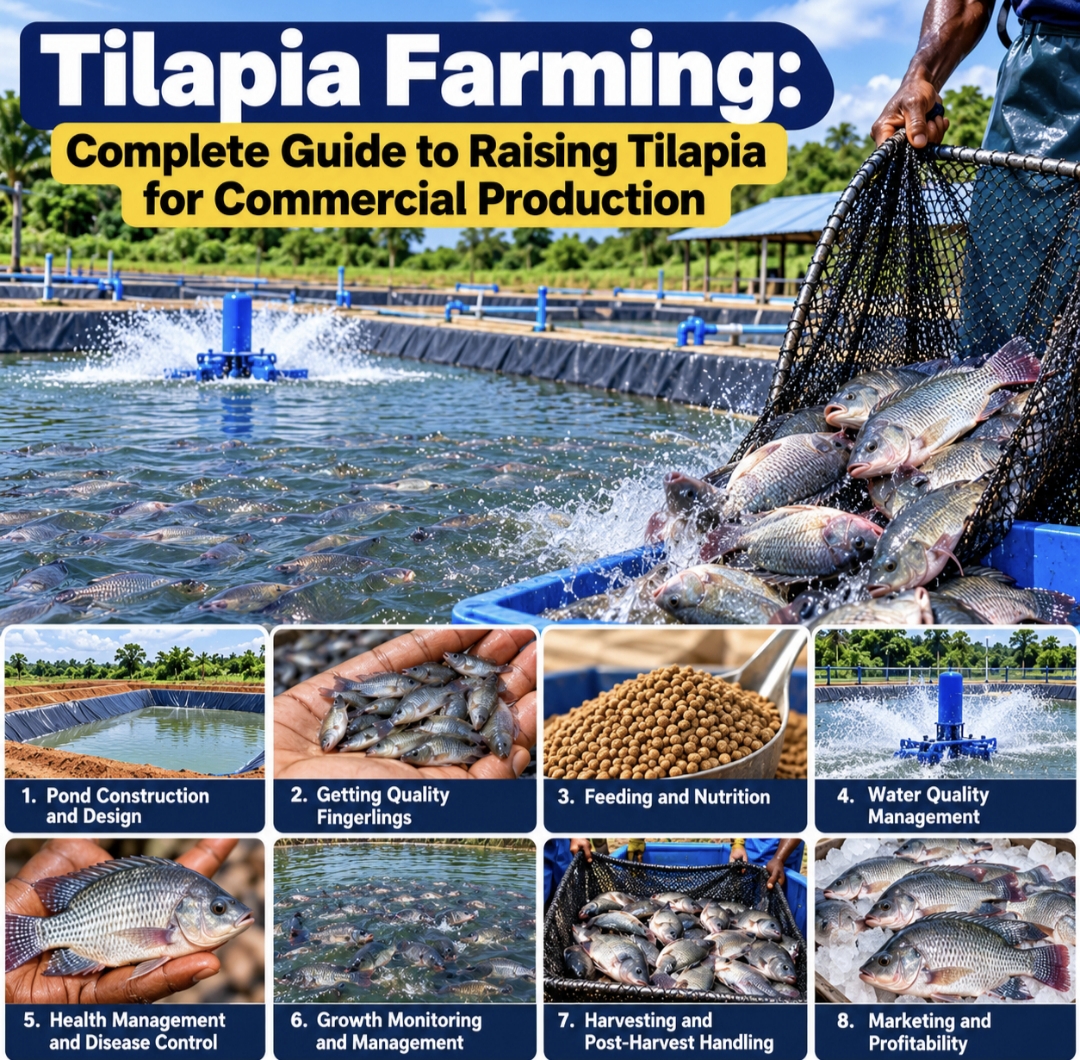
Introduction
Fish farming has become an important part of modern aquaculture and the global food system. As demand for fish continues to create opportunities for farmers, entrepreneurs and investors, understanding the financial side of fish production has become just as important as understanding how to raise healthy fish.
Fish farming can generate income through the production and sale of table-size fish, fingerlings, broodstock, processed fish and other aquaculture products. However, producing fish does not automatically guarantee profit. A farm can have excellent production results and still lose money if feed costs are too high, mortality is excessive, selling prices are too low or operating expenses are poorly controlled.
Fish farming profitability depends on the relationship between production costs, fish survival, growth rate, feed efficiency, selling price, production volume and farm management.
This comprehensive guide explains how to calculate fish farming costs, estimate revenue, determine profit, calculate break-even points, manage feed expenses, reduce losses and build a financially sustainable fish farming business.
What Is Fish Farming Profitability?
Fish farming profitability refers to the ability of an aquaculture enterprise to generate more revenue than the total cost required to produce and sell fish.
The basic formula is:
Profit = Total Revenue − Total Costs
If revenue is greater than costs, the farm generates a positive operating profit.
If costs are greater than revenue, the farm operates at a loss.
However, profitability should not be evaluated only by looking at money received from fish sales. Farmers should calculate the complete cost of production.
Why Profitability Analysis Is Important
Many new fish farmers focus primarily on the number of fish they can produce.
For example, a farmer may think:
"I stocked 10,000 fish and expect to sell 8,000 fish."
That information alone is not enough to determine whether the business will be profitable.
The farmer also needs to know:
- How much the fingerlings cost
- How much feed will be required
- How much labor will cost
- How much water will cost
- How much electricity will cost
- How much medication and health management will cost
- How much fish mortality is expected
- How much each fish will weigh
- How much customers will pay
- How much transportation will cost
- How much the pond or equipment costs
- How much working capital is required
Profitability analysis brings all these factors together.
Major Types of Fish Farming
The financial structure of a fish farm depends partly on the type of production system.
Common fish-farming enterprises include:
- Catfish farming
- Tilapia farming
- Carp farming
- Trout farming
- Salmon farming
- Ornamental fish farming
- Fingerling production
- Broodstock production
- Integrated aquaculture
- Cage farming
- Pond farming
- Tank farming
- Recirculating aquaculture systems
Each system has different capital requirements, operating costs and market opportunities.
Understanding Fixed Costs
Fixed costs are expenses that generally do not change directly with the number of fish produced during a particular production period.
Examples include:
- Pond construction
- Tanks
- Buildings
- Pumps
- Water infrastructure
- Generators
- Aeration equipment
- Processing equipment
- Storage facilities
- Security infrastructure
Some fixed assets can be used across many production cycles.
Understanding Variable Costs
Variable costs usually increase as production increases.
Major variable costs can include:
- Fingerlings
- Feed
- Medication
- Water
- Electricity
- Labor
- Transportation
- Packaging
- Harvesting
- Processing
In many intensive fish farms, feed represents one of the largest operating expenses.
Initial Capital Investment
Before fish are stocked, farmers may need to spend money establishing the farm.
Startup expenses may include:
- Land preparation
- Pond excavation
- Concrete tanks
- Tarpaulin tanks
- Water systems
- Pumps
- Pipes
- Aerators
- Feeders
- Nets
- Storage facilities
- Security
- Electricity
- Backup power
- Office facilities
The amount required varies enormously depending on the production system.
A small pond-based operation may require relatively modest infrastructure, while a commercial recirculating aquaculture system can require substantial capital.
Cost of Fingerlings
Fingerlings are young fish purchased for stocking.
Their price depends on:
- Species
- Size
- Genetics
- Supplier
- Location
- Quantity
- Season
- Quality
Buying the cheapest fingerlings is not necessarily the best financial decision.
Poor-quality fingerlings can grow slowly, suffer high mortality or produce inconsistent harvest sizes.
Importance of Fingerling Quality
High-quality fingerlings can contribute to better farm performance.
Farmers should consider:
- Active swimming
- Uniformity
- Good body condition
- Reliable genetic source
- Appropriate size
- Health history
- Supplier reputation
Healthy stocking material provides a stronger foundation for production.
Feed Cost in Fish Farming
Feed is often one of the largest expenses in intensive fish production.
Fish require nutrients for:
- Growth
- Tissue development
- Maintenance
- Reproduction
- Immune function
Commercial feeds are formulated to provide combinations of protein, energy, fats, vitamins and minerals.
The appropriate feed depends on the fish species and life stage.
Feed Conversion Ratio
Feed conversion ratio, or FCR, is one of the most important financial indicators in fish farming.
A simplified formula is:
FCR = Feed consumed ÷ Weight gained
For example, if a fish farm uses 1,200 kg of feed to produce 1,000 kg of additional fish biomass:
FCR = 1,200 ÷ 1,000 = 1.2
A lower FCR generally indicates more efficient conversion of feed into fish biomass, assuming comparable production conditions.
Actual FCR varies according to species, feed quality, temperature, water quality, stocking density and management.
Why Feed Efficiency Matters
Suppose two farms each produce 10,000 kg of fish.
Farm A uses 12,000 kg of feed.
Farm B uses 15,000 kg of feed.
If feed costs $1 per kg:
Farm A feed cost:
12,000 × $1 = $12,000
Farm B feed cost:
15,000 × $1 = $15,000
The second farm spends $3,000 more on feed to produce the same quantity of fish.
This demonstrates why feed management can have a major impact on profitability.
Fish Mortality and Profitability
Mortality directly affects potential revenue.
If a farmer stocks 10,000 fish but only 8,000 survive to harvest, the farmer has lost the potential production represented by the 2,000 fish that died.
Mortality can result from:
- Poor water quality
- Disease
- Overstocking
- Poor fingerling quality
- Feed problems
- Temperature stress
- Oxygen shortages
- Poor handling
- Predators
Reducing avoidable mortality can therefore improve profitability.
Water Quality and Financial Performance
Water quality is both a biological and financial issue.
Important water-quality parameters can include:
- Dissolved oxygen
- Temperature
- pH
- Ammonia
- Nitrite
- Alkalinity
- Water clarity
Poor water quality can reduce feeding, slow growth and increase mortality.
A water-quality problem can therefore increase costs while reducing revenue.
Importance of Dissolved Oxygen
Fish require oxygen for normal physiological functions.
Low dissolved oxygen can cause:
- Reduced feeding
- Poor growth
- Stress
- Increased mortality
Aeration can help in systems where oxygen levels become limiting, but aeration equipment also creates energy and maintenance costs.
The goal is to maintain an appropriate production environment while controlling energy expenditure.
Labor Costs
Labor costs depend on the scale and technology of the farm.
Tasks may include:
- Feeding
- Pond inspection
- Water management
- Equipment maintenance
- Fish grading
- Harvesting
- Processing
- Cleaning
- Security
- Record keeping
- Transportation
Automation may reduce labor requirements in larger systems, but equipment itself has capital and maintenance costs.
Electricity and Energy Costs
Energy may be required for:
- Water pumping
- Aeration
- Filtration
- Lighting
- Refrigeration
- Processing
- Heating or cooling
- Security
Energy-efficient equipment can reduce operating expenses.
Farmers should monitor electricity consumption because energy costs can accumulate significantly over multiple production cycles.
Water Costs
Water may be obtained from:
- Wells
- Boreholes
- Rivers
- Reservoirs
- Rainwater systems
- Municipal supplies
The source must be suitable for the fish species and production system.
Water treatment and pumping can add to production costs.
Fish Health Costs
Fish-health expenses may include:
- Diagnostic services
- Veterinary or aquatic animal health services
- Water-quality testing
- Preventive management
- Treatment
- Equipment sanitation
Farmers should prioritize prevention because disease outbreaks can cause both direct and indirect financial losses.
Transportation Costs
Transportation is sometimes overlooked in fish-farm budgets.
Costs may include transporting:
- Fingerlings
- Feed
- Equipment
- Harvested fish
- Workers
- Packaging
- Processed products
If customers are located far from the farm, transportation can significantly reduce the margin per kilogram of fish sold.
Harvesting Costs
Harvesting can require:
- Nets
- Labor
- Containers
- Water
- Ice
- Transportation
- Processing equipment
Harvest planning should be coordinated with customers so fish are sold efficiently after harvest.
Processing Costs
Some farmers sell live fish, while others process their fish.
Processing can include:
- Cleaning
- Evisceration
- Cutting
- Filleting
- Smoking
- Drying
- Freezing
- Packaging
Processing adds costs but may create opportunities for higher-value products.
Fish Selling Price
The selling price is one of the most important variables in a profitability calculation.
Prices can vary according to:
- Fish species
- Fish size
- Location
- Season
- Supply
- Demand
- Processing level
- Customer type
- Quality
- Transportation
Farmers should research their local market before stocking fish.
Farm-Gate Price Versus Retail Price
The price received directly by a farmer may differ significantly from the final retail price.
For example, fish may pass through:
Farmer → Wholesaler → Retailer → Consumer
Each participant may add costs and a margin.
Farmers who develop direct relationships with consumers, restaurants or processors may potentially capture more value, although they may also take on additional marketing and distribution responsibilities.
Calculating Fish Farming Revenue
Revenue can be calculated using:
Revenue = Quantity of fish sold × Selling price per unit
For example, suppose a farm sells 5,000 kg of fish at an illustrative price of $3 per kg.
Revenue would be:
5,000 × $3 = $15,000
This is gross revenue, not profit.
All relevant costs must still be deducted.
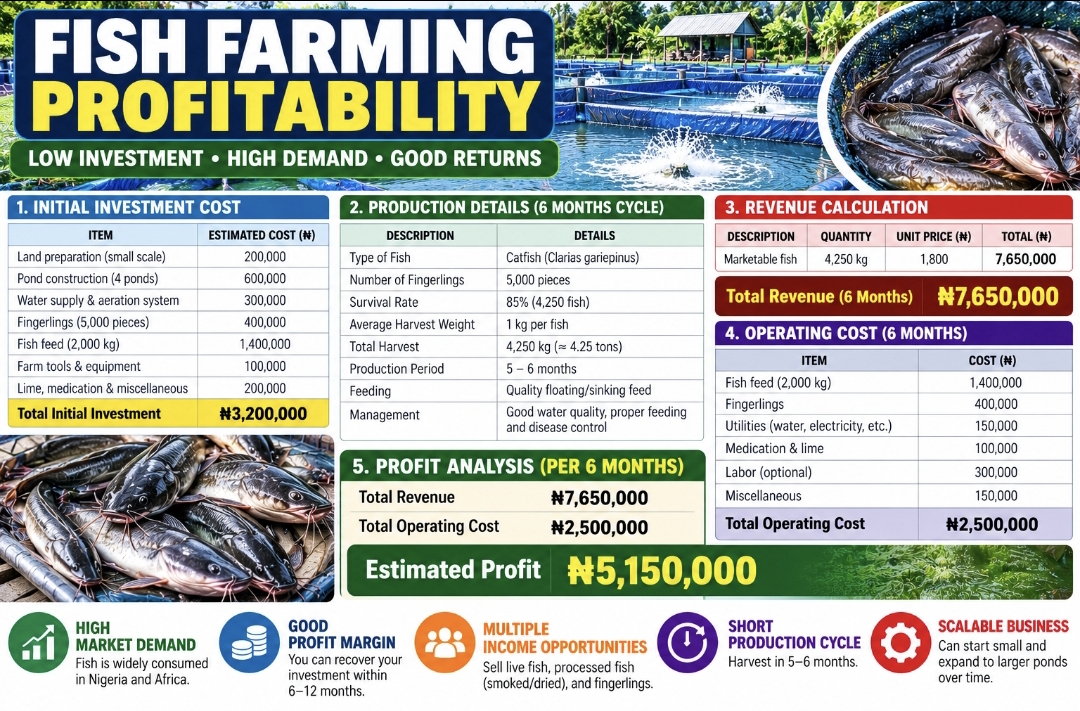
Illustrative Fish Farm Profit Calculation
Consider a hypothetical fish farm producing 5,000 kg of market-size fish.
Assume:
- Selling price = $3 per kg
- Total revenue = $15,000
- Fingerlings = $1,000
- Feed = $6,000
- Labor = $1,000
- Energy and water = $500
- Health management = $300
- Harvesting and transportation = $500
- Other operating expenses = $300
Total operating costs:
$1,000 + $6,000 + $1,000 + $500 + $300 + $500 + $300 = $9,600
Estimated operating profit:
$15,000 − $9,600 = $5,400
This is an illustrative example, not a guaranteed result. Actual figures vary significantly between farms and markets.
Gross Profit Versus Net Profit
It is important to distinguish gross profit from net profit.
Gross profit may refer to revenue minus direct production costs.
Net profit considers the broader expenses of operating the business, which can include:
- Administration
- Depreciation
- Interest
- Taxes
- Insurance
- Marketing
- Repairs
- Management
- Other overhead
Farmers should use a consistent accounting method when evaluating business performance.
Return on Investment
Return on investment, or ROI, measures the financial return relative to the amount invested.
A simplified formula is:
ROI = Profit ÷ Investment × 100
Suppose a farmer invests $20,000 and generates $5,000 in profit during the relevant period.
ROI:
$5,000 ÷ $20,000 × 100 = 25%
The time period must always be stated when comparing ROI figures.
Break-Even Analysis
Break-even analysis determines the level of sales required to cover costs.
A simplified break-even calculation is:
Break-even quantity = Fixed Costs ÷ Contribution per unit
Suppose:
- Fixed costs = $5,000
- Selling price per kg = $3
- Variable cost per kg = $2
Contribution per kg:
$3 − $2 = $1
Break-even quantity:
$5,000 ÷ $1 = 5,000 kg
The farm would therefore need to sell approximately 5,000 kg under these simplified assumptions to cover the specified costs.
Cost Per Kilogram of Fish
Cost per kilogram is an extremely useful management indicator.
Formula:
Cost per kg = Total Production Cost ÷ Total Fish Weight Produced
Suppose a farm spends $10,000 to produce 5,000 kg.
Cost per kg:
$10,000 ÷ 5,000 = $2 per kg
If fish are sold for $3 per kg, the simplified margin before other relevant costs is $1 per kg.
Cost Per Fish
Farmers can also calculate the approximate production cost per fish.
Suppose total production costs are $8,000 and 4,000 fish are harvested.
Cost per fish:
$8,000 ÷ 4,000 = $2
This calculation can be useful where fish are sold individually rather than by weight.
Importance of Harvest Size
Fish size can influence profitability.
Some markets prefer smaller fish, while others prefer larger fish.
Farmers should determine the preferred market size before designing the production cycle.
Growing fish significantly beyond the preferred market size can increase feed consumption and operating costs without necessarily generating an equivalent increase in selling price.
Fish Growth Rate
Growth rate affects how quickly capital can be converted into revenue.
Fast-growing fish can potentially reach market size sooner.
However, growth depends on:
- Genetics
- Feed
- Temperature
- Water quality
- Stocking density
- Health
- Management
Farmers should monitor growth rather than assuming fish are developing normally.
Stocking Density and Profitability
Stocking density affects both biological performance and financial results.
Very low stocking densities may underuse available infrastructure.
Excessive stocking densities can create:
- Poor water quality
- Competition
- Stress
- Reduced growth
- Higher disease pressure
- Increased mortality
The ideal stocking density depends on the species and production system.
Pond-Based Fish Farming Economics
Pond systems can have relatively simple infrastructure compared with highly intensive systems.
Major costs may include:
- Pond construction
- Fingerlings
- Feed
- Water
- Labor
- Harvesting
- Maintenance
Profitability depends heavily on production efficiency and market prices.
Tank-Based Fish Farming Economics
Tank systems can provide greater control over the production environment.
Costs may include:
- Tanks
- Pumps
- Plumbing
- Aeration
- Filtration
- Electricity
- Water
Tank systems may be suitable where land or water availability limits traditional pond production.
Cage Fish Farming Economics
Cage farming involves raising fish in cages placed in suitable water bodies.
Costs may include:
- Cages
- Nets
- Anchoring systems
- Boats
- Feed
- Labor
- Monitoring
- Maintenance
The system requires careful consideration of water quality, security, environmental conditions and regulations.
Recirculating Aquaculture Systems
Recirculating aquaculture systems, commonly called RAS, recycle and treat water.
They may use:
- Mechanical filtration
- Biological filtration
- Aeration
- Pumps
- Water-quality monitoring
- Temperature control
RAS can allow intensive production in relatively small areas but generally requires higher technical expertise and capital investment.
Value Addition and Fish Profitability
Selling raw fish is not the only possible business model.
Value-added products can include:
- Fillets
- Smoked fish
- Frozen fish
- Dried fish
- Marinated fish
- Packaged fish
- Ready-to-cook products
Value addition can potentially increase revenue per kilogram, but it also creates additional costs and food-safety requirements.
Fish Processing Business
A farmer can integrate production with processing.
This may provide greater control over the value chain.
However, processing facilities may require:
- Equipment
- Electricity
- Cold storage
- Packaging
- Skilled workers
- Food-safety controls
- Regulatory approvals
The economics should be evaluated before investment.
Direct Fish Marketing
Direct marketing can help farmers develop relationships with end users.
Potential customers include:
- Households
- Restaurants
- Hotels
- Supermarkets
- Caterers
- Fish retailers
- Food processors
Direct marketing may increase the selling price, but farmers may also incur higher costs for delivery, packaging, customer service and marketing.
Digital Marketing for Fish Farmers
Modern fish farmers can use digital platforms to market their products.
Potential channels include:
- Websites
- Social media
- Messaging platforms
- Online marketplaces
- Digital advertisements
Farmers can display:
- Fish sizes
- Available quantities
- Prices
- Harvest dates
- Farm location
- Delivery options
- Processing options
Seasonal Fish Prices
Fish prices may change during the year.
Factors include:
- Seasonal demand
- Weather
- Production cycles
- Holidays
- Supply levels
- Transportation
- Feed costs
Farmers should monitor local market trends rather than assuming one price will remain constant throughout the year.
Managing Feed Wastage
Feed wastage directly increases production costs.
Farmers can reduce waste by:
- Feeding according to fish size
- Monitoring feeding response
- Using appropriate pellet sizes
- Maintaining feeders
- Avoiding overfeeding
- Adjusting feeding schedules
Uneaten feed can also deteriorate water quality.
Managing Production Records
Good records are essential for profitability analysis.
Farmers should record:
- Stocking date
- Number stocked
- Fingerling cost
- Feed quantity
- Feed cost
- Mortality
- Water-quality observations
- Treatments
- Sampling weights
- Harvest weight
- Selling price
- Revenue
- Operating expenses
Without records, it is difficult to identify why a production cycle made or lost money.
Fish Sampling
Regular sampling helps farmers estimate:
- Average fish weight
- Growth rate
- Biomass
- Feed requirements
- Expected harvest date
Sampling should be performed carefully to reduce fish stress and injury.
Biomass Estimation
Biomass refers to the total weight of fish in the production system.
A simplified calculation is:
Biomass = Number of surviving fish × Average fish weight
For example:
If 8,000 fish survive and average weight is 0.5 kg:
8,000 × 0.5 = 4,000 kg biomass
Biomass estimates help farmers make better feeding and management decisions.
Feeding Based on Biomass
Feed requirements can be estimated using a percentage of biomass, depending on species, age, temperature and production system.
For example, if a feeding plan calls for 2% of biomass per day and the estimated biomass is 4,000 kg:
4,000 × 2% = 80 kg feed per day
This is only an illustrative calculation. Actual feeding rates must be determined according to species, size, water temperature, feed formulation and observed feeding behavior.
Improving Fish Farm Efficiency
Efficiency means producing more saleable fish with the resources used.
Farmers can improve efficiency by:
- Reducing mortality
- Improving FCR
- Reducing feed waste
- Improving water quality
- Maintaining equipment
- Purchasing quality fingerlings
- Improving labor productivity
- Reducing unnecessary energy use
- Improving harvest planning
Preventing Financial Losses
Some losses can be prevented through proper management.
Farmers should avoid:
- Overstocking
- Poor water management
- Uncontrolled feeding
- Buying low-quality fingerlings
- Ignoring sick fish
- Poor record keeping
- Unplanned harvesting
- Selling without knowing production costs
Insurance and Risk Management
Where suitable aquaculture insurance products are available, farmers may consider insurance for certain risks.
Other risk-management strategies include:
- Emergency funds
- Diversified markets
- Multiple suppliers
- Backup power
- Water-storage capacity
- Strong biosecurity
- Accurate financial records
Importance of Working Capital
Working capital allows a farm to continue operating before revenue is received.
A farmer may need funds to purchase feed several times before the fish are ready for harvest.
Working capital may also be needed for:
- Fingerlings
- Labor
- Energy
- Water
- Repairs
- Transportation
- Emergency expenses
A farm should avoid committing all available capital to infrastructure while leaving insufficient money for daily operations.
Scaling a Fish Farming Business
Expansion should be based on actual farm performance.
Before increasing production, farmers should evaluate:
- Survival rate
- Growth rate
- FCR
- Cost per kg
- Selling price
- Customer demand
- Water availability
- Labor
- Equipment capacity
- Working capital
Scaling a poorly managed farm can increase losses rather than profits.
Small-Scale Fish Farming Profitability
Small farms can potentially be profitable if they maintain good cost control.
Advantages may include:
- Lower initial capital requirements
- Easier management
- Direct customer relationships
- Lower infrastructure requirements
However, small farms may have less bargaining power when purchasing feed and equipment.
Medium-Scale Fish Farming Profitability
Medium-scale farms can benefit from greater production volume.
They may be able to:
- Negotiate better input prices
- Supply larger customers
- Employ specialized workers
- Invest in better equipment
- Develop stronger distribution networks
Management complexity also increases.
Large-Scale Fish Farming Profitability
Large farms can benefit from economies of scale.
Potential advantages include:
- Bulk feed purchasing
- Specialized labor
- Automated systems
- Large customer contracts
- Processing facilities
- Efficient transportation
However, large farms also have greater exposure to disease outbreaks, market changes, energy costs and operational failures.
How to Increase Fish Farm Revenue
Revenue can potentially be increased through:
- Increasing survival rates
- Improving growth
- Selling at appropriate market sizes
- Developing direct customers
- Processing fish
- Selling fingerlings
- Producing broodstock
- Selling manure or other usable by-products
- Expanding distribution
Revenue growth should not come at the expense of biological performance.
How to Reduce Fish Farming Costs
Cost reduction strategies include:
- Reducing feed waste
- Improving FCR
- Maintaining equipment
- Reducing mortality
- Buying quality inputs
- Comparing suppliers
- Improving energy efficiency
- Planning harvests
- Reducing unnecessary labor
- Improving water management
Cost reduction should never involve compromising fish health or food safety.
Fish Farming Profitability Checklist
Before starting a commercial fish farm, ask:
- Do I know my target market?
- Do I know the expected selling price?
- Do I know my feed cost?
- Do I know the cost of fingerlings?
- Do I have sufficient water?
- Do I have reliable electricity or backup power?
- Do I understand the species I want to produce?
- Do I have enough working capital?
- Do I have a disease-prevention plan?
- Do I have a harvesting plan?
- Do I know my expected cost per kilogram?
- Do I have customers?
- Do I have accurate records?
- Do I have a contingency plan?
If these questions cannot be answered, additional planning is advisable before stocking fish.
Example of a Complete Hypothetical Fish Farm Budget
Consider a hypothetical production cycle producing 10,000 kg of market fish.
Assume:
- Revenue from fish sales: $30,000
- Fingerlings: $1,500
- Feed: $12,000
- Labor: $2,000
- Energy and water: $1,000
- Health management: $500
- Harvesting: $700
- Transportation: $800
- Maintenance: $500
- Other operating expenses: $500
Total operating costs:
$19,500
Illustrative operating profit:
$30,000 − $19,500 = $10,500
Operating margin:
$10,500 ÷ $30,000 × 100 = 35%
This is a hypothetical example for demonstrating the calculation method. It should not be interpreted as a typical or guaranteed fish-farming margin.
Why Actual Profit Can Differ From Projections
Projected profits can differ from actual results because:
- Fish may grow slower than expected
- Mortality may increase
- Feed prices may rise
- Selling prices may fall
- Energy costs may increase
- Harvest weight may differ
- Disease may occur
- Transportation costs may increase
- Customers may delay purchases
Financial projections should therefore include reasonable contingency allowances.
How to Create a Fish Farming Business Budget
A basic budget can be organized into four sections:
Section 1: Startup investment
Include ponds, tanks, pumps, equipment and construction.
Section 2: Production costs
Include fingerlings, feed, labor, water, electricity and health management.
Section 3: Revenue
Estimate expected saleable fish weight and selling price.
Section 4: Financial performance
Calculate gross revenue, operating costs, profit, cost per kilogram and break-even point.
The Importance of Conservative Planning
Farmers should avoid building a business plan around the highest possible selling price and lowest possible production cost.
A stronger approach is to consider:
- Conservative selling prices
- Higher feed costs
- Moderate mortality
- Realistic growth rates
- Unexpected maintenance
- Market delays
If the business remains financially viable under conservative assumptions, the plan may be more resilient.
Common Financial Mistakes in Fish Farming
Common mistakes include:
- Underestimating feed costs
- Ignoring mortality
- Ignoring labor
- Ignoring depreciation
- Failing to calculate cost per kilogram
- Spending too much on infrastructure
- Starting without sufficient working capital
- Assuming every fish will survive
- Assuming market prices will remain constant
- Mixing household money with farm money
Separate farm finances from personal finances whenever possible.
Keeping Farm Money Separate
A dedicated farm account or accounting system can help farmers track:
- Sales
- Purchases
- Labor
- Feed
- Repairs
- Transportation
- Profit
This makes it easier to understand whether the farm is genuinely generating money.
Reinvesting Fish Farming Profits
Profits can be used to strengthen the business.
Possible reinvestments include:
- Additional ponds
- Better water systems
- Aeration
- Cold storage
- Processing equipment
- Improved security
- Better record-keeping systems
- Marketing
- Working capital
Reinvestment should be based on demonstrated demand and production performance.
When Should a Fish Farmer Expand?
Expansion may be considered when:
- Existing facilities are consistently utilized
- Customers are available
- Production records show positive performance
- Working capital is sufficient
- Water resources can support expansion
- Management capacity is available
Expansion should be gradual and controlled.
Frequently Asked Questions About Fish Farming Profitability
Is fish farming profitable?
Fish farming can be profitable, but profitability depends on production efficiency, fish survival, feed costs, selling prices, market demand and management.
What is the biggest cost in fish farming?
Feed is often one of the largest operating expenses in intensive fish farming, although the exact cost structure varies by species and production system.
How do I calculate fish farm profit?
Use:
Profit = Total Revenue − Total Costs
Calculate revenue from actual saleable fish and subtract all relevant operating and business expenses.
How can I reduce fish farming costs?
Focus on feed efficiency, mortality reduction, water management, equipment maintenance, reliable input purchasing and efficient labor.
What is FCR in fish farming?
FCR stands for Feed Conversion Ratio. It measures how much feed is required to produce a given amount of fish biomass.
Does a larger fish farm always make more profit?
No. Larger farms can benefit from economies of scale, but they also have greater capital requirements and operational risks. Efficiency is more important than size alone.
Can small-scale fish farming be profitable?
Yes, a small fish farm can potentially be profitable if it has appropriate production costs, good management and a reliable market.
How important is fish market research?
Market research is extremely important because the selling price, preferred fish size, customer type and demand directly affect revenue.
What is the most important financial calculation?
Farmers should understand at least their total production cost, revenue, profit, cost per kilogram, FCR and break-even point.
Can fish processing increase profitability?
Processing can potentially increase the value of fish products, but it also introduces additional costs, equipment requirements and food-safety responsibilities.
Final Thoughts
Fish farming profitability is not determined by the number of fish stocked or the amount of money received at harvest. It is determined by how effectively the entire production system converts capital, feed, water, labor and other resources into saleable fish.
A profitable fish farmer must understand both aquaculture and business management.
The biological side involves producing healthy fish with good survival and growth. The financial side involves controlling costs, understanding market prices, calculating margins and protecting cash flow.
Feed management deserves particular attention because feed can represent a substantial portion of operating expenses. Improving feed efficiency and reducing waste can have a significant effect on the cost of producing each kilogram of fish.
Water quality is equally important because poor environmental conditions can reduce growth and increase mortality. Every fish that dies represents not only lost potential revenue but also resources already spent on feed, labor and other inputs.
Marketing should also begin before harvest. Farmers should understand who will buy their fish, what sizes customers prefer, how much they are willing to pay and whether they require live, fresh, frozen, smoked or processed products.
Most importantly, farmers should keep accurate records.
At the end of every production cycle, calculate:
Total fish stocked
Total fish harvested
Survival rate
Total feed used
FCR
Total production cost
Total harvest weight
Selling price
Total revenue
Profit
Cost per kilogram
These figures provide a much clearer picture of farm performance than simply looking at the money received from sales.
Fish farming can become a scalable agricultural enterprise, but sustainable profitability comes from disciplined management rather than assumptions. Farmers who understand their numbers, control avoidable losses, maintain fish health, develop strong markets and continuously improve production efficiency can build stronger and more resilient aquaculture businesses.
Related posts;
- Types of Yam in Africa and Their Commercial Benefits: A Complete Guide to Yam Production, Uses and Business Opportunities
- Types of Potato: Complete Guide to Potato Varieties, Uses, Characteristics and Best Types for Farming.
- Types of Pepper Widely Known and Used in Africa: A Comprehensive Guide to Pepper Varieties, Uses, Cultivation and Economic Importance

- Transforming Agriculture: How an Effective Website Can Boost Your Agro Business

- Transforming Agriculture with Cutting-Edge Web Solutions

- Tilapia Farming: Complete Guide to Raising Tilapia for Commercial Production

- SUCCESSFUL WATERMELON FARMING: A Complete Guide to Growing Watermelon for Profit.