Overview
Rotational grazing is a modern livestock management system in which animals are moved between different grazing areas instead of allowing them to remain continuously on the same piece of land. The system is designed to give grazed pasture enough time to recover while allowing livestock to access fresh forage.
For farmers raising cattle, sheep, goats, horses and other grazing animals, pasture is one of the most important resources on the farm. However, simply having a large area of grass does not guarantee efficient livestock production. How animals use that pasture can significantly affect forage availability, animal performance, soil health and the long-term productivity of the farm.
Continuous grazing can place excessive pressure on preferred plants, particularly when stocking rates are too high or rainfall is limited. Rotational grazing provides a structured way to manage this pressure by dividing pasture into multiple grazing areas and controlling when livestock enter and leave each area.
A properly managed rotational grazing system can improve pasture utilization, encourage plant recovery, reduce unnecessary feed waste and help farmers make better use of available land.
This comprehensive guide explains what rotational grazing is, how it works, how to design a rotational grazing system, how to calculate grazing areas, how to manage livestock movement, common mistakes to avoid and how rotational grazing can contribute to profitable and sustainable livestock farming.
What Is Rotational Grazing?
Rotational grazing is a pasture management system in which livestock are moved from one grazing area to another according to a planned schedule.
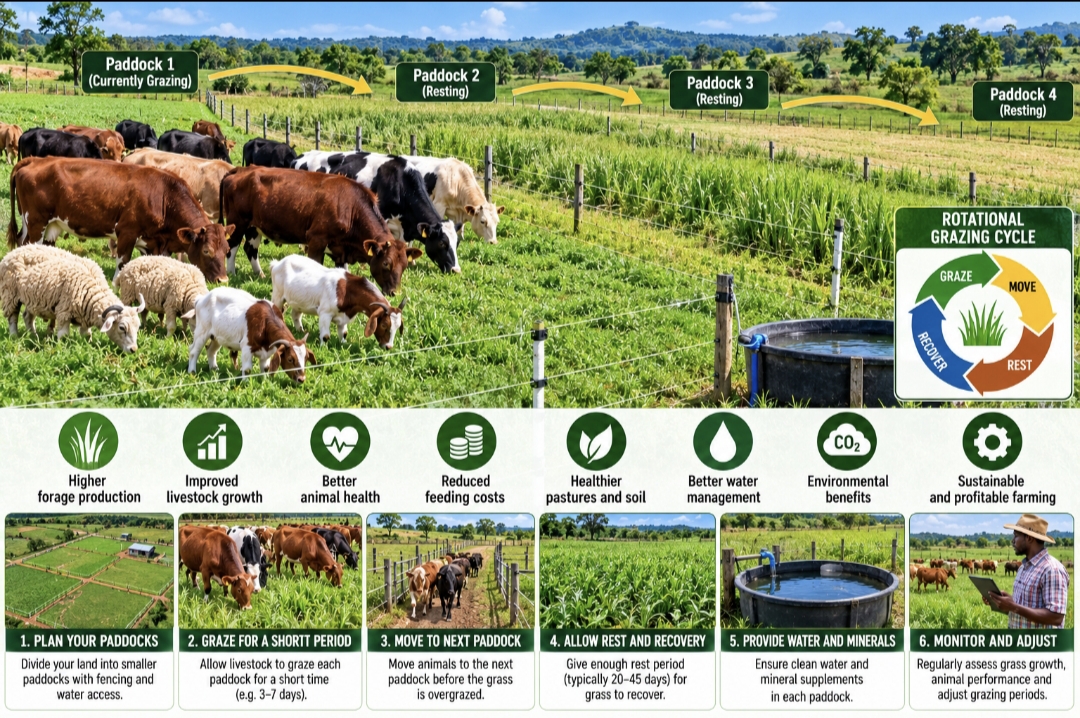
Instead of allowing animals to continuously graze the entire farm, the farmer divides the pasture into several paddocks or grazing units.
Animals graze one paddock for a specific period before being moved to another paddock. The previously grazed paddock is then given a rest period to allow vegetation to recover.
The exact grazing and rest periods depend on:
- Forage species
- Climate
- Rainfall
- Soil fertility
- Season
- Livestock type
- Stocking rate
- Pasture growth rate
- Farm management objectives
Rotational grazing can be implemented on small farms as well as large commercial livestock operations.
Why Rotational Grazing Is Important
Pasture plants need time to recover after being grazed.
When livestock continuously return to the same plants before they have recovered, plant vigor can decline. Over time, desirable forage species may disappear and be replaced by less productive vegetation or weeds.
Rotational grazing attempts to prevent this by controlling livestock movement.
Potential benefits include:
- Better pasture recovery
- More efficient forage utilization
- Reduced overgrazing
- Better livestock distribution
- Improved manure distribution
- Reduced pasture waste
- Improved soil protection
- Better control of grazing pressure
- Potential reduction in purchased feed
- Improved long-term pasture productivity
However, rotational grazing is not automatically successful simply because a farm has multiple paddocks. Management quality remains critical.
How Rotational Grazing Works
A basic rotational grazing system consists of several components:
- Pasture
- Paddocks
- Fencing
- Water points
- Livestock
- Grazing periods
- Rest periods
- Livestock movement plans
For example, a farm may divide its pasture into eight paddocks.
Animals graze paddock one while paddocks two through eight remain unused. After the planned grazing period, the animals move to paddock two.
The first paddock then begins its recovery period.
The cycle continues until the livestock eventually return to the first paddock.
What Is a Grazing Paddock?
A paddock is a defined section of pasture used for controlled livestock grazing.
Paddocks may be created using:
- Permanent fences
- Electric fences
- Temporary fencing
- Natural boundaries
- Combination fencing systems
Paddock size does not have to be identical across an entire farm.
Farmers can design paddocks based on:
- Land shape
- Water access
- Forage production
- Livestock numbers
- Terrain
- Soil conditions
- Management goals
Continuous Grazing vs Rotational Grazing
Continuous grazing allows livestock to remain on the same pasture area for a long period.
Rotational grazing controls livestock movement between different grazing areas.
Under continuous grazing, animals may repeatedly consume plants they prefer while ignoring less desirable plants.
Under rotational grazing, farmers can better control grazing pressure and provide rest periods.
Neither system is automatically successful or unsuccessful. Both can produce different results depending on stocking rate, pasture quality, climate and management.
The major advantage of rotational grazing is the additional control it provides over where and when livestock graze.
Main Principles of Rotational Grazing
Successful rotational grazing is based on several principles.
Control Grazing Intensity
Livestock should not remove excessive amounts of plant material from the pasture.
Provide Adequate Rest
Previously grazed plants need sufficient time to recover before animals return.
Match Stocking Rate to Forage
The number of animals should be appropriate for the amount of available forage.
Protect Soil
Grazing should be managed to minimize erosion, compaction and excessive exposure of soil.
Maintain Water Access
Animals should have reliable access to clean drinking water.
Monitor Pasture Growth
The farmer should observe actual pasture conditions rather than relying solely on predetermined dates.
Benefits of Rotational Grazing
Rotational grazing can provide several potential benefits when properly managed.
Better Forage Utilization
Livestock often selectively graze pasture.
They may repeatedly consume their preferred plants while leaving less desirable vegetation behind.
Controlled grazing can encourage more even utilization of available forage.
Improved Pasture Recovery
A rest period allows plants to rebuild leaf area and root reserves.
This can help maintain pasture productivity when grazing pressure is appropriate.
Reduced Overgrazing
Rotational grazing makes it easier to prevent livestock from continuously grazing the same plants.
This is particularly useful during periods of slow pasture growth.
Better Livestock Distribution
Animals tend to concentrate around water, shade and preferred grazing areas.
Paddock design can help distribute livestock more evenly across the farm.
Better Manure Distribution
When livestock move across different paddocks, manure and urine can be distributed across a wider area.
This can contribute to nutrient cycling.
Potential Feed Cost Reduction
If pasture productivity and utilization improve, farmers may reduce dependence on purchased forage or other feed sources.
The actual savings depend on farm conditions and management.
Soil Protection
Healthy vegetation provides ground cover that can reduce erosion and protect soil from heavy rainfall and wind.
Improved Farm Management
Rotational grazing creates a system in which the farmer can measure:
- Grazing days
- Rest days
- Animal numbers
- Pasture growth
- Forage availability
- Animal performance
This makes livestock management more organized.
How to Design a Rotational Grazing System
Designing a rotational grazing system should begin with an assessment of the farm.
Consider:
- Total land area
- Pasture type
- Livestock numbers
- Water availability
- Terrain
- Soil type
- Climate
- Existing fences
- Forage production
- Available budget
The goal is to create a system that is practical to operate.
Step 1: Measure the Available Land
Determine the total pasture area.
Land may be measured in acres, hectares or another local unit.
Accurate measurements make paddock planning easier.
Step 2: Determine Livestock Numbers
Record the number and type of animals.
A herd of cattle requires a different grazing strategy from a flock of sheep or goats.
Animal size and production stage also influence forage demand.
Step 3: Evaluate Pasture Production
Estimate how much forage the pasture produces during different seasons.
This may involve field observations, forage sampling or assistance from an agricultural professional.
Step 4: Identify Water Sources
Determine where animals can obtain drinking water.
Possible sources include:
- Wells
- Boreholes
- Tanks
- Ponds
- Streams
- Water troughs
- Piped systems
Water availability should influence paddock design.
Step 5: Divide the Farm Into Paddocks
Use fencing to create manageable grazing units.
Paddock design should minimize unnecessary livestock movement while allowing easy access to water.
Step 6: Establish Grazing Rules
Decide:
- When livestock enter a paddock
- How long they remain
- When they leave
- How long the paddock rests
- What happens during drought
Step 7: Monitor and Adjust
A grazing plan should be flexible.
If pasture growth slows, animals may need to leave paddocks sooner or receive additional feed.
Understanding Grazing Period
The grazing period is the length of time livestock remain in a particular paddock before being moved.
Short grazing periods can reduce repeated grazing of newly emerging plants.
Longer grazing periods may increase the risk of animals repeatedly grazing desirable plants.
The ideal duration depends on pasture growth and stocking density.
Understanding Rest Period
The rest period is the time a paddock remains free from grazing.
The objective is to allow plants to recover sufficiently before livestock return.
Fast-growing pasture may require a shorter rest period.
Slow-growing pasture may require a much longer recovery period.
Why Rest Periods Matter
When plants are grazed, they lose part of their photosynthetic leaf area.
They need time to produce new leaves.
Repeated grazing before adequate recovery can weaken the plants.
Adequate rest can help maintain:
- Leaf production
- Root development
- Plant vigor
- Pasture persistence
How Many Paddocks Are Needed?
There is no universal number of paddocks that works for every farm.
A simple system may have four to six paddocks.
More intensive systems may use many smaller paddocks.
The appropriate number depends on:
- Farm size
- Livestock numbers
- Pasture productivity
- Desired grazing duration
- Available infrastructure
- Management capacity
More paddocks can provide greater control but may also increase fencing and water-infrastructure costs.
Example of a Simple Rotational System
Suppose a farm has 10 paddocks.
Livestock graze one paddock for three days before moving to the next.
If the farmer follows the sequence:
Paddock 1 → Paddock 2 → Paddock 3 → Paddock 4 → Paddock 5 → Paddock 6 → Paddock 7 → Paddock 8 → Paddock 9 → Paddock 10
The first paddock receives a long rest period before livestock return.
However, the actual rest period should be determined by pasture recovery, not simply by the number of paddocks.
Stocking Rate and Rotational Grazing
Stocking rate refers to the number of animals supported by a given area over a specified period.
A farmer should not increase animal numbers simply because rotational grazing has been introduced.
Rotational grazing improves management of forage; it does not create unlimited forage.
If forage production is insufficient, the farmer must reduce stocking pressure or provide additional feed.
Stocking Density vs Stocking Rate
These terms are related but different.
Stocking rate generally describes animals supported per unit of land over time.
Stocking density describes how many animals are concentrated in a specific area at a particular moment.
A farmer can use higher short-term stocking density in a paddock while keeping the overall farm stocking rate sustainable.
Rotational Grazing for Cattle
Cattle are among the livestock species commonly managed under rotational grazing.
A cattle rotational grazing system can be designed around:
- Herd size
- Cow-calf requirements
- Beef production
- Dairy production
- Pasture growth
- Water availability
Large cattle can consume significant amounts of forage, so stocking pressure must be monitored carefully.
Rotational Grazing for Goats
Goats can benefit from controlled grazing because they often browse shrubs and other vegetation in addition to consuming grasses.
However, farmers should monitor pasture carefully because goats can also remove vegetation aggressively in heavily stocked areas.
Rotational systems can help manage vegetation and reduce repeated browsing pressure.
Rotational Grazing for Sheep
Sheep can be effectively managed in paddocks.
Because sheep often graze relatively close to the ground, careful control of grazing duration and recovery time is important.
Rotational grazing can also be integrated with parasite-management strategies, although grazing rotation alone should not be assumed to eliminate parasites.
Rotational Grazing for Horses
Horse pasture management requires careful attention to grazing pressure and pasture condition.
Horses may repeatedly graze preferred areas and create bare spots around water and resting locations.
Paddock rotation can help distribute grazing pressure.
Water Management in Rotational Grazing
Water is one of the most important parts of paddock design.
Animals need regular access to clean drinking water.
A well-designed system may use:
- Central water points
- Individual paddock troughs
- Portable water troughs
- Underground pipelines
- Storage tanks
Portable troughs can be useful because they allow farmers to change watering locations as grazing areas change.
Fencing for Rotational Grazing
Fencing determines how effectively animals can be controlled.
Permanent Fencing
Permanent fences are useful for creating long-term paddock boundaries.
They can be durable but may require significant investment.
Electric Fencing
Electric fencing can provide flexible livestock control.
It may be used as permanent or temporary fencing depending on the equipment.
Temporary Fencing
Temporary fencing allows farmers to create smaller grazing areas within larger paddocks.
This can provide considerable flexibility.
Choosing the Right Fence
The best fencing system depends on:
- Animal species
- Farm size
- Terrain
- Security requirements
- Budget
- Electricity availability
- Desired flexibility
Pasture Height and Grazing Decisions
Farmers should observe pasture condition before moving livestock into or out of a paddock.
Important observations include:
- Plant height
- Leaf density
- Plant maturity
- Ground cover
- Regrowth
- Soil exposure
The goal is to avoid both underutilization and excessive grazing.
Don't Manage Grazing by Calendar Alone
A common mistake is deciding that animals must leave a paddock after exactly a certain number of days regardless of pasture condition.
Weather can change pasture growth dramatically.
A better approach is to combine planned grazing schedules with regular pasture observation.
Managing Rotational Grazing During the Rainy Season
When pasture growth is rapid, farmers may need to move animals more frequently.
Excess forage can be:
- Conserved as hay
- Converted to silage
- Used in another livestock unit
- Mechanically harvested
Allowing excess pasture to mature excessively may reduce its nutritional quality.
Managing Rotational Grazing During Dry Seasons
During dry periods, forage growth can decline.
Farmers may need to:
- Increase rest periods
- Reduce stocking pressure
- Provide hay
- Provide silage
- Supply supplemental feed
- Use drought-tolerant forage
- Irrigate where economically viable
Preparing feed reserves before the dry period is generally more effective than waiting until pasture is exhausted.
Rotational Grazing and Soil Fertility
Livestock return nutrients to the soil through manure and urine.
However, nutrient distribution may not always be uniform.
Animals often concentrate around:
- Water
- Shade
- Mineral feeders
- Gates
- Resting areas
Farmers should monitor these areas for excessive nutrient accumulation and soil damage.
Rotational Grazing and Soil Compaction
Heavy livestock can compact soil, particularly when the soil is wet.
Signs of compaction include:
- Poor water infiltration
- Standing water
- Reduced root growth
- Hard soil
- Poor pasture growth
Avoiding excessive livestock traffic on wet soils can reduce damage.
Rotational Grazing and Weed Control
Poor grazing management can contribute to weed invasion.
Maintaining vigorous desirable forage plants can reduce opportunities for weeds to establish.
Mechanical control, mowing and appropriate herbicide use may sometimes be required.
Rotational Grazing and Animal Health
Good grazing management can contribute indirectly to animal health by providing access to fresh forage and reducing extreme pasture pressure.
However, pasture rotation should not be viewed as a replacement for:
- Vaccination
- Parasite control
- Veterinary care
- Biosecurity
- Clean water
- Balanced nutrition
Animal health requires a complete management program.
Rotational Grazing and Parasite Management
Some livestock parasites have life cycles connected to pasture.
Strategic pasture management can sometimes reduce exposure, but the effectiveness varies by parasite, climate, livestock species and rotation schedule.
Farmers should work with animal-health professionals when developing parasite-control programs.
Rotational Grazing and Livestock Nutrition
Pasture quality changes as plants mature.
Young leafy plants are often more digestible than highly mature forage.
Farmers should therefore manage grazing to provide animals with suitable forage quality while maintaining enough plant material for recovery.
Minerals in Rotational Grazing Systems
Pasture does not always supply every mineral required by livestock.
Depending on animal requirements and local forage conditions, farmers may provide:
- Salt
- Mineral blocks
- Calcium
- Phosphorus
- Trace minerals
Mineral supplementation should be based on livestock requirements and professional nutritional guidance where necessary.
Record Keeping for Rotational Grazing
Good records can significantly improve pasture management.
A grazing record may include: Date Paddock Animals Grazing Days Condition Next Action Day 1 A 50 3 Good Move Day 4 B 50 3 Good Move Day 7 C 50 3 Moderate Monitor
The exact format can be adapted to the farm.
Digital records can make long-term analysis easier.
Measuring Success
A rotational grazing system should be evaluated using measurable indicators.
These can include:
- Animal weight gain
- Milk production
- Pasture yield
- Grazing days
- Rest periods
- Feed purchases
- Soil condition
- Weed levels
- Livestock mortality
- Reproductive performance
If the system does not improve farm performance, the management plan should be reviewed.
Economics of Rotational Grazing
Rotational grazing requires investment.
Potential costs include:
- Fencing
- Water infrastructure
- Gates
- Water tanks
- Pumps
- Pipes
- Livestock handling facilities
- Labor
- Pasture establishment
However, potential economic benefits may include:
- Better forage utilization
- Reduced pasture degradation
- Lower purchased-feed requirements
- Improved animal productivity
- Better land utilization
The economic result depends on the farm's starting condition and how effectively the system is managed.
Example of a Simple Economic Calculation
Suppose a farmer invests $12,000 in fencing and water infrastructure.
If improved pasture management reduces purchased feed expenses by $3,000 annually, the direct feed-cost recovery would be:
$12,000 ÷ $3,000 = 4 years
This is only an illustrative calculation. It does not account for maintenance, financing costs, changes in feed prices or other benefits and expenses.
Farmers should conduct their own farm-specific analysis before investing.
How to Reduce the Cost of Rotational Grazing
Farmers with limited capital can start gradually.
Possible approaches include:
- Begin with fewer paddocks
- Use temporary electric fencing
- Improve existing fences
- Use existing water sources
- Install infrastructure in stages
- Start with the most productive pasture
- Expand after measuring results
A rotational system does not have to be highly sophisticated to be useful.
Common Rotational Grazing Mistakes
Overstocking
Rotational grazing cannot compensate for excessive livestock numbers.
Poor Paddock Design
Paddocks that are too large or poorly positioned can make livestock management difficult.
Inadequate Water
Animals should not be forced to walk excessive distances for water.
Insufficient Rest
Returning livestock before plants recover can weaken pasture.
Grazing Too Long
Animals may repeatedly graze new regrowth if they remain in the same paddock too long.
Ignoring Weather
Drought, heavy rainfall and unusual temperature conditions can change pasture growth.
Failing to Monitor Animals
A pasture may look good while livestock performance declines if nutritional requirements are not being met.
Poor Fence Maintenance
Broken fences can disrupt the grazing plan and allow livestock into areas where they should not be.
Lack of Feed Reserves
Every seasonal livestock farm should have a plan for periods when pasture production declines.
Step-by-Step Guide to Starting Rotational Grazing
Step 1: Evaluate Your Farm
Measure the land and assess pasture productivity.
Step 2: Count Your Animals
Determine the number, species and production stage of livestock.
Step 3: Assess Feed Demand
Estimate how much forage the animals require.
Step 4: Map the Farm
Identify existing fences, roads, water points, shade and difficult terrain.
Step 5: Design Paddocks
Create grazing units that are practical to manage.
Step 6: Establish Water Access
Provide reliable drinking water.
Step 7: Install Fencing
Start with essential boundaries and expand gradually.
Step 8: Establish a Grazing Schedule
Create an initial movement plan.
Step 9: Monitor Pasture
Check forage condition before and after grazing.
Step 10: Monitor Animal Performance
Track weight, milk production, body condition and reproduction where relevant.
Step 11: Adjust the System
Increase or reduce grazing periods according to actual pasture recovery.
Step 12: Build Feed Reserves
Produce hay or silage when forage is abundant.
Rotational Grazing and Sustainable Agriculture
Rotational grazing can form part of a broader sustainable livestock strategy.
Well-managed grazing can maintain ground cover and reduce the risk of pasture degradation.
It can also improve nutrient cycling and make better use of rainfall.
However, sustainability depends on maintaining a balance between animal demand and the productive capacity of the land.
Combining Rotational Grazing With Pasture Improvement
Rotational grazing works best when combined with productive forage.
Farmers can improve pasture through:
- Reseeding
- Fertilization
- Legume integration
- Weed management
- Improved drainage
- Soil improvement
- Appropriate irrigation
Better pasture provides the foundation for better grazing management.
Integrating Rotational Grazing With Crop Production
Livestock farmers can combine grazing systems with crop production.
For example, crop fields may be followed by forage crops or cover crops that can later be grazed.
Livestock manure can then return nutrients to crop fields.
This creates an integrated crop-livestock system.
Technology and Precision Grazing
Technology is creating new opportunities for grazing management.
Modern tools may include:
- GPS livestock tracking
- Electronic identification
- Virtual fencing
- Satellite pasture monitoring
- Drone imagery
- Soil sensors
- Weather stations
- Digital grazing-management applications
These technologies can provide farmers with more information for decision-making.
Virtual Fencing
Virtual fencing uses technology to establish livestock boundaries without relying entirely on physical fences.
Animals may wear specialized devices that provide alerts or signals when they approach virtual boundaries.
The suitability and legality of such systems depend on location, animal type, regulations and available technology.
Drone Monitoring
Drones can provide aerial views of:
- Pasture coverage
- Bare soil
- Water points
- Fence lines
- Weed patches
- Livestock distribution
This can help farmers identify problems that may be difficult to see from ground level.
Future of Rotational Grazing
The future of rotational grazing is likely to involve increasingly precise management.
Farmers may use real-time data to estimate forage availability and determine when animals should be moved.
Improved forage genetics, automated water systems, electronic livestock identification and digital farm records can also make grazing systems more efficient.
The fundamental principle, however, will remain the same: match livestock demand with pasture production while giving vegetation sufficient time to recover.
Frequently Asked Questions About Rotational Grazing
What is rotational grazing?
Rotational grazing is a livestock management system in which animals are moved between different pasture areas to control grazing pressure and allow previously grazed areas to recover.
Is rotational grazing profitable?
It can improve farm economics by increasing forage utilization, reducing pasture degradation and potentially lowering purchased-feed costs. Actual profitability depends on infrastructure costs, pasture productivity, livestock performance and management.
How many paddocks do I need?
There is no universal number. The appropriate number depends on farm size, livestock numbers, forage growth and the desired grazing and rest periods.
How long should livestock stay in one paddock?
The answer depends on forage growth, animal numbers and grazing intensity. Farmers should avoid allowing livestock to repeatedly graze newly emerging regrowth.
How long should pasture rest?
Rest periods vary widely according to plant species, climate, season and pasture condition. The pasture itself should determine when animals return.
Is rotational grazing suitable for cattle?
Yes. Cattle are commonly managed using rotational grazing systems.
Can goats be rotationally grazed?
Yes. Goats can be managed through paddock rotation, although their browsing behavior should be considered when designing the system.
Does rotational grazing eliminate overgrazing?
No. Rotational grazing can help control grazing pressure, but overstocking or poor management can still cause overgrazing.
Does rotational grazing reduce feed costs?
It can potentially reduce purchased-feed costs by improving pasture utilization, but results vary among farms.
Do I need expensive equipment?
No. A basic rotational grazing system can begin with simple fencing, water infrastructure and good management. More advanced technology can be added later.
Can small farms use rotational grazing?
Yes. Small farms can divide available pasture into several manageable grazing areas and rotate livestock according to pasture recovery.
Can rotational grazing improve soil?
Properly managed grazing can help maintain vegetation cover and nutrient cycling, which may support soil health. Poorly managed grazing can still damage soil.
What happens during drought?
Farmers may need to reduce stocking pressure, increase pasture rest periods, provide conserved forage or supplemental feed and use alternative grazing areas.
Final Thoughts on Rotational Grazing
Rotational grazing is a practical approach to managing livestock and pasture together. Instead of treating pasture as an unlimited resource, the system recognizes that forage plants need time to grow and recover.
The success of rotational grazing depends on several factors, including appropriate stocking rates, good pasture management, adequate water, effective fencing and regular monitoring.
Farmers should avoid copying a grazing schedule from another farm without considering their own conditions. Climate, soil, forage species, livestock numbers and seasonal growth can all be different.
A successful rotational grazing system is therefore one that responds to the actual condition of the pasture and animals.
For commercial livestock farmers, rotational grazing can become an important component of a broader strategy that includes pasture improvement, animal nutrition, health management, record keeping and feed conservation.
When these components work together, the farmer can make better use of available land while maintaining the productivity of the pasture for future seasons.
Latest posts;
- Types of Yam in Africa and Their Commercial Benefits: A Complete Guide to Yam Production, Uses and Business Opportunities
- Types of Potato: Complete Guide to Potato Varieties, Uses, Characteristics and Best Types for Farming.
- Types of Pepper Widely Known and Used in Africa: A Comprehensive Guide to Pepper Varieties, Uses, Cultivation and Economic Importance
- Transforming Agriculture: How an Effective Website Can Boost Your Agro Business

- Transforming Agriculture with Cutting-Edge Web Solutions

- Tilapia Farming: Complete Guide to Raising Tilapia for Commercial Production

- SUCCESSFUL WATERMELON FARMING: A Complete Guide to Growing Watermelon for Profit.
- Soybean Farming: Complete Guide to Growing Soybeans for Profit