Preamble
Tilapia farming is one of the most important branches of modern aquaculture. Tilapia are widely farmed in many parts of the world because of their adaptability, consumer acceptance, relatively efficient growth and ability to perform well in different production systems.
Commercial tilapia farming can be carried out in earthen ponds, concrete ponds, tanks, cages, raceways and recirculating aquaculture systems. Depending on the farmer's objectives, tilapia production can range from small household operations to highly intensive commercial farms.
However, successful tilapia farming requires more than stocking fish in a pond. Farmers must understand water quality, stocking density, nutrition, breeding control, fish health, biosecurity, harvesting, marketing and financial management.
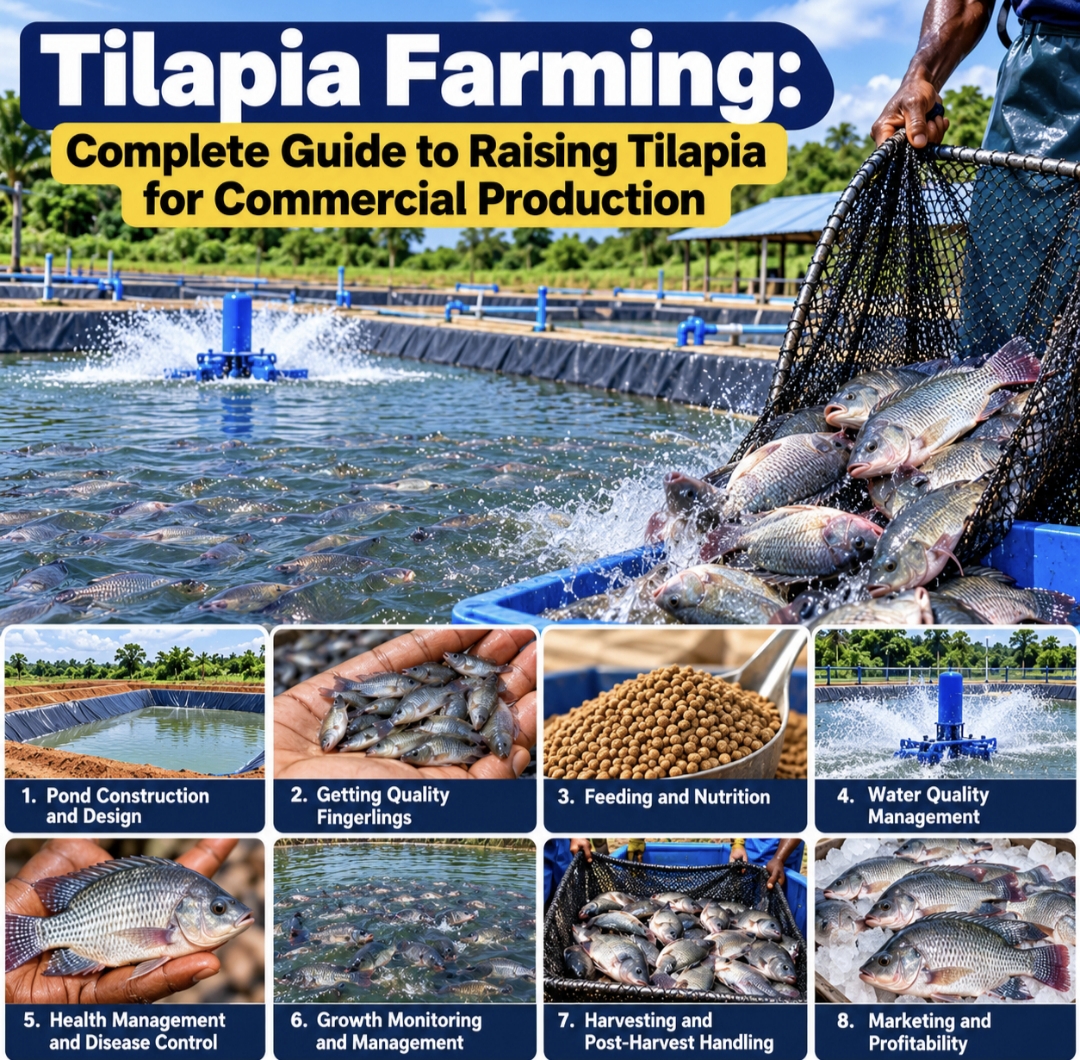
This comprehensive guide explains how tilapia farming works, how to choose quality fingerlings, prepare a farm, manage feeding and water quality, control reproduction, prevent disease, harvest fish and build a profitable commercial tilapia business.
What Is Tilapia Farming?
Tilapia farming is the controlled production of tilapia fish for human consumption and commercial purposes.
Tilapia belong to a group of freshwater and brackish-water fish that have become important in aquaculture.
Several tilapia species and strains are used in farming, with Nile tilapia being particularly important in global aquaculture.
Commercial production generally involves obtaining fingerlings, growing them under controlled conditions and harvesting them when they reach the size preferred by the target market.
Why Is Tilapia Farming Important?
Tilapia is important because it contributes to the global supply of affordable animal protein and supports employment throughout the aquaculture value chain.
The industry creates opportunities for:
- Fish farmers
- Hatchery operators
- Feed manufacturers
- Veterinary and aquatic-health professionals
- Equipment suppliers
- Fish processors
- Transporters
- Wholesalers
- Retailers
- Restaurants
Tilapia production can therefore contribute to both food security and economic development.
Is Tilapia Farming Profitable?
Tilapia farming can be profitable when production costs are controlled and fish are sold into a strong market.
Major factors affecting profitability include:
- Fingerling cost
- Feed cost
- Feed efficiency
- Survival rate
- Growth rate
- Stocking density
- Water quality
- Labor
- Energy
- Infrastructure
- Selling price
- Market access
A high selling price alone does not guarantee profitability.
A farm must produce marketable fish efficiently while minimizing unnecessary expenses and losses.
Advantages of Tilapia Farming
Tilapia farming has several potential advantages.
Strong Consumer Demand
Tilapia is popular in many regions and is consumed fresh, frozen, grilled, fried, baked, smoked and in various processed products.
Adaptability
Tilapia can be raised in several types of aquaculture systems when environmental conditions are appropriate.
Commercial Production Potential
Tilapia can be produced at small, medium and large scales.
Market Versatility
Farmers can sell whole fish, cleaned fish, fillets and other value-added products.
Suitable for Integrated Farming
Tilapia can be incorporated into some integrated aquaculture-agriculture systems.
Important Tilapia Species and Strains
Not every fish sold under the general name "tilapia" has exactly the same production characteristics.
Important farmed groups include Nile tilapia and other tilapia species and improved strains.
Farmers should identify the exact species or strain before purchasing fingerlings.
Nile Tilapia
Nile tilapia is one of the most important farmed tilapia species worldwide.
It is widely used because of its growth performance and market acceptance.
However, production performance depends heavily on genetics, environmental conditions, feed and farm management.
Choosing the Right Tilapia Strain
Genetic quality can significantly influence growth and production.
Where available, farmers should obtain fingerlings from reputable hatcheries that use reliable breeding programs.
Important considerations include:
- Growth performance
- Survival
- Uniformity
- Adaptation to local conditions
- Reproductive characteristics
- Disease resistance traits
- Market size
The Importance of All-Male Tilapia Production
One of the major management issues in tilapia farming is uncontrolled reproduction.
Tilapia can reproduce readily under suitable conditions.
If both males and females are allowed to reproduce freely, ponds can become overcrowded with small fish.
This can reduce growth and make harvesting difficult.
For this reason, many commercial systems use predominantly male or all-male populations.
Why Uncontrolled Tilapia Breeding Is a Problem
When tilapia reproduce repeatedly inside grow-out ponds, large numbers of young fish can compete with the stocked fish for:
- Feed
- Oxygen
- Space
- Nutrients
The result can be many undersized fish instead of fewer market-sized fish.
This is why reproductive control is a major consideration in commercial tilapia farming.
How All-Male Tilapia Populations Are Produced
Commercial hatcheries can use established methods to produce predominantly male tilapia populations.
Depending on the region and regulations, methods may include genetic approaches, selective breeding or controlled sex-reversal techniques during early life stages.
Farmers should purchase appropriately produced fingerlings from reputable hatcheries rather than attempting technical sex-control procedures without proper expertise and regulatory approval.
Selecting a Location for Tilapia Farming
A suitable location should provide reliable water, good access, drainage, security and proximity to the target market.
Consider:
- Water source
- Land availability
- Soil
- Flood risk
- Road access
- Electricity
- Security
- Market distance
- Environmental conditions
The location should be evaluated before major construction.
Water Requirements for Tilapia
Water quality is fundamental to tilapia production.
Important parameters include:
- Temperature
- Dissolved oxygen
- pH
- Ammonia
- Nitrite
- Alkalinity
- Hardness
- Salinity where applicable
The ideal range for each parameter depends on the species, strain, life stage and production system.
Tilapia and Water Temperature
Tilapia are warm-water fish.
Temperature affects metabolism, feeding, growth, reproduction and oxygen availability.
Very low or excessively high temperatures can reduce performance and increase stress.
Farmers should therefore choose production locations and systems appropriate for tilapia's environmental requirements.
Dissolved Oxygen Management
Tilapia require sufficient dissolved oxygen for normal activity and growth.
Oxygen can decline due to high stocking density, decomposition, excess feeding, high temperatures and inadequate water movement.
Aeration can be particularly important in intensive production.
Managing pH
pH affects the aquatic environment and the toxicity of certain compounds.
Sudden fluctuations can stress fish.
Farmers should monitor pH regularly and manage the production environment rather than making uncontrolled chemical adjustments.
Ammonia and Nitrite Management
Fish waste and decomposing organic matter can contribute to ammonia accumulation.
Ammonia toxicity depends partly on water chemistry and temperature.
Nitrite can also become problematic under certain conditions.
Good feeding practices, appropriate stocking, biological filtration and water management are important tools for maintaining suitable conditions.
Choosing a Tilapia Production System
Tilapia can be produced in several systems.
Common options include:
- Earthen ponds
- Concrete ponds
- Plastic tanks
- Fiberglass tanks
- Cages
- Raceways
- Recirculating aquaculture systems
Each system has different advantages, costs and management requirements.
Tilapia Farming in Earthen Ponds
Earthen ponds are widely used in many tilapia-producing regions.
They can provide relatively large production areas and may support natural productivity in addition to formulated feed.
However, pond management requires careful control of water quality, stocking, predators and unwanted reproduction.
Tilapia Farming in Concrete Ponds
Concrete ponds provide greater structural control and can be easier to drain and clean.
They may be suitable for urban or semi-urban production where land is limited.
However, construction and water management costs can be higher.
Tilapia Farming in Tanks
Tank systems provide greater control over the production environment.
They can be useful where land is limited.
However, tank systems often require stronger water management and may require mechanical aeration, filtration or water exchange.
Tilapia Cage Farming
Cage farming involves keeping tilapia inside floating cages placed in suitable water bodies.
Cage systems can reduce the need to construct ponds.
However, farmers must consider:
- Water quality
- Carrying capacity
- Storms
- Predators
- Theft
- Fish escape
- Environmental regulations
Cage farming should only be carried out where legally permitted and environmentally appropriate.
Recirculating Tilapia Farming
Recirculating aquaculture systems use filtration and water-treatment technologies to reuse water.
These systems can support intensive production where water is limited.
However, they require substantial technical knowledge and reliable equipment.
A failure in pumps, oxygen supply or filtration can quickly become dangerous for fish.
Preparing the Fish Pond
Before stocking tilapia, the production unit should be properly prepared.
Preparation can include:
- Cleaning
- Checking water inlet and outlet systems
- Inspecting pond walls
- Testing water
- Installing aeration where required
- Removing unwanted organisms
- Checking drainage
- Confirming equipment operation
Preparation reduces avoidable problems after stocking.
Buying Quality Tilapia Fingerlings
Quality fingerlings are essential.
Purchase fingerlings from a reputable hatchery with a reliable production history.
Good fingerlings should generally be:
- Active
- Healthy-looking
- Uniform in size
- Free of visible abnormalities
- Appropriate for the production system
Why Uniform Fingerlings Matter
If fingerlings vary significantly in size, larger fish may dominate access to feed.
This can create uneven growth.
Uniform stocking makes it easier to manage feeding and estimate harvest performance.
Transporting Tilapia Fingerlings
Fingerlings should be transported carefully.
Overcrowding, poor oxygenation, extreme temperatures and prolonged transportation can increase stress.
Transport methods should be adapted to fish size, distance and environmental conditions.
Acclimatizing Fingerlings
Before releasing fingerlings into the production environment, farmers should allow them to gradually adjust to differences in temperature and water chemistry.
Sudden changes can cause severe stress.
A careful acclimatization procedure can improve survival.
Tilapia Stocking Density
Stocking density should be determined according to the production system.
A low-density pond may support a different biomass than an intensive tank with aeration and filtration.
Farmers should consider the farm's maximum water-quality and oxygen-management capacity rather than simply maximizing the number of fish.
Why High Stocking Density Is Risky
High stocking density increases:
- Oxygen demand
- Waste production
- Feed requirements
- Disease pressure
- Management complexity
If infrastructure is inadequate, fish growth can decline and mortality can increase.
Tilapia Feeding Management
Feed is one of the largest costs in commercial tilapia farming.
A good feeding program should provide the nutrients fish need while minimizing waste.
Feed quantity should be adjusted according to fish biomass, size, temperature, appetite and production conditions.
Tilapia Feed Requirements
Commercial tilapia feed typically contains protein, energy, fats, vitamins and minerals.
The appropriate nutrient level changes as fish grow.
Young fish generally have different nutritional requirements from larger grow-out fish.
Choosing Floating or Sinking Feed
Floating pellets can make feeding behavior easier to observe.
Farmers can see whether fish are consuming the feed and reduce feeding if excess remains.
Sinking feed can also be appropriate in certain situations.
The best choice depends on the production system and feeding strategy.
Feeding Frequency
Feeding frequency depends on fish size, water temperature, production system and feed type.
Small fish generally require more frequent feeding relative to their body size, while larger fish can often be managed with fewer feeding events.
Farmers should follow appropriate feeding guidelines and adjust according to actual fish response.
Avoiding Overfeeding
Overfeeding is expensive and can reduce water quality.
Uneaten feed decomposes and contributes organic matter to the system.
The objective is to provide enough feed for healthy growth without creating unnecessary waste.
Monitoring Feed Conversion Ratio
Feed conversion ratio provides an indication of feeding efficiency.
The basic formula is:
FCR = Total Feed Used ÷ Weight Gain
For example, if a farm uses 1,500 kilograms of feed to produce 1,200 kilograms of fish weight gain:
1,500 ÷ 1,200 = 1.25
A lower FCR generally indicates more efficient conversion of feed into biomass, although FCR should always be interpreted in relation to the specific production system.
Managing Tilapia Growth
Regular sampling allows farmers to determine average fish weight and biomass.
Records should include:
- Sampling date
- Average weight
- Average length
- Feed consumption
- Mortality
- Estimated biomass
This information supports better feeding and harvest decisions.
Maintaining Water Quality in Tilapia Farms
Good water quality should be maintained throughout the production cycle.
Farmers should establish a routine for monitoring:
- Dissolved oxygen
- Temperature
- pH
- Ammonia
- Nitrite
- Other relevant parameters
Managing Organic Matter
Uneaten feed, feces and dead organisms contribute organic matter.
Excessive accumulation can increase oxygen consumption and reduce water quality.
Good feeding management and appropriate cleaning or water exchange can help control the problem.
Water Exchange in Tilapia Farming
Some production systems require regular water exchange.
The frequency depends on the production system, water quality, stocking density and filtration capacity.
Water introduced into the farm should also be suitable for fish.
Biosecurity in Tilapia Farming
Biosecurity helps prevent disease introduction and spread.
Important practices include:
- Quality fingerlings
- Equipment sanitation
- Controlled access
- Separation of production units
- Proper disposal of dead fish
- Water-source protection
- Quarantine where appropriate
Common Tilapia Health Problems
Tilapia can be affected by bacterial, parasitic, viral and environmental problems.
Poor water quality, overcrowding, inadequate nutrition and stressful conditions can increase vulnerability.
Rather than treating every problem as a specific disease, farmers should first investigate environmental and management conditions.
Signs of Stress in Tilapia
Possible signs include:
- Reduced appetite
- Gasping
- Unusual swimming
- Isolation
- Skin lesions
- Fin damage
- Abnormal coloration
- Sudden mortality
These signs require investigation.
Preventing Tilapia Diseases
Prevention should focus on maintaining healthy production conditions.
Key measures include:
- Healthy fingerlings
- Good water quality
- Proper feeding
- Appropriate stocking
- Good sanitation
- Biosecurity
- Prompt removal of dead fish
Do Not Use Fish Medicines Without Proper Diagnosis
Randomly applying medications or chemicals can create additional problems.
Some substances can harm fish, damage water quality or create food-safety concerns.
Serious disease events should be investigated with assistance from an appropriate aquatic animal health professional.
Tilapia Pond Management
Good pond management involves regular observation.
Farmers should check:
- Fish behavior
- Feeding response
- Water color
- Water level
- Oxygen conditions
- Mortalities
- Pond structures
- Predator activity
Daily observation can reveal problems before they become severe.
Managing Tilapia Reproduction
Reproductive control is one of the most important aspects of commercial tilapia farming.
Uncontrolled reproduction can produce excessive numbers of small fish.
Commercial growers should therefore use appropriate fingerling sources and management systems designed to reduce unwanted reproduction.
Harvesting Tilapia
Harvest timing depends on:
- Market size
- Fish growth
- Feed costs
- Market price
- Production costs
- Customer demand
Allowing fish to remain in the system longer is not automatically more profitable because feed and operating costs continue to accumulate.
Partial Tilapia Harvesting
Partial harvesting can provide cash flow and reduce biomass.
It may also allow larger fish to be sold while smaller fish continue growing.
However, handling should be performed carefully to minimize stress and injury.
Complete Tilapia Harvesting
Complete harvesting may be appropriate at the end of a production cycle.
After harvest, ponds and tanks should be inspected and prepared for the next batch.
Tilapia Processing
Tilapia can be marketed in several forms.
Products can include:
- Whole fresh fish
- Gutted fish
- Cleaned fish
- Fillets
- Frozen fish
- Smoked fish
- Ready-to-cook portions
Processing can create additional value and reach different customer segments.
Marketing Tilapia
Successful production must be matched with effective marketing.
Potential customers include:
- Consumers
- Restaurants
- Hotels
- Supermarkets
- Fish retailers
- Wholesalers
- Food processors
- Caterers
Farmers should establish relationships with potential buyers before harvesting.
Selling Tilapia Directly to Consumers
Direct sales can potentially provide better margins.
Farmers can sell through:
- Farm-gate sales
- Local markets
- Online orders
- Social media
- Home delivery
- Community distribution
Good packaging and customer service can help build repeat business.
Selling Tilapia to Restaurants
Restaurants can provide consistent demand.
Farmers should learn the restaurant's preferred fish size, quantity, delivery schedule and payment terms.
Reliability is often as important as price.
Using Social Media to Market Tilapia
Digital marketing can help fish farmers reach consumers without relying entirely on traditional intermediaries.
Useful content includes:
- Farm videos
- Harvest demonstrations
- Fresh fish photographs
- Customer reviews
- Product sizes
- Availability announcements
- Processing demonstrations
Tilapia Farm Branding
A recognizable brand can help differentiate one farm from competitors.
Branding can include:
- Farm name
- Logo
- Packaging
- Labels
- Contact information
- Social media accounts
- Quality promise
Professional presentation can increase consumer confidence.
Calculating Tilapia Farming Costs
Costs may include:
- Land
- Pond or tank construction
- Fingerlings
- Feed
- Labor
- Water
- Electricity
- Aeration
- Equipment
- Health management
- Transportation
- Packaging
- Marketing
- Maintenance
All costs should be recorded.
Example of a Simple Tilapia Profit Calculation
Suppose a farmer spends:
Fingerlings: $700
Feed: $2,000
Labor: $400
Water and energy: $250
Maintenance and health management: $150
Marketing and transportation: $200
Total operating costs:
$3,700
If the farmer sells the harvested fish for:
$5,000
The simplified operating margin is:
$5,000 − $3,700 = $1,300
This is only an illustrative calculation. A complete profitability analysis should include all relevant fixed and variable costs.
Calculating Cost Per Kilogram
Suppose total relevant production costs are $3,700 and the farm produces 925 kilograms of marketable fish.
Cost per kilogram:
$3,700 ÷ 925 = $4 per kilogram
If the average selling price is $5 per kilogram, the simplified margin is $1 per kilogram before other costs not included in the example.
Understanding Break-Even
Break-even occurs when total revenue equals total costs.
If relevant costs are $3,700 and the average selling price is $5 per kilogram:
$3,700 ÷ $5 = 740 kilograms
The simplified break-even volume is therefore 740 kilograms.
Common Tilapia Farming Mistakes
Overstocking
Stocking too many fish can exceed the farm's oxygen and water-treatment capacity.
Uncontrolled Breeding
Mixed-sex populations can result in excessive reproduction and small fish.
Poor Fingerling Quality
Weak or genetically poor fingerlings can reduce production performance.
Overfeeding
Excess feed increases costs and damages water quality.
Poor Water Management
Water-quality problems can quickly affect fish health and growth.
Ignoring Market Demand
Farmers should know what size and quantity customers want before producing large volumes.
Expanding Too Quickly
Production should increase only when the farmer has sufficient management capacity, capital and market access.
Poor Record Keeping
Without records, it becomes difficult to calculate true production costs and profitability.
Starting a Tilapia Farm Step by Step
Step 1: Research Your Market
Determine which customers buy tilapia and what size they prefer.
Step 2: Select a Suitable Production System
Choose ponds, tanks, cages or another system according to your resources.
Step 3: Secure a Suitable Location
Ensure reliable water, drainage, access and security.
Step 4: Test the Water
Evaluate the major water-quality parameters relevant to tilapia production.
Step 5: Build the Farm
Construct ponds or tanks and install water and aeration systems.
Step 6: Purchase Quality Fingerlings
Use reputable hatchery suppliers.
Step 7: Acclimatize and Stock
Gradually introduce fingerlings into the production system.
Step 8: Establish a Feeding Program
Use appropriate feed and monitor feeding behavior.
Step 9: Monitor Growth and Water Quality
Keep regular records and respond to problems quickly.
Step 10: Prepare Your Market
Develop relationships with buyers before harvest.
Step 11: Harvest at the Right Time
Harvest according to market demand and economic performance.
Step 12: Analyze the Production Cycle
Calculate survival, feed efficiency, production cost, revenue and profit.
How to Improve Tilapia Farm Profitability
Profitability can be improved by focusing on production efficiency rather than simply increasing the number of fish.
Farmers can improve performance by:
- Using quality fingerlings
- Maintaining appropriate stocking density
- Reducing feed waste
- Monitoring FCR
- Maintaining water quality
- Reducing mortality
- Improving harvest timing
- Selling directly where practical
- Adding value through processing
- Maintaining accurate records
Sustainable Tilapia Farming
Sustainable production should balance economic performance with environmental responsibility.
Important areas include:
- Efficient feed use
- Waste management
- Responsible water use
- Proper wastewater management
- Disease prevention
- Avoiding unnecessary chemical use
- Preventing fish escapes where relevant
- Protecting surrounding ecosystems
Integrating Tilapia With Other Agricultural Activities
Tilapia farming can sometimes be integrated with crops or other agricultural enterprises.
Potential benefits include improved resource use and diversified income.
However, integration must be carefully designed to avoid contamination and disease problems.
Technology in Modern Tilapia Farming
Modern technology can improve production efficiency.
Examples include:
- Automated feeders
- Dissolved oxygen sensors
- Digital water-quality monitors
- Automated aerators
- Cameras
- Electronic farm records
- Remote monitoring systems
Technology should be selected according to the farm's scale and management capacity.
The Future of Tilapia Farming
Tilapia is likely to remain an important aquaculture species as demand for aquatic protein continues to grow.
Future development is likely to focus on:
- Better genetics
- Feed efficiency
- Disease management
- Water-quality monitoring
- Sustainable production
- Automation
- Improved processing
- Cold-chain development
- Digital farm management
Frequently Asked Questions About Tilapia Farming
Is tilapia farming profitable?
Yes, tilapia farming can be profitable when production costs, fish survival, feed efficiency, growth and market prices are managed effectively.
What is the best tilapia species for farming?
Nile tilapia is one of the most widely farmed tilapia species, but the best choice depends on local conditions, regulations, genetics and market demand.
Can tilapia be farmed in tanks?
Yes. Tilapia can be raised in tanks, although intensive tank production requires careful water-quality and oxygen management.
Can tilapia be raised in an earthen pond?
Yes. Earthen ponds are widely used for tilapia production where soil, water and environmental conditions are suitable.
Why do tilapia ponds become overcrowded?
Tilapia can reproduce readily. If reproduction is not controlled, large numbers of young fish can compete with stocked fish and reduce growth.
How can farmers prevent unwanted tilapia reproduction?
Commercial farmers can use appropriate predominantly male fingerlings and established reproductive-control methods. Fingerlings should be obtained from reputable hatcheries.
What do tilapia eat?
Farmed tilapia commonly receive formulated feeds designed to provide appropriate protein, energy, vitamins and minerals. Natural food organisms may also contribute to nutrition in some pond systems.
How often should tilapia be fed?
Feeding frequency depends on fish size, water temperature, feed type and production system. Farmers should follow appropriate feeding recommendations and monitor fish response.
What causes tilapia to die suddenly?
Possible causes include low dissolved oxygen, poor water quality, disease, toxins, extreme temperatures, overstocking and other environmental problems. Water should be tested immediately when unexplained mortality occurs.
How can tilapia growth be improved?
Use quality fingerlings, appropriate feed, suitable stocking density, good water quality and effective health management.
What size tilapia should be harvested?
The ideal harvest size depends on customer preferences, market price and production economics.
Can tilapia farming be started on a small scale?
Yes. Small-scale tank or pond systems can be used to gain experience before expanding.
What is the biggest cost in tilapia farming?
Feed is often one of the largest operating expenses, although fingerlings, labor, energy, infrastructure and water management can also be significant.
How can tilapia farmers reduce feed costs?
Reduce feed waste, use appropriate-quality feed, monitor growth, maintain water quality and track feed conversion.
Can tilapia farming be combined with crop farming?
Yes, in suitable integrated systems. The system must be designed carefully to maintain fish health and environmental safety.
Conclusion
Tilapia farming offers significant opportunities for farmers and entrepreneurs who are willing to approach aquaculture as a serious business.
The species' popularity, market acceptance and suitability for several production systems make tilapia an important farmed fish around the world. However, profitability depends on much more than simply having a pond and stocking fish.
Farmers must begin with market research and select a suitable species or strain. The farm location should provide reliable water, appropriate environmental conditions, drainage, security and market access.
Quality fingerlings, proper stocking density, efficient feeding and excellent water-quality management are essential throughout the production cycle. Reproductive control is particularly important because uncontrolled tilapia breeding can result in overcrowding and poor growth.
Farmers should also maintain accurate records of feed, growth, mortality, water quality, production costs and sales. These records provide the information needed to determine whether the farm is actually profitable.
Finally, successful tilapia farming should be combined with responsible environmental management, good biosecurity, safe fish handling and effective marketing.
With careful planning, appropriate technology, quality stock and disciplined management, tilapia farming can become a sustainable source of nutritious food, employment and commercial income.
Latest posts
- Types of Yam in Africa and Their Commercial Benefits: A Complete Guide to Yam Production, Uses and Business Opportunities
- Types of Potato: Complete Guide to Potato Varieties, Uses, Characteristics and Best Types for Farming.
- Types of Pepper Widely Known and Used in Africa: A Comprehensive Guide to Pepper Varieties, Uses, Cultivation and Economic Importance
- Transforming Agriculture: How an Effective Website Can Boost Your Agro Business

- Transforming Agriculture with Cutting-Edge Web Solutions

- Tilapia Farming: Complete Guide to Raising Tilapia for Commercial Production

- SUCCESSFUL WATERMELON FARMING: A Complete Guide to Growing Watermelon for Profit.
- Soybean Farming: Complete Guide to Growing Soybeans for Profit
- Sheep Farming: Complete Guide to Raising Sheep for Commercial Profit