Introduction
Leafy vegetable farming is one of the most important and potentially profitable areas of commercial vegetable production. Leafy vegetables are consumed daily by millions of people and are an essential part of many African diets. They are used in soups, stews, salads, sauces, vegetable dishes, smoothies, and other meals.
The growing demand for fresh and nutritious vegetables creates opportunities for farmers who can produce high-quality leafy vegetables consistently. Unlike some perennial or long-duration crops, many leafy vegetables have relatively short production cycles, allowing farmers to harvest and sell their produce within a few weeks after planting.
Leafy vegetable farming can be carried out on a small piece of land or expanded into a large commercial farm. Farmers can produce vegetables in open fields, raised beds, gardens, greenhouses, or other controlled production systems depending on available resources and the target market.
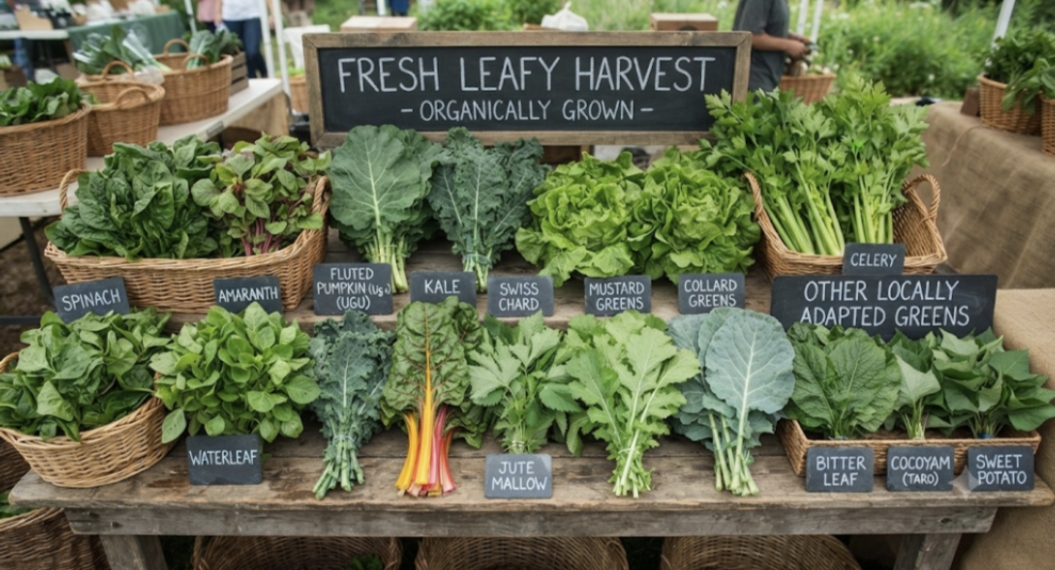
Some popular leafy vegetables grown commercially include spinach, amaranth, waterleaf, fluted pumpkin, kale, lettuce, cabbage, Swiss chard, jute mallow, and other locally preferred leafy crops.
However, successful leafy vegetable farming requires more than simply planting seeds and waiting for harvest. Farmers need to select appropriate crops, choose suitable land, prepare the soil, use quality seeds or planting materials, manage water and nutrients, control weeds and pests, harvest correctly, minimize post-harvest losses, and develop a reliable market.
This comprehensive guide explains everything farmers need to know about leafy vegetable farming, including how to start, suitable crops, soil requirements, planting, irrigation, fertilizer application, pest and disease management, harvesting, marketing, production costs, profitability, and common mistakes to avoid.
What Is Leafy Vegetable Farming?
Leafy vegetable farming is the cultivation of vegetable crops primarily for their edible leaves, stems, shoots, or tender foliage.
Some leafy vegetables are harvested mainly for their leaves, while others may provide edible stems, young shoots, or other plant parts.
Examples include:
- Spinach
- Amaranth
- Waterleaf
- Fluted pumpkin
- Kale
- Lettuce
- Swiss chard
- Jute mallow
- Mustard greens
- Collard greens
- Celery
- Other locally adapted leafy vegetables
Leafy vegetables are generally valued for their vitamins, minerals, fibre, antioxidants, and other nutrients.
Commercial leafy vegetable farming focuses on producing healthy, clean, attractive, and fresh vegetables that meet the requirements of consumers and buyers.
Why Leafy Vegetable Farming Is Profitable
Leafy vegetable farming can be profitable because many leafy vegetables have short production cycles and strong consumer demand.
Farmers can potentially harvest some crops within a few weeks, depending on the species and production method.
Other advantages include:
- High demand in local markets
- Relatively short production cycles
- Multiple vegetable species to choose from
- Possibility of repeated harvesting for some crops
- Suitable for small-scale farmers
- Can be expanded commercially
- Can be cultivated close to urban markets
- High demand from restaurants and food vendors
- Can be sold directly to consumers
- Potential for year-round production with irrigation
- Suitable for intensive farming systems
The profitability of leafy vegetable farming depends on production costs, yield, selling price, crop quality, market access, labour costs, transportation, and post-harvest losses.
Popular Leafy Vegetables for Commercial Farming
There are many leafy vegetables that can be cultivated commercially.
The best choice depends on climate, soil, water availability, consumer preferences, seed availability, market demand, and expected profit.
Popular options include:
- Amaranth
- Spinach
- Waterleaf
- Fluted pumpkin
- Kale
- Lettuce
- Jute mallow
- Swiss chard
- Mustard greens
- Collard greens
- Celery
- African eggplant leaves
- Cassava leaves where locally consumed and properly prepared
- Other indigenous leafy vegetables
Farmers should not choose a crop simply because it grows well. The market should be considered before planting.
Amaranth Farming
Amaranth is one of the leafy vegetables that can be cultivated commercially in tropical environments.
It grows relatively quickly under suitable conditions and can be harvested for its tender leaves and shoots.
Amaranth can be sold in local vegetable markets and supplied to households, restaurants, food vendors, and other buyers.
Its relatively short production cycle makes it attractive to farmers seeking quick turnover.
Spinach Farming
Spinach is another popular leafy vegetable.
It is valued for its nutritional content and is used in numerous dishes.
Farmers should select varieties suitable for their local climate because spinach performance can be affected by temperature.
Good soil preparation, adequate moisture, proper spacing, weed management, and timely harvesting are important for commercial spinach production.
Waterleaf Farming
Waterleaf is widely used in various African dishes and can be an important commercial leafy vegetable.
It prefers adequate moisture and fertile soil.
Because waterleaf grows rapidly under favourable conditions, farmers need to maintain regular harvesting and marketing arrangements.
The crop is particularly suitable for farmers who have access to reliable water.
Fluted Pumpkin Farming
Fluted pumpkin, commonly known in Nigeria as ugu, is a highly valued leafy vegetable.
It is cultivated for its edible leaves and tender shoots and is used extensively in soups and other dishes.
Unlike some short-duration leafy crops, fluted pumpkin can be managed for repeated harvesting under suitable conditions.
Farmers can produce it for local markets, restaurants, households, and commercial vegetable traders.
Kale Farming
Kale is a nutritious leafy vegetable that can be cultivated commercially in suitable climates.
It is valued for its leaves and can be marketed fresh.
Kale production requires good soil fertility, adequate water, proper spacing, and effective pest management.
Lettuce Farming
Lettuce is widely used in salads, sandwiches, burgers, restaurants, hotels, and catering businesses.
It can be particularly attractive for farmers located near urban markets.
Lettuce generally requires careful water management and good soil fertility.
Because the crop is highly perishable, farmers should establish a market before producing large quantities.
Jute Mallow Farming
Jute mallow is an important leafy vegetable in many African communities.
It is commonly used in soups and traditional dishes.
The crop can be grown commercially where local demand is strong.
Farmers should select suitable planting material and maintain adequate moisture and fertility for good leaf production.
Choosing the Best Leafy Vegetable to Farm
Choosing the right vegetable is one of the most important decisions in commercial leafy vegetable farming.
Farmers should consider:
- Local consumer demand
- Market price
- Production cycle
- Climate
- Soil type
- Water availability
- Seed availability
- Labour requirements
- Pest and disease pressure
- Storage requirements
- Transportation distance
- Availability of buyers
A farmer close to a major city may have opportunities to supply restaurants, supermarkets, hotels, caterers, and households directly.
Farmers in rural areas may focus more on wholesalers, local markets, aggregators, and vegetable traders.
Best Climate for Leafy Vegetable Farming
Most leafy vegetables require suitable temperatures, adequate moisture, and sufficient sunlight.
However, climate requirements differ among vegetable species.
Some leafy vegetables perform better under relatively cool conditions, while many tropical leafy vegetables tolerate warmer environments.
High temperatures can cause some vegetables to bolt, become bitter, wilt quickly, or produce poor-quality leaves.
Farmers should therefore select crops and varieties adapted to their local environment.
Importance of Water in Leafy Vegetable Farming
Water is one of the most important inputs in leafy vegetable production.
Because the harvested portion is often the leaf, water stress can quickly reduce quality.
Insufficient water may cause:
- Wilting
- Slow growth
- Small leaves
- Poor appearance
- Reduced yield
- Premature flowering in some crops
Excessive irrigation can also be harmful because waterlogged soils may damage roots and increase disease problems.
The goal is to maintain adequate soil moisture without creating prolonged waterlogging.
Best Soil for Leafy Vegetable Farming
Most leafy vegetables perform well in fertile, well-drained soils with good organic matter.
Suitable soil should:
- Drain excess water properly
- Hold enough moisture
- Contain adequate nutrients
- Have good structure
- Allow root development
- Be relatively free from harmful contaminants
Loamy and sandy-loam soils are often suitable for vegetable production.
Very compacted soils should be improved before planting.
Soil pH for Leafy Vegetables
Many leafy vegetables perform well in slightly acidic to neutral soils.
A pH range around 6.0 to 7.0 is suitable for many vegetable crops, although individual crops may have different requirements.
Farmers should conduct a soil test before establishing commercial production.
Soil testing helps identify nutrient deficiencies, excessive acidity, and other fertility problems.
Land Selection for Commercial Vegetable Farming
A suitable site should have access to clean water, good soil, adequate sunlight, reasonable drainage, and convenient access to markets.
Farmers should avoid locations that are regularly flooded or contaminated.
Proximity to roads is also important because leafy vegetables are highly perishable.
A farm that is far from its major market may experience significant losses if transportation is slow or poorly managed.
Land Preparation for Leafy Vegetable Farming
Proper land preparation provides a good environment for root growth and crop establishment.
Begin by clearing unwanted vegetation.
Remove large stones, roots, plastics, and other materials that may interfere with cultivation.
Depending on the production system, the soil can be ploughed, tilled, dug, or prepared manually.
Break large soil clods and create a relatively fine seedbed.
Raised beds can be useful where drainage needs improvement.
Importance of Raised Beds
Raised beds can improve drainage and make vegetable management easier.
They can also help farmers organize planting rows and irrigation channels.
Raised beds are particularly useful in areas where heavy rainfall can cause waterlogging.
The dimensions of beds should be based on the farm's production system, available labour, irrigation method, and equipment.
Using Organic Matter in Vegetable Farming
Organic matter can improve soil structure, moisture retention, and biological activity.
Farmers can use well-decomposed compost or properly processed organic manure.
Fresh manure should generally not be applied directly before harvesting leafy vegetables because it can create sanitation concerns and may increase the risk of contamination.
Compost and manure should be properly processed and applied according to appropriate agricultural recommendations.
Selecting Quality Seeds
Quality seeds are essential for establishing a healthy crop.
Farmers should purchase seeds from reliable suppliers.
Good seed should have:
- High germination potential
- Good genetic quality
- Appropriate variety characteristics
- Proper packaging
- Reliable source information
- Suitable adaptation to the local environment
Farmers should avoid buying seed simply because it is cheap.
Poor-quality seed can lead to poor germination and uneven crop establishment.
Seedbed Preparation
Some leafy vegetables can be planted directly into prepared beds, while others may benefit from nursery establishment before transplanting.
The appropriate method depends on the crop.
The seedbed should be fine, fertile, well-drained, and free of excessive weeds.
Small seeds should generally not be buried too deeply.
After sowing, water gently to prevent seeds from being displaced.
Direct Seeding of Leafy Vegetables
Direct seeding involves planting seeds directly in the final production bed.
This method is commonly used for several leafy vegetables.
Advantages include:
- Reduced transplanting labour
- Less transplanting shock
- Faster establishment
- Simple farm management
However, proper spacing and thinning are important to avoid overcrowding.
Transplanting Leafy Vegetables
Some leafy vegetables can be raised in nurseries before being transplanted.
Transplanting can help farmers establish strong seedlings and organize plant spacing more effectively.
Seedlings should be transplanted carefully to minimize root damage.
Transplanting is best done when environmental conditions are favourable, preferably when the heat is not excessive.
Spacing for Leafy Vegetable Farming
Plant spacing depends on the vegetable species and production objective.
Closely spaced plants may produce many small leaves, while wider spacing can encourage larger individual plants.
Farmers should follow the recommended spacing for the selected crop and variety.
Avoid overcrowding because it can increase competition for water, nutrients, and sunlight and may create a humid environment favourable to some diseases.
Irrigation Methods for Leafy Vegetables
Commercial farmers can use several irrigation systems.
These include:
- Watering cans
- Hose irrigation
- Sprinkler irrigation
- Drip irrigation
- Furrow irrigation where appropriate
Drip irrigation can be highly useful because it supplies water directly to the crop root zone.
Sprinklers can also be used, although wet foliage may increase the risk of some diseases under certain conditions.
The choice of irrigation system depends on farm size, water availability, crop type, budget, and local conditions.
Fertilizer Management for Leafy Vegetables
Leafy vegetables require nutrients for rapid leaf development.
Important nutrients include nitrogen, phosphorus, potassium, calcium, magnesium, sulfur, and various micronutrients.
Nitrogen is particularly important for vegetative growth, but excessive nitrogen can create problems.
Too much fertilizer can increase production costs, damage plants, contribute to nutrient imbalances, and create food-safety concerns.
The best fertilizer programme should be based on soil testing and the nutrient requirements of the specific vegetable.
Organic Fertilizer for Leafy Vegetables
Organic fertilizers such as well-decomposed compost can be valuable for improving soil fertility.
They can provide nutrients while also improving soil structure.
However, farmers should ensure that organic inputs are properly composted and handled safely.
Leafy vegetables are often eaten fresh or lightly cooked, so food safety should be treated as a major priority.
Weed Management
Weeds compete directly with vegetable crops.
If weeds are allowed to grow unchecked, they can reduce crop growth and yield.
Effective weed control methods include:
- Hand weeding
- Hoeing
- Mulching
- Mechanical cultivation
- Proper spacing
- Timely planting
- Appropriate herbicides where legally registered and suitable
Weeding should be done carefully to avoid damaging vegetable roots.
Mulching in Leafy Vegetable Farming
Mulching involves covering the soil surface with suitable organic or other appropriate materials.
Benefits can include:
- Reduced weed growth
- Improved moisture retention
- Reduced soil erosion
- Moderation of soil temperature
- Reduced soil splash onto leaves
However, mulch materials should be clean and properly managed.
Common Pests of Leafy Vegetables
Leafy vegetables can attract many pests because the leaves are the primary marketable part of the crop.
Common pests include:
- Aphids
- Caterpillars
- Leaf miners
- Flea beetles
- Grasshoppers
- Whiteflies
- Thrips
- Cutworms
- Snails and slugs in suitable environments
Farmers should inspect their crops regularly.
Early detection makes pest management easier and can reduce the need for extensive pesticide applications.
Managing Pests Naturally
Integrated pest management can help reduce excessive dependence on pesticides.
Useful practices include:
- Field sanitation
- Crop rotation
- Weed control
- Monitoring pest populations
- Removing heavily infested plant material
- Encouraging beneficial insects
- Using resistant varieties where available
- Applying approved biological or chemical control measures when necessary
Farmers should always follow the label instructions for agricultural pesticides.
Common Diseases of Leafy Vegetables
Leafy vegetables can suffer from diseases caused by fungi, bacteria, viruses, and other pathogens.
Possible symptoms include:
- Leaf spots
- Yellowing
- Wilting
- Leaf blight
- Root rot
- Powdery growth
- Stunted growth
- Leaf distortion
Disease management begins with prevention.
Good drainage, clean planting materials, adequate spacing, crop rotation, field sanitation, and proper irrigation can help reduce disease pressure.
Importance of Crop Rotation
Crop rotation helps reduce the buildup of certain pests and diseases.
Instead of growing the same vegetable repeatedly on the same land, farmers can rotate with crops from different plant families.
Crop rotation can also contribute to better soil management and more sustainable production.
Food Safety in Leafy Vegetable Farming
Food safety is extremely important in leafy vegetable production.
Because some leafy vegetables are eaten raw or only lightly cooked, contamination can pose a serious risk.
Farmers should use clean irrigation water and avoid contaminating produce with untreated manure.
Harvesting equipment, containers, and workers' hands should be kept clean.
Chemical pesticides should be used responsibly, and farmers should observe the required pre-harvest intervals.
Harvesting Leafy Vegetables
Harvesting time depends on the crop and the market requirement.
Some leafy vegetables are harvested when young and tender, while others are allowed to develop larger leaves.
Harvesting should be done carefully to prevent unnecessary damage.
Use clean harvesting tools where required and avoid placing harvested vegetables directly on dirty surfaces.
Best Time of Day to Harvest Leafy Vegetables
Harvesting during the cooler parts of the day can help maintain freshness.
Early morning is often suitable because plants are generally well hydrated.
Avoid harvesting during extreme heat where possible.
After harvest, vegetables should be moved quickly to a cool and protected environment.
Repeated Harvesting
Some leafy vegetables can be harvested repeatedly.
Instead of removing the entire plant, farmers may harvest mature leaves and allow the plant to continue producing new foliage.
This can increase total production from the same planting.
However, harvesting should be managed carefully so that enough healthy foliage remains for continued plant growth.
Post-Harvest Handling
Leafy vegetables are highly perishable.
After harvesting, they can lose water rapidly and become wilted.
Proper post-harvest handling includes:
- Keeping produce shaded
- Minimizing physical damage
- Removing damaged leaves
- Sorting produce
- Keeping containers clean
- Reducing unnecessary delays
- Maintaining suitable temperature and humidity
Post-harvest handling can make a major difference in the amount of produce that reaches the consumer in good condition.
Washing Leafy Vegetables Before Sale
Whether vegetables should be washed before sale depends on the target market and available facilities.
If washing is carried out, clean and safe water should be used.
Farmers should avoid using contaminated water because it can introduce pathogens.
Produce should also be handled hygienically after washing.
Packaging Leafy Vegetables for Market
Packaging protects vegetables during transportation and can improve presentation.
Possible packaging options include:
- Clean baskets
- Plastic crates
- Ventilated cartons
- Food-grade bags
- Reusable vegetable containers
Packaging should provide adequate ventilation and prevent crushing.
For premium markets such as supermarkets and hotels, attractive and standardized packaging can increase market appeal.
Marketing Leafy Vegetables
Marketing should begin before the farm is established.
Potential buyers include:
- Local market traders
- Vegetable wholesalers
- Restaurants
- Hotels
- Caterers
- Supermarkets
- Food vendors
- Food processors
- Households
- Health-conscious consumers
- Retail vegetable shops
Farmers should identify their target buyers and understand what quality, quantity, packaging, and delivery schedule they require.
Selling Leafy Vegetables Directly to Consumers
Direct sales can potentially provide better margins because farmers can reduce the number of intermediaries.
Farmers can sell through:
- Farm-gate sales
- Social media
- Online marketplaces
- Community delivery
- Vegetable subscription services
- Local retail outlets
Direct marketing is particularly useful for farmers operating close to urban centres.
Supplying Restaurants and Hotels
Restaurants and hotels can become valuable repeat customers.
They often require vegetables consistently rather than occasionally.
Farmers who want to supply commercial food businesses should focus on:
- Consistent quality
- Reliable quantity
- Clean produce
- Timely delivery
- Competitive pricing
- Professional communication
Building long-term relationships with reliable buyers can provide more stable income than relying entirely on open-market sales.
Leafy Vegetable Farming Near Urban Areas
Urban and peri-urban vegetable farming can be particularly attractive because leafy vegetables are perishable and benefit from short transportation distances.
Farmers near cities can supply fresh produce directly to consumers, restaurants, supermarkets, and vegetable traders.
However, urban farmers must pay particular attention to the quality of irrigation water and soil because contamination risks may be higher in some locations.
Cost of Starting Leafy Vegetable Farming
The cost of starting a leafy vegetable farm depends on farm size, crop selection, location, irrigation method, labour costs, seed prices, fertilizer requirements, and market distance.
Major expenses may include:
- Land preparation
- Land rental
- Seeds or planting materials
- Nursery materials
- Fertilizer
- Organic manure
- Irrigation equipment
- Water
- Labour
- Pest management
- Weed management
- Harvesting
- Packaging
- Transportation
- Marketing
Farmers should prepare a detailed budget before investing.
Leafy Vegetable Farming Profitability
The profitability of leafy vegetable farming depends on yield, selling price, production costs, harvest frequency, and post-harvest losses.
A simple calculation is:
Total Revenue = Quantity of Vegetables Sold × Selling Price
Net Profit = Total Revenue − Total Production Costs
For example, if a farmer produces and sells 1,500 bundles of leafy vegetables at an average of ₦500 per bundle:
1,500 × ₦500 = ₦750,000
If the total cost of production, harvesting, transportation, and marketing is ₦400,000:
₦750,000 − ₦400,000 = ₦350,000
This is only an illustration. Actual prices and costs vary by crop, location, season, market, and farm size.
How to Increase Profit from Leafy Vegetable Farming
Farmers can improve profitability by increasing yield while controlling production expenses and reducing waste.
Important strategies include:
- Select high-performing varieties
- Use quality seeds
- Improve soil fertility
- Use efficient irrigation
- Control weeds early
- Monitor pests regularly
- Harvest at the right stage
- Reduce post-harvest losses
- Build direct relationships with buyers
- Supply restaurants and supermarkets
- Package produce properly
- Keep accurate farm records
- Plant according to market demand
The objective should be to maximize the percentage of produce that can be sold at a profitable price.
Importance of Record Keeping
Farm records help farmers understand whether the business is actually profitable.
Records should include:
- Seed costs
- Fertilizer costs
- Labour expenses
- Irrigation expenses
- Pesticide costs
- Transportation
- Packaging
- Harvest quantity
- Selling price
- Total sales
- Customer information
- Losses
Accurate records make it easier to calculate profit and determine which crops perform best.
Common Challenges in Leafy Vegetable Farming
Leafy vegetable farmers face several challenges.
These include:
- Unstable market prices
- Pest attacks
- Diseases
- Drought
- Excessive rainfall
- Poor drainage
- High labour costs
- High fertilizer costs
- Poor-quality seeds
- Transportation problems
- Post-harvest losses
- Limited cold storage
- Unsuitable irrigation water
- Competition from other farmers
Farmers should develop strategies to manage these risks before expanding production.
How to Reduce Post-Harvest Losses
Post-harvest losses can significantly reduce the profitability of leafy vegetable farming.
Farmers can reduce losses by harvesting at the appropriate time, using clean containers, protecting produce from direct sunlight, reducing unnecessary handling, improving transportation, and selling quickly.
Where economically feasible, farmers can also explore cooling and cold-chain systems.
Greenhouse Leafy Vegetable Farming
Greenhouse farming allows farmers to produce certain leafy vegetables under more controlled conditions.
It can provide greater control over:
- Temperature
- Water
- Fertilizer
- Pests
- Growing environment
However, greenhouse production requires higher initial investment and technical knowledge.
It is most suitable when the expected market price and production advantages justify the investment.
Hydroponic Leafy Vegetable Farming
Hydroponics is a soilless production system in which plants receive water and nutrients through a controlled growing solution.
Leafy vegetables such as lettuce and some other greens can perform well in hydroponic systems.
Potential advantages include efficient water use, controlled nutrition, and high productivity per unit area.
However, hydroponic farming requires investment in equipment, electricity, nutrient management, water quality management, and technical skills.
Farmers should understand the system thoroughly before making a large investment.
Organic Leafy Vegetable Farming
Organic vegetable farming focuses on production practices that limit the use of synthetic agricultural inputs and emphasize soil health and ecological management.
Farmers interested in organic production should understand the relevant standards and certification requirements for their target market.
Organic production can create premium-market opportunities in some locations, but farmers should not assume that all organic produce automatically sells at a higher price.
The market must be researched before investing in certification or specialized production systems.
Commercial Leafy Vegetable Farming in Nigeria
Leafy vegetable farming has significant potential in Nigeria because vegetables are an important part of the Nigerian diet.
Different regions have strong demand for vegetables such as ugu, waterleaf, amaranth, spinach, lettuce, and other local crops.
Farmers can target local markets, urban consumers, restaurants, hotels, supermarkets, food vendors, and vegetable wholesalers.
Nigeria's diverse climate allows different vegetable production systems across various regions, although crop selection and planting seasons should be adapted to local conditions.
Leafy Vegetable Farming in the Dry Season
Dry-season vegetable farming can be highly attractive because vegetable prices may become favourable when rainfall is limited.
However, successful dry-season production requires reliable access to clean irrigation water.
Farmers should invest in appropriate irrigation equipment and carefully manage water use.
Before starting dry-season production, farmers should compare expected market prices with the cost of pumping, labour, fertilizer, and other inputs.
Rainy Season Leafy Vegetable Farming
Rainy-season production can reduce irrigation costs but may introduce other challenges.
Excessive rainfall can cause:
- Waterlogging
- Soil erosion
- Nutrient leaching
- Disease outbreaks
- Difficult harvesting
- Transportation problems
Raised beds, good drainage, appropriate planting schedules, and disease monitoring can help reduce these problems.
How to Start a Leafy Vegetable Farm Step by Step
Starting a commercial leafy vegetable farm can be organized into the following steps:
- Research the local vegetable market.
- Identify vegetables with strong demand.
- Find suitable farmland.
- Ensure access to clean and reliable water.
- Conduct a soil test.
- Select suitable crops and varieties.
- Purchase quality seeds or planting materials.
- Prepare the land.
- Establish raised beds where appropriate.
- Plant or establish seedlings.
- Maintain proper spacing.
- Establish an irrigation schedule.
- Apply nutrients according to crop requirements.
- Control weeds.
- Monitor pests and diseases.
- Maintain good farm hygiene.
- Harvest at the correct stage.
- Sort and package the vegetables.
- Transport produce carefully.
- Sell to identified buyers.
- Record revenue and expenses.
- Evaluate the production cycle and improve the next crop.
Best Leafy Vegetables for Beginners
Farmers who are new to vegetable production should consider crops that are well adapted to their local environment and have strong local demand.
Amaranth, waterleaf, spinach, lettuce, and other locally popular vegetables may be suitable depending on the farmer's location and available resources.
Rather than planting many different crops at once, beginners can start with a small number of vegetables and gain practical experience before expanding.
How Much Land Is Needed for Leafy Vegetable Farming?
Leafy vegetables can be produced on very small plots, making them suitable for farmers with limited land.
Commercial production can also be carried out on hectares of land.
The appropriate farm size depends on:
- Available capital
- Water supply
- Labour
- Equipment
- Market demand
- Expected yield
- Storage facilities
- Transportation capacity
A farmer should not cultivate more land than can be effectively managed and marketed.
Can Leafy Vegetable Farming Be Done All Year Round?
Yes, many leafy vegetables can be produced throughout the year where climate and water conditions permit.
Irrigation is particularly important for dry-season production.
However, production schedules should be adjusted according to temperature, rainfall, pest pressure, market prices, and crop requirements.
Continuous production can also increase pest and disease pressure if crop rotation and sanitation are ignored.
How to Build a Reliable Leafy Vegetable Business
A profitable vegetable business requires more than good farming.
Farmers should build relationships with customers and understand their requirements.
A reliable vegetable business should focus on:
- Consistent quality
- Reliable supply
- Good communication
- Fair pricing
- Clean produce
- Proper packaging
- Timely delivery
- Accurate records
A farmer who consistently delivers quality produce can develop repeat customers and reduce dependence on uncertain spot-market sales.
Common Mistakes in Leafy Vegetable Farming
Several mistakes can reduce production and profitability.
Common mistakes include:
- Choosing crops without researching demand
- Using poor-quality seeds
- Planting in unsuitable soil
- Using contaminated water
- Overcrowding plants
- Poor irrigation management
- Overusing fertilizer
- Ignoring weeds
- Ignoring pests and diseases
- Harvesting during excessive heat
- Poor handling after harvest
- Delaying transportation
- Failing to identify buyers
- Producing more than the market can absorb
- Failing to keep financial records
Avoiding these mistakes can significantly improve the chances of commercial success.
Tips for Successful Leafy Vegetable Farming
Farmers who want to succeed should focus on the entire production chain.
Start with the market and work backwards.
Determine what consumers want, when they want it, how much they are willing to pay, and what quality standards they expect.
Then select crops that can meet those requirements.
Use quality planting materials, prepare the soil properly, maintain adequate moisture, control weeds, monitor pests, harvest carefully, and move produce quickly to the market.
Future Opportunities in Leafy Vegetable Farming
The leafy vegetable industry offers opportunities beyond traditional open-market sales.
Farmers can explore:
- Direct-to-consumer vegetable delivery
- Restaurant supply
- Supermarket supply
- Vegetable subscription services
- Packaged salad production
- Dried vegetable products
- Vegetable processing
- Seedling production
- Farm training
- Agritourism
- Online vegetable marketing
Value addition can increase revenue, although it also introduces additional processing, packaging, food-safety, and regulatory requirements.
Conclusion
Leafy vegetable farming is a promising agricultural business for farmers who understand both production and marketing. The relatively short production cycles of many leafy vegetables provide opportunities for frequent harvests and faster turnover compared with many long-duration crops.
Successful production starts with selecting the right crop and variety for the local environment and market. Farmers should then choose suitable land, prepare the soil properly, use quality seeds or planting materials, maintain adequate irrigation, manage soil fertility, control weeds, monitor pests and diseases, and harvest at the appropriate stage.
Because leafy vegetables are highly perishable, post-harvest handling is equally important. Harvested vegetables should be protected from excessive heat, physical damage, contamination, and unnecessary delays before reaching the consumer.
Farmers should also develop their market before expanding production. Restaurants, hotels, supermarkets, wholesalers, food vendors, retailers, and direct consumers can provide different marketing opportunities.
Commercial leafy vegetable farming can be profitable, but profitability depends on careful management. Farmers should calculate production costs, monitor selling prices, reduce waste, maintain good records, and continuously improve their production practices.
With proper planning, reliable water, suitable soil, quality planting materials, good agronomic practices, effective marketing, and strong customer relationships, leafy vegetable farming can become a sustainable and profitable agricultural enterprise.
Read more;
- Poultry Meat Benefits to Humanity: Complete Guide to Its Nutritional, Economic and Social Importance

- Tilapia Farming: Complete Guide to Raising Tilapia for Commercial Production

- Fish Pond Construction: Complete Guide to Designing and Building a Modern Fish Pond

- Grazing Livestock Farming Business: Complete Guide to Starting and Making Profit

- Commercial Cattle Farming: Complete Guide to Raising Cattle for Profit

- Goat Farming Business: Complete Guide to Meat and Breeding Production

- Sheep Farming: Complete Guide to Raising Sheep for Commercial Profit

- Modern Pasture Farming: How to Grow High-Quality Livestock Feed
- Rotational Grazing: Complete Guide to Improving Livestock Production
- Commercial Livestock Breeding: How to Build a Productive Herd