Overview
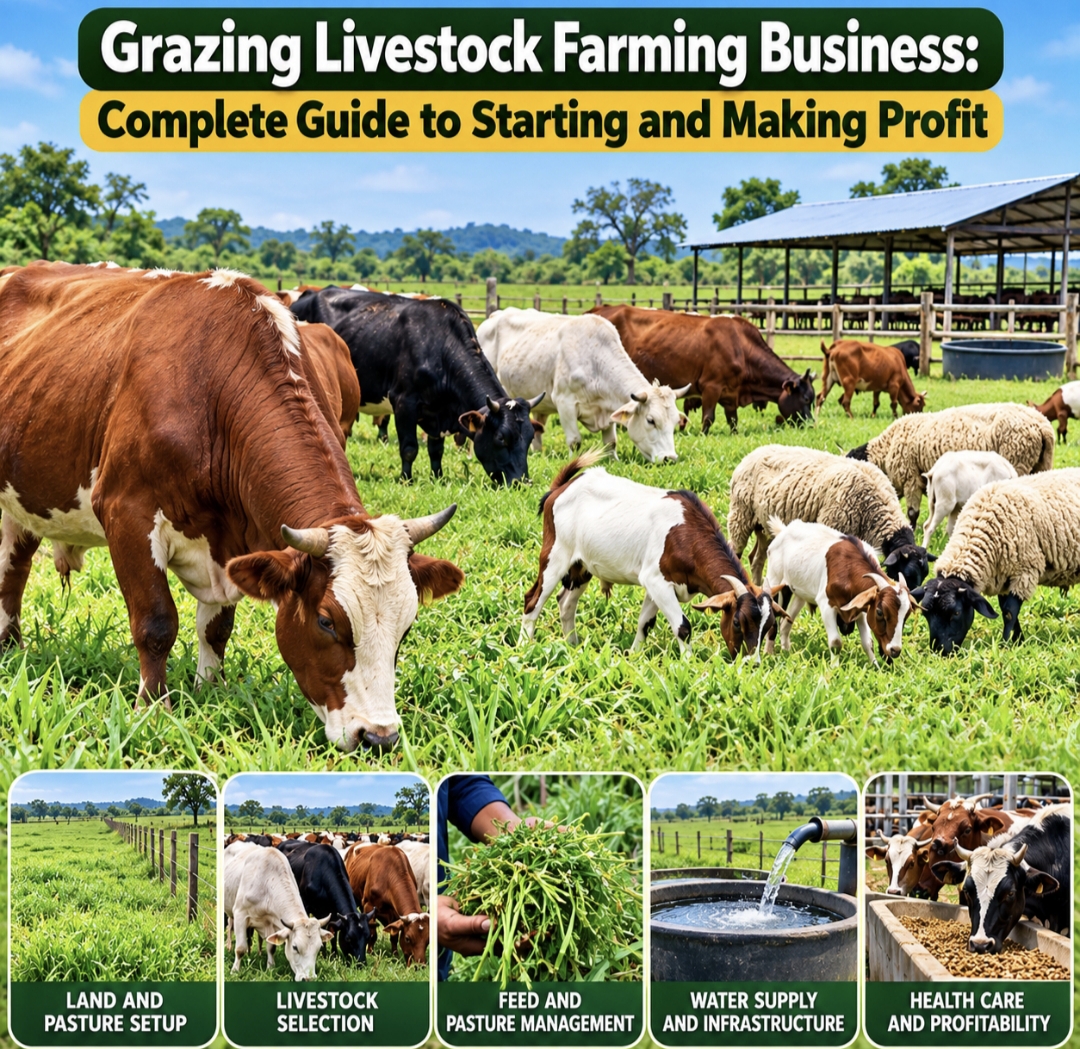
Grazing livestock farming is one of the oldest forms of animal agriculture, but modern grazing systems have transformed it into a highly organized commercial enterprise. Instead of simply allowing animals to move around and search for food, modern livestock farmers manage pasture, water, breeding, animal health, nutrition, land use, security and marketing as parts of one integrated business.
- Livestock
- Land preparation
- Fencing
- Water
- Shelter
- Feed reserves
- Veterinary care
- Labour
- Transportation
- Emergency funds
Grazing livestock farming involves raising animals such as cattle, sheep, goats and, in some systems, other herbivorous livestock primarily on pasture and other forage resources. Depending on the production system, farmers may combine grazing with supplementary feeding, housing, breeding programmes and commercial fattening.
The business can be started on a small scale and gradually expanded. However, profitability depends less on the number of animals owned and more on how efficiently the farmer manages land, feed, animal health, reproduction, labour and markets.
This comprehensive guide explains how grazing livestock farming works, the livestock suitable for grazing, land requirements, pasture development, feeding, water management, breeding, disease prevention, business planning, marketing and ways to improve profitability.
What Is Grazing Livestock Farming?
Grazing livestock farming is a livestock production system where animals obtain much of their nutrition by feeding on grasses, legumes, forage plants and other suitable vegetation.
The animals may graze directly on natural pasture or on deliberately established improved pasture.
Traditional grazing often involves animals moving freely over large areas. Modern commercial grazing, however, can be much more controlled.
Farmers can divide their land into paddocks, control how long animals remain in each paddock, provide supplementary feed, monitor animal growth and use planned breeding programmes.
The goal is to produce healthy animals efficiently while maintaining the productivity of the land.
Livestock Suitable for Grazing
Several livestock species can be raised successfully under grazing systems.
Cattle
Cattle are among the most important grazing livestock globally.
They can be raised for:
- Beef production
- Milk production
- Breeding
- Fattening
- Draft purposes in some traditional systems
Because cattle are large animals, they generally require more feed and space than sheep or goats.
Goats
Goats are highly adaptable animals and can consume a wide variety of vegetation.
Commercial goat farming can focus on:
- Meat
- Milk
- Breeding
- Young-stock production
Goats can be particularly useful where available vegetation includes shrubs, browse and mixed forage.
Sheep
Sheep are important grazing livestock for meat and wool production in many parts of the world.
They can perform well on properly managed pasture and can also be integrated with cattle because different species may utilize vegetation differently.
Types of Grazing Systems
There is no single grazing system suitable for every farm.
The major systems include continuous grazing, rotational grazing, strip grazing, deferred grazing and mixed-species grazing.
Continuous Grazing
Under continuous grazing, livestock remain on the same pasture for an extended period.
This system is simple, but poor management can lead to overgrazing.
Animals may repeatedly consume the most desirable plants while less desirable vegetation becomes dominant.
Rotational Grazing
Rotational grazing divides pasture into several sections called paddocks.
Animals graze one paddock while the others recover.
For example:
Paddock A → Paddock B → Paddock C → Paddock D
After grazing the fourth paddock, the farmer may return the animals to the first paddock if sufficient regrowth has occurred.
The actual rotation should be determined by pasture growth rather than a rigid calendar.
Strip Grazing
Strip grazing gives livestock access to a limited section of pasture at a time.
Temporary fencing can be used to create grazing strips.
This can improve pasture utilization and reduce unnecessary trampling.
Mixed-Species Grazing
Cattle, sheep and goats can sometimes be grazed in the same overall farm system.
Different livestock species have different feeding behaviours.
Cattle primarily consume grasses, while goats often utilize shrubs and browse more extensively.
When carefully managed, mixed grazing can improve utilization of available vegetation.
Choosing Land for Grazing Livestock
Land is one of the most important assets in grazing livestock farming.
Good livestock land should have:
- Suitable vegetation
- Adequate drainage
- Reliable water
- Reasonable soil fertility
- Accessibility
- Security
- Appropriate fencing potential
- Access to markets
- Sufficient carrying capacity
The amount of land required depends on animal species, pasture productivity, rainfall, soil quality, management system and stocking rate.
There is no universal number of acres that can safely support a particular number of animals.
Understanding Carrying Capacity
Carrying capacity is the number of animals that a particular area of land can support sustainably under defined management conditions.
A pasture with high rainfall, fertile soil and improved forage may support considerably more animals than poor, dry pasture.
Farmers should therefore avoid determining herd size based solely on land area.
Instead, evaluate the amount and quality of forage available throughout the year.
Pasture Development
Pasture is the foundation of grazing livestock production.
A productive pasture should provide sufficient forage during as much of the year as possible.
Farmers may establish improved grasses and legumes that are adapted to their local climate and soil.
Potential forage options include:
- Guinea grass
- Napier grass
- Rhodes grass
- Brachiaria
- Panicum
- Desmodium
- Stylo
- Other locally adapted forage species
The best forage species depends on the farming environment.
Soil Preparation
Before establishing improved pasture, farmers should assess the land.
Important considerations include:
- Soil type
- Soil fertility
- Drainage
- Acidity
- Rainfall
- Existing vegetation
Where necessary, soil testing can help determine appropriate nutrient management.
Water Management
Water is essential for livestock survival, growth and productivity.
Animals should have regular access to clean, safe drinking water.
Possible water sources include:
- Boreholes
- Wells
- Rainwater harvesting
- Properly managed streams
- Storage tanks
- Water troughs
Water should be distributed conveniently so that animals do not have to travel excessive distances.
Livestock Housing
Although grazing animals spend much of their time outdoors, suitable shelter is still important.
Housing protects livestock from:
- Extreme weather
- Heavy rain
- Excessive heat
- Cold
- Predators
- Theft
Housing should be well ventilated and properly drained.
For sheep and goats especially, damp and poorly drained environments can create health problems.
Fencing
Commercial grazing operations benefit greatly from effective fencing.
Fencing can:
- Keep animals within designated areas
- Prevent livestock from entering crops
- Create paddocks
- Improve grazing control
- Increase security
- Make livestock management easier
Farmers should choose fencing materials according to livestock species, terrain, security requirements and budget.
Buying Livestock
The quality of animals purchased at the beginning can strongly affect the future performance of the farm.
Do not purchase livestock simply because they are cheap.
Look for animals with:
- Good body condition
- Bright eyes
- Normal movement
- Healthy skin and coat
- Good appetite
- Normal breathing
- No obvious wounds
- No visible signs of disease
- Good structural characteristics
Where breeding is the objective, additional attention should be given to reproductive history, genetics and physical conformation.
Quarantine New Animals
New animals should preferably be separated from the existing herd for an appropriate quarantine period.
This provides an opportunity to monitor them for disease and other health problems before introducing them to the established herd.
Veterinary guidance is particularly important when purchasing animals from multiple sources.
Feeding Grazing Livestock
Pasture may provide a substantial proportion of livestock nutrition, but pasture quality changes throughout the year.
Animals may require supplementary feed when:
- Pasture is insufficient
- Pasture quality declines
- Animals are growing rapidly
- Females are pregnant
- Females are producing milk
- Animals are being fattened
- Weather conditions reduce forage availability
Potential supplementary feeds include:
- Hay
- Silage
- Crop residues
- Legume forage
- Commercial concentrates
- Mineral supplements
Feed should be appropriate for the species and production objective.
Dry-Season Feeding
One of the most important aspects of grazing livestock management is preparing for periods when pasture production declines.
Farmers can conserve forage during periods of abundance by producing:
- Hay
- Silage
- Dried forage
- Properly stored crop residues
Planning feed supplies before shortages occur can reduce emergency feed costs.
Mineral Supplementation
Minerals play important roles in livestock growth, reproduction, bone development and general health.
Depending on pasture quality and animal requirements, farmers may use appropriate mineral supplements.
The exact supplementation programme should be based on local conditions and professional livestock advice.
Livestock Breeding
Breeding is central to long-term herd development.
A commercial breeding programme should focus on:
- Healthy breeding animals
- Good reproductive performance
- Appropriate genetics
- Proper nutrition
- Disease prevention
- Accurate records
Farmers should avoid keeping breeding animals simply because they are available.
Animals with poor reproductive performance can reduce farm profitability.
Selecting Breeding Females
Good breeding females should generally demonstrate:
- Good health
- Sound body structure
- Good reproductive performance
- Adequate body condition
- Good mothering ability
- Desirable production characteristics
The exact criteria differ by species and production objective.
Selecting Breeding Males
A breeding male can influence the characteristics of many offspring.
Farmers should therefore pay attention to:
- Health
- Fertility
- Structural soundness
- Breed characteristics
- Growth performance
- Reproductive history where available
Professional breeding advice can be valuable when establishing a commercial herd.
Animal Health Management
Animal health is one of the biggest determinants of profitability.
A good livestock health programme should include:
- Vaccination where appropriate
- Parasite control
- Regular observation
- Proper nutrition
- Clean water
- Good hygiene
- Quarantine procedures
- Prompt veterinary attention
Farmers should work with qualified veterinary professionals for disease prevention and treatment.
Parasite Control
Internal and external parasites can reduce livestock performance.
They may cause:
- Weight loss
- Poor growth
- Anaemia
- Reduced productivity
- Reproductive problems
- Death in severe cases
Parasite-control programmes should be based on local disease conditions and professional veterinary advice.
Record Keeping
Commercial livestock farming should be managed using accurate records.
Important records include:
- Animal identification
- Purchase date
- Purchase price
- Births
- Deaths
- Vaccinations
- Treatments
- Breeding events
- Feed expenses
- Labour costs
- Sales
- Selling prices
- Weight records
Records allow the farmer to determine whether the business is actually profitable.
Livestock Identification
Animals can be identified using suitable methods such as:
- Ear tags
- Electronic identification
- Branding where legally and ethically appropriate
- Other farm identification systems
Good identification makes it easier to track individual animals.
Labour Requirements
Labour requirements depend on herd size and management system.
Daily activities may include:
- Checking animals
- Monitoring water
- Inspecting fences
- Moving animals
- Feeding supplements
- Cleaning facilities
- Monitoring sick animals
- Recording births and deaths
Larger farms may require trained livestock attendants and dedicated farm managers.
Livestock Security
Security should be treated as a major component of the business.
Measures may include:
- Strong perimeter fencing
- Proper identification
- Secure night housing
- Farm attendants
- Regular livestock counting
- Reliable records
- Strategic location of water points
- Cooperation with local communities
Security arrangements should comply with local laws and regulations.
Livestock Marketing
Producing livestock is only one part of the business.
You also need a reliable market.
Potential buyers include:
- Livestock traders
- Butchers
- Restaurants
- Meat processors
- Breeding farms
- Other farmers
- Wholesalers
- Direct consumers
Understanding the market before expanding production can help reduce the risk of holding animals longer than planned.
Selling at the Right Time
Farmers should not automatically sell animals as soon as they become marketable.
The best selling time depends on:
- Animal condition
- Market prices
- Feed costs
- Seasonal demand
- Farm cash-flow requirements
- Production objectives
However, delaying sales also has costs, particularly when additional feed is required.
Value Addition
Livestock can generate revenue beyond the sale of live animals.
Possible value chains include:
Livestock → slaughter → meat → processing → packaging → retail
Depending on the species and applicable regulations, other products may include:
- Milk
- Breeding animals
- Manure
- Hides and skins
- Processed meat
- Young livestock
Food processing requires appropriate hygiene, regulatory compliance and infrastructure.
Manure as a Farm Resource
Livestock manure can become an important resource.
Properly managed manure can contribute nutrients and organic matter to agricultural soils.
This creates an opportunity for integrated crop-livestock farming.
For example:
Crops → crop residues → livestock feed
and:
Livestock → manure → crop production
This can improve resource utilization when properly managed.
Starting a Grazing Livestock Business With Limited Capital
A common mistake is spending nearly all available capital on animals.
A better approach is to divide the investment between:
For example, if a farmer has a fixed startup budget, purchasing fewer animals while establishing reliable infrastructure may create a stronger foundation than purchasing a large herd without sufficient water, pasture or security.
Example Business Budget Structure
An illustrative allocation could look like this: Category Example allocation Livestock 45–55% Fencing 10–15% Water system 5–10% Housing/shelter 8–12% Feed reserve 5–10% Veterinary care 3–5% Labour and transport 5–10% Emergency reserve 3–5%
These percentages are planning examples rather than fixed market prices.
Actual costs depend on location, species, breed, animal age, infrastructure and market conditions.
How to Calculate Livestock Profit
The basic formula is:
Profit = Total Revenue − Total Costs
Total revenue may include:
- Animal sales
- Breeding stock sales
- Milk
- Manure
- Other livestock products
Total costs may include:
- Animal purchases
- Feed
- Veterinary expenses
- Labour
- Water
- Fencing
- Housing
- Transportation
- Land costs
- Security
- Equipment
- Marketing
- Mortality losses
A farmer should calculate profitability over an appropriate production period rather than judging the business from one sale.
Important Performance Indicators
Commercial farmers can monitor:
Mortality rate
Number of deaths ÷ total animals × 100
Growth rate
Change in body weight over a defined period.
Feed cost per animal
Total feed expenditure ÷ number of animals.
Revenue per animal
Total livestock revenue ÷ animals sold.
Gross margin
Revenue − variable production costs.
These measurements help identify where money is being gained or lost.
Major Risks in Grazing Livestock Farming
Grazing livestock farming can be profitable, but it is not risk-free.
Important risks include:
- Disease outbreaks
- Drought
- Pasture shortages
- High feed prices
- Theft
- Predators
- Flooding
- Market-price fluctuations
- Poor breeding performance
- Overgrazing
- Poor farm management
Risk management should be incorporated into the business plan from the beginning.
Overgrazing
Overgrazing occurs when animals consume vegetation faster than the pasture can recover.
Signs may include:
- Bare soil
- Reduced grass height
- Declining pasture quality
- Increased weeds
- Soil erosion
- Reduced carrying capacity
Rotational grazing, appropriate stocking rates and pasture monitoring can help reduce the problem.
Climate and Grazing Livestock
Climate conditions strongly influence grazing systems.
Rainfall determines pasture growth, while temperature affects water consumption, animal comfort and forage productivity.
Farmers should therefore plan for periods of low rainfall and establish feed reserves whenever possible.
Technology in Modern Grazing
Modern livestock farmers can use technology to improve management.
Examples include:
- Electronic animal identification
- Digital farm records
- Weighing systems
- GPS tracking
- Remote cameras
- Automated water systems
- Mobile farm-management applications
- Weather monitoring
Technology does not replace good management, but it can improve efficiency and record keeping.
Integrated Crop and Livestock Farming
Combining crops and livestock can create additional benefits.
Crops can supply suitable residues for livestock feed, while livestock manure can contribute nutrients to crop fields.
Possible combinations include:
- Maize and cattle
- Sorghum and livestock
- Cassava and livestock
- Legumes and livestock
- Forage crops and ruminants
The materials must be suitable and safely managed before being used as livestock feed.
How to Make Grazing Livestock Farming More Profitable
Profitability can be improved through several strategies.
Improve Pasture Quality
Better pasture can reduce dependence on expensive purchased feeds.
Reduce Animal Mortality
Healthy animals mean fewer financial losses.
Improve Breeding
Better reproductive performance increases the number of marketable animals produced from the existing herd.
Monitor Growth
Knowing how quickly animals gain weight helps determine when selling becomes economically sensible.
Reduce Feed Waste
Proper storage and feeding can prevent unnecessary feed losses.
Build Strong Market Relationships
Direct relationships with reliable buyers can improve marketing efficiency.
Keep Detailed Records
Records reveal which parts of the farm are profitable and which require improvement.
Common Mistakes Beginners Should Avoid
New farmers often make several mistakes.
Buying too many animals:
A large herd without sufficient pasture, water and management can quickly become a financial burden.
Ignoring veterinary care:
Waiting until animals are severely sick can result in avoidable losses.
Poor pasture management:
Overgrazing can destroy the farm's most important feed resource.
No emergency fund:
Unexpected veterinary, feed or infrastructure expenses can occur.
No records:
Without records, it becomes difficult to determine the true profitability of the farm.
Buying animals without inspection:
Cheap animals can become expensive if they have poor health or reproductive potential.
Ignoring the market:
A farmer may produce good animals but still struggle if there is no reliable market.
Step-by-Step Plan for Starting
A practical sequence is:
Step 1: Choose the livestock species.
Step 2: Define the production objective.
Step 3: Assess available land.
Step 4: Determine pasture carrying capacity.
Step 5: Establish water supply.
Step 6: Construct appropriate shelter.
Step 7: Install fencing.
Step 8: Establish or improve pasture.
Step 9: Identify reliable livestock suppliers.
Step 10: Purchase healthy animals.
Step 11: Quarantine new animals.
Step 12: Establish a veterinary programme.
Step 13: Begin proper record keeping.
Step 14: Identify buyers.
Step 15: Monitor growth and production.
Step 16: Sell animals according to the business plan.
Step 17: Reinvest part of the profits.
Step 18: Expand only when the existing system can support more animals.
Frequently Asked Questions About Grazing Livestock Farming
Is grazing livestock farming profitable?
It can be profitable when animals, land, feed, health, labour and marketing are properly managed. Profitability varies significantly according to species, production system, location, input costs and selling prices.
Which livestock is easiest for a beginner?
Goats and sheep can be easier to manage on a smaller scale than cattle, although the best choice depends on the farmer's land, resources, market and experience.
How much land is needed for livestock grazing?
There is no universal acreage requirement. Carrying capacity depends on pasture productivity, rainfall, soil fertility, animal species, stocking density and management.
Can livestock survive entirely on grass?
Some grazing livestock can obtain much of their nutrition from pasture, but nutritional requirements vary. During periods of inadequate pasture or increased production demands, supplementary feed may be necessary.
How can I prevent overgrazing?
Use appropriate stocking rates, monitor pasture condition and consider rotational grazing or other controlled grazing systems.
Is water important in grazing livestock farming?
Yes. Adequate clean water is essential for livestock health, growth, reproduction and productivity.
Should I start with many animals?
Not necessarily. Starting at a manageable scale allows the farmer to develop management skills, test the market and improve infrastructure before expanding.
Can cattle, goats and sheep be kept together?
They can sometimes be integrated under carefully managed systems, but stocking density, nutrition, disease management and animal behaviour must be considered.
How can livestock farming be integrated with crop farming?
Suitable crop residues can contribute to livestock feed, while properly managed manure can contribute nutrients to crop production.
What is the biggest mistake in grazing livestock farming?
There is no single mistake responsible for every failure, but poor management of pasture, animal health, finances and markets can significantly reduce profitability.
Final Thoughts
Grazing livestock farming is more than simply allowing animals to feed on grass. Modern commercial grazing requires the farmer to manage pasture, water, nutrition, breeding, animal health, infrastructure, security, labour, records and marketing as one interconnected business.
A successful grazing livestock enterprise should be designed around the resources available rather than the number of animals the farmer wants to own.
Start with a manageable herd, establish reliable water and pasture, protect the animals, maintain good health records and understand your market. As the farm becomes more efficient and profitable, expansion can follow.
The long-term goal should be to create a livestock system in which healthy animals convert available forage and other resources into valuable products while the land remains productive for future production.
With proper planning and disciplined management, grazing livestock farming can become a scalable agricultural enterprise capable of generating income while supporting meat, milk, breeding, manure and other livestock value chains.
Latest posts
- Types of Yam in Africa and Their Commercial Benefits: A Complete Guide to Yam Production, Uses and Business Opportunities
- Types of Potato: Complete Guide to Potato Varieties, Uses, Characteristics and Best Types for Farming.
- Types of Pepper Widely Known and Used in Africa: A Comprehensive Guide to Pepper Varieties, Uses, Cultivation and Economic Importance
- Transforming Agriculture: How an Effective Website Can Boost Your Agro Business

- Transforming Agriculture with Cutting-Edge Web Solutions

- Tilapia Farming: Complete Guide to Raising Tilapia for Commercial Production

- SUCCESSFUL WATERMELON FARMING: A Complete Guide to Growing Watermelon for Profit.
- Soybean Farming: Complete Guide to Growing Soybeans for Profit
- Sheep Farming: Complete Guide to Raising Sheep for Commercial Profit