INTRODUCTION
Calotropis procera farming is an emerging agricultural opportunity that deserves more attention in Africa. Although the plant is commonly regarded as a wild shrub or weed in many communities, Calotropis procera has characteristics that could make it useful as a source of natural fibre, seed floss, biomass and other industrial raw materials.
For African entrepreneurs, the most interesting opportunity may not be selling the fresh plant. Instead, the greater opportunity lies in harvesting, processing and converting Calotropis procera into higher-value materials, especially natural fibre and lightweight floss that can potentially be used for stuffing, insulation, textile applications and other products.
Calotropis procera is native to a broad region extending from Macaronesia and northern and tropical Africa through parts of Asia. Kew's Plants of the World Online records the species as native to numerous African countries, including Nigeria, Ghana, Burkina Faso, Senegal, Niger, Mali, Kenya, Tanzania, Uganda, Sudan, Ethiopia and others. It commonly occurs in dry shrubland and desert environments.
This wide distribution means that the raw material is already available in many parts of Africa. The challenge is to transform it from an underutilized plant into a commercially useful agricultural resource.
WHAT IS CALOTROPIS PROCERA?
Calotropis procera is a perennial shrub belonging to the Apocynaceae family. It is commonly known by names such as Sodom apple, apple of Sodom, giant milkweed and rubber bush in different regions.
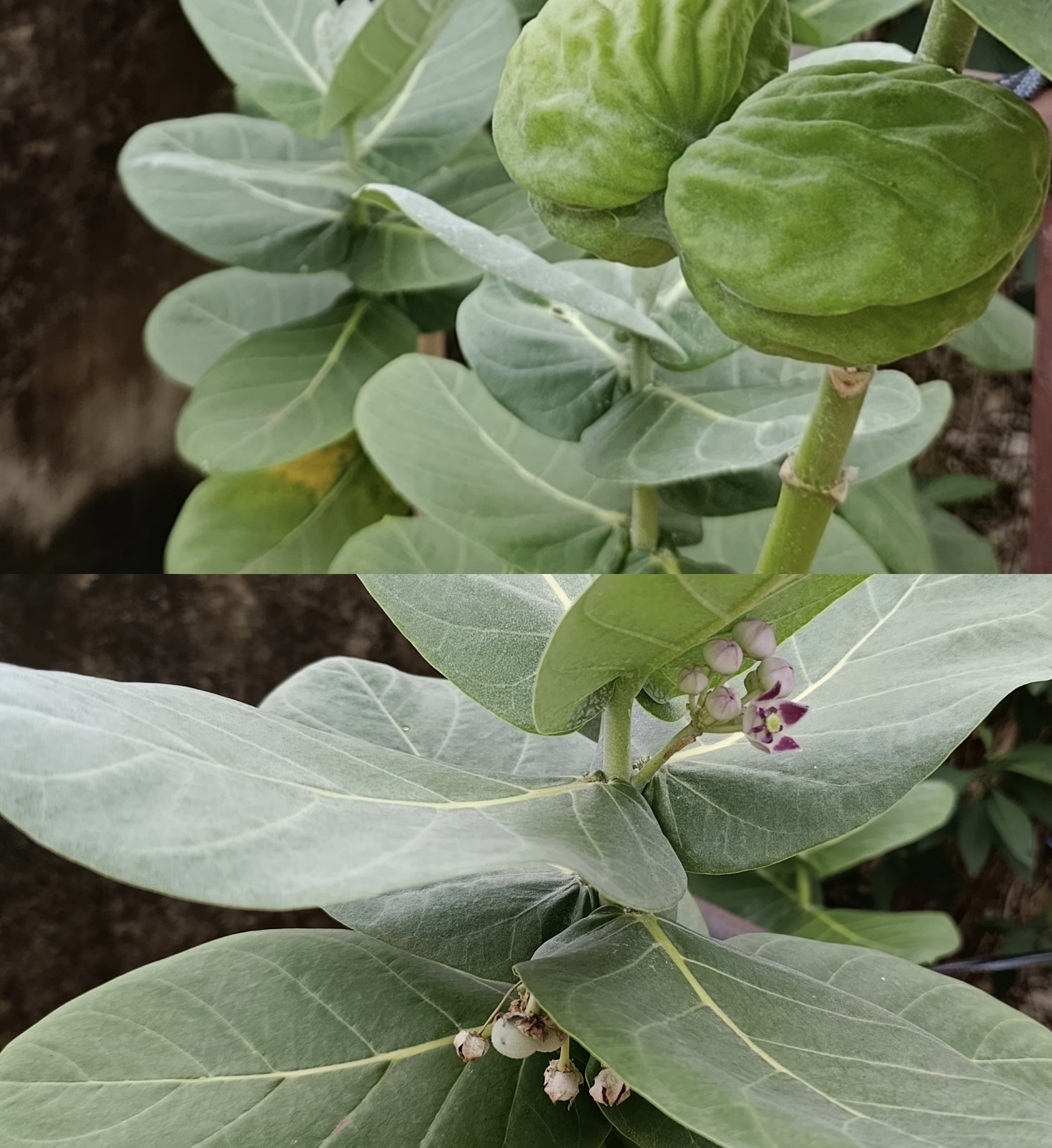
The plant has large, thick, grey-green leaves and produces attractive white or purplish flowers. Its fruits are inflated pods containing numerous seeds attached to silky fibres.
One of the plant's most noticeable characteristics is the milky latex released when its leaves, stems or other tissues are damaged.
The plant can survive difficult environmental conditions and is particularly associated with dry and semi-arid environments. This makes it potentially interesting for parts of Africa where conventional agricultural crops may struggle because of limited rainfall or poor soils.
However, its ability to survive harsh conditions should not be interpreted as meaning that it requires no management. Commercial production requires proper site selection, harvesting systems, worker safety and, most importantly, a reliable market.
WHY CONSIDER CALOTROPIS PROCERA AS A BUSINESS?
Traditional agriculture in Africa focuses heavily on crops such as maize, rice, cassava, beans, sorghum, millet, cocoa, oil palm and vegetables. These crops are important, but there is also growing interest in non-food agricultural products and natural fibres.
Calotropis procera presents an interesting possibility because several parts of the plant can potentially be used as raw materials.
The most commercially interesting materials include:
- Seed floss
- Bast fibre
- Biomass
- Research-grade plant material
- Fibre for textile applications
- Potential oil-absorbent materials
- Specialty natural-fibre products
The key principle is value addition.
Instead of simply harvesting a wild Calotropis plant and selling it cheaply, an entrepreneur can develop a system that looks like this:
Calotropis plant → pods → seed/floss separation → cleaning → drying → fibre processing → finished product
The further you move along this value chain, the greater the potential for creating value.
CALOTROPIS PROCERA FARMING IN AFRICA
Calotropis procera already occurs naturally across large parts of Africa. This gives the plant an advantage that many newly introduced crops do not have.
Kew's Plants of the World Online lists the species as native to numerous African countries, including Nigeria, Ghana, Burkina Faso, Cameroon, Chad, Ethiopia, Kenya, Mali, Mauritania, Niger, Senegal, Sierra Leone, Somalia, Sudan, Tanzania, Uganda and Zambia.
Its natural distribution demonstrates that the plant can grow in a variety of African environments, particularly dry and tropical regions.
However, commercial farmers should avoid assuming that every location will produce the same yield or fibre quality.
Before establishing a plantation, conduct a small trial and evaluate:
- Plant survival
- Growth rate
- Pod production
- Floss production
- Fibre quality
- Labour requirements
- Harvesting costs
- Processing costs
- Market demand
A small pilot can prevent a major financial loss.
CHOOSING THE RIGHT LOCATION
Calotropis procera generally performs well in warm climates and is particularly adapted to dry conditions.
Potential production areas include parts of:
- Northern Nigeria
- Ghana
- Burkina Faso
- Senegal
- Mali
- Niger
- Sudan
- Ethiopia
- Kenya
- Tanzania
- Uganda
- Zambia
- Other suitable tropical and semi-arid regions
The exact suitability depends on local environmental conditions.
Soil
The plant is relatively tolerant and can occur on marginal land, but commercial production should still prioritize land that allows good root development and access for harvesting.
Avoid locations with prolonged waterlogging.
Well-drained soils are preferable because excessive water around the root system can create establishment and disease problems.
Temperature
Calotropis procera is a warm-climate plant. Areas with high temperatures and seasonal dryness can be suitable.
Rainfall
Because the plant is adapted to dry environments, it can survive periods of limited rainfall. However, adequate water during establishment can improve early growth.
Commercial farmers should therefore consider irrigation or supplemental watering during the establishment stage where rainfall is unreliable.
HOW TO START CALOTROPIS PROCERA FARMING
Step 1: Study the Market Before Planting
This is the most important step.
Do not plant a large Calotropis farm simply because the plant is available in your area.
First identify what you intend to sell.
Possible products include:
- Raw seed floss
- Processed floss
- Bast fibre
- Natural-fibre stuffing
- Fibre blends
- Textile raw material
- Research material
- Biomass
- Specialty fibre products
Contact potential buyers before planting.
Potential customers may include:
- Textile companies
- Mattress manufacturers
- Pillow manufacturers
- Furniture companies
- Natural-fibre businesses
- Universities
- Research laboratories
- Craft manufacturers
- Composite-material developers
- Environmental-product companies
The strongest business model is one in which you know the customer before investing heavily in production.
Step 2: Start With a Small Demonstration Farm
For a new entrepreneur, starting with a small plot is safer than immediately establishing several hectares.
A pilot farm of approximately ¼ to 1 hectare can provide valuable information about:
- Growth
- Labour
- Harvesting
- Pod production
- Floss yield
- Processing difficulty
- Product quality
- Market response
Once the results are satisfactory, expansion becomes much easier.
Step 3: Obtain Healthy Planting Material
Calotropis procera can be propagated through seeds and vegetative methods.
Seeds should come from healthy plants with desirable characteristics.
For a commercial fibre project, it would eventually be useful to select plants based on:
- High pod production
- Strong growth
- Good seed production
- High floss yield
- Suitable fibre characteristics
- Adaptation to local conditions
Over time, farmers could develop locally adapted planting material.
Step 4: Establish a Nursery
A nursery can be useful for producing uniform seedlings.
Prepare a clean nursery area with:
- Containers or nursery bags
- Suitable growing medium
- Good drainage
- Protection from excessive disturbance
- Adequate moisture during establishment
The objective is to produce healthy young plants before transferring them to the field.
Do not overwater the seedlings.
Step 5: Transplant to the Field
Transplant healthy seedlings after establishment.
Spacing should be determined through local trials because the optimum spacing will depend on whether the objective is:
- Seed production
- Floss production
- Fibre production
- Biomass production
A wider spacing may make harvesting easier, while closer spacing could increase the number of plants per hectare.
Rather than copying a single spacing recommendation from another country, African farmers should conduct small trials to determine which arrangement produces the best economic return.
MANAGING THE CALOTROPIS FARM
Although Calotropis procera is hardy, commercial farming still requires management.
Important activities include:
Weed management
Remove competing weeds during establishment.
Plant population management
Replace poorly established plants where necessary.
Pest monitoring
Regularly inspect plants for insects and other problems.
Field sanitation
Remove unwanted plant material and maintain accessible paths.
Harvest planning
Organize the farm so that mature pods can be collected efficiently.
Worker safety
Workers must be trained to recognize the plant and avoid contact with its latex.CALOTROPIS PROCERA PODS
CALOTROPIS PROCERA PODS
If your primary product is seed floss, the pods are the most important part of the production system.
The objective is to collect pods at the appropriate maturity stage.
Harvesting too early may reduce the development of the floss, while waiting until pods naturally open can result in losses as the lightweight floss is dispersed by wind.
A practical approach is to monitor the pods closely as they mature and harvest them before uncontrolled opening.
Workers should use protective gloves and eye protection.
UNDERSTANDING CALOTROPIS FLOSS
The floss is the silky material attached to the seeds.
When the pod opens, the seeds are carried with their lightweight fibres, helping natural dispersal.
This floss is particularly interesting because it is:
- Very lightweight
- Soft
- Fluffy
- Naturally buoyant
- Suitable for certain filling applications
Historically and commercially, Calotropis seed fibres have been investigated and used as stuffing material for products such as pillows and mattresses.
This makes floss one of the most promising parts of the plant for value addition.
HOW TO PROCESS CALOTROPIS FLOSS
Processing should be carried out carefully because the goal is to produce a clean, dry and consistent material.
The basic processing chain is:
Harvest pods
↓
Open pods
↓
Separate seeds and floss
↓
Remove contaminants
↓
Dry
↓
Sanitize
↓
Open/fluff
↓
Grade
↓
Package
Stage 1: Opening the Pods
Mature pods are opened manually during small-scale production.
The operator separates the seed-and-floss material from the empty pod.
At larger production volumes, mechanical opening and separation equipment can be developed.
Stage 2: Seed Separation
The seeds need to be separated from the floss.
For a small business, manual separation may be acceptable.
At commercial scale, mechanical systems using airflow, screening and controlled separation could improve productivity.
Stage 3: Cleaning
Raw floss can contain:
- Seeds
- Pod fragments
- Leaves
- Dust
- Insects
- Other plant materials
A good processing system should therefore include screening and cleaning.
The objective is to produce a consistent, clean fibre.
Stage 4: Drying
Drying is critical.
Excess moisture can encourage:
- Mould
- Bacterial growth
- Bad odour
- Insect infestation
- Product deterioration
For commercial production, a controlled dryer is preferable to relying entirely on open-air drying.
A solar dryer can be a practical starting point for small African businesses, provided the system protects the fibre from dust, rain, insects and other contamination.
Stage 5: Sanitation
If the floss is going to be used for pillows, mattresses, toys or clothing, sanitation and microbiological quality become extremely important.
A commercial producer should establish a validated treatment process.
Do not simply spray unknown chemicals onto the fibre.
The final material should be tested for microbial contamination and other relevant safety parameters.
HOW TO MAKE CALOTROPIS FLOSS STUFFING
After cleaning and drying, the floss can be opened and fluffed.
The objective is to create a material with:
- Good loft
- Softness
- Low moisture
- Low contamination
- Consistent texture
- Good compression recovery
A small producer can initially open the fibre manually.
As production increases, a fibre-opening machine can be introduced.
The processed floss can then be used for experimental products such as:
- Pillows
- Cushions
- Decorative products
- Specialty insulation
- Other non-food filling materials
Before selling these products commercially, proper product testing is necessary.
CALOTROPIS BAST FIBRE PROCESSING
Calotropis procera also has fibre-bearing stem material.
The basic process is:
Harvest suitable stems
↓
Remove bark
↓
Separate fibre
↓
Clean
↓
Dry
↓
Grade
↓
Bundle
↓
Sell or process further
Bast fibre can potentially be investigated for applications in:
- Textiles
- Rope
- Paper
- Composite materials
- Craft products
- Nonwoven products
The commercial suitability depends on fibre strength, length, cleanliness, processing cost and customer requirements.
CALOTROPIS FIBRE AND THE TEXTILE INDUSTRY
Natural fibres are attracting increasing interest because manufacturers and consumers are looking for renewable materials.
Calotropis fibre has attracted scientific interest as a potential natural-fibre resource.
African entrepreneurs could therefore explore partnerships with:
- Textile universities
- Fashion schools
- Research institutes
- Traditional textile producers
- Fibre manufacturers
- Sustainable-fashion businesses
A particularly useful strategy is to produce small standardized fibre samples and send them to potential users.
Rather than telling a manufacturer:
"I have Calotropis."
tell them:
"I have a cleaned and graded natural fibre sample with a defined moisture content and fibre specification. Would you like to test it in your production process?"
That is a much more professional approach.
CALOTROPIS FLOSS FOR PILLOW PRODUCTION
Pillow production could provide a simple way to test the commercial potential of the floss.
A pilot producer could manufacture a small number of pillows using carefully cleaned and processed floss.
The product should be evaluated for:
- Softness
- Loft
- Compression recovery
- Fibre leakage
- Odour
- Moisture
- Dust
- Microbial quality
- Skin compatibility
- Flammability
The pillow should not be marketed as medically beneficial simply because it contains a plant fibre.
The safest marketing approach is to focus on the material's natural-fibre characteristics unless specific claims have been scientifically tested.
CALOTROPIS FIBRE FOR INSULATION
Another potential opportunity is insulation.
The lightweight structure of some plant fibres makes them interesting candidates for insulation and other lightweight materials.
However, a commercial insulation product requires much more than simply putting raw fibre into a wall.
It should be tested for:
- Thermal conductivity
- Moisture absorption
- Fire behaviour
- Density
- Durability
- Mould resistance
- Pest resistance
Therefore, insulation should initially be treated as a research and development opportunity.
CALOTROPIS FIBRE AND OIL ABSORPTION
Another interesting research area is the use of Calotropis fibre for oil absorption.
The fibre's physical structure has attracted research interest for absorbing oil and other hydrophobic materials.
This could potentially lead to products such as:
- Oil-absorbent pads
- Spill mats
- Workshop spill materials
- Industrial absorbent products
Africa has large industrial, transportation and petroleum sectors, which makes environmental cleanup materials an interesting market.
However, commercial oil-spill products require testing and certification appropriate to their intended use.
EQUIPMENT NEEDED FOR A SMALL PROCESSING BUSINESS
A small Calotropis processing operation does not need a large factory at the beginning.
Basic equipment may include:
- Harvesting knives
- Secateurs
- Protective gloves
- Protective goggles
- Boots
- Drying racks
- Solar dryer
- Weighing scale
- Moisture meter
- Sieves
- Screens
- Storage bags
- Fibre-opening tools
- Work tables
- Packaging equipment
As production increases, consider:
- Mechanical pod opener
- Seed/floss separator
- Fibre cleaner
- Fibre opener
- Carding machine
- Fibre baler
- Mechanical stem stripper
- Dust extraction system
- Industrial dryer
- Packaging machine
Do not purchase expensive equipment until you have confirmed that your production volume and market justify it.
ESTIMATED STARTUP APPROACH
The cost of starting a Calotropis business will vary widely between African countries.
Instead of giving one misleading fixed figure, divide your investment into stages.
Stage 1: Research and market testing
Spend money on:
- Small-scale collection
- Sample processing
- Product prototypes
- Laboratory testing
- Customer research
Stage 2: Pilot production
Invest in:
- Small farm
- Nursery
- Drying equipment
- Basic processing equipment
- Packaging
Stage 3: Commercial production
Only after obtaining buyers should you invest in:
- Larger land area
- Mechanical processing
- Storage facilities
- Workers
- Transport
- Industrial equipment
For a Nigerian entrepreneur working with approximately ₦1 million, a sensible strategy would be to use the money for a small pilot rather than attempting to establish a large commercial plantation.
BUSINESS MODEL FOR AFRICAN FARMERS
There are several possible business models.
Model 1: Grow and Sell Pods
Farmers grow Calotropis and sell mature pods to processors.
This requires relatively little processing infrastructure.
The disadvantage is lower value per unit of raw material.
Model 2: Grow and Sell Floss
Farmers harvest pods, remove the seeds and sell cleaned floss.
This creates more value.
Model 3: Fibre Processing
The entrepreneur purchases or grows Calotropis, extracts the fibre and sells standardized fibre to manufacturers.
This is more capital intensive but potentially more profitable.
Model 4: Finished Products
The entrepreneur produces:
- Pillows
- Cushions
- Decorative products
- Specialty insulation
- Fibre crafts
This captures more of the value chain.
Model 5: Fibre Aggregation Centre
This may be especially suitable for rural Africa.
Farmers and collectors supply pods or stems to a central processing facility.
The facility then:
buys → cleans → processes → grades → packages → sells
This creates employment while allowing many small farmers to participate.
CREATING A CALOTROPIS FARMER COOPERATIVE
A cooperative could make the business more scalable.
For example:
100 farmers
↓
Each produces Calotropis raw material
↓
Collection centres
↓
Central processing factory
↓
Clean fibre
↓
Large buyers
This model can reduce individual farmer costs and provide processors with a more reliable supply.
The cooperative could also provide:
- Planting material
- Training
- Protective equipment
- Harvesting standards
- Quality control
- Transport
- Market access
POTENTIAL CUSTOMERS
Before establishing a commercial farm, entrepreneurs should investigate potential buyers such as:
Textile manufacturers
They may be interested in natural fibres and fibre blends.
Pillow and mattress manufacturers
They could potentially use processed floss if it meets their quality and safety requirements.
Furniture manufacturers
Cushion and upholstery filling could be explored.
Research institutions
Universities and laboratories may require plant material for fibre and phytochemical research.
Environmental-product companies
These could be potential customers for oil-absorbent fibre products.
Craft manufacturers
Small quantities of clean floss may be useful for experimental products.
MAJOR CHALLENGES
Calotropis farming is not without challenges.
1. Limited established market
Unlike maize, rice or cocoa, there may not be a large organized commodity market for Calotropis fibre in many African countries.
This is why market research must come before large-scale planting.
2. Processing difficulty
Separating clean fibre from seeds and plant debris can be labour intensive.
Mechanization will eventually be important.
3. Quality consistency
Manufacturers need consistent fibre.
Your fibre should have predictable:
- Moisture
- Colour
- Cleanliness
- Fibre length
- Density
- Packaging
- Contamination levels
4. Safety
Calotropis produces toxic latex.
Scientific literature documents serious ocular injury following exposure to the latex, including corneal damage and other complications.
Workers must therefore receive proper safety training and use protective equipment.
5. Product certification
Consumer products such as pillows, mattresses, toys and insulation require appropriate testing.
A natural product is not automatically a safe finished product.
SAFETY PRECAUTIONS FOR FARMERS
This deserves special attention.
Calotropis procera produces a milky latex throughout its tissues. Scientific literature describes the latex as biologically active and potentially toxic.
Direct eye exposure can cause significant ocular injury. In a published case series involving 29 eyes, exposure produced corneal oedema and other complications, with some patients developing secondary glaucoma.
Workers should therefore use:
- Gloves
- Safety goggles
- Long sleeves
- Protective footwear
- Proper washing facilities
Avoid touching the face or eyes while working.
Do not use Calotropis latex as a home medicine.
Do not allow children to handle the plant.
Do not allow livestock to consume large quantities of plant material.
Keep harvested material separate from food and animal feed.
ENVIRONMENTAL CONSIDERATIONS
Because Calotropis procera can establish successfully in dry environments, farmers should manage plantations carefully.
Do not allow a commercial plantation to spread uncontrollably into neighbouring land.
Harvest pods responsibly and monitor the boundaries of the farm.
Before introducing the plant into a region where it is not already established, consult local agricultural or environmental authorities.
In areas where the plant is already native, controlled production may be easier to manage, but local environmental regulations still apply.
HOW TO MAKE THE BUSINESS MORE PROFITABLE
The biggest mistake would be to sell raw Calotropis.
Instead, build a value chain.
Low value
Raw plant
↓
Higher value
Pods
↓
Higher value
Cleaned floss
↓
Higher value
Processed fibre
↓
Higher value
Fibre blends
↓
Highest potential value
Finished products
This principle applies to many agricultural businesses.
The farmer who only sells raw material usually captures less value than the entrepreneur who processes, packages and markets the finished product.
EXAMPLE OF FIVE-YEAR DEVELOPMENT STRATEGY
Year 1: Research
- Identify local Calotropis populations
- Conduct small planting trials
- Test pod and floss production
- Experiment with fibre extraction
- Identify potential buyers
- Produce samples
Year 2: Pilot production
- Expand the best-performing planting material
- Establish a small processing centre
- Improve drying
- Improve cleaning
- Develop fibre specifications
- Produce sample products
Year 3: Commercial contracts
- Sign supply agreements
- Establish farmer partnerships
- Purchase better equipment
- Increase production
- Develop branding
Year 4: Expansion
- Establish additional collection centres
- Increase processing capacity
- Develop finished products
- Enter regional markets
Year 5: Industrial development
- Develop mechanized processing
- Supply larger manufacturers
- Explore export opportunities
- Develop new fibre-based products
- Establish a recognizable African natural-fibre brand
IS CALOTROPIS PROCERA FARMING PROFITABLE?
It can potentially become profitable, but there is currently insufficient basis to promise a specific profit per hectare for Africa.
The profitability depends on:
- Pod yield
- Floss yield
- Fibre yield
- Labour costs
- Land costs
- Processing efficiency
- Equipment costs
- Product quality
- Selling price
- Transportation
- Market demand
- Ability to secure buyers
For this reason, anyone promising that Calotropis farming will automatically produce a particular amount of money per acre or hectare should be treated cautiously.
The best approach is to establish a small pilot and calculate your actual production cost.
Use this formula:
Profit = Total Sales − Total Production and Processing Costs
And calculate:
Cost per kg = Total Production Cost ÷ Kilograms of Finished Fibre
This figure becomes extremely important when negotiating with buyers.
WHY AFRICA COULD HAVE AN ADVANTAGE
Africa has several characteristics that could support the development of natural-fibre businesses.
The continent has:
- Large agricultural communities
- Extensive drylands
- Significant labour availability
- Growing textile industries
- Large furniture markets
- Growing interest in sustainable materials
- Existing Calotropis populations in many regions
Instead of viewing Calotropis only as a wild plant, entrepreneurs can investigate whether it can become part of a circular agricultural and manufacturing economy.
Farmers produce raw material.
Processors create fibre.
Manufacturers create products.
Retailers sell the products.
Consumers purchase African-made natural materials.
That creates value at multiple stages.
FREQUENTLY ASKED QUESTIONS
Is Calotropis procera a good commercial crop?
It has potential, especially as a source of natural fibre and seed floss, but it is still an emerging commercial opportunity in many African markets. Farmers should establish buyers before investing in large-scale production.
Can Calotropis floss be used to make pillows?
Calotropis seed floss has historically been used as stuffing and has characteristics that make it interesting for filling applications. However, commercial pillows require appropriate cleaning, sanitation and product testing.
Can Calotropis fibre be used in textiles?
Yes, it is being investigated as a natural fibre resource. Fibre quality, processing cost and blending requirements must be evaluated for each textile application.
Can Calotropis grow in Nigeria?
Yes. Calotropis procera is native to Nigeria and many other African countries.
Does Calotropis require much water?
The plant is adapted to dry conditions and can tolerate periods of limited water, but young plants still need adequate moisture during establishment.
Is Calotropis poisonous?
The plant contains biologically active and toxic compounds, particularly its latex. Workers should avoid contact with the latex, especially contact with the eyes.
Can I eat Calotropis?
It should not be treated as an edible crop. Do not consume the plant or its latex.
Can I start Calotropis farming with ₦1 million?
A ₦1 million budget could be used for a small Nigerian pilot involving planting, harvesting, drying, basic processing, testing and product development. It would not be sensible to assume that ₦1 million is enough for a full industrial processing plant.
What is the best Calotropis product to start with?
For a small entrepreneur, cleaned seed floss and simple fibre products are worth investigating first because they require less complicated processing than pharmaceutical extraction or advanced composite manufacturing.
CONCLUSION
Calotropis procera may look like an ordinary wild shrub, but its seed floss and fibre provide an interesting opportunity for African agricultural entrepreneurs.
The most promising approach is not simply to establish a large plantation and hope that buyers will appear. Instead, entrepreneurs should build the business around market demand and value addition.
Start small.
Identify the plant.
Test the local environment.
Harvest pods.
Process the floss.
Extract and clean the fibre.
Develop samples.
Test the products.
Find buyers.
Then expand production.
A successful Calotropis business could eventually connect African farmers with textile manufacturers, furniture companies, mattress producers, environmental-product manufacturers, research institutions and other industries seeking renewable raw materials.
The long-term opportunity is therefore bigger than Calotropis farming alone. It is the development of an African natural-fibre value chain in which farmers supply raw materials and processors transform them into standardized, higher-value products.
For entrepreneurs willing to invest in research, quality control, processing technology and market development, Calotropis procera could become an interesting niche agricultural business—particularly in regions where the plant already grows naturally and where suitable markets can be developed.
The most important rule is simple: find the market before planting at scale.
Read more;
- Poultry Meat Benefits to Humanity: Complete Guide to Its Nutritional, Economic and Social Importance

- Tilapia Farming: Complete Guide to Raising Tilapia for Commercial Production

- Fish Pond Construction: Complete Guide to Designing and Building a Modern Fish Pond

- Grazing Livestock Farming Business: Complete Guide to Starting and Making Profit

- Commercial Cattle Farming: Complete Guide to Raising Cattle for Profit

- Goat Farming Business: Complete Guide to Meat and Breeding Production
- Sheep Farming: Complete Guide to Raising Sheep for Commercial Profit

- Modern Pasture Farming: How to Grow High-Quality Livestock Feed