Introduction
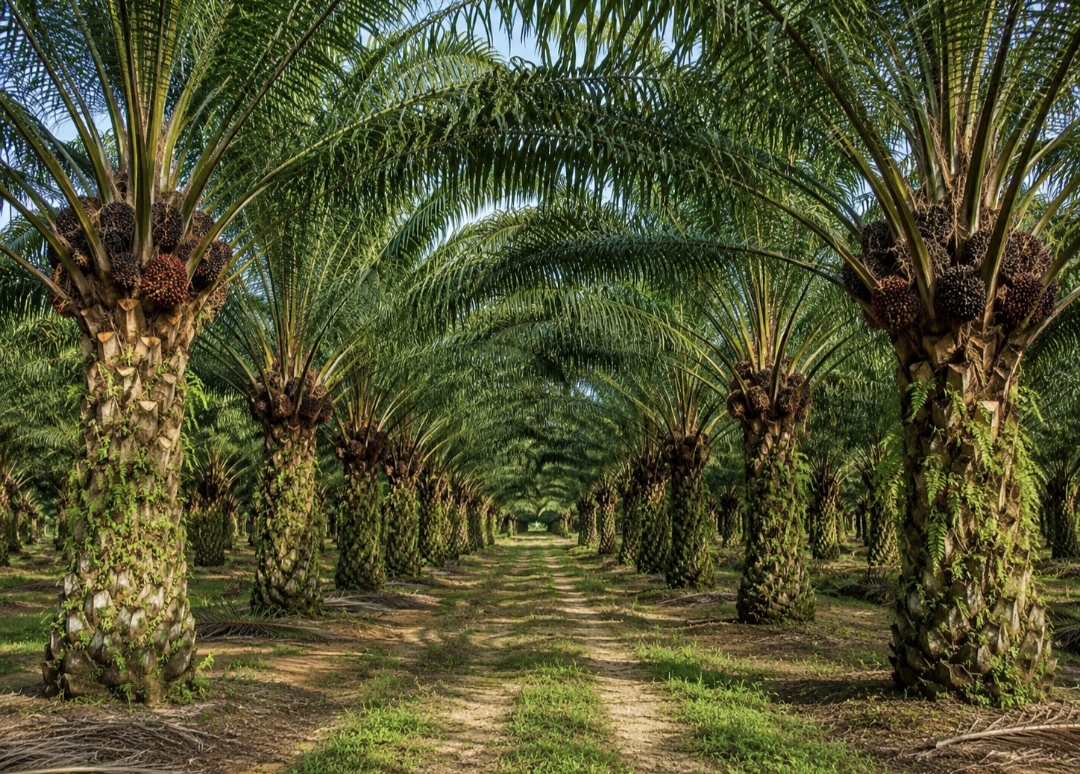
Hybrid oil palm farming is one of the most promising long-term agricultural businesses in tropical Africa. Oil palm produces fresh fruit bunches that can be processed into palm oil and palm kernel products, creating opportunities for farmers, processors, traders, transporters and other agribusiness operators.
Africa is historically important to oil palm production. The crop originated in West and Central Africa and remains particularly important in countries such as Nigeria, Ghana, Côte d’Ivoire, Cameroon, Liberia, Sierra Leone, Guinea and several other tropical African countries.
Modern oil palm farming is different from simply maintaining traditional wild or semi-wild palm groves. Commercial plantations can use improved planting materials, systematic spacing, fertilizer management, weed control, pest monitoring, improved harvesting and better processing systems.
One of the most important improvements is the use of Tenera planting material, produced from crosses involving Dura and Pisifera. FAO describes Tenera as a hybrid with a thinner shell and thicker oil-bearing mesocarp than traditional Dura palms.
For farmers interested in commercial production, however, the word "hybrid" should not automatically mean that every seed sold as hybrid will produce excellent palms. The quality and genetic origin of planting material matter enormously. Farmers should obtain seedlings from reputable, recognised sources rather than planting random seeds collected from existing plantations.
This guide explains how to establish and manage a hybrid oil palm farm in Africa, from choosing land and seedlings to planting, fertilizer management, harvesting, processing, marketing and profitability.
What Is Hybrid Oil Palm Farming?
Hybrid oil palm farming involves cultivating genetically improved oil palm planting materials selected or bred for desirable characteristics such as high fresh fruit bunch production, oil yield, disease tolerance, growth characteristics and other agronomic traits.
Commercial oil palm breeding has historically used three major fruit forms:
- Dura
- Pisifera
- Tenera
Dura generally has a thick shell and comparatively thinner mesocarp, while Pisifera has little or no shell. Their cross produces Tenera, which has a thinner shell and a larger oil-bearing mesocarp.
For farmers, this distinction is important because planting random Dura seeds from traditional palms can produce a plantation with substantially different performance from one established with properly selected commercial planting material.
Why Hybrid Oil Palm Is Attractive for African Farmers
Oil palm can provide income over many years once a plantation becomes productive.
Unlike annual crops that require complete replanting after every harvest, an established oil palm plantation continues producing bunches for many years.
The crop also creates multiple business opportunities.
A farmer can earn from:
- Fresh fruit bunches
- Palm oil
- Palm kernels
- Palm kernel oil
- Palm kernel cake
- Palm fibre
- Palm shells
- Palm fronds
- Processing services
The palm oil value chain can therefore support more than just fruit production.
Understanding the Oil Palm Value Chain
Oil palm farming is only the first part of a larger agricultural value chain.
The basic process is:
Seed production → nursery → plantation → fresh fruit bunch harvesting → transportation → processing → palm oil → palm kernel products → marketing
Farmers can participate in one or several stages.
A smallholder may simply produce fresh fruit bunches and sell them to a nearby mill.
A larger farmer may establish a processing facility.
An entrepreneur with sufficient capital may operate a palm oil mill and purchase fresh fruit bunches from neighbouring farmers.
The best model depends on capital, land, technical skills, market access and local regulations.
Countries Where Hybrid Oil Palm Farming Can Work
Oil palm requires tropical conditions, so not every African country is suitable.
Commercial opportunities are particularly relevant in humid tropical regions of:
- Nigeria
- Ghana
- Côte d’Ivoire
- Cameroon
- Liberia
- Sierra Leone
- Guinea
- Equatorial Guinea
- Gabon
- Democratic Republic of Congo
- Republic of Congo
Other African locations may also be suitable where local climate and soil conditions support the crop.
The exact suitability of a particular farm should be assessed locally rather than assuming that an entire country has the same conditions.
Climate Requirements for Oil Palm
Climate is one of the most important determinants of oil palm performance.
Oil palm is a tropical crop requiring substantial water availability.
FAO notes that oil palm is generally cultivated in tropical high-rainfall environments and identifies a minimum annual rainfall requirement of around 1,600 mm for plantation production.
For commercial production, more important than annual rainfall alone is the distribution of rainfall throughout the year.
Long periods of severe drought can reduce growth and fruit production.
Research on oil palm suitability in Ghana also identified water deficit as a major limitation to production and found the most suitable areas concentrated in wetter southern regions.
Temperature Requirements
Oil palm prefers warm tropical temperatures.
General agronomic references commonly associate good production with mean maximum temperatures around 29–33°C and minimum temperatures around 22–24°C.
The crop performs best where extreme cold does not occur and where sunlight and moisture are adequate.
Farmers should therefore be cautious about establishing large plantations in locations with prolonged cool conditions.
Rainfall Requirements
A well-distributed annual rainfall is highly desirable.
A total rainfall figure can be misleading because two farms receiving the same annual rainfall may have very different production potential if one experiences a long dry season.
Where rainfall is inadequate, irrigation or supplementary water management may become necessary, particularly during important stages of young palm establishment.
Soil Requirements
Oil palm can grow on several soil types, but good drainage and adequate rooting depth are important.
Suitable soils generally have:
- Good drainage
- Adequate fertility
- Good moisture-holding capacity
- Sufficient rooting depth
- Suitable physical structure
- No severe compaction
Before establishing a commercial plantation, conduct a soil test.
A soil test can help determine:
- Soil pH
- Nitrogen status
- Phosphorus
- Potassium
- Magnesium
- Calcium
- Organic matter
- Other relevant nutrients
Choosing Land for Hybrid Oil Palm
Land selection is one of the most important decisions in the entire business.
Do not buy or lease land simply because it is cheap.
Consider:
- Climate
- Soil
- Rainfall
- Drainage
- Road access
- Water availability
- Distance to a palm oil mill
- Land tenure
- Community relations
- Electricity availability
- Labour availability
- Expansion potential
The distance between the farm and processing facility can significantly influence profitability because fresh fruit bunches are bulky and perishable.
Land Ownership and Legal Considerations
Before clearing land, confirm that you have legally recognised rights to use it.
Depending on the country and location, this may involve:
- Land title
- Lease agreement
- Community consent
- Government permits
- Environmental requirements
- Local authority approvals
Large-scale plantation development can have significant social and environmental implications, so proper due diligence is essential.
Avoid Unsuitable Forest Clearance
Commercial oil palm development should not be based on indiscriminate destruction of valuable natural forests.
Where possible, prioritise land already designated or suitable for agricultural use, degraded agricultural land, fallow land and previously cultivated areas where agronomically appropriate.
Responsible land development can reduce environmental risks while maintaining agricultural productivity.
Selecting Hybrid Oil Palm Seedlings
Seedling quality is arguably the most important investment in a new plantation.
A poor-quality seedling can remain in the field for decades while producing disappointing yields.
Purchase seedlings from reputable commercial nurseries, recognised research organisations or approved planting-material suppliers.
Ask about:
- Genetic origin
- Variety or breeding material
- Nursery management
- Age
- Disease status
- Expected performance
- Recommended planting density
Avoid Random Oil Palm Seeds
One of the common mistakes among new farmers is collecting seeds from an attractive palm and planting them.
A large, productive-looking palm does not guarantee that its offspring will have the same characteristics.
Commercial breeding involves selection and controlled crossing.
Therefore, a farmer seeking a high-performing plantation should use quality planting material rather than relying on random seeds.
Nursery Management
Oil palm is normally raised in a nursery before field establishment.
A good nursery should have:
- Reliable water
- Good drainage
- Quality soil or suitable growing medium
- Adequate sunlight
- Protection from animals
- Good access
- Regular monitoring
Seedlings should receive appropriate nutrition and water.
Poor nursery management can produce weak plants that struggle after field planting.
Pre-Nursery and Main Nursery
Commercial oil palm nurseries may use a pre-nursery stage followed by a main nursery.
During the early stage, seedlings are carefully managed to ensure uniform development.
They are subsequently transferred into larger containers or growing areas where they remain until they reach an appropriate field-planting stage.
The nursery period allows farmers to remove abnormal, weak or diseased seedlings before they occupy valuable plantation space.
Selecting Seedlings for Field Planting
Do not plant every seedling simply because you paid for it.
Select healthy, vigorous and properly developed seedlings.
Avoid seedlings with:
- Severe leaf abnormalities
- Poor growth
- Disease symptoms
- Damaged roots
- Severe nutrient deficiency
- Unusual development
Uniform planting material helps create a more manageable plantation.
Preparing the Plantation Site
Site preparation depends on the previous land use.
The objective is to create suitable conditions while minimising soil degradation.
Remove obstacles that interfere with planting and farm operations.
Where possible, avoid unnecessary soil disturbance.
On sloping land, erosion-control measures should be incorporated into the plantation design.
Drainage Planning
Good drainage is important in areas prone to excessive water.
Construct drainage channels where necessary, but avoid unnecessarily draining naturally wet ecosystems that should remain protected.
The objective is to prevent harmful waterlogging while maintaining appropriate soil moisture.
Road and Access Planning
Farm roads should be planned before planting.
Roads are required for:
- Seedling transportation
- Fertilizer movement
- Harvesting
- Fresh fruit bunch evacuation
- Worker access
- Equipment movement
- Farm maintenance
Poor road access can become a major problem during the rainy season.
Planting Pattern
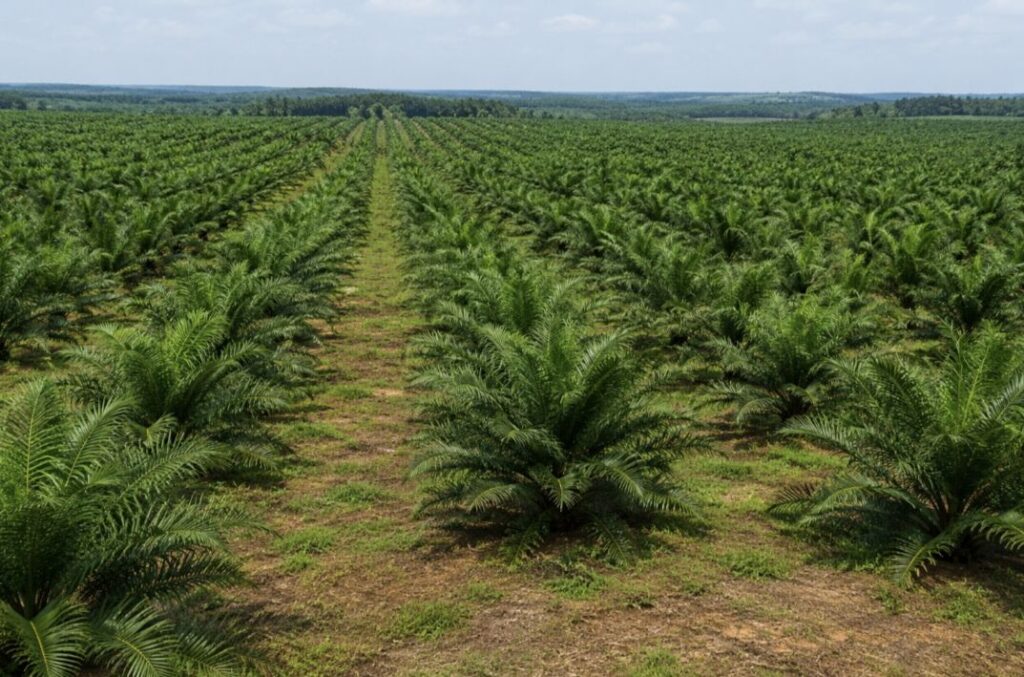
Oil palms require adequate space because mature palms develop large canopies.
Planting too densely can increase competition for light, water and nutrients and eventually interfere with harvesting.
Research from a long-term trial in Nigeria found an optimum range of about 143–160 palms per hectare for the specific planting material and environmental conditions studied, using an equilateral triangular arrangement.
This should not be treated as a universal number for every African farm. Recommended density depends on planting material, environment and management.
Triangular Planting System
Oil palms are commonly arranged in an equilateral triangular pattern.
This arrangement makes efficient use of plantation space and helps distribute palms relatively evenly.
Accurate field measurement is important.
Poorly aligned planting can make harvesting, weed management and transportation more difficult.
Spacing Between Oil Palms
Spacing commonly falls within approximately 8–9 metres depending on planting material and production system.
FAO material describes approximately 7.8 metres between rows and 9 metres between palms as a planting arrangement corresponding to about 143 palms per hectare.
However, modern compact planting materials can sometimes support higher densities. FAO's Ecocrop database notes that some compact hybrids have been developed for higher densities and easier harvesting.
Therefore, follow the planting recommendation supplied for your specific planting material.
Digging Planting Holes
Prepare planting holes at the pegged locations.
The holes should be large enough to accommodate the root system without forcing roots into unnatural positions.
Avoid planting seedlings too deeply.
The base of the stem should be positioned correctly relative to the surrounding soil.
Best Time to Plant Oil Palm
Where rainfall is seasonal, field planting should normally be timed to coincide with the beginning of reliable rains.
This gives newly transplanted palms access to moisture during establishment.
FAO guidance also recommends planting during the beginning of the rainy period in areas with seasonal rainfall.
Transplanting Seedlings
Handle seedlings carefully.
Avoid unnecessary damage to the root ball.
Place the seedling upright in the hole and fill around the root system with suitable soil.
Firm the soil gently.
Water where necessary, particularly if rainfall is inadequate.
Protecting Young Palms
Young palms can be vulnerable to:
- Rodents
- Livestock
- Insects
- Weeds
- Drought
- Mechanical damage
Where animal damage is common, protective measures may be necessary.
Mulching around young palms can also help conserve soil moisture and suppress weeds.
Weed Management
Weed control is especially important during the early years.
Young palms have not yet developed a large canopy and can suffer substantial competition.
Maintain a suitable weed-free area around young palms while allowing appropriate ground cover between rows.
FAO guidance emphasises regular weed removal around young palms during the early years.
Cover Crops
Cover crops can provide several benefits.
They may:
- Reduce erosion
- Protect soil
- Suppress weeds
- Improve soil organic matter
- Reduce exposure of bare soil
Suitable cover crops should be selected according to local conditions and plantation management objectives.
Mulching
Mulching around young palms can conserve moisture and reduce weed competition.
Suitable organic materials can be placed around the palm while keeping an appropriate distance from the stem.
Avoid creating conditions that encourage pests or diseases.
Fertilizer Management
Oil palm requires significant nutrients throughout its productive life.
Nutrient requirements change as the palm grows.
Young palms need nutrients for vegetative development, while mature palms require substantial nutrients to support fruit production.
FAO notes that young palms particularly need nitrogen, while potassium becomes especially important once palms begin producing.
Soil Testing Before Fertilizing
Do not apply fertilizer based only on guesswork.
Soil testing provides useful information about nutrient availability.
Leaf or tissue analysis can also be useful in established plantations when properly interpreted.
A professional agronomist or extension specialist can help translate test results into a fertilization programme.
Nitrogen Management
Nitrogen supports leaf and vegetative development.
Insufficient nitrogen can result in poor growth and pale foliage.
Excessive nitrogen, however, can be wasteful and may create nutrient imbalances.
Apply nitrogen according to soil and plant requirements.
Potassium Management
Potassium is particularly important for oil palm production.
Adequate potassium contributes to plant growth and fruit bunch development.
As palms become productive, potassium demand can become substantial.
Magnesium and Other Nutrients
Magnesium is involved in chlorophyll formation and photosynthesis.
Other nutrients may also become limiting depending on soil conditions.
This is why a balanced fertilizer programme is generally more effective than applying only one nutrient continuously.
Fertilizer Application Method
Fertilizer should be placed where palm roots can access it without causing unnecessary losses.
Do not dump fertilizer directly against the stem.
Follow the recommendation for the fertilizer type, palm age and soil.
Fertilizer programmes should be adjusted according to rainfall, soil and leaf analysis where available.
Irrigation for Oil Palm
Oil palm is primarily suited to high-rainfall environments.
Supplementary irrigation may be beneficial in areas with significant dry periods, particularly during establishment.
FAO's Ecocrop information notes that irrigation may be required during early stages and later during dry periods.
However, irrigation infrastructure can be expensive on large plantations.
Before installing irrigation, calculate whether the expected improvement in production justifies the capital and operating costs.
Pest Management
Oil palm can be attacked by various insects and animals.
Potential problems include:
- Rhinoceros beetles
- Palm weevils
- Defoliating insects
- Rodents
- Termites
- Other locally important pests
The pest situation differs between regions.
Regular monitoring is therefore more useful than assuming that every plantation has the same pest problem.
Rhinoceros Beetles
Rhinoceros beetles can damage young palms by feeding around the growing point.
Good plantation sanitation and careful management of breeding sites can help reduce risk.
Severe infestations may require professionally recommended control measures.
Palm Weevils
Palm weevils can exploit wounds or damaged plant tissue.
Avoid unnecessary injuries to palm trunks.
If suspicious symptoms appear, seek professional assistance quickly.
Rodent Damage
Rodents can damage young palms and consume plant material.
Integrated rodent management may include habitat management, sanitation and locally appropriate control measures.
Avoid indiscriminate use of poisonous substances, particularly where they could endanger livestock, wildlife or farm workers.
Diseases of Oil Palm
Oil palms can suffer from several diseases.
The importance of particular diseases varies between countries and production systems.
Possible problems include:
- Basal stem rot
- Fusarium wilt
- Bud rot
- Leaf diseases
- Vascular diseases
- Nursery diseases
Correct identification is essential.
Do not assume every yellow or dying palm has the same disease.
Basal Stem Rot
Basal stem rot can be a serious disease problem in some oil palm-growing regions.
Affected palms may show declining growth, yellowing and eventual collapse.
Disease management should involve proper field sanitation, monitoring and advice from qualified plant-health specialists.
Fusarium Wilt
Fusarium wilt has historically been important in some African oil palm production systems.
Using healthy planting material and disease-aware plantation management can help reduce risk.
Pruning Oil Palm
Pruning involves removing old, dead or unsuitable fronds.
Good pruning helps maintain access to bunches and facilitates harvesting.
However, excessive pruning should be avoided because green fronds are essential for photosynthesis.
Maintaining the Plantation
A commercial oil palm plantation requires regular maintenance.
Activities include:
- Weed control
- Fertilizer application
- Pest monitoring
- Disease monitoring
- Pruning
- Road maintenance
- Drainage maintenance
- Harvesting
- Transport
- Replanting planning
Neglecting maintenance can gradually reduce productivity.
When Does Hybrid Oil Palm Start Producing?
Oil palm is a long-term crop.
Under suitable conditions, palms may begin bearing fruit after approximately 3–4 years, with production increasing as the plantation matures. FAO's Ecocrop database gives a general range of 3–4 years to first bearing and approximately 8–10 years to full production.
Actual performance varies according to planting material, environment and management.
First Harvest
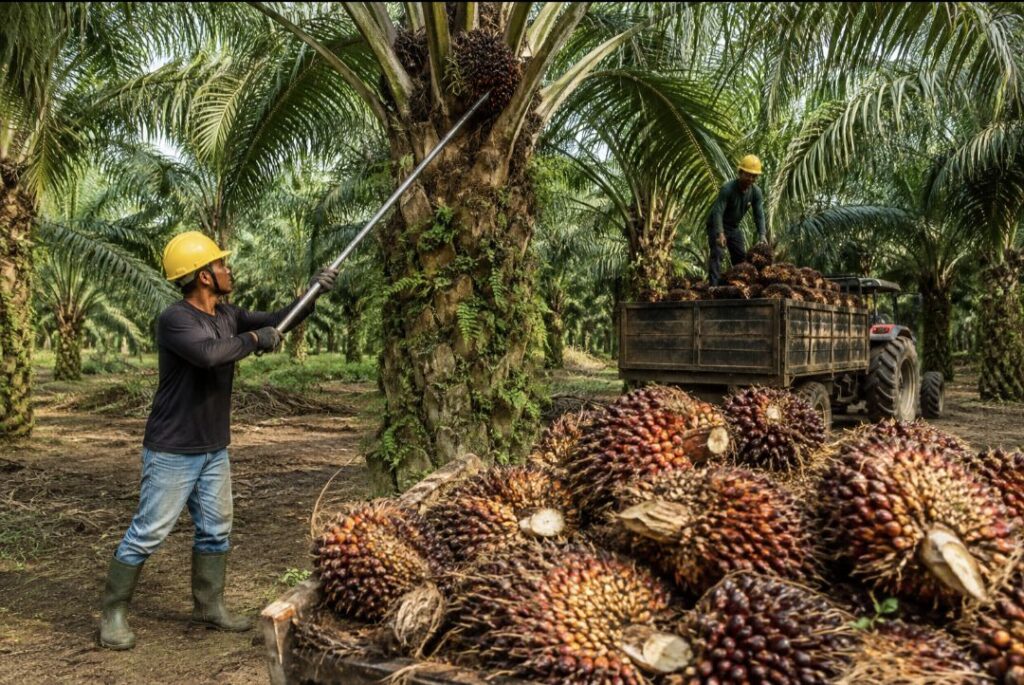
The first harvest is exciting for a farmer because it represents the beginning of revenue generation.
However, early production should not be mistaken for full commercial maturity.
Production normally increases as the palms develop.
Full Production
A well-managed plantation can reach much higher production after the early establishment years.
The precise production curve varies according to planting material, soil, climate, fertilizer, water availability and management.
Farmers should therefore use realistic yield assumptions in financial planning.
Harvesting Fresh Fruit Bunches
Harvesting is one of the most important activities in oil palm farming.
Fresh fruit bunches should be harvested at the appropriate maturity stage.
Harvesting too early reduces oil recovery.
Harvesting too late can increase fruit losses and complicate collection.
Recognising Harvest Maturity
Harvest maturity is generally assessed using indicators such as fruit colour and the presence of naturally detached fruits.
Workers should be trained to identify the correct maturity stage for the mill receiving the fruit.
Harvesting Tools
Harvesting equipment depends on palm age and height.
Young palms can be harvested with shorter tools.
As palms become taller, longer harvesting poles and specialised equipment may be required.
The use of improved harvesting equipment can improve worker safety and efficiency.
Harvesting Frequency
Harvesting should be conducted regularly.
Leaving ripe bunches on the palms for too long can increase fruit losses.
The ideal harvesting interval depends on plantation conditions, labour availability, season and mill requirements.
Transporting Fresh Fruit Bunches
Fresh fruit bunches should be transported to the processing facility as soon as reasonably possible.
FAO notes that fresh fruit bunches are perishable and that delays in evacuation can create losses for farmers.
This makes proximity to a functioning mill an important factor when selecting land.
Building or Accessing a Palm Oil Mill
A plantation does not necessarily need its own processing facility.
Smallholders can sell bunches to existing mills.
However, larger plantations may eventually consider owning or partnering in processing facilities.
The decision depends on:
- Farm size
- Available capital
- Nearby mill capacity
- Expected fruit supply
- Processing technology
- Energy costs
- Labour
- Environmental requirements
- Market access
Palm Oil Processing
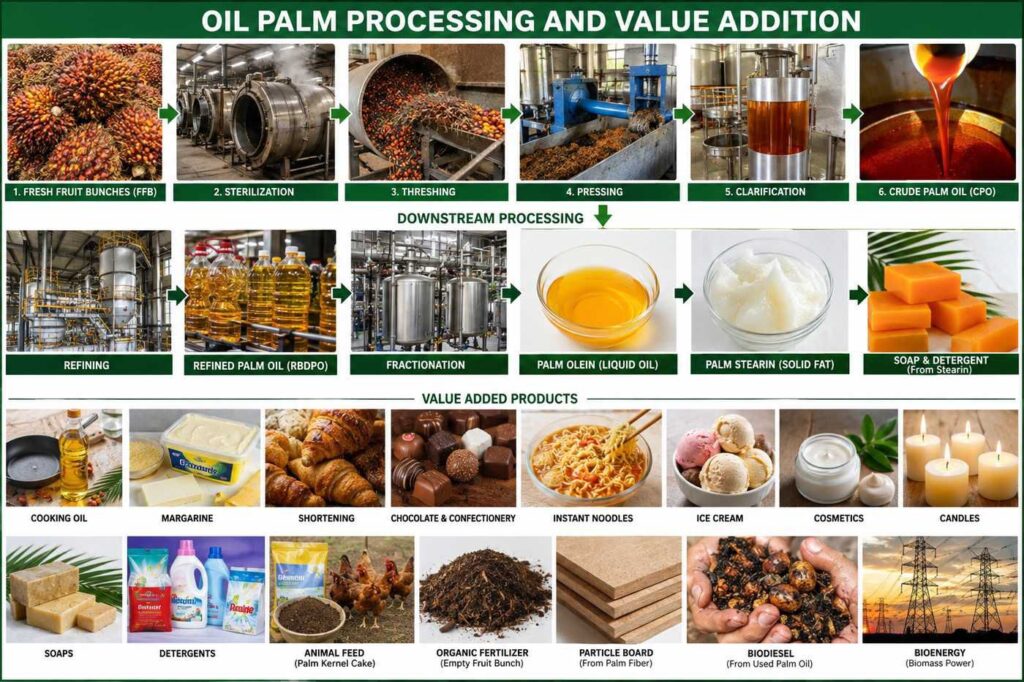
Fresh fruit bunches are processed to recover crude palm oil.
A simplified process includes:
Harvesting → transport → sterilisation → threshing → digestion → pressing → clarification → storage
The exact process and machinery depend on mill scale and technology.
Palm Kernel Processing
After palm oil extraction, the nuts can be separated and processed.
Palm kernels can produce palm kernel oil, while the remaining kernel cake can have value as an animal-feed ingredient depending on processing and market requirements.
Other Oil Palm By-Products
Oil palm produces several potentially useful by-products.
These include:
- Empty fruit bunches
- Palm fibre
- Palm shells
- Palm kernel cake
- Palm fronds
- Palm kernel oil
Some can be used for energy, composting, animal feed or other industrial purposes.
Marketing Fresh Fruit Bunches
The simplest business model is to sell fresh fruit bunches to a nearby processor.
Before establishing the plantation, identify:
- Nearby mills
- Buying prices
- Weighing methods
- Payment terms
- Transportation requirements
- Quality standards
- Seasonal purchasing conditions
A nearby market can significantly reduce transportation expenses.
Starting a Palm Oil Processing Business
Farmers who want to move beyond production can consider palm oil processing.
A small or medium-scale mill may purchase bunches from several farmers.
However, processing requires significant investment.
Costs can include:
- Land
- Building
- Boiler
- Steriliser
- Thresher
- Digester
- Press
- Clarification equipment
- Storage tanks
- Generator or power supply
- Water system
- Waste management
- Labour
- Transportation
Do not buy machinery before conducting a feasibility study.
How to Make Money From Hybrid Oil Palm Farming
There are several possible revenue streams.
The first is selling fresh fruit bunches.
The second is processing your own bunches into palm oil.
The third is selling palm kernels.
The fourth is selling palm kernel products.
The fifth is integrating livestock or other compatible enterprises into the plantation where agronomically and environmentally appropriate.
The sixth is establishing a palm nursery and selling quality seedlings, subject to applicable certification and regulatory requirements.
Intercropping During the Early Years
Young oil palms leave substantial space between rows.
Some farmers use this space for compatible short-duration crops during the early years.
Potential intercrops can include:
- Plantain
- Banana
- Pineapple
- Legumes
- Selected vegetables
However, intercrops should not compete excessively with the young palms for water and nutrients.
The choice should be based on local agronomic recommendations.
Integrating Livestock
Livestock integration may provide an additional income stream.
For example, carefully managed poultry or small ruminants may be considered in suitable plantation systems.
However, livestock must not damage young palms.
Any integrated system should be designed around the needs of both the palms and livestock.
Cost of Establishing a Hybrid Oil Palm Farm
The cost of establishing an oil palm plantation varies widely.
Major expenses include:
- Land acquisition or lease
- Surveying
- Land preparation
- Roads
- Drainage
- Nursery
- Quality seedlings
- Transport
- Planting labour
- Fertilizer
- Weed control
- Pest management
- Maintenance
- Security
- Harvesting infrastructure
A farmer should prepare a multi-year budget because oil palm does not generate significant commercial income immediately after planting.
The Importance of Working Capital
A major mistake is spending all available money on land and seedlings.
Oil palm requires several years of maintenance before the plantation reaches substantial production.
You therefore need sufficient working capital for:
- Fertilizer
- Labour
- Weed control
- Pest management
- Transportation
- Road maintenance
- Replacement seedlings
- Farm supervision
Plan financially for the establishment period.
Example of a Simple Oil Palm Profit Model
Suppose a farmer establishes a plantation of 10 hectares.
If the farm eventually reaches an average marketable production of 15 tonnes of fresh fruit bunches per hectare annually, total production would be:
10 × 15 = 150 tonnes per year
If the average selling price were ₦100,000 per tonne:
150 × ₦100,000 = ₦15,000,000 gross annual revenue
This is only an illustrative calculation, not a guaranteed yield or market price.
Actual revenue depends on the plantation's age, planting material, management, market price, harvesting efficiency and other factors.
Why Yield Estimates Must Be Conservative
Do not create a business plan using an unrealistic maximum yield.
Instead, calculate:
- Low production scenario
- Expected production scenario
- High production scenario
Also calculate different selling-price scenarios.
A plantation business can survive market fluctuations more effectively when financial planning is conservative.
Major Risks in Hybrid Oil Palm Farming
Oil palm is a long-term investment, so farmers must understand the risks.
These include:
- Drought
- Poor planting material
- Disease
- Pest attacks
- Poor soil fertility
- High fertilizer prices
- Labour shortages
- Poor roads
- Low fruit prices
- Mill closures
- Theft
- Land disputes
- Environmental restrictions
Good planning can reduce some of these risks.
Managing Market Risk
Do not depend entirely on one processor if alternatives exist.
Build relationships with several buyers.
Where economically feasible, consider becoming part of a farmer cooperative.
Cooperatives can sometimes improve access to:
- Inputs
- Extension services
- Markets
- Transport
- Processing
- Financing
Managing Climate Risk
Climate variability is a major consideration.
Farmers should select land with strong natural suitability rather than trying to force oil palm into an unsuitable environment.
Research in Ghana, for example, found water deficit to be a major constraint on oil palm suitability.
Good soil moisture management, appropriate ground cover and water conservation can help improve resilience.
Sustainable Oil Palm Farming
Modern commercial oil palm production should consider environmental sustainability.
Sustainable practices include:
- Protecting natural forests
- Preventing unnecessary burning
- Maintaining soil cover
- Reducing erosion
- Managing water responsibly
- Protecting waterways
- Using fertilizers efficiently
- Managing pesticides responsibly
- Treating workers fairly
- Respecting community land rights
Sustainability is increasingly important to international markets and responsible investors.
Soil Conservation
Maintain ground cover wherever appropriate.
Avoid leaving large areas of soil bare.
On sloping land, use erosion-control practices such as contour-aligned field layouts and suitable cover crops.
Protect drainage channels and waterways from sediment and chemical contamination.
Water Protection
Do not allow fertilizer, pesticides, processing waste or sediment to contaminate streams and rivers.
Maintain appropriate buffer zones around sensitive water bodies according to local regulations and best practice.
Waste Management in Palm Oil Processing
Palm oil mills generate substantial organic residues.
These include:
- Empty fruit bunches
- Palm fibre
- Palm shells
- Effluent
Proper management is essential.
Some residues can be reused as fuel, mulch, compost or other agricultural inputs, depending on local regulations and technical feasibility.
Farm Security
Oil palm plantations can remain in production for decades, making security important.
Potential threats include:
- Fruit theft
- Equipment theft
- Livestock damage
- Illegal harvesting
- Land encroachment
Good farm boundaries, records, community relationships and appropriate security measures can reduce risk.
Record Keeping
Keep records from the first day.
Record:
- Number of seedlings planted
- Planting dates
- Seedling supplier
- Fertilizer applications
- Labour
- Weed-control activities
- Pest problems
- Disease incidents
- Harvest quantity
- Selling price
- Transportation
- Processing expenses
- Total revenue
These records allow you to calculate the actual performance of the plantation.
How Many Oil Palms Can Be Planted on One Hectare?
The exact number depends on planting arrangement and material.
A commonly used range for conventional oil palm is approximately 143–160 palms per hectare in some West African conditions and planting materials. A long-term trial in Nigeria reached an optimum plateau within this range for the specific material and environment studied.
Do not automatically plant 160 palms per hectare everywhere.
Use the recommended density for your particular planting material.
How Many Oil Palms Can Be Planted on One Acre?
Since one hectare is approximately 2.47 acres, a conventional density of around 143–160 palms per hectare corresponds roughly to 58–65 palms per acre.
The actual number depends on the selected spacing and field layout.
How Long Can an Oil Palm Plantation Produce?
Oil palm is a long-lived perennial crop.
Commercial plantations are often managed for several decades.
FAO information indicates that palms are commonly cut down around 25–35 years when increasing height makes harvesting impractical, although individual palms can live considerably longer.
Planning for Replanting
Replanting should be considered years before the old plantation becomes uneconomical.
A farmer should maintain records of:
- Palm age
- Yield
- Height
- Disease
- Harvesting difficulty
- Production costs
When yields decline or harvesting becomes uneconomical, replanting may become financially sensible.
Hybrid Oil Palm Farming Business Plan
A practical business plan should contain:
Farm location: Identify the region and confirm climatic suitability.
Farm size: State the number of hectares or acres.
Planting material: Specify the source and type of improved seedlings.
Planting density: Follow the supplier's recommended spacing.
Infrastructure: Include roads, drainage, nursery and water systems.
Production plan: Explain planting, fertilizer, weed management and harvesting.
Marketing plan: Identify mills and other buyers.
Financial plan: Estimate establishment costs, annual maintenance, expected production and revenue.
Risk plan: Identify climate, market, disease and operational risks.
Expansion plan: Explain how the business will grow.
Step-by-Step Plan for Starting a Hybrid Oil Palm Farm
A beginner can follow this sequence:
Step 1: Study the local oil palm market.
Step 2: Identify suitable land.
Step 3: Confirm land ownership or legal rights.
Step 4: Conduct soil and climate suitability assessments.
Step 5: Identify a reliable source of improved planting material.
Step 6: Develop the farm layout.
Step 7: Prepare access roads and drainage.
Step 8: Establish or purchase quality nursery seedlings.
Step 9: Prepare planting holes and peg the field.
Step 10: Transplant at the beginning of suitable rains.
Step 11: Maintain weed-free areas around young palms.
Step 12: Apply fertilizer according to soil and plant requirements.
Step 13: Monitor pests and diseases.
Step 14: Maintain roads and drainage.
Step 15: Begin harvesting when the palms reach maturity.
Step 16: Transport bunches promptly to the mill.
Step 17: Keep detailed production and financial records.
Step 18: Reinvest part of the income into plantation maintenance.
Frequently Asked Questions About Hybrid Oil Palm Farming
Is hybrid oil palm better than traditional oil palm?
Improved commercial planting materials can provide advantages over random traditional seed because they are selected through breeding programmes for desirable characteristics. Tenera, for example, results from Dura × Pisifera breeding and has a larger oil-bearing mesocarp than Dura.
However, actual farm performance depends on the genetic material, environment and management.
Can I grow hybrid oil palm in northern Africa?
Oil palm is fundamentally a tropical crop requiring high temperatures and substantial water. Most North African environments are unsuitable for conventional commercial oil palm production unless highly controlled systems are used.
Can oil palm grow in Nigeria?
Yes. Nigeria has extensive areas suitable for oil palm, particularly in wetter southern regions. However, suitability varies considerably between locations.
How much rainfall does oil palm need?
Oil palm generally requires high rainfall. FAO identifies about 1,600 mm per year as a minimum general requirement for plantation cultivation, while more favourable commercial production often occurs under considerably wetter conditions.
How long before hybrid oil palm produces fruit?
Under suitable conditions, oil palm can begin producing around 3–4 years after planting, although substantial production develops later.
Can I intercrop young oil palms?
Yes, suitable short-duration crops can sometimes be grown between young palms. The intercrop should not compete excessively with the palms for water, nutrients or sunlight.
Is palm oil processing profitable?
Palm oil processing can be profitable when there is sufficient fresh fruit supply, efficient equipment, reliable energy, good management and strong markets.
However, processing requires considerably more capital and technical management than simply producing fresh fruit bunches.
Should I establish a palm oil mill together with my farm?
Not necessarily.
For a small farmer, selling fresh fruit bunches to an existing mill may be more practical.
A processing facility becomes more attractive when there is enough fruit supply from your own farm and surrounding farms to keep the mill operating efficiently.
What is the most important investment in oil palm farming?
Quality planting material and suitable land are among the most important investments.
A farmer can correct some management problems later, but poor genetics or unsuitable land can limit the plantation for decades.
What is the biggest mistake new oil palm farmers make?
One major mistake is focusing on planting without planning the years of maintenance before the plantation becomes commercially productive.
Oil palm is a long-term investment, so the farmer must budget for several years of fertilizer, weed management, labour, pest control, road maintenance and supervision.
Conclusion
Hybrid oil palm farming offers significant opportunities for African farmers and agribusiness investors, particularly in areas with suitable tropical climates, adequate rainfall, fertile soils and access to processing facilities.
The foundation of a profitable plantation is not simply planting many palms. It is selecting suitable land, obtaining genuine high-quality planting material, using an appropriate planting density, managing soil fertility, controlling weeds and pests, protecting the plantation from diseases, harvesting at the right maturity and ensuring rapid access to a reliable processing market.
Tenera and other improved planting materials can offer significant advantages over random seed, but farmers should purchase planting materials from reputable sources rather than relying on unverified claims of "hybrid" performance.
Planting density also matters. Research from a long-term Nigerian trial found approximately 143–160 palms per hectare to be an optimum range for the specific planting material and environmental conditions studied, demonstrating why spacing should be based on evidence rather than simply maximising the number of trees.
Most importantly, oil palm should be treated as a long-term agribusiness investment. The plantation may begin producing after several years, but the strongest commercial returns develop later. During the establishment period, careful financial planning is essential.
For African farmers, the opportunity is not limited to growing palms. The wider value chain includes seedlings, fresh fruit bunch production, transportation, palm oil processing, palm kernel processing, animal-feed products, biomass utilisation and other value-added businesses.
A farmer who combines quality planting material + suitable land + proper agronomy + reliable market access + efficient harvesting + good financial management can build a productive oil palm enterprise capable of generating income for decades.
Read more;
- Transforming Agriculture: How an Effective Website Can Boost Your Agro Business

- MODERN AGRICULTURE WITH MASSIVE INCOME
- HIGH YIELD PLANTAIN AND BANANA FARMING:The Complete Guide to High-Yield, Profitable Commercial Production. (2026 EDITION)
- Transforming Agriculture with Cutting-Edge Web Solutions

- CATFISH FARMING(HYBRID): THE COMPLETE STEP-BY-STEP GUIDE FOR BEGINNERS AND COMMERCIAL FARMERS (2026 EDITION)
- SUCCESSFUL WATERMELON FARMING: A Complete Guide to Growing Watermelon for Profit.
- GROUNDNUT FARMING IN NIGERIA: A Complete Professional Guide to Production, Management, Harvesting and Profitability.