Prologue
Livestock feed production is an important part of modern animal agriculture. As livestock farming becomes increasingly commercialized, farmers need reliable sources of nutritious feed that can support animal growth, reproduction, milk production, meat production and overall health.
Feed is often one of the largest operating expenses in livestock production. Depending on the production system, animals may consume pasture, hay, silage, crop residues, concentrates, mineral supplements or complete manufactured feeds. Understanding how these ingredients work together can help farmers improve feeding efficiency and reduce unnecessary costs.
Commercial livestock feed production involves selecting suitable raw materials, processing them appropriately, formulating balanced rations, maintaining hygiene, storing ingredients correctly and monitoring animal performance.
A good livestock feed should provide the nutrients required by the target animal at its particular stage of production. A ration designed for a rapidly growing calf, for example, will not necessarily be appropriate for a mature dairy cow, breeding sheep or growing goat.
This comprehensive guide explains livestock feed production, major feed ingredients, feed processing, ration formulation, feeding requirements, feed preservation, quality control, storage, business opportunities and common mistakes.
What Is Livestock Feed Production?
Livestock feed production is the process of preparing agricultural materials and other approved ingredients into feed that can be consumed by livestock.
Feed production can take place at different scales.
A small farmer may mix ingredients manually for a few animals, while a commercial feed mill may use specialized equipment to produce several tonnes of feed daily.
Livestock feed may be produced as:
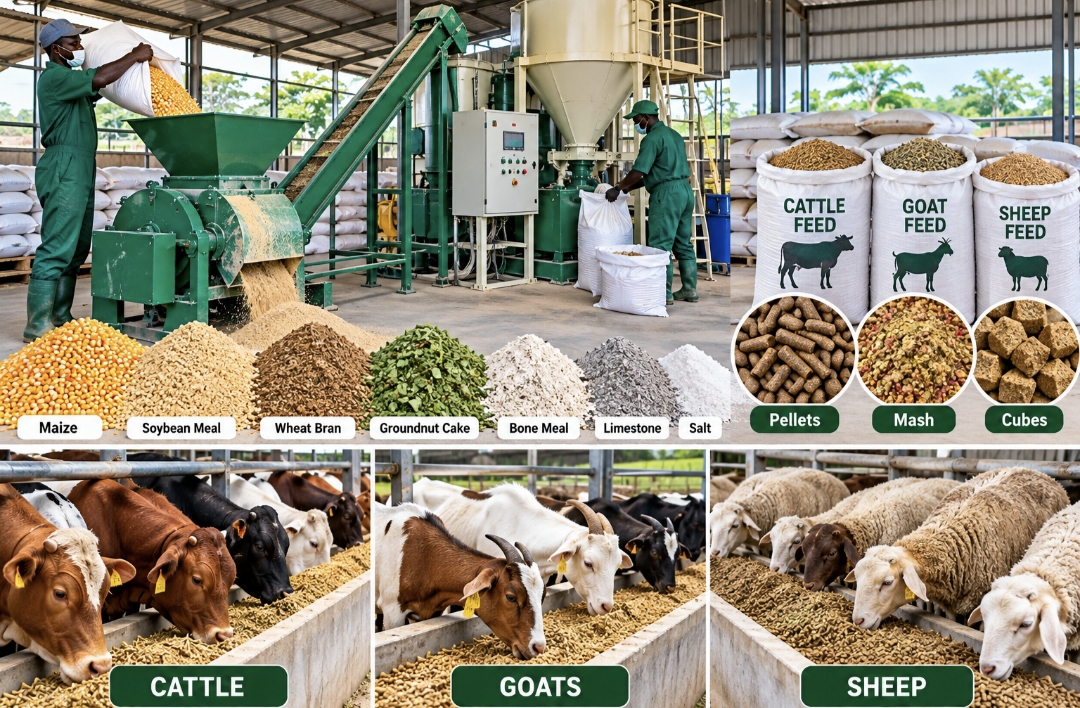
- Mash
- Pellets
- Crumbles
- Blocks
- Hay
- Silage
- Fresh forage
- Dried forage
- Complete mixed rations
The production method depends on the type of livestock, available ingredients, farm size and feeding system.
Why Livestock Feed Is Important
Livestock require nutrients to maintain their bodies and perform productive functions.
Adequate nutrition supports:
- Growth
- Weight gain
- Muscle development
- Milk production
- Reproduction
- Pregnancy
- Lactation
- Immunity
- Body maintenance
- Recovery from illness
- Work performance in working animals
Poor nutrition can reduce productivity even when animals receive adequate quantities of feed.
The objective is therefore not simply to give animals more feed but to provide appropriate nutrients in the correct quantities.
Main Nutrients in Livestock Feed
Livestock feed contains several major nutrient categories.
Energy
Energy is required for movement, body maintenance, growth, reproduction and production.
Energy can come from carbohydrates, fats and other nutrients.
Protein
Protein is essential for muscle development, tissue repair, enzymes, hormones and production.
Growing animals and lactating animals can have relatively high protein requirements.
Fiber
Fiber is particularly important for ruminants such as cattle, goats and sheep.
Adequate fiber supports normal rumen function and chewing activity.
Minerals
Important minerals include:
- Calcium
- Phosphorus
- Sodium
- Potassium
- Magnesium
- Sulfur
- Zinc
- Copper
- Selenium
- Manganese
Requirements vary by animal species and production stage.
Vitamins
Vitamins support many biological functions.
Livestock can obtain vitamins from forage, feed ingredients, microbial activity in the digestive system and commercial vitamin supplements.
Water
Water is often overlooked when discussing feed, but it is one of the most important components of livestock nutrition.
Animals require adequate clean water for digestion, temperature regulation, circulation and production.
Understanding Ruminant Livestock
Cattle, goats and sheep are ruminants.
Their digestive systems allow them to utilize fibrous plant materials through microbial fermentation in the rumen.
This makes forage an important component of their diets.
However, ruminants can also benefit from appropriately formulated supplementary feeds, especially during periods of high nutritional demand.
Feed for Cattle
Cattle feed requirements vary according to whether the animals are:
- Calves
- Growing cattle
- Beef cattle
- Breeding cows
- Dairy cows
- Pregnant animals
- Lactating animals
- Fattening cattle
A dairy cow producing large quantities of milk, for example, requires a different nutritional program from a mature cow that is not lactating.
Feed for Goats
Goats can utilize a combination of:
- Grasses
- Browse
- Legumes
- Hay
- Silage
- Crop residues
- Concentrates
Growing kids and lactating does may require additional nutritional support.
Feed for Sheep
Sheep can consume grasses, legumes, hay and other suitable forage.
Their feed requirements depend on:
- Age
- Body size
- Growth rate
- Pregnancy
- Lactation
- Breeding condition
- Production purpose
Types of Livestock Feed
Livestock feed can broadly be divided into forage, concentrates, supplements and conserved feeds.
Forage
Forage includes plants consumed by grazing or harvested for livestock.
Examples include:
- Pasture grasses
- Legumes
- Browse plants
- Hay
- Fresh forage
Concentrate Feed
Concentrates are generally nutrient-dense feeds containing relatively less fiber than mature forage.
Examples can include:
- Cereal grains
- Bran
- Oilseed meals
- Protein concentrates
- Commercial feed mixtures
Mineral Supplements
Mineral supplements provide nutrients that may be deficient in the base diet.
They may be supplied as:
- Mineral blocks
- Loose minerals
- Mineral premixes
Vitamin Supplements
Vitamin supplements may be used when the diet does not provide adequate amounts or when animals have specific nutritional requirements.
Hay
Hay is dried forage stored for later use.
It can be particularly valuable when fresh pasture is unavailable.
Silage
Silage is fermented forage preserved under controlled oxygen-limited conditions.
It can provide a useful source of conserved feed.
Common Ingredients Used in Livestock Feed
The ingredients available for livestock feed production vary by region.
Common categories include:
- Maize and other grains
- Wheat by-products
- Rice bran
- Wheat bran
- Sorghum
- Barley
- Oats
- Soybean meal
- Canola meal
- Sunflower meal
- Groundnut meal
- Fish-derived protein ingredients where legally and nutritionally appropriate
- Molasses
- Forage meals
- Mineral premixes
- Salt
Not every ingredient is suitable for every animal.
Energy Feed Ingredients
Energy-rich ingredients help supply calories to livestock.
Common examples include cereal grains and certain processed agricultural by-products.
The exact choice depends on price, availability, nutritional composition and animal requirements.
Protein Feed Ingredients
Protein sources are particularly important for growing and producing animals.
Examples include:
- Soybean meal
- Canola meal
- Sunflower meal
- Groundnut meal
- Certain legume meals
Protein quality and digestibility should be considered rather than simply comparing crude protein percentages.
Fiber Sources
Fiber can be supplied through:
- Pasture
- Hay
- Straw
- Crop residues
- Forage crops
- Certain by-products
Ruminants generally require effective fiber to support normal rumen function.
Mineral Sources
Mineral ingredients may include:
- Limestone
- Dicalcium phosphate
- Salt
- Trace mineral premixes
The appropriate combination depends on the animal's requirements and the mineral content of other feed ingredients.
Role of Molasses
Molasses can provide readily available energy and may improve palatability in certain feed formulations.
It can also help bind some feed materials.
However, inclusion levels should be controlled because excessive amounts can create nutritional and handling problems.
Feed Formulation
Feed formulation is the process of combining ingredients in specific proportions to meet nutritional requirements.
A good formulation should consider:
- Animal species
- Age
- Body weight
- Production stage
- Energy requirement
- Protein requirement
- Fiber
- Minerals
- Vitamins
- Ingredient availability
- Ingredient cost
Why Feed Formulation Matters
Poorly formulated feed may lead to:
- Slow growth
- Poor reproduction
- Reduced milk production
- Excessive feed costs
- Nutrient deficiencies
- Nutrient wastage
- Digestive problems
A balanced ration is therefore more important than simply producing feed that appears attractive or contains many ingredients.
Feed Formulation for Different Production Stages
Animals have changing nutritional needs.
A livestock feeding program may therefore have different diets for:
- Young animals
- Growing animals
- Breeding animals
- Pregnant animals
- Lactating animals
- Fattening animals
- Mature maintenance animals
Calf Feeding
Young calves require special nutritional management.
Depending on the production system, calves may receive:
- Colostrum immediately after birth
- Milk or milk replacer
- Calf starter
- Hay
- Clean water
Colostrum management is particularly important because newborn calves depend heavily on early intake of maternal antibodies.
Growing Cattle Feed
Growing cattle need sufficient nutrients for steady development.
A ration may combine forage with supplementary energy and protein sources depending on pasture quality.
Beef Fattening Feed
Fattening systems often use energy-dense diets to support weight gain.
However, diets should be introduced gradually and contain appropriate fiber to reduce digestive problems.
Dairy Cow Feed
Lactating dairy cows have high nutritional requirements because they are producing milk.
Their feeding program may include:
- High-quality forage
- Silage
- Hay
- Concentrates
- Protein supplements
- Minerals
- Adequate water
The exact ration should reflect milk production level and forage quality.
Goat Kid Feed
Young goats require adequate nutrients for rapid development.
Depending on the production system, their diets may include:
- Milk
- High-quality forage
- Hay
- Concentrates
- Minerals
- Clean water
Sheep Lamb Feed
Lambs require appropriate nutrition for growth.
A creep-feeding system may be used in some intensive production systems to give young lambs access to feed without requiring adult animals to consume the same ration.
Feed Processing
Feed processing can improve handling, mixing and sometimes digestibility.
Common processing methods include:
- Grinding
- Crushing
- Milling
- Chopping
- Mixing
- Pelleting
- Flaking
- Drying
The appropriate method depends on the ingredient and target animal.
Grinding Feed Ingredients
Grinding reduces particle size.
It can help improve mixing and may improve accessibility of nutrients in certain ingredients.
However, excessively fine particles can create dust and may not be desirable for some livestock diets.
Feed Mixing
Uniform mixing is essential in commercial feed production.
If ingredients are poorly mixed, some animals may consume excessive amounts of one nutrient while others receive insufficient amounts.
A mixer can improve consistency, particularly for larger operations.
Pelleted Feed
Pellets are produced by compressing processed feed ingredients into compact pieces.
Potential advantages include:
- Reduced sorting
- Easier transportation
- Improved handling
- More uniform nutrient intake
- Reduced dust in some formulations
Pellet production requires appropriate equipment and quality control.
Mash Feed
Mash is feed produced by grinding and mixing ingredients without pelletizing.
It can be simpler and less expensive to produce on a small scale.
Feed Blocks
Feed blocks can combine forage, energy, protein, minerals and binding materials into a solid form.
They can be useful in certain extensive livestock systems.
Hay Production
Hay production involves cutting forage and drying it to a suitable moisture level for storage.
Important steps include:
- Select suitable forage
- Harvest at appropriate maturity
- Cut the forage
- Allow it to dry
- Turn or condition where appropriate
- Bale or stack
- Store under dry conditions
Silage Production
Silage production involves harvesting suitable forage, chopping it, packing it tightly and sealing it to encourage fermentation.
Good silage management requires:
- Suitable forage
- Appropriate moisture
- Proper chopping
- Good compaction
- Rapid sealing
- Protection from air and water
Feed Preservation
Feed preservation allows farmers to store nutrients for future use.
Important preservation methods include:
- Drying
- Haymaking
- Ensiling
- Proper storage of concentrates
- Protection from moisture and pests
Feed Storage
Poor storage can destroy the value of high-quality feed.
Feed stores should be:
- Dry
- Clean
- Well ventilated
- Protected from rodents
- Protected from insects
- Protected from rain
- Easy to inspect
Feed should ideally be stored above the ground and rotated using a first-in, first-out system.
Preventing Mold in Livestock Feed
Mold can develop when feed becomes damp.
Moldy feed can reduce nutritional quality and may contain harmful mycotoxins.
Farmers should:
- Keep feed dry
- Repair leaking roofs
- Avoid placing bags directly on wet floors
- Control insects
- Control rodents
- Remove damaged feed
- Avoid storing feed for unnecessarily long periods
Mycotoxins in Animal Feed
Mycotoxins are toxic substances produced by certain fungi.
They can occur in poorly stored grains and other agricultural materials.
Risk increases when feed ingredients are exposed to:
- High moisture
- Warm temperatures
- Poor ventilation
- Long storage periods
Good drying and storage practices are essential for reducing risk.
Feed Hygiene
Feed production should be treated as a food-safety activity because livestock consume the products and humans may eventually consume animal products.
Good hygiene includes:
- Clean equipment
- Clean storage areas
- Proper ingredient handling
- Pest control
- Preventing contamination
- Regular inspection
Water Quality and Feed Efficiency
Even high-quality feed cannot perform properly if animals lack clean water.
Water intake affects:
- Digestion
- Feed intake
- Milk production
- Temperature regulation
- General health
Water sources should therefore be monitored regularly.
Feed Testing
Commercial feed producers can improve quality control by testing ingredients and finished feed.
Possible tests include:
- Moisture
- Crude protein
- Fiber
- Fat
- Ash
- Mineral content
- Mycotoxins where relevant
Testing requirements depend on the type of operation and applicable regulations.
Small-Scale Livestock Feed Production
Small farmers do not necessarily need a large feed mill.
A small operation can begin with:
- Accurate weighing equipment
- Clean mixing containers
- A grinder or mill where necessary
- Storage containers
- Basic formulation records
As production increases, the farmer can invest in mechanical mixers, pelletizers and automated equipment.
Commercial Livestock Feed Production Business
Livestock feed production can also be developed into a commercial business.
Potential customers include:
- Cattle farmers
- Goat farmers
- Sheep farmers
- Dairy farms
- Beef producers
- Livestock cooperatives
- Agricultural businesses
The business can focus on producing specialized feed for particular animal categories.
Starting a Feed Production Business
A basic commercial feed business may involve the following steps:
- Research the local livestock market
- Identify target customers
- Study available ingredients
- Establish a reliable supply chain
- Develop balanced formulations
- Acquire processing equipment
- Establish quality-control procedures
- Obtain required permits
- Produce trial batches
- Test product quality
- Package the feed
- Build distribution channels
Choosing a Location for a Feed Mill
A commercial feed mill should ideally be located close to:
- Raw material suppliers
- Livestock-producing areas
- Major transportation routes
- Target customers
- Reliable electricity or alternative power
- Clean water
Transportation costs can have a significant effect on feed prices.
Equipment for Livestock Feed Production
Equipment requirements depend on production scale.
Possible equipment includes:
- Hammer mill
- Grinder
- Feed mixer
- Weighing scales
- Conveyor
- Pellet mill
- Crumbler
- Bagging machine
- Sewing machine
- Moisture meter
- Storage bins
- Grain cleaner
A small farm may require only a fraction of this equipment.
Manual vs Automated Feed Production
Manual production may be appropriate for small farms.
Advantages include:
- Lower initial investment
- Simpler operation
- Easier entry
Disadvantages include:
- More labor
- Slower production
- Greater risk of inconsistent mixing
Automated systems can increase production capacity and consistency but require greater capital investment.
Raw Material Sourcing
A feed business needs reliable suppliers.
Possible sources include:
- Grain producers
- Oilseed processors
- Agricultural cooperatives
- Food-processing companies
- Grain markets
- Specialized feed ingredient suppliers
Before signing long-term supply agreements, producers should verify ingredient quality and consistency.
Seasonal Feed Ingredient Prices
Ingredient prices can change significantly according to:
- Harvest seasons
- Weather
- Transportation costs
- Export demand
- Local supply
- Energy costs
- Market conditions
Feed producers should monitor prices and avoid relying on a single supplier.
Reducing Feed Production Costs
Cost reduction should focus on efficiency rather than simply purchasing the cheapest ingredients.
Useful strategies include:
- Buying suitable ingredients in bulk
- Reducing waste
- Improving storage
- Comparing suppliers
- Using locally available ingredients
- Improving feed conversion
- Maintaining accurate formulation
- Reducing transportation costs
The cheapest ingredient is not necessarily the most economical if it has poor nutritional value or causes quality problems.
Alternative Feed Ingredients
Agricultural by-products can sometimes be incorporated into livestock feed.
Examples include:
- Bran
- Oilseed meals
- Brewer's grains
- Certain fruit-processing residues
- Crop residues
- Root-crop by-products
However, alternative ingredients must be evaluated for nutritional value, safety, contamination risk and suitability for the target animal.
Crop Residues as Livestock Feed
Crop residues may include:
- Straw
- Maize stover
- Sorghum residues
- Groundnut haulms
- Legume residues
Some residues can provide useful fiber, but nutritional quality varies considerably.
Treatment or supplementation may sometimes be required to improve their feeding value.
Feed Additives
Some commercial diets contain approved feed additives.
Depending on the animal and jurisdiction, these may include:
- Enzymes
- Probiotics
- Yeast products
- Buffers
- Antioxidants
- Preservatives
- Specialized nutritional additives
Feed additives should be used according to their intended purpose, dosage and applicable regulations.
Feed Safety Regulations
Commercial feed manufacturers must comply with the laws and regulations applicable to their location.
Requirements may cover:
- Ingredient safety
- Labeling
- Manufacturing conditions
- Product claims
- Contaminant limits
- Packaging
- Traceability
Anyone planning a commercial feed business should consult the appropriate agricultural and regulatory authorities before selling feed.
Labeling Livestock Feed
Feed labels may provide information such as:
- Product name
- Target animal
- Ingredient information
- Guaranteed analysis
- Feeding instructions
- Net weight
- Manufacturer
- Batch identification
- Manufacturing date
- Expiry or best-use information where required
Accurate labeling helps farmers use the product correctly.
Feed Packaging
Packaging protects feed from:
- Moisture
- Contamination
- Pests
- Physical damage
Common packaging materials include:
- Woven bags
- Paper bags
- Plastic-lined bags
- Bulk containers
Packaging should be appropriate for the product and storage conditions.
Quality Control in Feed Production
Quality control should occur at every stage.
This includes:
- Inspecting incoming ingredients
- Weighing accurately
- Following the correct formulation
- Mixing uniformly
- Monitoring moisture
- Testing finished products where appropriate
- Recording batches
- Storing correctly
Batch Records
Each production batch should ideally have a record showing:
- Date
- Ingredients
- Quantities
- Batch number
- Production staff
- Processing conditions
- Quality checks
Good records make it easier to identify problems if customers report issues.
Feed Conversion and Livestock Performance
Feed quality should ultimately be evaluated by animal performance.
Important measurements may include:
- Weight gain
- Feed intake
- Milk production
- Reproductive performance
- Mortality
- Body condition
For meat animals, feed conversion ratio can be useful.
A simplified feed conversion calculation is:
Feed conversion ratio = Feed consumed ÷ Weight gained
Lower values can indicate greater feed efficiency, although comparisons should only be made between animals under appropriately similar conditions.
Example Feed Efficiency Calculation
Suppose a growing animal consumes 180 kilograms of dry feed and gains 60 kilograms of body weight.
The simplified feed conversion ratio is:
180 ÷ 60 = 3
This means approximately 3 kilograms of feed were consumed per kilogram of weight gain during the measured period.
Actual feed conversion calculations should account for the appropriate dry-matter basis and production conditions.
Common Livestock Feed Production Mistakes
Using Poor-Quality Ingredients
Cheap ingredients can create expensive animal-performance problems.
Incorrect Weighing
Small formulation errors can become significant in large batches.
Poor Mixing
Uneven mixing can cause inconsistent nutrient intake.
Ignoring Moisture
Excess moisture can encourage mold and spoilage.
Poor Storage
Even good feed can become unsafe if stored improperly.
Changing Feed Too Quickly
Sudden dietary changes can cause digestive problems, particularly in ruminants.
Ignoring Fiber Requirements
High-concentrate diets without adequate effective fiber can create serious nutritional problems in ruminants.
Using Unverified Feed Additives
Only approved and appropriately used additives should be included.
Not Testing Ingredients
Contaminated or nutrient-deficient ingredients can compromise the finished feed.
Copying Another Farmer's Formula
A ration that works for one farm may not be appropriate for another because forage quality, animal genetics, production levels and ingredient composition differ.
How to Improve Livestock Feed Quality
Farmers and feed producers can improve quality by:
- Testing ingredients
- Using accurate scales
- Maintaining clean equipment
- Following consistent formulations
- Training workers
- Maintaining batch records
- Storing feed correctly
- Monitoring livestock performance
- Reviewing formulations regularly
Feed Production for Grazing Livestock
Grazing animals should not automatically receive large amounts of concentrate feed.
The amount of supplementary feed required depends on pasture quality and animal nutritional requirements.
High-quality pasture can provide a substantial portion of the diet in many systems.
Supplementary feed can then be used strategically when pasture does not provide sufficient nutrients.
Combining Pasture and Concentrate Feed
An integrated feeding system may use:
- Fresh pasture
- Hay
- Silage
- Concentrates
- Minerals
- Clean water
This approach can provide greater flexibility than relying on a single feed source.
Feed Planning Throughout the Year
A commercial livestock farm should develop a seasonal feed plan.
The plan can identify:
- Expected pasture production
- Hay requirements
- Silage requirements
- Concentrate needs
- Dry-season shortages
- Feed storage capacity
- Expected ingredient purchases
Planning ahead can reduce the risk of emergency feed purchases.
Building a Feed Reserve
Farmers can build feed reserves during periods of abundance.
Possible reserves include:
- Hay
- Silage
- Dried forage
- Properly stored grains
- Suitable by-products
The amount needed depends on herd size and expected shortage duration.
Sustainable Livestock Feed Production
Sustainable feed production focuses on producing nutritious feed while reducing waste and unnecessary pressure on natural resources.
Useful strategies include:
- Using appropriate local ingredients
- Recycling suitable agricultural by-products
- Reducing feed waste
- Improving feed efficiency
- Producing pasture
- Conserving surplus forage
- Maintaining soil health
- Using water efficiently
Future of Livestock Feed Production
Technology is increasingly influencing feed production.
Future systems are likely to use:
- Precision formulation
- Automated weighing
- Digital quality control
- Ingredient databases
- Artificial intelligence-assisted formulation
- Improved feed-processing equipment
- Alternative protein sources
- Better feed-testing technologies
These developments can improve consistency and resource efficiency.
Step-by-Step Plan for Starting a Small Feed Production Operation
Step 1: Identify the Target Livestock
Choose whether you will produce feed for cattle, goats, sheep or another livestock category.
Step 2: Study Nutritional Requirements
Understand the needs of the target animals.
Step 3: Identify Available Ingredients
Find reliable sources of grains, protein sources, forage and minerals.
Step 4: Develop Appropriate Formulations
Use qualified animal nutrition expertise where necessary.
Step 5: Start With Small Batches
Small trial batches can help identify problems before large-scale production.
Step 6: Test the Feed
Evaluate nutritional and safety characteristics where appropriate.
Step 7: Monitor Animals
Observe feed intake, growth, body condition and production.
Step 8: Improve the Formula
Adjust the ration based on objective results and ingredient changes.
Step 9: Improve Production Efficiency
Introduce suitable machinery as demand increases.
Step 10: Build a Reliable Supply Chain
Maintain multiple dependable ingredient sources where practical.
Step 11: Maintain Quality Control
Do not allow production volume to compromise feed quality.
Frequently Asked Questions About Livestock Feed Production
What is livestock feed production?
Livestock feed production is the process of selecting, processing and combining suitable ingredients to produce nutritious feed for animals.
What are the main ingredients in livestock feed?
Common ingredients include grains, protein meals, bran, forage, minerals and other approved nutritional ingredients.
What is the best feed for cattle?
There is no single best feed for every cattle operation. The appropriate ration depends on whether the animals are calves, breeding cattle, dairy cows, beef cattle or fattening animals.
What is the best feed for goats?
Goats can utilize pasture, browse, hay and other forage, with concentrates and minerals added when required by their nutritional needs.
What is the best feed for sheep?
Sheep can utilize good pasture, hay, silage and appropriately formulated supplementary feed depending on their production stage.
Can farmers produce livestock feed themselves?
Yes. Farmers can produce feed on a small or large scale, provided they understand the nutritional requirements of their animals and maintain appropriate feed-safety practices.
Is livestock feed production profitable?
It can be profitable when there is reliable demand, efficient production, good ingredient sourcing, appropriate pricing and consistent product quality.
How can feed production costs be reduced?
Costs can be managed through efficient ingredient sourcing, reduced waste, appropriate formulation, good storage and improved feed utilization.
Can crop waste be used for livestock feed?
Some agricultural residues can be valuable feed resources, but their nutritional quality and safety must be evaluated before use.
Why does livestock feed become moldy?
Feed commonly becomes moldy when it is exposed to excessive moisture and poor storage conditions.
How long can livestock feed be stored?
Storage life varies according to feed type, moisture, temperature, packaging and storage conditions. Feed should be regularly inspected and used before quality deteriorates.
What equipment is needed for a feed mill?
Depending on production scale, equipment may include grinders, hammer mills, mixers, scales, pellet mills, conveyors, bagging machines and storage systems.
Can pasture reduce the cost of livestock feed?
Yes. Productive pasture can provide a substantial amount of forage and potentially reduce the amount of purchased feed required.
Final Thoughts on Livestock Feed Production
Livestock feed production is a fundamental part of successful commercial animal agriculture. The goal is not simply to mix many ingredients together but to produce a safe, consistent and nutritionally appropriate diet for the target animal.
Successful feed production begins with understanding animal requirements. From there, farmers and feed manufacturers can select suitable ingredients, formulate balanced rations, process them appropriately and maintain strict quality control.
For grazing livestock, pasture should remain an important part of the feeding strategy wherever the production system allows it. Hay and silage can help preserve forage for periods when fresh pasture is unavailable, while concentrates and mineral supplements can provide additional nutrients when required.
Commercial feed production can also become a viable agricultural business, particularly in regions with substantial livestock populations. However, success requires more than purchasing machinery. Reliable raw materials, proper formulation, quality control, storage, regulatory compliance and customer trust are all essential.
The future of livestock feed production will increasingly focus on efficiency, nutrition, technology, sustainability and better utilization of agricultural resources.
For farmers, the most important principle is simple: feed quality directly influences livestock performance. Investing in good nutrition is therefore an investment in the productivity and long-term profitability of the livestock enterprise.
Latest posts;
- Beans Farming: A Complete Guide to Different Types of Beans, Their Uses, Nutrition, and Farming
- Cassava Farming in Africa: A Complete Guide to Planting, Growing, Harvesting and Making Profit from Cassava
- CATFISH FARMING(HYBRID): THE COMPLETE STEP-BY-STEP GUIDE FOR BEGINNERS AND COMMERCIAL FARMERS (2026 EDITION)
- Cattle Fattening Business: Complete Guide to Raising Beef Cattle for Profit
- COCOA FARMING IN AFRICA: A Complete Professional Guide (Part 1)
- COCOA FARMING IN AFRICA: A Complete Professional Guide (Part 2)
- Commercial Carrot Farming: A Complete Guide to Growing Carrots for Profit
- Commercial Cashew Farming: A Complete Guide to Growing Cashew for Profit