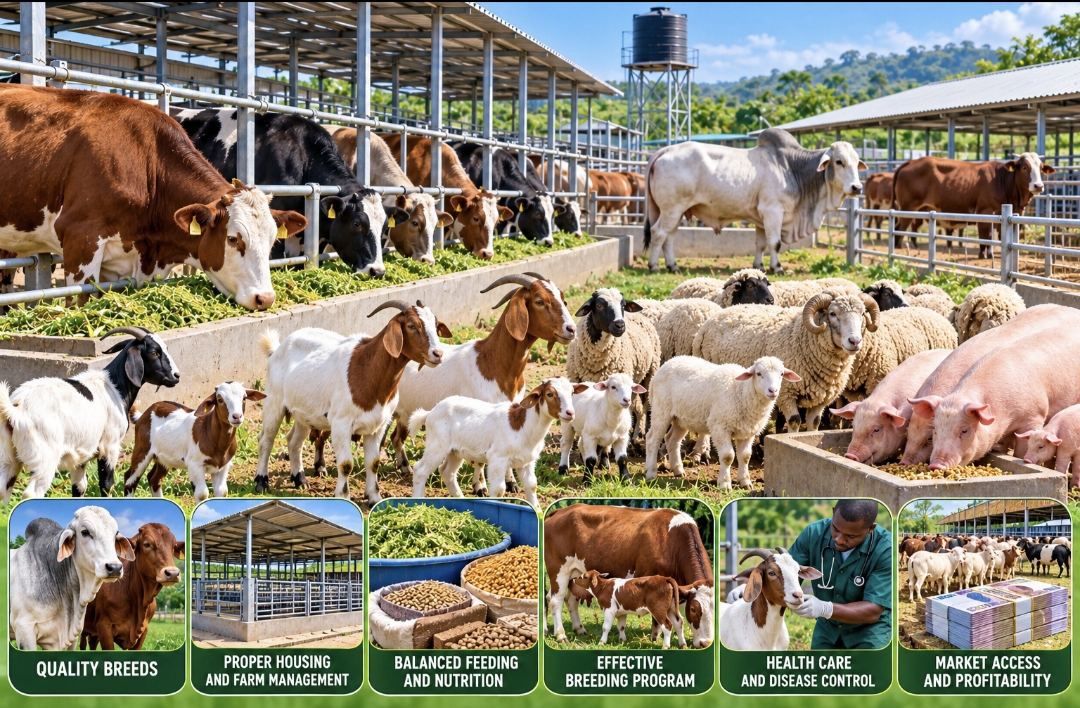
Introduction
Commercial livestock breeding is one of the most important areas of modern animal agriculture. While feeding and housing determine much of an animal's day-to-day performance, genetics and reproductive management determine the productive potential of the herd over many generations.
A well-managed breeding program can help farmers produce healthier animals, improve growth rates, increase milk or meat production, improve fertility, reduce production costs, and build a more valuable livestock enterprise.
Commercial livestock breeding involves selecting suitable males and females, managing mating, providing proper nutrition, maintaining animal health, keeping accurate records, caring for pregnant animals, managing newborn offspring, and continuously selecting better animals for future breeding.
Whether the enterprise involves cattle, goats, sheep, pigs, poultry, or other livestock species, the basic principle remains similar: breed animals with desirable characteristics and manage their environment so those characteristics can be expressed successfully.
This comprehensive guide explains how commercial livestock breeding works, how to select breeding animals, how to manage reproduction, how to reduce genetic problems, and how to build a productive and profitable herd.
What Is Commercial Livestock Breeding?
Commercial livestock breeding is the planned reproduction of animals for the purpose of producing offspring with desirable characteristics that contribute to the goals of a farming business.
Unlike uncontrolled reproduction, commercial breeding is based on specific objectives.
A farmer may want to produce animals that:
- Grow rapidly
- Convert feed efficiently
- Produce more meat
- Produce more milk
- Have high fertility
- Give birth regularly
- Resist certain diseases
- Adapt to local climatic conditions
- Have good body structure
- Produce high-quality offspring
- Survive well under available management conditions
The objective is not simply to produce more animals. The objective is to produce better animals that create greater economic value.
For example, producing 100 low-performing animals may be less profitable than producing 70 healthy animals with superior growth, fertility, survival, and market characteristics.
Why Livestock Breeding Is Important
Genetics influences many characteristics that determine livestock productivity.
Two animals receiving similar feed and management may perform differently because their genetic potential is different.
Selective breeding allows farmers to gradually improve the performance of a herd.
Over several generations, a properly managed breeding program can improve:
- Growth rate
- Mature size
- Fertility
- Mothering ability
- Milk production
- Meat quality
- Feed efficiency
- Disease resistance
- Heat tolerance
- Birth weight
- Weaning weight
- Survival
- Longevity
- Carcass characteristics
Breeding improvement is particularly valuable because genetic gains can remain in the herd and be passed to future generations.
Define Your Breeding Objective
Before purchasing breeding animals, determine exactly what you want your livestock enterprise to produce.
A meat-producing farm may prioritize:
- Rapid growth
- Efficient feed conversion
- Muscular development
- Suitable carcass characteristics
- Good survival
- Strong offspring
A dairy enterprise may prioritize:
- Milk yield
- Lactation persistence
- Udder structure
- Fertility
- Longevity
- Disease resistance
A breeding-stock enterprise may focus on:
- Reproductive performance
- Pedigree
- Genetic quality
- Conformation
- Growth
- Breed characteristics
- Offspring performance
Your breeding objective should match the market you intend to serve.
Choose the Right Livestock Species
Commercial breeding can be carried out with several livestock species.
Common options include:
- Cattle
- Goats
- Sheep
- Pigs
- Chickens
- Rabbits
- Buffalo
- Camels
- Other regionally important livestock
Each species has different reproductive characteristics, gestation periods, housing requirements, nutritional requirements, and market opportunities.
Choose the species based on available land, feed, water, capital, labor, climate, experience, infrastructure, and market demand.
Choosing Suitable Breeds
Breed selection is an important part of commercial breeding.
Different breeds have been developed or selected for different production purposes.
Some breeds are particularly recognized for:
- Meat
- Milk
- Fiber
- Eggs
- Growth
- Reproduction
- Draught ability
- Climate adaptation
However, the most productive breed in one environment may not necessarily be the most suitable in another.
A breed that performs exceptionally well under high-input conditions may require substantial feed, housing, veterinary care, and climate control.
A locally adapted breed may sometimes perform better economically because it can survive and reproduce under the conditions available to the farmer.
Adaptation Is More Important Than Appearance
Farmers sometimes select breeding animals because they look impressive.
Large body size, attractive color, or impressive horns may be visually appealing, but these characteristics do not automatically mean an animal will be a productive breeder.
Consider:
- Fertility
- Health
- Growth
- Structural soundness
- Adaptability
- Temperament
- Reproductive history
- Offspring performance
- Feed requirements
The best breeding animal is one that fits your production system and business objective.
Selecting Female Breeding Stock
Female animals form the foundation of many commercial breeding herds.
When selecting females, examine:
- Age
- Body condition
- Reproductive history
- Udder or mammary structure
- Feet and legs
- General health
- Growth history
- Temperament
- Mothering ability
- Previous offspring
- Fertility
A female that consistently becomes pregnant, gives birth successfully, raises healthy offspring, and returns to breeding efficiently can be extremely valuable.
Selecting Male Breeding Stock
The breeding male deserves particular attention because one male can father a large number of offspring.
A poor-quality male can therefore have a disproportionately negative effect on herd genetics.
When selecting a breeding male, examine:
- Health
- Body structure
- Legs and feet
- Testicular development
- Reproductive soundness
- Growth
- Breed characteristics
- Temperament
- Genetic background
- Previous offspring performance where available
For valuable breeding programs, a professional breeding soundness examination can be worthwhile.
Why the Breeding Male Matters So Much
Consider a herd containing 40 breeding females.
If one male is used for most of the matings, his genetics may influence a large proportion of the next generation.
This means purchasing a cheap but genetically inferior male can create years of problems.
Farmers should therefore view a quality breeding male as a long-term genetic investment rather than simply another livestock purchase.
Understanding Genetic Selection
Genetic selection means choosing animals with desirable inherited characteristics to become parents of the next generation.
Suppose a farmer wants faster-growing cattle.
The farmer could record the weights of young animals and identify those that consistently grow faster under comparable conditions.
Instead of breeding randomly, the farmer gives greater breeding opportunities to animals demonstrating desirable performance.
Repeated selection can gradually shift the genetic characteristics of the herd.
Phenotype and Genotype
Phenotype refers to what you can observe in an animal.
Examples include:
- Body size
- Growth
- Milk production
- Coat characteristics
- Physical structure
Genotype refers to the animal's genetic makeup.
An animal's observed performance is influenced by both genetics and environment.
For example, a genetically strong animal may perform poorly if it receives inadequate nutrition.
Therefore, farmers should avoid selecting breeding animals based only on appearance.
The Importance of Records
Good breeding programs depend heavily on accurate records.
Important information includes:
- Animal identification
- Birth date
- Parents
- Breed
- Birth weight
- Weaning weight
- Growth measurements
- Heat dates
- Mating dates
- Pregnancy results
- Birth dates
- Number of offspring
- Weaning performance
- Health treatments
- Disease history
- Culling decisions
- Sale price
Records allow farmers to identify animals that consistently perform well.
Without records, breeding decisions often become based on memory or appearance.
Animal Identification
Each breeding animal should have a unique identification system.
Depending on the species and farm size, identification may involve:
- Ear tags
- Electronic identification
- Tattoos
- Branding where legally and ethically appropriate
- Leg bands for certain species
- Digital identification systems
The identification method should be durable, easy to read, and connected to farm records.
Natural Mating
Natural mating is one of the simplest breeding systems.
A selected male is introduced to a group of females during the breeding period.
Advantages include:
- Simple management
- Relatively low equipment requirements
- Suitable for small and medium farms
- Lower technical complexity
However, natural mating can make it harder to control exact parentage unless the mating groups are carefully managed.
Controlled Mating
Controlled mating involves deliberately deciding which male mates with which females.
This gives the farmer greater control over genetics.
For example, a farmer could divide females into breeding groups and assign specific males according to the desired characteristics.
Controlled mating is useful for:
- Maintaining pedigrees
- Preventing unwanted mating
- Managing genetics
- Reducing inbreeding
- Testing breeding lines
Artificial Insemination
Artificial insemination involves introducing semen from a selected male into a female using reproductive techniques.
It can provide access to genetics from high-value males without keeping the male physically on the farm.
Potential advantages include:
- Genetic improvement
- Access to superior genetics
- Better control of parentage
- Reduced need to maintain many males
- Faster dissemination of desirable genetics
However, successful artificial insemination requires proper training, timing, semen handling, reproductive monitoring, and appropriate equipment.
Advanced Reproductive Technologies
Larger commercial operations may use advanced reproductive technologies such as:
- Estrus synchronization
- Artificial insemination
- Embryo transfer
- In vitro embryo production
- Genomic selection
These technologies can accelerate genetic progress but may require specialized expertise and significant investment.
Small farmers do not necessarily need advanced technologies to establish a successful breeding program.
Good animal selection, nutrition, health management, records, and reproductive control can produce substantial results.
Understanding the Reproductive Cycle
Successful breeding requires an understanding of the reproductive cycle of the species being farmed.
The farmer needs to recognize:
- When females become sexually mature
- When they enter heat
- How long the reproductive cycle lasts
- When ovulation occurs
- When mating should take place
- Gestation length
- When females can return to breeding after giving birth
These characteristics vary significantly between species and breeds.
Farmers should therefore use species-specific reproductive guidance from veterinarians or qualified livestock professionals.
Detecting Heat
Heat detection is critical for successful breeding.
Signs vary by species but may include:
- Increased activity
- Restlessness
- Mounting behavior
- Standing to be mounted
- Changes in vocalization
- Swollen reproductive tissues
- Mucus discharge
- Changes in feeding or behavior
Accurate heat detection can improve conception rates when natural mating or artificial insemination is used.
Nutrition Before Breeding
Nutrition has a major influence on reproduction.
Animals that are severely underfed may experience:
- Delayed puberty
- Poor fertility
- Weak reproductive performance
- Poor conception rates
- Reduced milk production
- Poor offspring growth
Breeding animals should receive adequate energy, protein, minerals, vitamins, fiber, and clean water according to species, age, body condition, and production stage.
Body Condition and Reproduction
Body condition is an important indicator of nutritional status.
Animals that are excessively thin may have reduced reproductive performance.
Animals that are excessively fat can also experience health and reproductive problems in some production systems.
The goal is an appropriate body condition rather than simply maximizing body weight.
Farmers should use species-specific body-condition scoring systems where available.
Pregnancy Management
Once a female becomes pregnant, management should shift toward protecting her health and supporting fetal development.
Important considerations include:
- Adequate nutrition
- Clean water
- Mineral supplementation where required
- Disease prevention
- Parasite control
- Safe housing
- Reduced unnecessary stress
- Regular observation
Pregnant animals should be handled carefully, particularly during advanced pregnancy.
Managing the Pregnant Female
The nutritional needs of a pregnant animal change as pregnancy progresses.
In many species, fetal growth accelerates toward the later stages of pregnancy.
However, overfeeding can also create problems.
The feeding program should therefore be adjusted according to:
- Species
- Breed
- Pregnancy stage
- Number of fetuses
- Body condition
- Environmental conditions
A veterinarian or livestock nutritionist can help formulate appropriate rations.
Preparing for Birth
Farmers should prepare clean and safe areas for animals approaching birth.
The maternity area should be:
- Clean
- Dry
- Well ventilated
- Protected from extreme weather
- Free from dangerous objects
- Easy to monitor
The goal is to reduce infection, injury, and complications.
Recognizing Difficult Births
Difficult birth, known as dystocia, can threaten both the mother and offspring.
Warning signs include:
- Prolonged labor
- Abnormal presentation
- Excessive straining without progress
- Visible abnormal positioning of the offspring
- Severe distress
Farmers should seek qualified veterinary assistance when normal delivery is not progressing.
Trying to forcefully intervene without proper knowledge can cause serious injury.
Newborn Livestock Care
The first hours and days after birth are extremely important.
Newborn animals require:
- Colostrum
- Warmth
- Clean surroundings
- Adequate feeding
- Proper identification
- Monitoring
- Appropriate preventive health care
Colostrum provides important immune protection and should be provided promptly according to the species' management guidelines.
Managing Colostrum
Colostrum is the first milk produced after birth.
It contains antibodies and nutrients that are essential for newborn survival.
Failure to receive adequate colostrum can increase the risk of illness and death.
Farmers should establish a clear newborn-care protocol and seek veterinary guidance on species-specific colostrum requirements.
Weaning
Weaning is the transition from dependence on the mother's milk to greater reliance on solid feed.
The timing depends on:
- Species
- Production system
- Growth rate
- Feed availability
- Health
- Management objectives
A successful weaning program minimizes unnecessary stress and provides adequate nutrition.
Selecting Replacement Females
Not every female offspring should automatically become a breeding animal.
Select replacement females based on measurable characteristics such as:
- Growth
- Health
- Structure
- Fertility potential
- Maternal background
- Temperament
- Breed objective
- Family performance
Removing inferior replacements helps improve herd quality over time.
Culling Poor Breeding Animals
Culling means removing animals from the breeding program because they no longer meet the farm's requirements.
Reasons for culling may include:
- Repeated reproductive failure
- Poor offspring performance
- Structural defects
- Chronic health problems
- Poor mothering ability
- Poor productivity
- Advanced age
- Undesirable genetic characteristics
Culling is not simply about removing old animals. It is a strategic method of improving herd efficiency.
Avoiding Inbreeding
Inbreeding occurs when closely related animals are repeatedly bred.
High levels of inbreeding can increase the risk of inherited problems and may reduce reproductive and productive performance.
Farmers can reduce unnecessary inbreeding by:
- Keeping accurate pedigrees
- Rotating breeding males
- Purchasing unrelated breeding stock
- Using controlled mating
- Working with breeding specialists
Crossbreeding
Crossbreeding involves mating animals from different breeds.
The objective may be to combine desirable characteristics from multiple genetic lines.
For example, one breed may contribute:
- Growth
while another may contribute:
- Adaptability
- Fertility
- Maternal performance
Crossbreeding can also produce heterosis, sometimes called hybrid vigor, in which crossbred offspring perform better for certain traits than the average of their parent breeds.
The results depend on the breeds and traits involved.
Terminal Crossbreeding
In some commercial systems, crossbreeding is designed primarily to produce market animals rather than future breeding stock.
The offspring may be raised for:
- Meat
- Milk
- Eggs
- Other livestock products
A structured breeding plan is important because indiscriminate crossbreeding can eventually make herd genetics difficult to manage.
Herd Health and Breeding Success
Reproduction cannot be separated from animal health.
Disease can reduce:
- Fertility
- Conception
- Pregnancy survival
- Birth rates
- Growth
- Milk production
- Offspring survival
A commercial breeding farm should therefore have a preventive health program.
This may include:
- Vaccination according to local veterinary recommendations
- Parasite management
- Biosecurity
- Quarantine
- Clean water
- Hygiene
- Regular observation
- Veterinary examination
Quarantine New Animals
Newly purchased animals should not immediately be mixed with the established herd.
A quarantine period allows the farmer to observe the new animals and implement appropriate health screening and preventive measures.
The exact quarantine protocol should be developed with a veterinarian because disease risks differ between regions and livestock species.
Biosecurity on Breeding Farms
Biosecurity reduces the risk of introducing or spreading disease.
Important practices include:
- Controlling visitors
- Cleaning equipment
- Isolating sick animals
- Managing animal movement
- Quarantining new purchases
- Maintaining clean feeding areas
- Preventing contact with high-risk animals
A strong biosecurity program protects both animal health and business investment.
Water Requirements
Clean water is essential for reproductive performance and overall livestock health.
Water requirements vary according to:
- Species
- Body size
- Temperature
- Feed composition
- Pregnancy
- Lactation
- Production level
Water should be clean, accessible, and available in sufficient quantities.
Housing for Breeding Livestock
Breeding animals require safe housing or pasture environments.
Housing should provide:
- Adequate space
- Good ventilation
- Drainage
- Protection from extreme weather
- Clean resting areas
- Safe flooring
- Easy access to feed and water
Overcrowding can increase stress, injuries, disease transmission, and competition for resources.
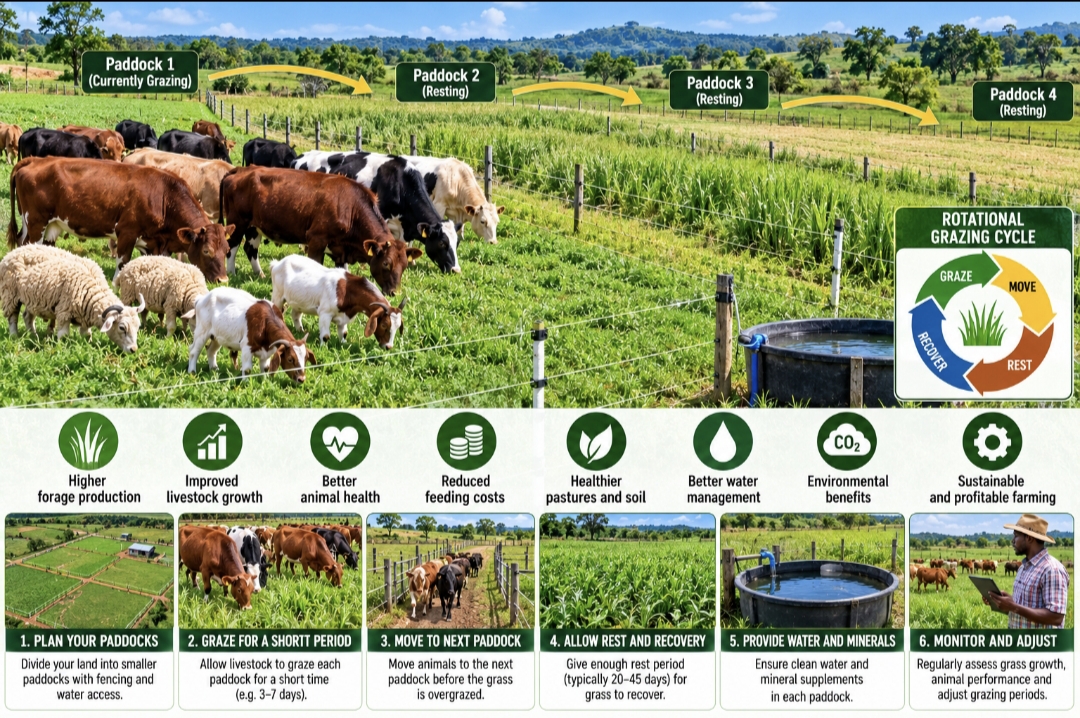
Pasture Management
For grazing livestock, pasture quality has a major effect on breeding performance.
Good pasture management involves:
- Rotational grazing where appropriate
- Maintaining adequate forage
- Preventing severe overgrazing
- Providing mineral supplementation where necessary
- Managing weeds
- Protecting water sources
- Allowing pasture recovery
A productive breeding herd requires a reliable feed base throughout the year.
Supplementary Feeding
Pasture may not always supply all required nutrients.
Supplementary feed can be provided when:
- Forage quality declines
- Animals are pregnant
- Females are lactating
- Young animals are growing
- Weather conditions reduce pasture availability
Supplements should be formulated according to actual nutritional requirements rather than provided randomly.
Record Keeping for Breeding Decisions
Breeding records should allow you to answer questions such as:
- Which females become pregnant quickly?
- Which animals produce healthy offspring?
- Which mothers raise offspring successfully?
- Which males produce fast-growing offspring?
- Which animals repeatedly require treatment?
- Which breeding lines perform best?
These records transform breeding from guesswork into a measurable management system.
Important Reproductive Performance Indicators
Useful breeding indicators include:
- Conception rate
- Pregnancy rate
- Birth rate
- Calving/kidding/lambing rate
- Stillbirth rate
- Offspring survival
- Weaning rate
- Age at first breeding
- Age at first birth
- Birth interval
- Weaning weight
- Growth rate
The exact definitions should be standardized within the farm so performance can be compared accurately over time.
Example of a Simple Breeding Calculation
Suppose a farm has 50 breeding females.
If 44 become pregnant during the breeding period:
Conception rate = 44 ÷ 50 × 100
= 88%
If 42 eventually produce viable offspring:
Birth rate relative to the original breeding group = 42 ÷ 50 × 100
= 84%
These simple calculations can help identify reproductive problems.
Economic Value of Better Breeding
Genetic improvement can increase profitability through several pathways.
Suppose improved breeding produces offspring that reach market weight 20 days earlier.
If the animals consume an average of $2.50 worth of feed per day during that period:
20 × $2.50 = $50 potential feed-cost difference per animal
For 100 animals:
100 × $50 = $5,000
This is only an illustrative calculation. Actual results depend on feed prices, animal performance, market prices, mortality, management costs, and other factors.
Building a Small Commercial Breeding Enterprise
A beginner does not necessarily need hundreds of animals.
A smaller breeding enterprise can begin with:
- Suitable breeding females
- One or more quality males, depending on species and mating system
- Secure housing
- Reliable feed
- Water
- Basic equipment
- Veterinary support
- Record-keeping system
- Market access
The business can then expand using retained high-quality replacements and reinvested profits.
Example Breeding Business Model
Consider an illustrative livestock breeding operation with 30 females.
Assume:
- 30 breeding females
- 27 successful pregnancies
- 25 surviving offspring
- 20 offspring retained or sold as breeding/market animals
- 5 animals removed or managed differently based on the farm's breeding strategy
Suppose the average sale value of suitable offspring is $300.
25 × $300 = $7,500 gross sales value
This is not profit.
The farmer must subtract:
- Feed
- Veterinary expenses
- Labor
- Housing
- Breeding costs
- Transportation
- Mortality losses
- Equipment
- Land costs
- Utilities
- Marketing
- Other operating expenses
The example demonstrates why breeding performance and cost control must be evaluated together.
Calculate Cost Per Successful Offspring
One useful management metric is the cost of producing a successful offspring.
For example, if a farm spends $9,000 on breeding-related operating costs during a production cycle and successfully weans 30 offspring:
$9,000 ÷ 30 = $300 per weaned offspring
If the average market value is significantly above the production cost, the enterprise may have room for profit.
If costs are too close to selling value, the farmer should investigate ways to improve reproductive performance, feed efficiency, survival, and market value.
Market Your Breeding Stock Properly
Breeding animals can command higher prices than ordinary market animals when they demonstrate superior genetics and performance.
A breeding-stock seller should provide useful information such as:
- Age
- Breed
- Parentage
- Health history
- Growth records
- Reproductive records
- Vaccination information
- Performance records
- Identification number
Transparent records can increase buyer confidence.
Selling Breeding Males
Quality breeding males may represent an important source of revenue.
However, never select males solely because they are large.
Buyers may be interested in:
- Fertility
- Genetics
- Growth
- Health
- Structure
- Temperament
- Breed characteristics
- Offspring performance
A well-documented breeding male can be considerably more valuable than an ordinary animal of similar age and size.
Technology in Modern Livestock Breeding
Technology is increasingly changing livestock breeding.
Farmers can use:
- Digital livestock records
- Electronic identification
- Weighing systems
- Mobile farm-management applications
- Automated water systems
- Reproductive monitoring
- Genetic testing
- Digital pedigree management
- Remote cameras
- Data analytics
Technology should be selected based on whether it solves a real farm-management problem.
Genomic Selection
Genomic technologies allow farmers and breeding organizations to evaluate genetic information at a deeper level.
Genomic selection can help estimate genetic potential for certain traits before an animal has completed its entire productive life.
It is especially valuable in structured commercial breeding programs and organized genetic improvement systems.
Artificial Intelligence and Livestock Breeding
Artificial intelligence is increasingly being explored for livestock management.
Potential applications include:
- Detecting unusual animal behavior
- Monitoring activity
- Identifying heat
- Tracking weight changes
- Predicting reproductive events
- Analyzing breeding records
- Identifying health abnormalities
- Supporting herd management decisions
AI should be treated as a decision-support tool rather than a replacement for veterinary expertise or responsible farm management.
Climate and Breeding
Climate conditions can influence livestock reproduction.
Heat stress, inadequate feed, water shortages, and changing pasture conditions may affect fertility and offspring survival.
Farmers can improve resilience by:
- Selecting adapted genetics
- Providing shade
- Ensuring adequate water
- Managing pasture
- Adjusting breeding seasons
- Improving housing ventilation
- Maintaining appropriate body condition
Breeding animals that are suited to the local environment can reduce production challenges.
Animal Welfare in Breeding Operations
Commercial breeding should prioritize animal welfare.
Animals should have:
- Adequate food
- Clean water
- Safe shelter
- Appropriate space
- Proper health care
- Protection from unnecessary pain
- Appropriate handling
- Opportunities to rest
Stress and poor welfare can also reduce reproductive and productive performance.
Environmental Sustainability
A sustainable breeding enterprise aims to produce more value without unnecessarily increasing resource consumption.
Farmers can improve sustainability by:
- Improving feed efficiency
- Preventing overgrazing
- Recycling manure
- Protecting soil
- Managing water efficiently
- Reducing unnecessary animal losses
- Selecting productive and adapted animals
- Using appropriate stocking rates
Better genetics can contribute to sustainability when animals produce more output from available resources.
Common Mistakes in Commercial Livestock Breeding
Several mistakes can reduce the performance of a breeding enterprise.
One common mistake is breeding animals without a clear objective.
Another is selecting animals based only on appearance.
Other problems include:
- Poor record keeping
- Ignoring fertility
- Using unhealthy breeding males
- Inbreeding
- Poor nutrition
- Overcrowding
- Neglecting disease prevention
- Introducing animals without quarantine
- Keeping poor-performing animals for too long
- Breeding females before they are sufficiently developed
- Failing to monitor pregnancy
- Poor newborn care
- Ignoring market demand
How to Start a Commercial Livestock Breeding Business
A practical startup process can follow these steps.
Step 1: Choose the species
Select cattle, goats, sheep, pigs, poultry, or another livestock species according to your resources and market.
Step 2: Define your objective
Decide whether you are producing meat animals, milk animals, breeding stock, or another product.
Step 3: Research suitable genetics
Identify breeds and genetic lines that fit your environment and production system.
Step 4: Prepare infrastructure
Provide housing, fencing, water systems, feed storage, handling facilities, and appropriate equipment.
Step 5: Purchase quality breeding animals
Buy healthy animals from reputable sources whenever possible.
Step 6: Quarantine new animals
Keep new livestock separate and follow appropriate health-screening procedures.
Step 7: Establish a feeding program
Ensure breeding animals receive appropriate nutrition throughout the production cycle.
Step 8: Create a breeding calendar
Track mating, pregnancy, expected births, weaning, and future breeding.
Step 9: Keep detailed records
Record every important event involving your breeding animals.
Step 10: Monitor reproductive performance
Calculate conception, birth, survival, and weaning rates.
Step 11: Select replacements
Keep the best-performing young animals for future breeding where appropriate.
Step 12: Cull strategically
Remove animals that consistently fail to meet the breeding objective.
Step 13: Market offspring
Sell animals according to your target market and production strategy.
Step 14: Reinvest
Use part of the returns to improve genetics, feed, infrastructure, health management, and technology.
How to Improve Herd Genetics Over Time
Genetic improvement is a long-term process.
A farmer should consistently:
- Define desired traits.
- Measure performance.
- Identify superior animals.
- Breed superior animals.
- Remove inferior animals from the breeding program.
- Avoid excessive inbreeding.
- Maintain accurate records.
- Evaluate offspring performance.
- Adjust selection criteria when necessary.
The greatest results generally come from consistent selection over multiple generations rather than attempting to transform a herd in one breeding cycle.
Commercial Breeding vs Livestock Fattening
Breeding and fattening are different businesses.
Breeding focuses on producing offspring and improving genetics.
Fattening focuses on increasing the body weight and market value of existing animals.
A breeding farm may sell:
- Young breeding animals
- Replacement females
- Breeding males
- Weaned offspring
A fattening operation generally purchases animals and feeds them until they reach a target market condition.
Some businesses combine both systems.
Integrating Breeding With Fattening
An integrated livestock enterprise can produce its own young animals and then raise selected offspring for meat.
This can provide greater control over:
- Genetics
- Health
- Feeding
- Growth
- Market timing
However, the business also becomes more management-intensive.
Farmers should compare the additional costs with the potential benefits before integrating both systems.
Breeding for Profit Rather Than Just Production
High production does not automatically equal high profit.
An animal that produces a large amount of output but requires extremely expensive inputs may not be economically superior.
Commercial breeding should therefore consider profitability traits, including:
- Fertility
- Survival
- Feed efficiency
- Disease resistance
- Growth
- Longevity
- Product quality
- Adaptability
The most useful animal is one that produces valuable output efficiently under the farm's actual conditions.
How Long Does Genetic Improvement Take?
Genetic improvement is gradual.
Some traits can respond relatively quickly to selection, while others require many generations.
Reproductive traits can be more difficult to improve because they are influenced strongly by environmental and management factors.
This is why farmers should avoid expecting dramatic genetic changes after one breeding season.
The Importance of Professional Advice
Commercial breeding involves biological and financial risks.
Working with qualified professionals can improve decision-making.
Useful advisers may include:
- Veterinarians
- Animal scientists
- Livestock nutritionists
- Genetic specialists
- Agricultural extension officers
- Experienced breeding organizations
Professional advice becomes particularly important when using artificial insemination, embryo technologies, genetic testing, or when reproductive problems occur.
Frequently Asked Questions About Commercial Livestock Breeding
What is the main goal of commercial livestock breeding?
The main goal is to produce healthy, productive offspring with desirable inherited characteristics while improving the economic performance of the livestock enterprise.
Which livestock is best for commercial breeding?
There is no single species that is universally best. Cattle, goats, sheep, pigs, poultry, and other livestock can all support commercial breeding businesses. The appropriate choice depends on resources, climate, management ability, and market demand.
Is breeding livestock profitable?
Breeding can be profitable when reproductive performance, animal health, genetics, feed costs, mortality, and marketing are managed effectively. Profitability varies considerably between farms.
How many animals do I need to start?
There is no universal minimum. A small breeding enterprise can begin with a manageable number of quality females and appropriate breeding arrangements and expand gradually.
Is the breeding male important?
Yes. A breeding male can influence a large number of offspring, making male selection extremely important.
Should I choose the biggest animal for breeding?
Not necessarily. Size should be considered alongside fertility, health, structure, growth, adaptability, temperament, and other traits relevant to your breeding objective.
What is selective breeding?
Selective breeding is the deliberate selection of animals with desirable characteristics as parents of future generations.
What is crossbreeding?
Crossbreeding involves mating animals from different breeds to combine desirable characteristics and, in some cases, benefit from hybrid vigor.
How can I prevent inbreeding?
Maintain accurate pedigree records, avoid repeated mating between close relatives, and introduce unrelated genetics when appropriate.
Why is record keeping important?
Records allow farmers to compare animals objectively and identify the animals that contribute the most desirable traits to future generations.
What should breeding animals eat?
They require balanced nutrition appropriate for their species, age, body condition, reproductive stage, and production objective. The diet should supply adequate energy, protein, minerals, vitamins, fiber, and water.
When should young animals be bred?
Breeding should be based on species, breed, body development, health, and appropriate reproductive maturity rather than age alone. Local veterinary or livestock guidance should be followed.
What causes poor fertility in livestock?
Possible causes include inadequate nutrition, disease, poor body condition, heat stress, reproductive disorders, poor breeding management, genetic factors, and unsuitable breeding timing.
Can artificial insemination improve a breeding business?
Artificial insemination can provide access to selected genetics and improve control over breeding, but it requires appropriate technical skills, timing, equipment, and reproductive management.
How do I know which animals to keep for breeding?
Use objective records covering health, growth, fertility, structure, parentage, reproductive performance, and other traits that match your breeding goals.
Final Thoughts
Commercial livestock breeding is a long-term agricultural business built around genetics, reproduction, animal health, nutrition, records, and disciplined selection.
The foundation of a successful breeding operation is not simply owning many animals. It is building a herd in which each generation has the potential to perform better than the previous one.
Farmers should begin with clear breeLatest ding objectives, select suitable and adapted genetics, pay close attention to breeding males and females, maintain excellent nutrition and health programs, monitor reproductive performance, and keep accurate records.
The combination of good genetics and good management is what creates productive livestock.
Whether you are starting with a small group of goats, sheep, cattle, pigs, poultry, or another livestock species, the same principle applies: measure performance, select carefully, manage responsibly, and improve continuously.
A successful commercial breeding business is built one generation at a time.
Latest posts;
- Beans Farming: A Complete Guide to Different Types of Beans, Their Uses, Nutrition, and Farming
- Cassava Farming in Africa: A Complete Guide to Planting, Growing, Harvesting and Making Profit from Cassava
- CATFISH FARMING(HYBRID): THE COMPLETE STEP-BY-STEP GUIDE FOR BEGINNERS AND COMMERCIAL FARMERS (2026 EDITION)
- Cattle Fattening Business: Complete Guide to Raising Beef Cattle for Profit
- COCOA FARMING IN AFRICA: A Complete Professional Guide (Part 1)

- COCOA FARMING IN AFRICA: A Complete Professional Guide (Part 2)
- Commercial Carrot Farming: A Complete Guide to Growing Carrots for Profit
- Commercial Cashew Farming: A Complete Guide to Growing Cashew for Profit
- Commercial Cattle Farming: Complete Guide to Raising Cattle for Profit