INTRODUCTION
Maize (Zea mays), commonly known as corn, is one of the most important cereal crops in Nigeria and across the world. It serves as a staple food for millions of people, a major ingredient in livestock feed, and a valuable raw material for industries producing flour, starch, beverages, cooking oil, ethanol, and many other products.
Nigeria is among Africa's leading maize-producing countries due to its favorable climate and large agricultural workforce. With the growing demand for food, poultry feed, and industrial raw materials, maize farming remains one of the most profitable agricultural enterprises for both smallholder and commercial farmers.
When managed properly using improved seeds, good agronomic practices, and effective pest control, maize farming can produce high yields and generate substantial income.
This guide explains every stage of maize production in Nigeria, from selecting land to planting, providing practical knowledge that both beginners and experienced farmers can apply.
IMPORTANCE OF MAIZE FARMING
Maize contributes significantly to Nigeria's economy and food security.
Some of its major benefits include:
- Provides food for millions of Nigerians.
- Generates income for farmers.
- Supplies raw materials for industries.
- Supports the poultry, fish, and livestock sectors.
- Creates employment opportunities throughout the agricultural value chain.
- Improves household food security.
- Offers excellent market demand throughout the year.
Because maize matures relatively quickly—typically within 90 to 120 days depending on the variety—it allows farmers to earn income faster than many perennial crops.
NUTRITIONAL VALUE OF MAIZE
Maize is rich in nutrients that support human health.
It contains:
- Carbohydrates for energy
- Protein
- Dietary fibre
- Vitamin A (yellow varieties)
- Vitamin B complex
- Vitamin C
- Magnesium
- Potassium
- Iron
- Phosphorus
- Zinc
Maize can be processed into:
- Pap (ogi)
- Corn flour
- Cornmeal
- Popcorn
- Roasted corn
- Boiled corn
- Corn starch
- Corn oil
- Animal feed
CLIMATE REQUIREMENTS FOR MAIZE FARMING
Maize performs best in warm tropical and subtropical climates.
Temperature
The ideal temperature ranges between 20°C and 30°C.
Temperatures below 15°C slow growth, while prolonged temperatures above 35°C can reduce grain formation.
Rainfall
Maize requires approximately 500–1,200 mm of well-distributed rainfall during the growing season.
In southern Nigeria, rainfall is generally adequate for rain-fed production.
In northern Nigeria, supplementary irrigation may be necessary during dry periods.
Sunlight
Maize requires full sunlight throughout the growing season.
Avoid planting in shaded areas because insufficient sunlight reduces photosynthesis and lowers yield.
SOIL REQUIREMENTS
The success of maize farming begins with proper soil selection.
The ideal soil should be:
- Deep
- Fertile
- Well-drained
- Rich in organic matter
- Loamy or sandy loam
- Slightly acidic to neutral (pH 5.5–7.0)
Avoid:
- Waterlogged soils
- Heavy clay soils with poor drainage
- Rocky land
- Highly acidic soils without correction
Conducting a soil test before planting helps determine nutrient levels and fertilizer requirements.
LAND SELECTION
Choosing the right farmland is one of the most important decisions in maize production.
Select land that:
- Receives full sunlight.
- Has access to roads for transportation.
- Is free from flooding.
- Has fertile soil.
- Has adequate drainage.
- Has a reliable water source if irrigation is planned.
- Has minimal weed pressure.
Commercial farmers should also consider proximity to grain buyers, feed mills, and storage facilities to reduce transportation costs.
LAND PREPARATION
Proper land preparation promotes healthy root development and uniform crop establishment.
Step 1: Clear the Land
Remove bushes, shrubs, tree stumps, and previous crop residues where necessary.
Useful crop residues may be incorporated into the soil to improve organic matter.
Step 2: Ploughing
Ploughing loosens compacted soil and improves aeration.
It also enhances water infiltration and root penetration.
Step 3: Harrowing
Harrowing breaks large soil clods into a fine seedbed suitable for planting.
Step 4: Ridging (Optional)
Ridging is particularly useful in areas with poor drainage or heavy rainfall.
Flat planting is also common and suitable in many regions.
BEST TIME TO PLANT MAIZE IN NIGERIA
Planting time depends on rainfall patterns.
Southern Nigeria
- First season: March–April
- Second season: August–September
Northern Nigeria
- May–July
Timely planting ensures that flowering coincides with adequate soil moisture, resulting in higher grain yield.
CHOOSING THE RIGHT MAIZE VARIETY
Selecting improved seed varieties greatly influences productivity.
Important characteristics include:
- High yield potential
- Early maturity
- Drought tolerance
- Disease resistance
- Pest resistance
- Good grain quality
- Adaptation to local conditions
Farmers should purchase certified seeds from reputable seed companies rather than planting grain saved from previous harvests.
TYPES OF MAIZE
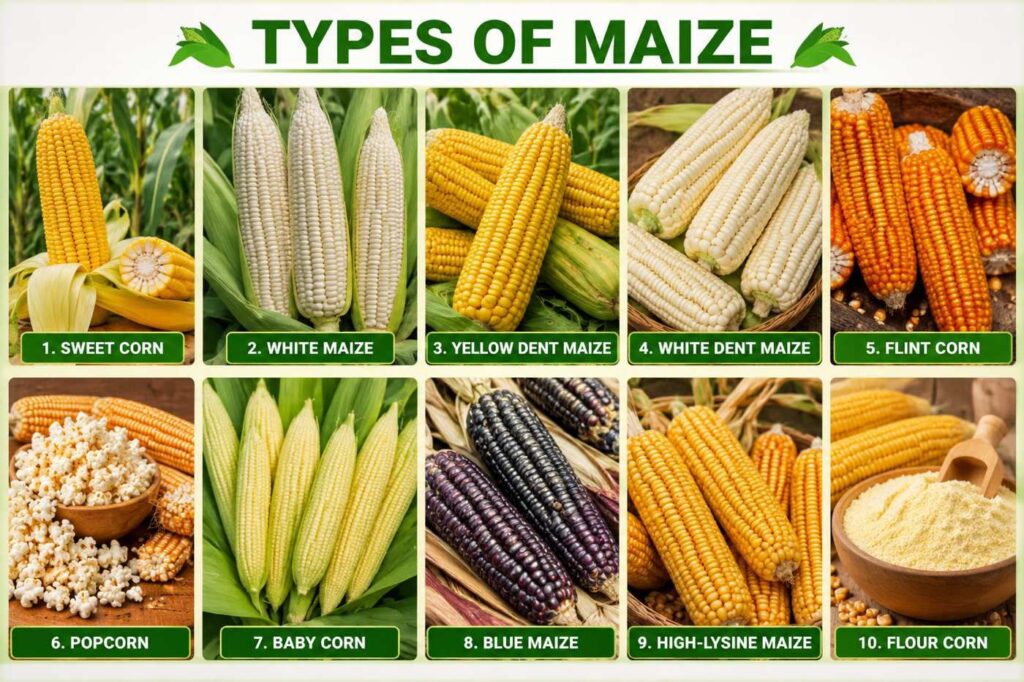
Several maize types are grown in Nigeria.
White Maize
The most common variety used for food and livestock feed.
Yellow Maize
Rich in vitamin A and widely preferred by poultry feed manufacturers.
Sweet Corn
Contains more sugar and is consumed fresh.
Popcorn
Specially grown for popping.
Quality Protein Maize (QPM)
Contains higher-quality protein and improved nutritional value.
SELECTING HIGH-QUALITY SEEDS
Good seed quality determines crop establishment.
Choose seeds that are:
- Certified
- Clean
- Uniform
- Disease-free
- Insect-free
- High germination rate (above 90%)
Never use mouldy or damaged seeds.
SEED TREATMENT
Before planting, treat seeds with recommended fungicides or insecticides where appropriate to protect young seedlings from soil-borne diseases and insect attack.
Always follow label instructions and safety guidelines.
PLANTING METHODS
Maize may be planted:
- By hand
- Using jab planters
- Using mechanical planters on large farms
Mechanical planting ensures uniform spacing and reduces labour costs.
PLANTING SPACE
Recommended spacing for grain production:
- 75 cm between rows
- 25 cm between plants
Place one or two seeds per hole at a depth of 3–5 cm.
Correct spacing ensures adequate sunlight, air circulation, and nutrient availability while reducing competition between plants.
SEED RATE
Depending on spacing and variety, farmers generally require 20–30 kg of seed per hectare.
Always follow the recommendation provided by the seed supplier.
GERMINATION AND EARLY CROP ESTABLISHMENT
Healthy seeds usually germinate within 4–7 days after planting under favourable moisture and temperature conditions.
Inspect the field after emergence and replace missing plants promptly to maintain the desired plant population.
Uniform crop establishment is essential for achieving high yields at harvest.
CONCLUSION OF PART 1
Successful maize farming starts long before harvest. Careful selection of fertile land, the use of certified improved seed, proper land preparation, and timely planting provide the foundation for healthy crop growth and high productivity. Farmers who pay attention to these early stages are better positioned to achieve excellent yields and maximise profits.
In Part 2, we will cover fertilizer application, irrigation, weed management, pest and disease control, crop nutrition, and other essential crop management practices that determine the success of a maize farm.
Read more;
- Charcoal Business in Nigeria: A Complete Guide to Starting, Producing, Buying, Selling and Exporting Charcoal

- Poultry Meat Benefits to Humanity: Complete Guide to Its Nutritional, Economic and Social Importance

- Tilapia Farming: Complete Guide to Raising Tilapia for Commercial Production

- Fish Pond Construction: Complete Guide to Designing and Building a Modern Fish Pond

- Grazing Livestock Farming Business: Complete Guide to Starting and Making Profit

- Commercial Cattle Farming: Complete Guide to Raising Cattle for Profit

- Goat Farming Business: Complete Guide to Meat and Breeding Production

- Sheep Farming: Complete Guide to Raising Sheep for Commercial Profit

- Modern Pasture Farming: How to Grow High-Quality Livestock Feed