Introduction
Pepper is one of the most important vegetable and spice crops consumed across Africa. It is deeply integrated into African food culture, traditional cuisine, commercial agriculture and food processing. From the fresh pepper used to prepare soups and stews to dried pepper used as a spice, peppers provide flavour, aroma, colour and varying levels of heat to countless African dishes.
Across the continent, peppers are grown by smallholder farmers, commercial producers and home gardeners. They are cultivated in countries such as Nigeria, Ghana, Cameroon, Côte d'Ivoire, Benin, Togo, Senegal, Kenya, Uganda, Tanzania, Ethiopia, Zambia, Zimbabwe and South Africa. The crop is particularly important in West Africa, where fresh and dried peppers are used extensively in traditional meals.
The word "pepper" can refer to several different plants and varieties. In African agriculture, the most commonly cultivated hot peppers belong primarily to the Capsicum genus. However, different varieties have developed distinct shapes, colours, levels of heat, aromas and culinary uses.
Some peppers are extremely hot, while others have mild or moderate heat. Some are mainly used fresh, others are preferred for drying and grinding, while certain varieties are especially valuable for sauces, pepper pastes, pickles and industrial food production.
Understanding the different types of pepper is important for farmers because the choice of variety can influence yield, market demand, production cost, harvesting period, disease tolerance, processing opportunities and profitability.
This article examines the major types of pepper widely known and used in Africa, their characteristics, culinary applications, farming requirements, nutritional value, commercial potential and factors farmers should consider when choosing a pepper variety.
Understanding Pepper and Its Classification
Most cultivated peppers belong to the genus Capsicum, which is part of the nightshade family, Solanaceae. The genus contains several species and numerous cultivated varieties.
The major cultivated Capsicum species include Capsicum annuum, Capsicum frutescens, Capsicum chinense, Capsicum baccatum and Capsicum pubescens. However, not every species is equally common in African agriculture.
The appearance and heat of a pepper do not always tell you exactly which species it belongs to. Many varieties have been selected and developed over generations, resulting in different shapes, colours, sizes and levels of pungency.
The heat in hot peppers is primarily associated with compounds called capsaicinoids, especially capsaicin. The concentration of these compounds varies considerably between varieties and can also be influenced by growing conditions.
For African farmers, it is therefore more useful to understand peppers according to the varieties and market types commonly encountered than to focus only on botanical classification.
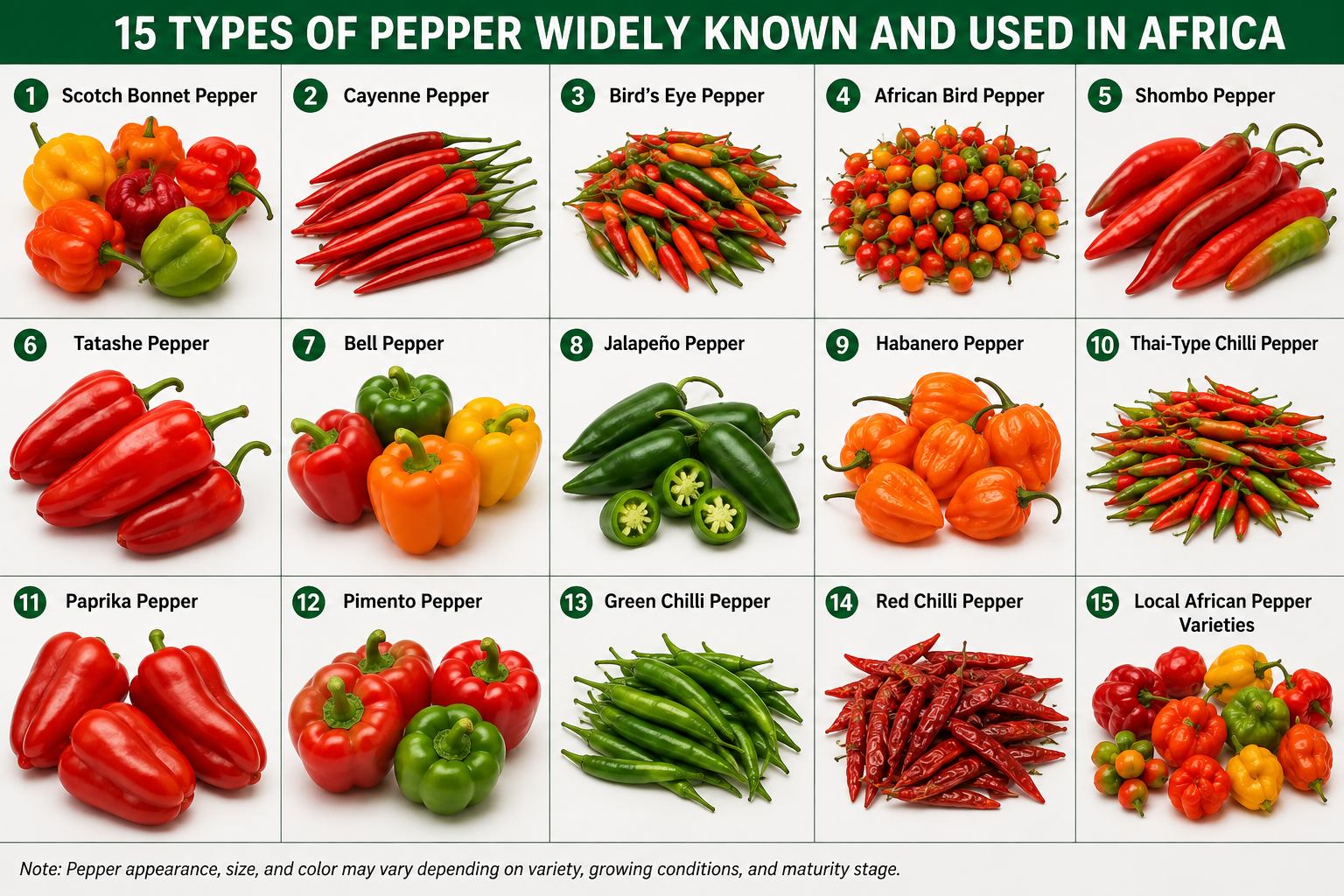
1. Scotch Bonnet Pepper
Scotch bonnet is one of the best-known hot pepper types in Africa and is particularly popular in West African cooking. It is commonly used in countries such as Nigeria, Ghana, Sierra Leone, Liberia and Cameroon.
The fruits are usually short, broad and somewhat irregular in shape. Depending on the variety, they may mature to yellow, orange, red or other colours.
Scotch bonnet is valued for its combination of strong heat and distinctive fruity aroma. Unlike some peppers that provide mainly heat, Scotch bonnet can contribute a characteristic flavour to sauces, soups and stews.
In Nigeria, Scotch bonnet-type peppers are commonly used in fresh pepper sauces and a wide range of traditional dishes.
The plant generally performs well under warm conditions when supplied with adequate sunlight, moisture and nutrients. Farmers growing Scotch bonnet commercially should pay attention to drainage because excessive water around the roots can encourage disease.
Scotch bonnet has strong market potential because it can be sold fresh, processed into pepper paste, dried or incorporated into sauces.
2. Cayenne Pepper
Cayenne pepper is another important pepper type used in Africa. It is commonly associated with long, narrow fruits that can mature from green to red.
Cayenne peppers are valued both as fresh vegetables and as spices. When dried and ground, they produce a red pepper powder that can be used to season food.
The variety is particularly attractive to farmers interested in processing because dried cayenne can be stored for considerably longer than fresh peppers when properly dried and packaged.
Cayenne peppers are often used in sauces, soups, stews, meat preparations, marinades and spice blends.
Commercial farmers can also explore markets for dried cayenne powder, whole dried peppers and processed pepper products.
3. Bird's Eye Pepper
Bird's eye pepper is a small but extremely hot pepper. It is widely known in different parts of Africa and is especially popular in East and Southern African cuisine.
The fruits are generally small, narrow and pointed. They can be green when immature and turn red or orange as they mature.
Despite their small size, bird's eye peppers can contain significant levels of pungency. They are therefore often used in small quantities.
Bird's eye pepper is commonly used to prepare hot sauces, spicy relishes and traditional dishes. It is also suitable for drying and grinding.
Because of its high heat level, bird's eye pepper can attract buyers who specifically seek very hot varieties.
4. African Bird Pepper
African bird pepper is a common name associated with small, highly pungent peppers found in several African regions. The name may refer to different local populations and closely related pepper types.
These peppers are usually small and produce substantial heat relative to their size.
They are used fresh, dried or ground. In traditional cooking, they can be added to soups, stews, sauces and meat dishes.
African bird peppers can also be valuable to processors producing chilli powder and hot pepper sauces.
Farmers should identify the exact variety they are planting because names used in local markets can differ from one region to another.
5. Shombo Pepper
Shombo is a popular pepper type in Nigeria and parts of West Africa. It is usually characterized by elongated fruits and is commonly used in Nigerian cooking.
The fruits may be harvested while green or allowed to mature to red. It is widely used in pepper sauces, stews and soups.
Shombo is particularly popular among consumers who want a strong pepper flavour without necessarily relying exclusively on the very small, extremely hot varieties.
The pepper is also suitable for drying and processing.
For farmers, shombo can be an attractive commercial crop because fresh peppers have regular demand in urban markets, restaurants and households.
6. Tatashe Pepper
Tatashe is one of the most recognizable pepper types in Nigerian cuisine. Compared with extremely hot peppers, tatashe is generally milder, although the actual heat can vary among varieties.
The fruits are usually relatively large, elongated or bell-like, with thick flesh. Mature fruits are commonly red.
Tatashe is particularly valued for its colour and flavour. It is often used in Nigerian stew and sauce preparation because it can provide a rich red colour without introducing as much heat as very hot peppers.
This makes it especially important for families and food businesses that want colourful pepper-based dishes without excessive pungency.
Tatashe can also be used in commercial food processing, including pepper paste and sauces.
7. Bell Pepper
Bell pepper is one of the mildest and most widely recognized members of the pepper family. Unlike most hot peppers, bell peppers generally contain very little capsaicin and therefore have little or no noticeable heat.
They are commonly available in green, red, yellow and orange forms.
Bell peppers are increasingly popular in African urban markets because they are used in fried rice, jollof rice, salads, pizza, sandwiches, stir-fries, sauces and other modern dishes.
Commercial farmers can obtain good market opportunities by supplying supermarkets, hotels, restaurants and food processors.
Bell peppers generally require good soil fertility, adequate irrigation and careful pest and disease management. Their production can be more demanding than some traditional pepper varieties, especially where temperatures, humidity or water management are unsuitable.
8. Jalapeño Pepper
Jalapeño is a popular chilli pepper that originated in Mexico but is now cultivated and consumed in many parts of the world, including Africa.
The fruits are medium-sized and generally cylindrical. They are often harvested green but can be allowed to mature to red.
Jalapeño has moderate heat compared with many African hot pepper varieties. It is used fresh, pickled, smoked, dried or processed into sauces.
Demand for jalapeño may be particularly strong around restaurants, hotels, supermarkets and consumers interested in international cuisines.
African farmers close to large urban markets may find niche opportunities in producing jalapeño for specialized buyers.
9. Habanero Pepper
Habanero is a very hot pepper variety known internationally for its intense heat and fruity flavour. It is cultivated in different African countries and can be particularly attractive to the hot-sauce market.
Habanero fruits are relatively small and often have a distinctive lantern-like shape. They can mature into orange, red, yellow or other colours depending on the cultivar.
The variety is used in hot sauces, marinades, pepper pastes and spicy food products.
Habanero can provide commercial opportunities because consumers and food processors seeking very hot peppers may be willing to pay for quality fruit.
Farmers should, however, avoid assuming that all habanero varieties perform identically. Seed source and cultivar selection can significantly affect yield, fruit size, maturity and heat.
10. Thai-Type Chilli Pepper
Thai-type chilli peppers are small, narrow and generally very hot. Although associated with Southeast Asian cuisine, they are also cultivated and used in some African markets.
They can be used fresh or dried and are suitable for sauces, curries, marinades and spicy dishes.
Their small fruit size can make harvesting labour-intensive, but their high pungency can create a market for specialized buyers.
Farmers should consider the availability of reliable markets before dedicating large areas to niche pepper varieties.
11. Paprika Pepper
Paprika peppers are generally selected for their colour and relatively low heat rather than extreme pungency.
They are particularly valuable to the food-processing industry because dried paprika can be ground into a colourful spice powder.
Paprika can be used in meat products, soups, sauces, seasoning blends and processed foods.
For African farmers, paprika can represent an opportunity to move beyond the fresh vegetable market into dried spice production.
Successful paprika production requires appropriate varieties, good harvesting practices and effective drying methods to preserve colour and quality.
12. Pimento Pepper
Pimento peppers are generally mild peppers with thick flesh and attractive colour. They may be used fresh, processed or preserved.
They are suitable for food products where mild flavour and colour are preferred.
Depending on the cultivar, pimento peppers can be red or other colours at maturity.
Although pimento is not as dominant in traditional African markets as some local hot pepper varieties, it can have commercial potential where there is demand from supermarkets, restaurants and food processors.
13. Green Chilli Pepper
Green chilli is not necessarily a single botanical variety. It is a general market category describing peppers harvested while green and immature.
Many chilli varieties can be sold as green chilli.
Green chilli is widely used across Africa in soups, stews, sauces, vegetable dishes and meat preparations.
It is popular because it provides fresh flavour and heat. It is also commonly incorporated into blended pepper mixtures.
Farmers can benefit from the fact that green peppers may be harvested before full maturity, allowing them to reach markets earlier.
However, harvesting immature fruits can affect the plant's continued production depending on variety and management.
14. Red Chilli Pepper
Red chilli is another broad market category rather than one specific variety. It generally refers to mature chilli fruits that have developed a red colour.
Red chilli is important in African cooking because it can be used fresh or dried.
Dried red chilli has significant commercial importance because it is easier to transport and store than fresh pepper.
It can be ground into powder, incorporated into seasoning blends or processed into sauces.
Farmers interested in red chilli production should pay particular attention to harvesting maturity and drying quality.
15. Local African Pepper Varieties
Africa has numerous locally adapted pepper varieties that may not always have internationally standardized names.
These varieties have been maintained by farmers over generations and may be particularly adapted to local environments.
Local varieties can have important advantages, including adaptation to local climate, consumer preferences and traditional cooking methods.
Some may have distinctive flavour, aroma, colour or heat characteristics.
However, local varieties can also show considerable variation in fruit size, yield and maturity.
Farmers interested in commercial production should therefore evaluate seed quality and select reliable planting material.
Pepper Production in Africa
Pepper can be grown in many parts of Africa because the crop generally prefers warm conditions. However, the exact environmental requirements depend on the variety.
Most pepper varieties perform best in fertile, well-drained soil with adequate moisture.
Pepper does not perform well when its roots remain continuously waterlogged. Poor drainage can increase the risk of root diseases and reduce plant growth.
Good land preparation is therefore important.
Farmers can grow peppers directly in the field or raise seedlings in a nursery before transplanting.
Nursery Management
For many commercial pepper varieties, starting plants in a nursery can provide better control during the early stages of growth.
Seeds should be planted in a clean growing medium. The nursery should receive sufficient sunlight while protecting young seedlings from excessive rainfall, pests and other environmental stresses.
Seedlings should be monitored carefully for damping-off and other diseases.
Transplanting is normally carried out when seedlings are sufficiently strong and have developed several healthy leaves.
Hardening seedlings before transplanting can help reduce transplant shock.
Soil Requirements
Pepper grows best in fertile soil with good drainage and adequate organic matter.
Before planting commercially, farmers should consider soil testing where available.
Important soil characteristics include pH, nutrient availability, organic matter and drainage.
Adding well-decomposed organic manure can improve soil structure and nutrient availability.
Excessive application of fertilizer should be avoided because nutrient imbalance can cause problems.
Nitrogen supports vegetative growth, but excessive nitrogen can produce excessive foliage at the expense of fruit production.
Potassium is also important for plant development and fruit quality.
Water Management
Pepper requires consistent moisture, especially during flowering and fruit development.
Water stress can cause poor fruit development, flower drop and reduced yield.
At the same time, excessive irrigation can create favourable conditions for root diseases.
Drip irrigation can be highly useful for commercial farmers because it delivers water close to the root zone while reducing unnecessary wetting of leaves.
Where irrigation is unavailable, farmers should plan planting according to rainfall patterns and maintain soil moisture using suitable mulching practices.
Fertilizer Management
Pepper production requires nutrients throughout the growing season.
A balanced fertilizer program should ideally be based on soil analysis.
Organic manure can be incorporated before planting, while additional fertilizer may be applied during crop development.
Farmers should avoid using fertilizer simply because they believe more fertilizer automatically means more yield.
Excess fertilizer can increase production costs and sometimes cause poor plant performance.
A good fertility program should balance nitrogen, phosphorus, potassium and micronutrients according to crop needs.
Weed Management
Weeds compete with pepper plants for water, nutrients, sunlight and space.
Early weed control is particularly important because young pepper plants can be easily suppressed by aggressive weeds.
Farmers can use hand weeding, hoeing, mulching or appropriate herbicide programs where permitted and properly managed.
Mulching can provide additional benefits by reducing soil moisture loss and moderating soil temperature.
Common Pepper Pests
Pepper can be attacked by several insect pests.
Common problems may include aphids, whiteflies, thrips, mites, fruit flies and caterpillars.
These pests can damage leaves, flowers and fruits.
Some insects can also transmit plant diseases.
Farmers should regularly inspect their fields rather than waiting until severe damage becomes visible.
Integrated pest management is preferable to relying entirely on chemical pesticides.
Integrated management can involve sanitation, resistant varieties where available, biological control, crop rotation, monitoring and careful pesticide use.
Diseases Affecting Pepper
Pepper diseases can significantly reduce production.
Common disease problems may include damping-off, bacterial diseases, fungal diseases, viral diseases and root-related problems.
Disease management starts with healthy planting materials and proper field sanitation.
Farmers should avoid planting peppers continuously on the same land where serious soil-borne diseases have occurred.
Crop rotation can help reduce the buildup of certain pathogens.
Good drainage and appropriate spacing can also reduce conditions that favour some diseases.
Harvesting Pepper
The correct harvesting stage depends on the intended market.
Green peppers are harvested before full maturity, while red, yellow or orange peppers are generally harvested after reaching their mature colour.
Fresh-market peppers should be harvested carefully to avoid bruising.
Damaged fruits can deteriorate rapidly and reduce the quality of an entire batch.
Farmers should use clean containers during harvesting and avoid throwing fruits into containers from a height.
Regular harvesting can encourage continued production in some varieties.
Post-Harvest Handling
Post-harvest management is extremely important because fresh peppers are perishable.
After harvesting, peppers should be protected from excessive heat and direct sunlight.
Sorting should remove rotten, severely damaged or diseased fruits.
Peppers intended for fresh markets should be handled gently and transported as quickly as practical.
Proper packaging can reduce physical damage.
Where cold storage facilities are available, they can help extend shelf life.
Drying Pepper
Drying is one of the most important methods of preserving pepper in Africa.
Farmers can dry peppers using traditional sun-drying methods or improved dryers.
Traditional drying can be inexpensive but may expose the product to dust, insects, animals, moisture and contamination.
Improved solar dryers or mechanical dryers can provide better control.
The objective is to reduce moisture sufficiently to prevent microbial growth while maintaining desirable colour, aroma and flavour.
Properly dried peppers should be stored in clean, dry and well-sealed packaging.
Pepper Processing and Value Addition
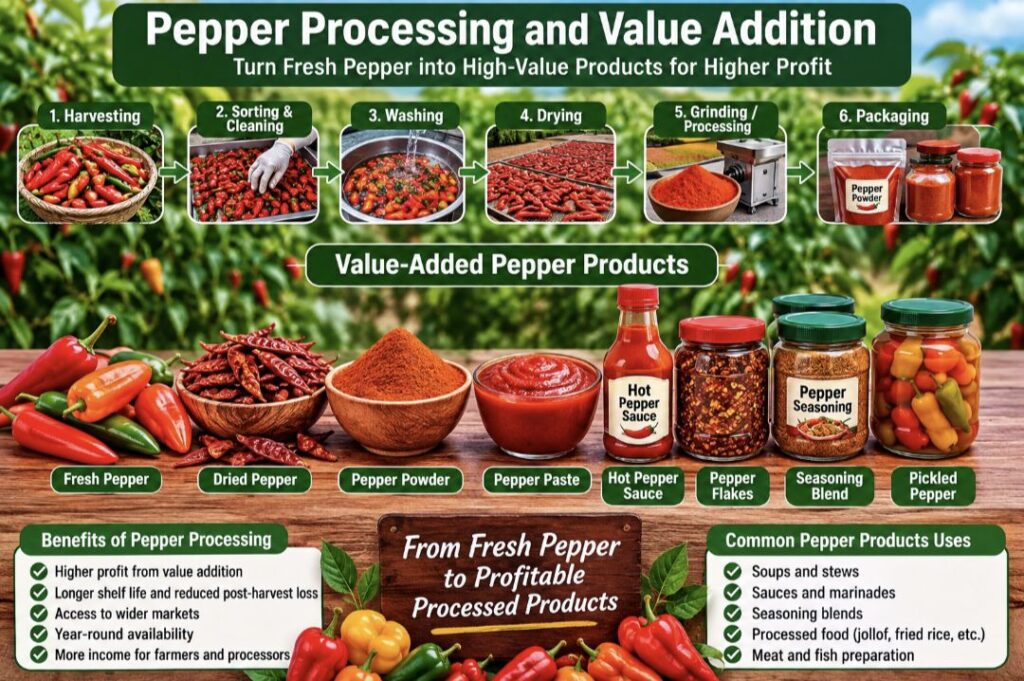
Pepper offers numerous opportunities for value addition.
Instead of selling all peppers fresh, farmers and entrepreneurs can process them into products such as:
- Dried whole pepper
- Pepper powder
- Pepper flakes
- Pepper paste
- Hot pepper sauce
- Chilli sauce
- Pepper seasoning
- Mixed spice
- Pickled pepper
- Frozen pepper
- Ready-to-use cooking pepper
Processing can potentially increase the value of the crop and reduce losses during periods of market oversupply.
However, processing businesses must maintain good hygiene, consistent quality and appropriate packaging.
Nutritional Importance of Pepper
Peppers can contribute useful nutrients to the human diet.
Depending on the variety, peppers may provide vitamin C, vitamin A-related compounds, vitamin E, vitamin K, folate and various antioxidants.
Red and other fully mature peppers can contain significant amounts of carotenoid pigments.
Hot peppers contain capsaicin and related compounds responsible for pungency.
The nutritional composition varies considerably according to variety, maturity, growing conditions and preparation method.
Economic Importance of Pepper in Africa
Pepper is economically important at several levels.
At the farm level, it provides income for smallholder farmers.
At the market level, traders earn income by purchasing, transporting and selling fresh peppers.
Processors generate value through drying, grinding, packaging and sauce production.
Restaurants, food vendors and households create continuous demand.
Pepper also supports employment in seed production, nursery operations, harvesting, transportation, processing and retail.
For many farmers, pepper can be attractive because it can provide multiple harvests depending on the variety and production system.
Pepper Farming as a Commercial Business
Commercial pepper farming should begin with market research rather than planting immediately.
Farmers should first determine what consumers and buyers in their area prefer.
For example, a market may have strong demand for very hot pepper, while another may prefer mild pepper.
Restaurants may require particular varieties, while processors may prioritize varieties suitable for drying.
Farmers should investigate potential buyers, expected prices, preferred fruit sizes, colour requirements and purchasing seasons.
Choosing the Right Pepper Variety
The best pepper variety is not necessarily the variety with the highest yield.
Farmers should consider several factors.
These include:
- Market demand
- Climate suitability
- Soil conditions
- Water availability
- Disease pressure
- Pest pressure
- Seed availability
- Fruit size
- Heat level
- Harvest duration
- Processing potential
- Expected selling price
- Storage requirements
- Labour availability
A variety that performs exceptionally well agronomically but has weak market demand may not be profitable.
Fresh Pepper Versus Dried Pepper
Fresh and dried peppers serve different markets.
Fresh pepper generally commands regular demand from households, restaurants and food vendors.
However, fresh pepper is highly perishable.
Dried pepper has a longer storage life and can be transported over longer distances.
Drying can therefore help farmers reduce losses when fresh market prices fall.
Some farmers may choose to sell part of their harvest fresh while processing the remainder.
This strategy can provide greater flexibility.
Pepper and Food Security
Pepper contributes to food security by providing an important vegetable and spice ingredient.
Although pepper is not usually consumed in quantities comparable to staple crops such as maize, rice, cassava and yam, it plays an important role in improving the taste and diversity of meals.
Its nutritional contribution can also complement other foods.
The ability to dry pepper means households can preserve it beyond the main harvest period.
Pepper in Nigerian Cuisine
Nigeria is one of the African countries where pepper is particularly important.
Different pepper types are used in preparing soups, stews, sauces, rice dishes, beans, meat dishes and numerous traditional foods.
Tatashe, shombo and small hot pepper varieties are especially familiar in Nigerian markets.
Pepper is also a major ingredient in commercial food businesses.
Restaurants, bukas, caterers, hotels and street-food vendors create substantial demand.
This makes pepper an important agricultural commodity for farmers close to major Nigerian consumption centres.
Pepper in West African Cuisine
Pepper is equally important in many West African countries.
It is used in Ghanaian, Beninese, Togolese, Ivorian, Senegalese, Sierra Leonean, Liberian and Gambian cuisines.
Different communities have developed their own preferred pepper combinations.
In many cases, peppers are combined with tomatoes, onions, garlic, ginger and other ingredients to create sauces and seasonings.
This cultural demand supports a large and diverse pepper market.
Pepper in East and Southern Africa
Pepper is also widely used in East and Southern Africa.
Countries such as Kenya, Uganda, Tanzania, Zambia, Zimbabwe and South Africa have markets for fresh and processed chilli peppers.
International cuisines and expanding food-processing industries have also created demand for specialized pepper varieties.
Farmers in these regions can potentially benefit from supplying hotels, restaurants, supermarkets and processors.
Export Opportunities
Pepper can also enter international markets.
Export opportunities may include fresh chilli, dried chilli, chilli powder and processed sauces.
However, export markets generally have strict quality requirements.
Farmers and processors interested in exporting must consider food safety, traceability, pesticide residue requirements, packaging, grading, documentation and reliable supply.
Exporting should therefore be approached as a professional supply-chain business rather than simply sending surplus farm produce abroad.
Climate Change and Pepper Production
Climate change presents challenges for pepper farmers.
Changes in rainfall patterns, increasing temperatures, drought, flooding and changing pest populations can affect production.
Farmers can reduce some risks through irrigation, improved drainage, mulching, shade management where appropriate, improved varieties and proper planting schedules.
Diversification can also reduce dependence on a single crop or variety.
Sustainable Pepper Production
Sustainable pepper production involves protecting the soil, water and surrounding environment while maintaining profitability.
Farmers can improve sustainability through crop rotation, organic matter management, efficient irrigation, integrated pest management and responsible fertilizer application.
Farmers should also follow pesticide label instructions and observe required pre-harvest intervals.
Improper pesticide use can create risks for consumers, farm workers and the environment.
Major Factors Affecting Pepper Yield
Several factors influence pepper yield.
The most important include:
- Seed quality
- Variety selection
- Soil fertility
- Water availability
- Plant spacing
- Pest control
- Disease management
- Weed control
- Weather
- Harvesting practices
- Farmer experience
Using excellent seeds without proper management may still result in poor yields.
Likewise, good farm management cannot fully compensate for unsuitable or poor-quality planting material.
Successful production requires the entire system to work together.
Common Mistakes Pepper Farmers Should Avoid
One common mistake is planting without first understanding the market.
Another is using poor-quality seeds from unreliable sources.
Farmers may also over-irrigate their fields or neglect drainage.
Planting too densely can increase competition between plants and create humid conditions that favour certain diseases.
Excessive pesticide use can increase production costs and may contribute to pest resistance.
Farmers should also avoid harvesting carelessly because damaged fruit has reduced market value.
Improving Pepper Profitability
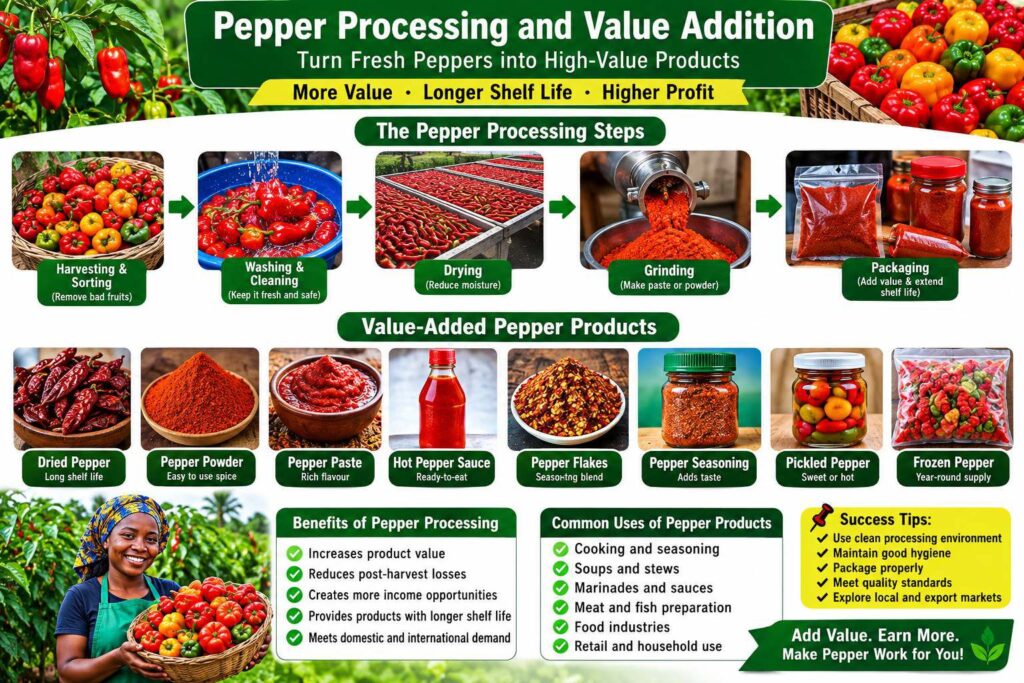
Profitability can be improved through better planning and value addition.
Farmers can increase returns by:
- Choosing varieties with strong market demand
- Using quality seeds
- Maintaining good plant nutrition
- Managing pests early
- Harvesting at the correct maturity
- Sorting produce
- Establishing reliable buyers
- Reducing post-harvest losses
- Drying surplus pepper
- Producing pepper powder or paste
- Developing branded products
- Keeping accurate farm records
The most profitable farmers are not necessarily those with the largest farms. Efficient management and access to good markets can be more important than farm size alone.
Future of Pepper Production in Africa
The future of pepper production in Africa is promising because demand is supported by population growth, urbanization, food businesses and food processing.
As African cities continue to expand, demand for fresh vegetables and convenient processed food products is expected to remain important.
Pepper can benefit from this trend because it is used extensively in household cooking and commercial food preparation.
Improved seed varieties, irrigation technology, greenhouse production, better storage, processing and modern marketing can further increase the value of the pepper industry.
Conclusion
Pepper is far more than a simple kitchen ingredient. It is an important agricultural commodity with cultural, nutritional and economic significance across Africa.
The continent uses a wide range of pepper types, including Scotch bonnet, cayenne, bird's eye pepper, African bird pepper, shombo, tatashe, bell pepper, jalapeño, habanero, paprika and numerous locally adapted varieties.
Each type has different characteristics and market opportunities. Some are valued primarily for intense heat, others for colour, aroma, sweetness or processing quality.
For farmers, selecting the right variety should always begin with an understanding of the target market. Climate, soil, water availability, disease pressure, seed quality and production costs should also be considered.
Pepper farming can be profitable when production is combined with good agronomic practices, efficient post-harvest handling and strong market connections. Farmers can further increase their opportunities by moving into value-added products such as dried pepper, pepper powder, pepper paste and hot sauces.
As Africa's population, cities and food industries continue to grow, demand for pepper is likely to remain strong. With improved production methods, quality planting materials, responsible farm management and better processing systems, pepper can continue to provide income and business opportunities for farmers and entrepreneurs across the continent.
For anyone considering commercial pepper farming, the most important lesson is simple: do not choose a pepper variety simply because it produces well; choose a variety that performs well in your environment and has a strong, dependable market.
Read more;
- Poultry Meat Benefits to Humanity: Complete Guide to Its Nutritional, Economic and Social Importance

- Tilapia Farming: Complete Guide to Raising Tilapia for Commercial Production

- Fish Pond Construction: Complete Guide to Designing and Building a Modern Fish Pond

- Grazing Livestock Farming Business: Complete Guide to Starting and Making Profit

- Commercial Cattle Farming: Complete Guide to Raising Cattle for Profit

- Goat Farming Business: Complete Guide to Meat and Breeding Production

- Sheep Farming: Complete Guide to Raising Sheep for Commercial Profit

- Modern Pasture Farming: How to Grow High-Quality Livestock Feed
- Rotational Grazing: Complete Guide to Improving Livestock Production

- Commercial Livestock Breeding: How to Build a Productive Herd