Summary
Greenhouse agriculture is one of the most advanced methods of modern farming. It allows farmers to grow crops inside a controlled or partially controlled environment where important factors such as temperature, humidity, light, water, air circulation and pest exposure can be managed more effectively.
As climate change, unpredictable rainfall, land degradation, pest outbreaks and increasing food demand continue to challenge conventional agriculture, greenhouse farming is becoming an increasingly attractive option for both commercial and small-scale farmers.
Unlike open-field farming, where crops are directly exposed to changing weather conditions, greenhouse agriculture provides farmers with greater control over the growing environment. This can improve crop quality, extend the growing season, increase productivity and create opportunities for year-round production.
Greenhouse farming is particularly useful for high-value crops such as tomatoes, cucumbers, peppers, lettuce, strawberries, herbs and various nursery plants. In Africa, including Nigeria, the system is gaining attention among commercial farmers, young entrepreneurs, agricultural investors and individuals looking for profitable agribusiness opportunities.
This comprehensive guide explains what greenhouse agriculture is, how it works, the different types of greenhouses, suitable crops, major benefits and challenges, greenhouse construction, irrigation, crop management, pest control, costs, profitability and important factors to consider before starting a greenhouse farm.
What Is Greenhouse Agriculture?
Greenhouse agriculture is a farming system in which crops are cultivated inside a specially constructed structure covered with transparent or semi-transparent materials.
The covering allows sunlight to enter while helping to protect plants from excessive rainfall, strong winds, extreme temperatures, certain pests and other environmental conditions.
A greenhouse can range from a simple low-cost structure designed to provide basic protection to a sophisticated commercial facility equipped with automated temperature control, irrigation, ventilation, heating, cooling and lighting systems.
The main objective is to create a more favorable environment for crop growth than may be available naturally outdoors.
In a well-managed greenhouse, the farmer can control several factors that influence plant growth. These include:
- Temperature
- Relative humidity
- Irrigation
- Fertilization
- Ventilation
- Light exposure
- Growing media
- Pest management
- Disease prevention
- Plant spacing
- Crop nutrition
This level of control can make greenhouse agriculture highly productive when properly planned and managed.
How Does Greenhouse Farming Work?
Greenhouse farming works by creating an environment in which crops receive the conditions necessary for healthy growth while being protected from unfavorable external conditions.
Sunlight passes through the greenhouse covering and warms the interior. Depending on the design, ventilation openings, fans, shade nets, cooling systems and other technologies can then be used to regulate the temperature.
Water is commonly supplied through irrigation systems such as drip irrigation. Fertilizers can also be delivered through irrigation water using a technique known as fertigation.
Farmers monitor the condition of the plants and adjust the growing environment according to the requirements of the crop.
For example, tomatoes require adequate sunlight, proper irrigation, balanced nutrients and good ventilation. If temperatures become too high, ventilation and shading may be necessary. If humidity becomes excessive, improved air circulation may help reduce disease pressure.
Therefore, successful greenhouse agriculture is not simply about putting crops inside a structure. It is about managing the entire growing environment.
Major Types of Greenhouses
There are different types of greenhouses, and the most appropriate design depends on climate, crop type, available capital, farm size and production objectives.
1. Tunnel Greenhouse
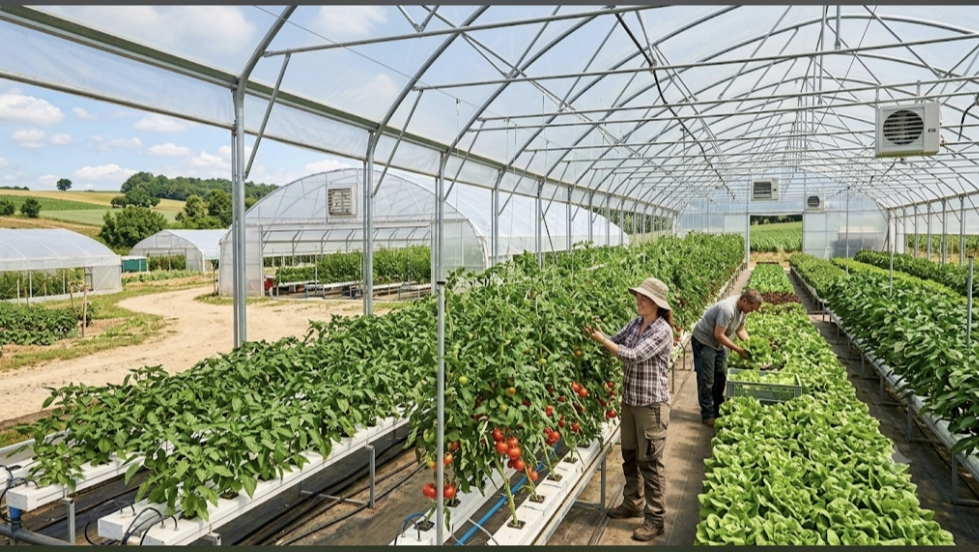
Tunnel greenhouses are among the simplest greenhouse structures. They generally have a curved roof and are constructed using metal or other suitable frames covered with greenhouse plastic.
They are relatively affordable and can be suitable for small and medium-scale farmers.
Tunnel greenhouses can be used for crops such as tomatoes, cucumbers, peppers, leafy vegetables and seedlings.
Their major advantages include relatively simple construction, good light penetration and lower initial costs compared with highly automated greenhouse systems.
2. Quonset Greenhouse
A Quonset greenhouse has a semicircular structure supported by curved frames.
It is relatively simple to construct and can be suitable for small-scale agricultural enterprises.
Its curved design helps provide structural strength while allowing sunlight to reach the plants.
3. Gable-Roof Greenhouse
Gable-roof greenhouses have sloping roofs similar to conventional buildings.
They provide good internal space and can offer effective ventilation when properly designed.
This type of greenhouse can be useful for commercial crop production where farmers require more working space and improved environmental control.
4. Multi-Span Greenhouse
A multi-span greenhouse consists of several greenhouse sections connected together.
It is commonly used for larger commercial farms because it makes it possible to cultivate crops across a larger area under one integrated structure.
Multi-span systems can also accommodate more advanced irrigation, ventilation and environmental-control systems.
5. Net House
A net house is not always considered a conventional greenhouse because it may not use a transparent plastic covering. Instead, it uses insect-proof or shade netting.
It can be particularly useful in warm climates where excessive heat is a major concern.
Net houses can help reduce pest pressure while allowing good airflow.
6. Shade House
Shade houses use shade nets to reduce excessive sunlight and heat.
They are particularly useful for crops and seedlings that are sensitive to intense sunlight.
Shade houses are also commonly used in plant nurseries.
Common Greenhouse Covering Materials
The covering material is one of the most important components of a greenhouse.
Polyethylene Film
Polyethylene plastic is widely used because it is relatively affordable, flexible and easy to install.
High-quality agricultural greenhouse films can provide good light transmission and protection against weather conditions.
However, the material must be replaced periodically depending on its quality, exposure and maintenance.
Polycarbonate
Polycarbonate panels are more rigid and durable than ordinary greenhouse film.
They can provide good insulation and may have a longer service life.
The main disadvantage is that they generally cost more.
Glass
Glass has traditionally been used in greenhouse construction and offers excellent light transmission.
However, glass greenhouses can be expensive to construct and maintain. They are therefore more common in specialized commercial operations.
Suitable Crops for Greenhouse Agriculture
One of the major advantages of greenhouse agriculture is the ability to cultivate a wide range of crops.
However, farmers should select crops based on market demand, climate, production costs and technical requirements.
Tomatoes
Tomatoes are among the most popular greenhouse crops.
Greenhouse production can provide better control over irrigation, nutrition, temperature and pest management.
Farmers can also train tomato plants vertically using strings, trellises or other support systems.
Cucumbers
Cucumbers are another highly suitable greenhouse crop.
They grow rapidly under favorable conditions and can produce multiple harvests during the production cycle.
Greenhouse cucumbers can be trained vertically, allowing efficient use of limited space.
Sweet Pepper
Sweet pepper can perform well in protected cultivation.
Greenhouse production allows farmers to manage temperature, irrigation and nutrition more precisely.
Hot Pepper
Various pepper varieties can also be cultivated under protected conditions.
The ability to produce quality peppers outside the traditional field season can create attractive market opportunities.
Lettuce
Lettuce has a relatively short production cycle and can be suitable for greenhouse and hydroponic systems.
It is particularly attractive for farmers supplying restaurants, supermarkets and urban consumers.
Herbs
Herbs such as basil, mint, coriander and parsley can be cultivated in protected environments.
High-value herbs can provide attractive returns where there is reliable demand.
Strawberries
Strawberries can be cultivated under protected conditions in suitable climates.
Greenhouse production can help protect fruits from certain environmental stresses and improve quality.
Seedlings
Greenhouses and nursery structures are also highly valuable for seedling production.
Farmers can produce healthy vegetable, fruit and ornamental plant seedlings for sale to other farmers.
Benefits of Greenhouse Agriculture
Greenhouse agriculture offers numerous advantages when properly designed and managed.
1. Higher Production Potential
Because farmers can manage important environmental factors, greenhouse crops can achieve high productivity per unit area.
Vertical growing systems can also help maximize available space.
2. Better Protection From Weather
Open-field crops are exposed to heavy rainfall, strong winds, drought, excessive sunlight and other weather-related challenges.
A greenhouse can reduce the impact of some of these conditions.
3. Extended Growing Season
Greenhouse production can allow farmers to cultivate crops during periods when outdoor conditions may not be ideal.
This can provide opportunities to supply markets during periods of limited production.
4. Improved Crop Quality
Controlled irrigation, nutrition and environmental conditions can contribute to more uniform crops.
Quality is particularly important when supplying supermarkets, hotels, restaurants and other premium markets.
5. Efficient Water Use
Drip irrigation systems can deliver water directly to the root zone.
This can significantly reduce unnecessary water loss compared with some traditional irrigation methods.
6. Reduced Weed Pressure
Growing crops in protected and well-managed systems can reduce weed problems, especially when appropriate growing media, mulching and sanitation practices are used.
7. Better Pest Management
A properly designed greenhouse can reduce exposure to some insect pests.
Insect-proof netting and good sanitation can further reduce pest entry.
However, greenhouse farming does not completely eliminate pests.
8. Better Use of Land
Greenhouse farming can produce significant quantities of high-value crops from relatively small areas.
This makes it attractive for farmers operating on limited land.
9. Opportunities for Year-Round Production
With appropriate environmental management, some greenhouse crops can be produced throughout much of the year.
This creates opportunities for continuous market supply.
10. Higher-Value Markets
Greenhouse farmers can target premium markets that demand consistent quality.
Potential customers include supermarkets, hotels, restaurants, food processors, exporters and individual consumers.
Challenges of Greenhouse Agriculture
Despite its many advantages, greenhouse farming has challenges that farmers should understand before investing.
High Initial Investment
Constructing a quality greenhouse can require significant capital.
Expenses may include:
- Greenhouse structure
- Covering materials
- Irrigation
- Water storage
- Pumps
- Fertilizers
- Seeds or seedlings
- Growing media
- Trellising materials
- Labour
- Pest-control products
- Ventilation systems
- Farm tools
Farmers should therefore prepare a realistic business plan before construction.
Technical Knowledge
Greenhouse agriculture requires more technical knowledge than many conventional farming systems.
Farmers need to understand irrigation, crop nutrition, temperature management, pest control, ventilation and crop training.
Poor management can result in significant financial losses.
Heat Management
In tropical regions such as Nigeria, excessive heat can become a serious problem.
A poorly designed greenhouse can become extremely hot, causing flower abortion, poor fruit development, plant stress and reduced yields.
Good ventilation, appropriate greenhouse orientation, shade management and suitable greenhouse designs are therefore important.
Disease Management
High humidity and poor ventilation can encourage fungal and bacterial diseases.
Farmers should maintain proper plant spacing, avoid excessive irrigation and remove infected plant materials promptly.
Market Risk
Producing a high yield does not automatically guarantee profit.
Farmers must know who will buy their produce before planting.
A greenhouse project should therefore include market research and a sales strategy.
How to Start a Greenhouse Farm
Starting a greenhouse farm requires careful planning.
Step 1: Conduct Market Research
Before building the greenhouse, identify crops with strong and reliable demand in your target market.
Find out:
- Current market prices
- Peak demand periods
- Potential buyers
- Competitors
- Production costs
- Transportation costs
- Expected selling prices
Do not choose a crop simply because it is popular. Choose one that has a viable market and matches your technical capacity.
Step 2: Choose a Suitable Location
The farm location is extremely important.
Choose a site with access to:
- Reliable water
- Good roads
- Electricity or alternative power
- Labour
- Markets
- Agricultural inputs
The site should also have good drainage.
Flood-prone locations should generally be avoided.
Step 3: Select the Greenhouse Design
Choose a greenhouse based on your climate, crop, budget and production objectives.
For a beginner, a simple but well-designed greenhouse may be more practical than an expensive automated system.
Step 4: Install a Reliable Water System
Water is one of the most important requirements for greenhouse production.
A reliable source could include a borehole, well or other suitable water source, subject to local conditions and water quality.
A water storage tank can provide additional security against supply interruptions.
Step 5: Install Irrigation
Drip irrigation is widely used in greenhouse farming.
It delivers water close to the plant root zone and can be integrated with fertigation.
Proper filtration is important because blocked emitters can affect crop performance.
Step 6: Prepare the Growing System
Crops can be grown directly in soil or in various growing media.
Some greenhouse systems use:
- Soil
- Cocopeat
- Perlite
- Vermiculite
- Rockwool
- Compost-based media
The choice depends on the crop, production system and available resources.
Step 7: Select Quality Seeds
High-quality seeds are essential.
Farmers should purchase seeds from reputable suppliers and select varieties suited to greenhouse production and local environmental conditions.
Hybrid varieties are commonly used in commercial production because of their yield potential and uniformity, although the best variety depends on the specific crop and market.
Step 8: Raise Healthy Seedlings
Healthy seedlings provide a strong foundation for successful greenhouse production.
Seeds should be planted in clean nursery trays or suitable seedbeds.
Seedlings require appropriate moisture, light, nutrition and protection from pests and diseases.
Step 9: Transplant Carefully
When seedlings reach the appropriate stage, they can be transplanted into the greenhouse.
Transplanting should be done carefully to minimize root damage.
Proper plant spacing is important for good airflow and efficient use of space.
Step 10: Provide Plant Support
Some crops, particularly tomatoes and cucumbers, benefit from vertical support.
Trellising allows plants to grow upward and improves the use of greenhouse space.
It can also improve airflow and make harvesting easier.
Greenhouse Irrigation Management
Irrigation management is one of the most important aspects of greenhouse farming.
Too little water can cause plant stress, poor growth and reduced yields.
Too much water can lead to root problems, nutrient leaching and disease.
Farmers should consider:
- Crop growth stage
- Temperature
- Humidity
- Growing medium
- Plant size
- Weather conditions
- Water quality
Automated irrigation systems can be used in advanced greenhouse operations.
However, even simple systems can be highly effective when properly managed.
Fertigation in Greenhouse Farming
Fertigation combines irrigation and fertilization.
Instead of applying all fertilizer separately, soluble nutrients can be delivered through irrigation water.
This allows nutrients to reach the plant root zone more efficiently.
A successful fertigation program should be based on the crop's nutrient requirements and, where possible, soil or growing-media testing.
Major plant nutrients include:
- Nitrogen
- Phosphorus
- Potassium
- Calcium
- Magnesium
- Sulfur
Plants also require micronutrients such as iron, zinc, boron, manganese, copper and molybdenum in smaller quantities.
Farmers should avoid excessive fertilizer application because it can damage plants and increase production costs.
Temperature and Humidity Management
Temperature is particularly important in greenhouse production.
Excessive heat can reduce plant productivity, while temperatures that are too low can slow growth.
Farmers can manage greenhouse temperature through:
- Ventilation
- Shade nets
- Fans
- Evaporative cooling
- Proper greenhouse orientation
- Appropriate covering materials
Humidity must also be monitored.
Excessive humidity can increase disease risk, particularly when ventilation is poor.
Pest and Disease Management
Greenhouse farming requires a strong pest and disease management program.
Common greenhouse pests may include:
- Aphids
- Whiteflies
- Thrips
- Spider mites
- Caterpillars
- Leaf miners
Diseases can include fungal, bacterial and viral infections.
Integrated Pest Management, commonly known as IPM, is one of the most effective approaches.
IPM combines preventive, biological, cultural and chemical control methods.
Important practices include:
- Using clean planting materials
- Installing insect-proof netting
- Removing infected plants
- Keeping the greenhouse clean
- Controlling weeds
- Monitoring plants regularly
- Avoiding excessive humidity
- Rotating crops where appropriate
- Using approved pesticides responsibly when necessary
Greenhouse Crop Training and Pruning
Crop training and pruning are important for many greenhouse crops.
Tomatoes, for example, can be trained vertically to improve light penetration, airflow and harvesting efficiency.
Pruning can help manage excessive vegetative growth and improve the plant's productivity when performed correctly.
However, pruning should be based on the crop variety and production system.
Improper pruning can damage plants and reduce yields.
Greenhouse Harvesting
Harvesting should be carried out at the appropriate maturity stage.
The ideal harvesting stage depends on the crop and target market.
For example, tomatoes intended for distant markets may be harvested at a different maturity stage from tomatoes intended for immediate consumption.
Harvesting should be done carefully to minimize bruising and physical damage.
Clean harvesting containers should be used.
Post-Harvest Handling
Good post-harvest management is essential for maintaining crop quality.
After harvesting, produce should be:
- Sorted
- Graded
- Cleaned where appropriate
- Packed
- Stored under suitable conditions
- Transported carefully
Poor post-harvest handling can result in significant losses even when greenhouse production is excellent.
Greenhouse Agriculture in Nigeria
Nigeria has significant potential for greenhouse agriculture because of its large population, growing food demand and diverse climatic conditions.
Vegetables such as tomatoes, cucumbers, peppers and leafy vegetables have strong consumer demand.
However, greenhouse farming in Nigeria requires careful adaptation to local climatic conditions.
The country's tropical climate means that heat management and ventilation are particularly important.
Farmers should not simply copy greenhouse designs used in colder countries.
Greenhouses designed for tropical climates should prioritize ventilation and cooling where necessary.
Water availability, electricity, security, road access and proximity to markets should also be considered.
Urban and peri-urban areas can offer opportunities for greenhouse vegetable production because farmers may be close to consumers and high-value markets.
Is Greenhouse Farming Profitable?
Greenhouse farming can be profitable, but profitability is not guaranteed.
The financial outcome depends on several factors, including:
- Initial construction cost
- Crop selection
- Yield
- Selling price
- Labour costs
- Input costs
- Water and energy expenses
- Pest and disease management
- Market access
- Post-harvest losses
- Management skill
High-value crops can provide attractive returns when production and marketing are properly managed.
However, farmers should avoid unrealistic claims about greenhouse profits.
A farmer producing an excellent crop but selling during a period of oversupply may earn less than expected.
The most profitable greenhouse farms usually combine efficient production with strong market planning.
How to Reduce Greenhouse Production Costs
Farmers can improve profitability by controlling unnecessary expenses.
Use Appropriate Technology
Not every farm needs expensive automation.
Start with technology that solves the most important production problems.
Buy Quality Inputs
Cheap materials can become expensive if they fail prematurely or produce poor results.
Quality greenhouse materials and reliable irrigation components can reduce maintenance problems.
Reduce Water Waste
Drip irrigation and proper scheduling can improve water efficiency.
Control Pests Early
Early detection is generally cheaper than trying to control a severe infestation.
Develop Direct Markets
Selling directly to restaurants, supermarkets, food businesses and consumers may improve margins compared with depending entirely on middlemen.
Keep Farm Records
Farmers should record:
- Seed costs
- Fertilizer costs
- Labour
- Water
- Electricity
- Pesticides
- Harvest quantities
- Sales
- Transportation
- Losses
Accurate records help farmers determine whether the greenhouse is actually profitable.
Greenhouse Farming vs Open-Field Farming
Greenhouse agriculture and open-field agriculture each have advantages.
Open-field farming generally requires lower initial investment and can be suitable for large-scale production of many staple crops.
Greenhouse agriculture, on the other hand, offers greater environmental control and can be especially attractive for high-value crops.
The right choice depends on the crop, location, available capital, market and farmer's technical skills.
Common Mistakes Greenhouse Farmers Should Avoid
Building Before Studying the Market
A greenhouse should not be constructed simply because greenhouse farming is fashionable.
Market research should come first.
Choosing the Wrong Greenhouse Design
A greenhouse designed for a cold climate may not perform well in a hot tropical environment.
Ignoring Ventilation
Poor ventilation can cause excessive heat and humidity.
Overwatering
More water does not necessarily mean faster growth.
Overusing Fertilizer
Excess nutrients can damage plants and waste money.
Planting Too Closely
Overcrowding reduces airflow and can increase disease problems.
Ignoring Record Keeping
Without financial records, farmers may not know whether they are making or losing money.
Producing Without Buyers
Farmers should develop a marketing strategy before planting.
Greenhouse Agriculture and Food Security
Greenhouse agriculture can contribute to food security by increasing the efficiency and reliability of food production.
Protected cultivation can help farmers produce vegetables during periods when open-field production is affected by unfavorable weather.
It can also support urban agriculture and intensive food production where land is limited.
However, greenhouse agriculture should complement rather than completely replace conventional farming.
Different agricultural systems are suitable for different crops, environments and economic conditions.
Future of Greenhouse Agriculture
The future of greenhouse agriculture is closely connected to agricultural technology.
Modern greenhouse systems are increasingly incorporating:
- Automated irrigation
- Sensors
- Climate monitoring
- Remote farm management
- Automated fertigation
- Hydroponics
- Renewable energy
- Artificial intelligence
- Precision agriculture
- Smart greenhouse systems
Sensors can monitor temperature, humidity, soil moisture and other conditions.
Automation can reduce labour requirements and improve precision.
Solar energy may also provide an alternative source of electricity for farms operating in areas with unreliable grid power.
As technology becomes more affordable, smart greenhouse farming is likely to become increasingly accessible to African farmers.
Final Thoughts
Greenhouse agriculture represents an important opportunity for modern farmers who want greater control over crop production.
It can provide higher productivity, better crop quality, efficient water use, extended production seasons and access to premium markets.
However, greenhouse farming should not be viewed as a guaranteed path to wealth. Success requires careful planning, appropriate greenhouse design, quality inputs, technical knowledge, proper irrigation, effective pest management and reliable market access.
For farmers in Nigeria and other African countries, choosing a greenhouse design suited to the local climate is particularly important. Heat management, ventilation, water availability and market access should be considered before construction begins.
The most successful greenhouse farmers are not necessarily those who build the biggest structures. They are those who understand their crops, control their production costs, maintain high quality and develop reliable markets.
With proper planning and professional management, greenhouse agriculture can become a valuable component of a profitable and sustainable agricultural enterprise.
Read more;
- Poultry Meat Benefits to Humanity: Complete Guide to Its Nutritional, Economic and Social Importance

- Tilapia Farming: Complete Guide to Raising Tilapia for Commercial Production

- Fish Pond Construction: Complete Guide to Designing and Building a Modern Fish Pond

- Grazing Livestock Farming Business: Complete Guide to Starting and Making Profit

- Commercial Cattle Farming: Complete Guide to Raising Cattle for Profit

- Goat Farming Business: Complete Guide to Meat and Breeding Production

- Sheep Farming: Complete Guide to Raising Sheep for Commercial Profit

- Modern Pasture Farming: How to Grow High-Quality Livestock Feed
- Rotational Grazing: Complete Guide to Improving Livestock Production