Summary
Modern agriculture depends heavily on fertilizers to maintain soil fertility, improve crop growth, and increase food production. As the world's population continues to grow, farmers are under increasing pressure to produce more food from limited farmland. Fertilizers play a major role in helping crops receive essential nutrients needed for healthy growth and high yields.
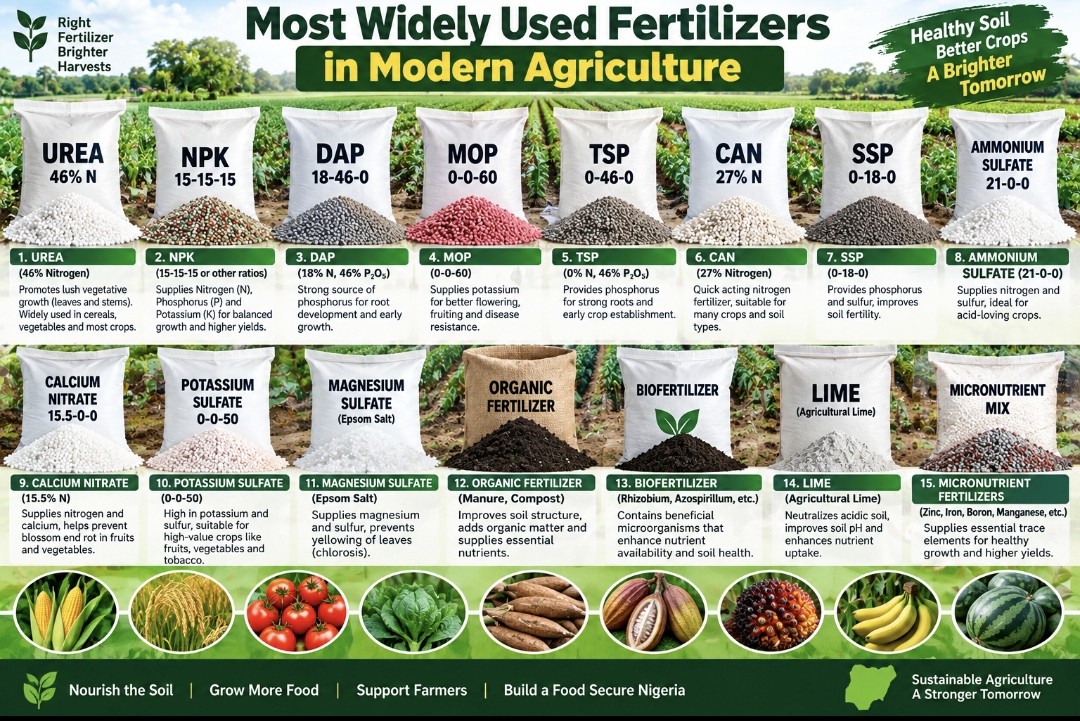
The most widely used fertilizers in modern agriculture are mainly classified according to the nutrients they supply. The three primary nutrients required in large quantities by crops are nitrogen (N), phosphorus (P), and potassium (K). These nutrients are commonly referred to as NPK.
Other important nutrients such as calcium, magnesium, sulfur, zinc, boron, and iron are also used to correct specific nutrient deficiencies.
This article explains the most widely used fertilizers in modern agriculture, their nutrient composition, benefits, application methods, and how farmers can select the right fertilizer for different crops.
Understanding Fertilizers in Modern Agriculture
A fertilizer is any natural or manufactured material applied to soil or plants to supply essential nutrients needed for growth and development.
Plants require nutrients for several important processes, including:
- Root development
- Leaf formation
- Flowering
- Fruit production
- Seed development
- Photosynthesis
- Disease resistance
- Overall plant growth
Although healthy soil naturally contains nutrients, continuous farming gradually reduces nutrient availability. Farmers therefore apply fertilizers to replace nutrients removed by harvested crops.
Modern fertilizers are available in different forms, including:
- Granular fertilizers
- Powder fertilizers
- Liquid fertilizers
- Water-soluble fertilizers
- Slow-release fertilizers
- Organic fertilizers
The choice of fertilizer depends on the crop, soil condition, climate, farming system, and production goals.
NPK Fertilizer: The Most Widely Used Fertilizer in Modern Agriculture
NPK fertilizer is one of the most widely used fertilizer categories in modern agriculture.
The name NPK represents the three major plant nutrients:
- N – Nitrogen
- P – Phosphorus
- K – Potassium
Different NPK fertilizers contain different ratios of these nutrients. Common examples include:
- NPK 15-15-15
- NPK 20-10-10
- NPK 12-12-17
- NPK 10-20-10
- NPK 20-20-20
NPK fertilizers are widely used because they provide multiple essential nutrients in a single product.
Farmers growing crops such as maize, rice, vegetables, cassava, tomatoes, peppers, potatoes, and many fruit crops commonly use NPK fertilizers.
Importance of Nitrogen Fertilizers
Nitrogen is one of the most important nutrients required by plants. It is especially important for vegetative growth.
Nitrogen promotes:
- Green leaf development
- Stem growth
- Protein formation
- Chlorophyll production
- Rapid vegetative development
- Increased crop biomass
Nitrogen deficiency often causes leaves to turn pale green or yellow.
Some of the most widely used nitrogen fertilizers include:
- Urea
- Ammonium sulfate
- Calcium ammonium nitrate
- Ammonium nitrate
Among these, urea is one of the most commonly used nitrogen fertilizers worldwide.
Urea Fertilizer
Urea is among the most popular and widely used fertilizers in modern agriculture.
It contains approximately 46% nitrogen, making it one of the most concentrated solid nitrogen fertilizers available.
Because of its high nitrogen content, urea is widely used for crops such as:
- Maize
- Rice
- Wheat
- Sorghum
- Vegetables
- Sugarcane
- Pasture grasses
Urea is relatively affordable compared with some other nitrogen fertilizers and is easy to transport because of its high nutrient concentration.
However, improper application can lead to nitrogen losses through ammonia volatilization.
For better results, urea should be incorporated into the soil or applied when sufficient moisture is available.
Ammonium Sulfate Fertilizer
Ammonium sulfate is another important nitrogen fertilizer used in modern farming.
It provides both nitrogen and sulfur.
This fertilizer is particularly useful in soils with sulfur deficiency.
Ammonium sulfate can be beneficial for crops such as:
- Rice
- Maize
- Vegetables
- Tea
- Coffee
- Oilseed crops
It is also useful in slightly alkaline soils because it has an acidifying effect on the soil.
Phosphorus Fertilizers in Agriculture
Phosphorus is essential for strong root development and energy transfer within plants.
It is particularly important during the early stages of crop growth.
Phosphorus helps promote:
- Root development
- Early plant establishment
- Flower formation
- Seed production
- Fruit development
- Energy transfer
Common phosphorus fertilizers include:
- DAP
- MAP
- Single superphosphate
- Triple superphosphate
Diammonium Phosphate (DAP)
Diammonium phosphate, commonly known as DAP, is one of the most widely used phosphorus fertilizers.
DAP contains both nitrogen and phosphorus.
It is commonly applied during planting because phosphorus is important for early root development.
DAP is widely used for:
- Maize
- Wheat
- Rice
- Vegetables
- Legumes
- Oilseed crops
One major advantage of DAP is that it supplies two important nutrients simultaneously.
Farmers often apply DAP close to the planting zone, ensuring young plants have access to phosphorus during early growth.
Monoammonium Phosphate (MAP)
Monoammonium phosphate, also known as MAP, is another important phosphorus fertilizer.
MAP is widely used because it is highly soluble and suitable for different agricultural systems.
It provides:
- Nitrogen
- Phosphorus
MAP is particularly useful for crops requiring strong early root development.
It is commonly used in:
- Field crops
- Vegetables
- Fruit production
- Fertigation systems
Single Superphosphate (SSP)
Single superphosphate is a traditional phosphorus fertilizer widely used in agriculture.
Apart from phosphorus, SSP also provides calcium and sulfur.
It is useful in soils where sulfur deficiency is common.
SSP is frequently used for:
- Legumes
- Oilseed crops
- Root crops
- Cereals
The additional sulfur content makes it beneficial for crops that require significant amounts of sulfur.
Potassium Fertilizers in Modern Agriculture
Potassium is another major nutrient required for healthy crop growth.
Unlike nitrogen, potassium is not primarily responsible for leafy growth. Instead, it plays an important role in plant strength, water regulation, and crop quality.
Potassium helps improve:
- Disease resistance
- Drought tolerance
- Fruit quality
- Root strength
- Water regulation
- Stress tolerance
- Crop yield
The most commonly used potassium fertilizers include:
- Muriate of potash
- Sulfate of potash
- Potassium nitrate
Muriate of Potash (MOP)
Muriate of potash, also known as potassium chloride, is one of the most widely used potassium fertilizers worldwide.
It is popular because it contains a high concentration of potassium and is generally more affordable than other potassium fertilizers.
MOP is used for many crops, including:
- Maize
- Wheat
- Rice
- Sugarcane
- Oil palm
- Cassava
However, because it contains chloride, it may not be suitable for crops that are sensitive to excessive chloride.
Sulfate of Potash (SOP)
Sulfate of potash provides potassium and sulfur.
It is commonly used for high-value crops, especially crops sensitive to chloride.
SOP is suitable for:
- Tomatoes
- Potatoes
- Fruits
- Vegetables
- Tobacco
One of its major advantages is its ability to supply potassium without adding excessive chloride to the soil.
Calcium Ammonium Nitrate (CAN)
Calcium ammonium nitrate is another popular nitrogen fertilizer.
It provides nitrogen and calcium.
CAN is commonly used because it is generally less likely to cause nitrogen loss compared with surface-applied urea.
It is suitable for:
- Vegetables
- Cereals
- Fruit crops
- Root crops
The calcium component can also contribute to improved soil and plant nutrition.
Compound Fertilizers
Compound fertilizers contain two or more essential plant nutrients.
NPK fertilizers are among the most common examples.
Compound fertilizers are popular because they simplify fertilizer application.
Instead of applying nitrogen, phosphorus, and potassium separately, farmers can apply a balanced fertilizer containing multiple nutrients.
Common compound fertilizer formulations include:
- NPK 15-15-15
- NPK 20-10-10
- NPK 12-12-17
- NPK 20-20-20
Different formulations are designed for different crops and growth stages.
NPK 15-15-15 Fertilizer
NPK 15-15-15 is one of the most commonly used balanced fertilizers.
It contains equal proportions of nitrogen, phosphorus, and potassium.
This fertilizer is widely used during early and middle stages of crop growth.
It can be applied to crops such as:
- Maize
- Vegetables
- Cassava
- Fruit trees
- Rice
- Pepper
- Tomatoes
The balanced nutrient ratio makes it suitable for general crop nutrition.
NPK 20-10-10 Fertilizer
NPK 20-10-10 contains a higher proportion of nitrogen.
It is particularly suitable for crops during active vegetative growth.
The higher nitrogen content encourages leaf and stem development.
It is commonly used for:
- Maize
- Vegetables
- Leafy crops
- Young fruit trees
Farmers should avoid excessive application because too much nitrogen can encourage excessive leafy growth while reducing flowering or fruit production.
Water-Soluble Fertilizers
Water-soluble fertilizers have become increasingly popular in modern agriculture.
These fertilizers dissolve easily in water and can be applied through irrigation systems.
This method is known as fertigation.
Water-soluble fertilizers are commonly used in:
- Greenhouse farming
- Hydroponics
- Drip irrigation
- Vegetable farming
- Commercial fruit production
Common formulations include:
- NPK 20-20-20
- NPK 19-19-19
- High potassium formulations
Water-soluble fertilizers allow farmers to supply nutrients directly through irrigation water.
Slow-Release and Controlled-Release Fertilizers
Modern agriculture increasingly uses slow-release fertilizers.
These fertilizers release nutrients gradually over time.
Their major advantages include:
- Reduced nutrient losses
- Improved nutrient efficiency
- Less frequent application
- Reduced environmental pollution
- Consistent nutrient availability
Slow-release fertilizers are particularly useful in:
- Commercial horticulture
- Nursery production
- Ornamental plants
- High-value crops
Although they can be more expensive, their efficiency may justify the cost in intensive farming systems.
Micronutrient Fertilizers
In addition to NPK, plants require smaller amounts of micronutrients.
Important micronutrients include:
- Zinc
- Boron
- Iron
- Copper
- Manganese
- Molybdenum
Although required in smaller quantities, micronutrients are essential for healthy plant development.
Micronutrient fertilizers are often applied when soil tests or crop symptoms indicate deficiencies.
For example:
Zinc is important for maize and rice.
Boron is important for flowering and fruit development.
Iron is important for chlorophyll formation.
Organic Fertilizers in Modern Agriculture
Organic fertilizers continue to play an important role in modern agriculture.
Common organic fertilizers include:
- Poultry manure
- Cow dung
- Compost
- Farmyard manure
- Green manure
- Vermicompost
Organic fertilizers improve soil structure and increase organic matter.
They can also improve:
- Water retention
- Soil microbial activity
- Nutrient availability
- Soil structure
However, organic fertilizers usually contain lower nutrient concentrations than synthetic fertilizers.
For this reason, many commercial farmers combine organic manure with mineral fertilizers.
Biofertilizers and Sustainable Agriculture
Biofertilizers are increasingly becoming important in sustainable agriculture.
Biofertilizers contain beneficial microorganisms that improve nutrient availability.
Examples include microorganisms that:
- Fix atmospheric nitrogen
- Solubilize phosphorus
- Improve root development
Biofertilizers can reduce dependence on synthetic fertilizers when properly integrated into a good soil management program.
Liquid Fertilizers
Liquid fertilizers are widely used in commercial farming systems.
They can be applied through:
- Foliar spraying
- Fertigation
- Irrigation systems
One major advantage of liquid fertilizers is rapid nutrient availability.
Foliar fertilizers are particularly useful for correcting micronutrient deficiencies.
However, foliar fertilizers should not always replace soil fertilization because crops require significant quantities of nutrients through their root systems.
Choosing the Right Fertilizer for Your Crop
The best fertilizer depends on several factors.
Farmers should consider:
- Crop type
- Soil fertility
- Growth stage
- Climate
- Irrigation system
- Nutrient requirements
For example, young crops may require more phosphorus to support root development.
Vegetative crops may require additional nitrogen.
Flowering and fruiting crops may require higher levels of potassium.
A soil test remains one of the best ways to determine which nutrients are lacking.
Importance of Soil Testing Before Fertilizer Application
Applying fertilizer without understanding soil conditions can lead to poor results.
A soil test helps determine:
- Soil pH
- Nitrogen availability
- Phosphorus levels
- Potassium levels
- Organic matter content
- Micronutrient deficiencies
Soil testing allows farmers to apply nutrients more accurately.
This reduces unnecessary fertilizer expenses and minimizes environmental pollution.
Proper Fertilizer Application Methods
The effectiveness of fertilizer depends not only on the type used but also on how it is applied.
Common fertilizer application methods include:
- Broadcasting
- Band placement
- Side dressing
- Fertigation
- Foliar application
- Deep placement
Band placement is often effective for phosphorus fertilizers because it places nutrients closer to plant roots.
Side dressing is commonly used for nitrogen fertilizers such as urea during crop growth.
Fertigation is widely used in modern irrigation systems.
Risks of Excessive Fertilizer Application
Applying excessive fertilizer does not always produce higher yields.
Over-fertilization can cause:
- Leaf burning
- Root damage
- Soil acidification
- Water pollution
- Nutrient imbalance
- Increased production costs
Excess nitrogen can also make some crops more susceptible to pests and diseases.
Farmers should therefore apply fertilizers according to recommended rates.
The Role of Precision Agriculture in Fertilizer Use
Precision agriculture is changing how fertilizers are applied in modern farming.
Technologies such as:
- GPS
- Soil sensors
- Drones
- Satellite monitoring
- Automated fertilizer spreaders
allow farmers to apply nutrients more accurately.
Instead of applying the same quantity of fertilizer across an entire farm, precision agriculture helps identify areas that require more or fewer nutrients.
This improves fertilizer efficiency and reduces waste.
Integrated Nutrient Management
One of the best approaches to modern crop nutrition is integrated nutrient management.
This involves combining different nutrient sources, including:
- Mineral fertilizers
- Organic manure
- Compost
- Crop residues
- Biofertilizers
Integrated nutrient management helps maintain long-term soil fertility.
It also reduces excessive dependence on a single fertilizer source.
Most Commonly Used Fertilizers at a Glance
The following fertilizers remain among the most widely used in modern agriculture:
- NPK fertilizer
- Urea
- DAP
- MAP
- Ammonium sulfate
- Calcium ammonium nitrate
- Muriate of potash
- Sulfate of potash
- Single superphosphate
- Water-soluble fertilizers
- Micronutrient fertilizers
- Organic fertilizers
Each fertilizer has a specific role depending on crop and soil requirements.
The Future of Fertilizers in Modern Agriculture
The future of fertilizer use is moving toward greater efficiency and sustainability.
Modern farming is increasingly adopting:
- Slow-release fertilizers
- Nano fertilizers
- Biofertilizers
- Precision nutrient application
- Smart irrigation systems
- Soil testing technologies
The goal is to produce more food while reducing fertilizer losses and environmental damage.
Future fertilizers are expected to become more efficient and environmentally friendly.
Conclusion
Fertilizers remain essential tools in modern agriculture and global food production. Among the most widely used fertilizers are NPK compounds, urea, DAP, MAP, ammonium sulfate, calcium ammonium nitrate, and potassium fertilizers such as muriate of potash.
Nitrogen supports vegetative growth, phosphorus promotes strong roots and early development, while potassium improves crop quality and resistance to environmental stress.
However, there is no single fertilizer that is best for every crop or soil. Successful fertilizer use depends on understanding the nutrient requirements of the crop and the fertility condition of the soil.
The best approach for modern farmers is to combine soil testing, proper fertilizer selection, correct application methods, organic matter management, and modern precision agriculture techniques.
By applying fertilizers responsibly and efficiently, farmers can achieve higher yields, reduce production costs, maintain healthy soils, and contribute to sustainable food production for future generations.
Frequently Asked Questions About Fertilizers
What is the most widely used fertilizer in agriculture?
NPK fertilizers and nitrogen fertilizers such as urea are among the most widely used fertilizers in modern agriculture.
What does NPK mean?
NPK stands for Nitrogen, Phosphorus, and Potassium, the three major nutrients required by plants.
Why is urea popular among farmers?
Urea is popular because it contains a high concentration of nitrogen, approximately 46%, making it an efficient nitrogen fertilizer.
Which fertilizer is best for maize?
The best fertilizer depends on soil conditions, but NPK fertilizers and nitrogen top dressing are commonly used in maize production.
Can organic fertilizer replace chemical fertilizer?
Organic fertilizers can provide nutrients and improve soil health, but they may not always supply sufficient nutrients for intensive commercial farming. Combining organic and mineral fertilizers is often beneficial.
Why is soil testing important before applying fertilizer?
Soil testing identifies nutrient deficiencies and helps farmers select the correct fertilizer and application rate.
Read more:
- Poultry Meat Benefits to Humanity: Complete Guide to Its Nutritional, Economic and Social Importance

- Tilapia Farming: Complete Guide to Raising Tilapia for Commercial Production

- Fish Pond Construction: Complete Guide to Designing and Building a Modern Fish Pond

- Grazing Livestock Farming Business: Complete Guide to Starting and Making Profit

- Commercial Cattle Farming: Complete Guide to Raising Cattle for Profit

- Goat Farming Business: Complete Guide to Meat and Breeding Production

- Sheep Farming: Complete Guide to Raising Sheep for Commercial Profit

- Modern Pasture Farming: How to Grow High-Quality Livestock Feed

- Rotational Grazing: Complete Guide to Improving Livestock Production