Overview
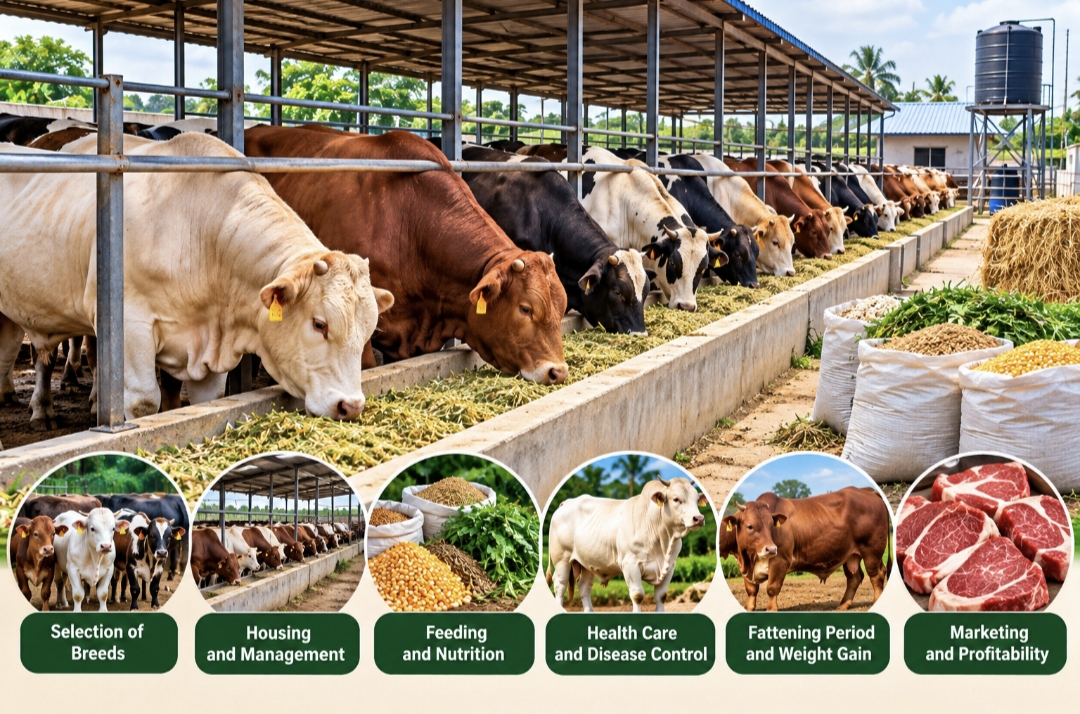
Cattle fattening is a commercial livestock production system in which cattle are managed and fed specifically to increase body weight, improve body condition and produce high-quality beef for the market.
Unlike breeding operations, which may take several years to build a productive herd, cattle fattening can operate on shorter production cycles. Farmers purchase suitable cattle, provide them with quality forage and supplementary feed, monitor their health and body weight, and sell them when they reach the desired market condition.
The business can be operated on a small, medium or large commercial scale. Some farmers use pasture-based systems, while others use semi-intensive or intensive feeding systems.
The profitability of cattle fattening depends on several factors, including the purchase price of cattle, animal health, feed costs, daily weight gain, mortality, management efficiency and the final selling price.
This comprehensive guide explains how cattle fattening works, how to select animals, establish feeding systems, manage housing and health, calculate potential returns, reduce costs and build a sustainable beef-fattening enterprise.
What Is Cattle Fattening?
Cattle fattening is the practice of feeding and managing cattle to increase their body weight and improve their market value before sale.
The cattle may be young growing animals, mature animals requiring additional condition or animals specifically selected for beef production.
A typical fattening operation involves:
- Purchasing suitable cattle
- Quarantining and assessing them
- Providing adequate feed and water
- Managing health
- Monitoring weight gain
- Maintaining proper housing
- Controlling feed costs
- Selling animals at an appropriate market stage
The farmer's objective is to increase the value of the animal by more than the cost of the additional feeding and management.
Why Start a Cattle Fattening Business?
Cattle fattening can provide several commercial opportunities.
Potential advantages include:
- Shorter production cycles than some breeding enterprises
- Strong demand for beef in many markets
- Ability to buy and sell according to market conditions
- Opportunity to utilize crop residues
- Opportunity to use pasture
- Potential to add value to under-conditioned cattle
- Manure production
- Scalability
However, cattle fattening is not automatically profitable. Poor feed management, expensive cattle purchases, disease or weak market planning can result in losses.
How Cattle Fattening Differs From Cattle Breeding
Cattle breeding focuses primarily on producing calves and developing a productive herd.
Cattle fattening focuses primarily on increasing the weight and market condition of animals.
A breeding operation may require a longer investment period, while a fattening operation can potentially complete a cycle within several months depending on the starting animal and production system.
Both businesses can be combined.
Types of Cattle Fattening Systems
Cattle fattening can be organized in several ways.
Pasture-Based Fattening
Animals obtain most of their feed from pasture.
This system can reduce dependence on purchased concentrate feed when productive pasture is available.
Semi-Intensive Fattening
Animals receive pasture or forage together with supplementary concentrate feed.
This approach provides greater control over nutrition while maintaining some use of grazing resources.
Intensive Fattening
Animals are kept in controlled facilities and receive carefully managed diets consisting largely of harvested forage and concentrates.
This system can support rapid growth but requires greater investment in feed, housing and management.
Choosing the Right Fattening System
The appropriate system depends on:
- Land availability
- Feed availability
- Capital
- Climate
- Labor
- Cattle type
- Market demand
- Water availability
- Management skills
A farmer with abundant pasture may use a different system from a farmer operating on limited land.
Selecting Cattle for Fattening
Animal selection is one of the most important decisions in cattle fattening.
Farmers should look for healthy animals with good growth potential.
Important characteristics include:
- Good body structure
- Strong legs
- Healthy appearance
- Good appetite
- Appropriate age
- Sound teeth
- No obvious disease
- Good muscle development
- Suitable frame size
Animals that are severely sick or chronically weak may perform poorly even under good feeding.
Importance of Age
Age influences growth potential and feed efficiency.
Younger growing cattle may have substantial potential for lean tissue growth, while older cattle may be purchased specifically for finishing.
The best age depends on the production system and market objective.
Breed Selection
Different cattle breeds have different characteristics.
Some are selected for:
- Meat production
- Milk production
- Heat tolerance
- Disease resistance
- Growth rate
- Adaptability
- Large mature size
Local breeds adapted to the environment may perform differently from imported or specialized breeds.
Crossbreeding can sometimes combine useful characteristics from different genetic backgrounds.
Body Condition and Purchase Decisions
Farmers should assess the animal rather than buying solely by appearance or asking price.
An animal that is extremely thin may require substantial time and feed before reaching market condition.
On the other hand, an animal that is already very fat may have less opportunity for economical additional growth.
The ideal purchase depends on the target market and expected production cycle.
Inspecting Cattle Before Purchase
Before purchasing cattle, inspect:
- Eyes
- Nose
- Mouth
- Skin
- Hair coat
- Legs
- Hooves
- Abdomen
- Breathing
- Body condition
- Behavior
- Appetite
Signs of illness should be taken seriously.
Where possible, veterinary or experienced livestock assistance can reduce purchasing risks.
Quarantine After Purchase
Newly purchased cattle should be managed carefully before being mixed with an existing herd.
A quarantine period can help identify health problems and reduce the risk of introducing disease.
During quarantine, farmers may conduct:
- Health observation
- Veterinary examination
- Parasite assessment
- Vaccination according to local recommendations
- Treatment where indicated
Specific procedures should be guided by a qualified animal-health professional.
Housing for Fattening Cattle
Housing should provide:
- Adequate space
- Good ventilation
- Shade
- Protection from extreme weather
- Dry resting areas
- Easy cleaning
- Safe feeding areas
- Safe water access
Cattle should not be overcrowded.
Overcrowding can increase stress, contamination and disease risk.
Feedlot Design
A feedlot is a facility where cattle are kept and fed under controlled conditions.
Important components may include:
- Feeding troughs
- Water troughs
- Fencing
- Shade
- Drainage
- Handling facilities
- Storage areas
- Manure management areas
Good drainage is particularly important in areas receiving heavy rainfall.
Importance of Clean Water
Cattle require substantial quantities of water, and requirements can increase under hot conditions and during high feed intake.
Clean water should be available consistently.
Water troughs should be cleaned regularly.
Poor water quality can reduce feed intake and negatively affect animal performance.
Feeding Cattle for Fattening
Feed is generally the largest variable expense in cattle fattening.
A feeding program may contain:
- Pasture
- Hay
- Silage
- Crop residues
- Grains
- Protein supplements
- Mineral supplements
- Salt
- Clean water
The exact ration depends on the animal and production system.
Forage in Cattle Fattening
Forage provides fiber that is important for normal rumen function.
Potential forage sources include:
- Pasture grasses
- Hay
- Silage
- Legumes
- Crop residues
High-quality forage can reduce dependence on expensive concentrate feed.
Concentrate Feed
Concentrates can provide additional energy and protein.
Possible ingredients include:
- Maize
- Sorghum
- Barley
- Wheat by-products
- Rice bran
- Oilseed meals
- Other suitable agricultural by-products
The formulation should be nutritionally appropriate for cattle.
Protein in Cattle Fattening
Protein is important for tissue growth and development.
Growing cattle may require adequate dietary protein to support efficient growth.
However, adding excessive protein beyond nutritional requirements may increase feed costs without producing proportional benefits.
Energy in Fattening Diets
Energy is critical for weight gain.
High-energy diets can support rapid growth, but diets should be introduced carefully.
Sudden increases in concentrate intake can cause digestive disorders.
Importance of Fiber
Even cattle receiving high-energy diets require appropriate effective fiber.
Fiber supports:
- Chewing
- Saliva production
- Rumen function
- Normal digestion
The balance between energy-dense feed and effective fiber is important in intensive fattening systems.
Introducing Feed Gradually
Cattle should not be moved suddenly from a forage-based diet to a high-concentrate ration.
Feed changes should generally be introduced gradually so the rumen microbial population can adapt.
Abrupt changes can increase the risk of digestive problems.
Feeding Schedule
A consistent feeding schedule can improve management.
Farmers may feed cattle at regular times each day while ensuring that animals have adequate access to forage and water.
The exact schedule depends on the production system.
Feed Wastage
Feed waste can significantly reduce profitability.
Common causes include:
- Poor trough design
- Overfeeding
- Rain damage
- Poor storage
- Excessive sorting
- Spillage
Reducing feed waste can improve the economics of the operation without necessarily increasing animal numbers.
Mineral Supplementation
Minerals are essential for cattle health and productivity.
Depending on the diet, cattle may require:
- Salt
- Calcium
- Phosphorus
- Magnesium
- Trace minerals
Mineral supplementation should be based on animal requirements and the mineral composition of the diet.
Animal Health Management
Healthy cattle convert feed into body weight more efficiently than sick animals.
A health program may include:
- Vaccination
- Parasite control
- Veterinary examination
- Quarantine
- Hoof care
- Clean water
- Proper nutrition
- Biosecurity
Local veterinary recommendations should guide disease-control programs.
Parasite Control
Internal and external parasites can reduce cattle performance.
Potential signs include:
- Weight loss
- Poor coat
- Diarrhea
- Weakness
- Reduced appetite
- Poor growth
Farmers should avoid unnecessary routine treatment without appropriate guidance because parasite resistance can develop.
Foot and Hoof Health
Healthy feet are essential because cattle must move easily between feeding and resting areas.
Wet, muddy or poorly drained environments can increase hoof problems.
Keeping housing and walking areas well drained can help reduce risk.
Heat Stress
High temperatures can reduce feed intake and animal performance.
Management strategies may include:
- Shade
- Adequate water
- Ventilation
- Avoiding unnecessary handling during the hottest periods
- Appropriate stocking density
Monitoring Body Weight
Regular weight monitoring is one of the most useful tools in cattle fattening.
If weighing equipment is unavailable, farmers may use body measurements or body-condition scoring as practical alternatives.
Weight records help determine:
- Average daily gain
- Feed efficiency
- Time to market
- Individual performance
Average Daily Gain
Average daily gain, or ADG, is a measure of how much weight an animal gains each day.
A simplified formula is:
ADG = Weight gained ÷ Number of days
For example, if a cattle gains 90 kilograms over 90 days:
90 ÷ 90 = 1 kilogram per day
Actual performance varies according to genetics, nutrition, age, health and environment.
Feed Conversion Ratio
Feed conversion ratio compares feed intake with weight gain.
A simplified formula is:
FCR = Feed consumed ÷ Weight gained
Suppose an animal consumes 600 kilograms of dry matter and gains 120 kilograms:
600 ÷ 120 = 5
This indicates that approximately 5 kilograms of feed dry matter were consumed per kilogram of weight gain during the measured period.
Keeping Cattle Records
Records should include:
- Purchase price
- Purchase date
- Animal identification
- Starting weight
- Feed consumption
- Health treatments
- Vaccination
- Weight measurements
- Sale date
- Sale weight
- Sale price
- Operating expenses
Good records make it easier to identify profitable and unprofitable animals.
Selecting a Market
Before purchasing cattle, the farmer should understand the intended market.
Potential customers include:
- Butchers
- Meat processors
- Restaurants
- Wholesalers
- Retailers
- Slaughter facilities
- Direct consumers
The market can influence the preferred animal size and finishing condition.
Timing the Sale
Selling too early may leave potential value unrealized.
Selling too late may increase feed costs without generating sufficient additional revenue.
The best selling point depends on:
- Animal weight
- Market price
- Feed cost
- Growth rate
- Customer requirements
- Seasonal demand
Understanding Live Weight and Carcass Weight
Live weight is the weight of the animal before slaughter.
Carcass weight refers to the weight of the carcass after slaughter and processing according to a defined standard.
Farmers should understand which measurement their market uses.
Value Addition in Cattle Fattening
A cattle business can potentially increase revenue through value addition.
Examples include:
- Direct marketing
- Supplying restaurants
- Selling to meat processors
- Contract production
- Manure sales
- Supplying breeding stock from suitable animals
Meat processing is subject to food-safety and regulatory requirements.
Manure as a By-Product
Cattle manure can be valuable for agriculture.
It can be:
- Applied to crops
- Used in compost
- Sold to crop farmers
- Used to improve soil organic matter
Proper manure management also reduces environmental problems.
Economics of Cattle Fattening
A simple cattle-fattening business model can be represented as:
Profit = Total sales revenue − Total production costs
Costs can include:
- Purchase price
- Feed
- Veterinary care
- Labor
- Water
- Housing
- Transportation
- Fencing
- Equipment
- Marketing
- Mortality losses
- Other operating expenses
Example Profit Calculation
Suppose a farmer purchases a young cattle for $1,200.
During the fattening period, the farmer spends:
- Feed: $450
- Veterinary and health costs: $70
- Labor: $100
- Water and utilities: $40
- Transport and miscellaneous expenses: $90
Total cost:
$1,200 + $450 + $70 + $100 + $40 + $90 = $1,950
If the animal is later sold for $2,400:
Profit = $2,400 − $1,950 = $450
This is an illustrative example rather than a guaranteed return. Actual profitability depends heavily on local cattle prices, feed costs, animal performance and market conditions.
Return on Investment
A simple return-on-investment calculation can be expressed as:
ROI = Profit ÷ Total investment × 100
Using the example above:
$450 ÷ $1,950 × 100 ≈ 23.1%
Again, this is only an illustration and does not represent expected profitability in any specific market.
Factors That Determine Cattle Fattening Profit
Profitability can be influenced by:
- Purchase price
- Selling price
- Daily weight gain
- Feed conversion
- Feed cost
- Animal health
- Mortality
- Labor
- Length of feeding period
- Market timing
- Transportation costs
A farmer should monitor all of these variables.
Buying Cattle at the Right Price
The purchase price has a major influence on final profitability.
Farmers should compare:
- Price per animal
- Price per kilogram of live weight
- Body condition
- Expected growth
- Health status
- Transportation expenses
Buying animals simply because they appear cheap can be risky if their growth potential is poor.
Reducing Feed Costs
Feed costs can be managed through:
- Producing pasture
- Producing hay
- Producing silage
- Using suitable crop residues
- Buying ingredients strategically
- Reducing feed wastage
- Improving feed conversion
- Matching diets to production stages
The goal should be to reduce the cost per kilogram of weight gained rather than simply purchasing the cheapest feed.
Pasture-Based Cattle Fattening
Pasture-based systems can reduce dependence on purchased concentrates.
A productive pasture may provide:
- Energy
- Protein
- Fiber
- Minerals
However, pasture quality varies significantly by season and plant maturity.
Supplementation may still be required when pasture cannot meet nutritional needs.
Intensive Cattle Fattening
Intensive systems provide greater control over feeding.
Advantages can include:
- Controlled diets
- Easier monitoring
- Efficient land use
- Potentially rapid finishing
Challenges can include:
- High feed costs
- Infrastructure requirements
- Greater management demands
- Higher risk from poor ration formulation
Semi-Intensive Cattle Fattening
Semi-intensive systems combine grazing or forage with supplementary feed.
This can provide a balance between land utilization and nutritional control.
Choosing Between Systems
The best system depends on available resources.
A farmer with abundant productive pasture may not need a highly intensive feedlot.
A farmer with limited land but access to feed ingredients may prefer a more intensive system.
Seasonal Management
Cattle fattening businesses should account for seasonal changes.
During periods of abundant pasture, farmers can conserve excess forage as hay or silage.
During feed shortages, stored forage and carefully planned concentrate feeding can help maintain animal performance.
Cattle Fattening and Climate
Climate influences:
- Pasture growth
- Water requirements
- Heat stress
- Disease pressure
- Feed availability
Farmers should design facilities and feeding programs for local environmental conditions.
Biosecurity in Cattle Fattening
Biosecurity reduces the risk of disease entering or spreading through the farm.
Useful practices include:
- Quarantine new animals
- Restrict unnecessary visitors
- Clean equipment
- Separate sick animals
- Control movement between herds
- Maintain vaccination programs
- Dispose of dead animals properly
Transportation of Cattle
Transport can cause stress and weight loss.
Farmers should use suitable vehicles and avoid unnecessary overcrowding.
Animals should be handled calmly.
Transportation regulations vary by location and should be followed.
Environmental Management
Cattle fattening can produce manure, wastewater and other waste.
Good environmental management includes:
- Proper manure storage
- Drainage management
- Water protection
- Odor control
- Responsible disposal
- Recycling manure as fertilizer
Sustainable Cattle Fattening
Sustainable fattening focuses on producing beef efficiently while maintaining animal welfare and protecting resources.
Important practices include:
- Efficient feed use
- Productive pasture
- Proper manure management
- Responsible water use
- Good animal health
- Appropriate stocking density
- Reducing feed waste
Animal Welfare
Animal welfare is an important part of responsible cattle production.
Cattle should have:
- Adequate feed
- Clean water
- Appropriate shelter
- Sufficient space
- Safe handling
- Protection from unnecessary injury
- Appropriate veterinary care
Stress can also affect animal performance.
Technology in Cattle Fattening
Modern technology can improve farm management.
Useful technologies include:
- Electronic identification
- Digital weight scales
- Automatic water systems
- Feed-management software
- GPS tracking
- Automated feeding systems
- Digital health records
- Temperature monitoring
Small farms can begin with simple digital records before adopting more advanced systems.
Artificial Intelligence and Cattle Management
AI-based technologies are increasingly being developed for livestock production.
Potential applications include:
- Detecting changes in animal behavior
- Monitoring weight
- Predicting feed requirements
- Identifying health abnormalities
- Analyzing pasture conditions
These technologies should complement rather than replace practical livestock management and veterinary expertise.
Common Cattle Fattening Mistakes
Buying Sick Animals
Starting with unhealthy animals can create major losses.
Overfeeding Concentrates
Excessive concentrate feeding can create digestive problems and unnecessary costs.
Ignoring Water
Insufficient or poor-quality water can reduce feed intake and growth.
Overstocking
Overcrowding increases stress and disease risks.
Poor Feed Storage
Moldy or spoiled feed can reduce performance and create health problems.
No Weight Records
Without weight measurements, it is difficult to know whether cattle are growing efficiently.
Keeping Animals Too Long
Additional feeding may become uneconomical after growth slows.
Selling Without Market Research
Farmers may miss better marketing opportunities if they do not understand buyer requirements.
Ignoring Manure Management
Poor waste management can create environmental and health problems.
Step-by-Step Guide to Starting a Cattle Fattening Business
Step 1: Research the Market
Identify cattle prices, feed costs, buyer requirements and demand.
Step 2: Choose the Production System
Select pasture-based, semi-intensive or intensive production according to available resources.
Step 3: Prepare the Farm
Construct appropriate housing, fencing, water facilities and handling areas.
Step 4: Develop a Feed Plan
Identify pasture, hay, silage and concentrate sources before buying animals.
Step 5: Establish a Health Program
Consult a qualified veterinarian or animal-health professional.
Step 6: Purchase Suitable Cattle
Select healthy animals with appropriate body structure and growth potential.
Step 7: Quarantine New Animals
Keep new cattle separate while health status is assessed.
Step 8: Begin the Feeding Program
Introduce diets carefully and monitor intake.
Step 9: Monitor Weight
Measure weight periodically and calculate growth rates.
Step 10: Control Costs
Track feed, labor, health and other expenses.
Step 11: Monitor Market Conditions
Watch prices and buyer requirements as the animals approach market condition.
Step 12: Sell Strategically
Sell when the additional feeding cost is no longer justified by expected additional value.
Frequently Asked Questions About Cattle Fattening
Is cattle fattening profitable?
Cattle fattening can be profitable, but profitability depends on purchase price, feed costs, growth rate, animal health and selling price.
How long does cattle fattening take?
The period varies according to starting age, breed, body condition, feeding system and target market. Some operations may run for several months, while others require longer.
What is the best cattle breed for fattening?
There is no universally best breed. Adaptability, growth potential, health, feed availability and market requirements should all be considered.
Can cattle be fattened entirely on pasture?
Some production systems can rely heavily on pasture, particularly where forage quality and availability are high. Other systems require supplementation.
What is the most important feed for fattening cattle?
There is no single feed that is universally sufficient. Cattle need a balanced diet providing appropriate energy, protein, fiber, minerals, vitamins and water.
How can I reduce cattle feed costs?
Producing pasture and conserved forage, reducing waste, sourcing suitable local ingredients and improving feed efficiency can help manage costs.
How often should cattle be weighed?
The ideal frequency depends on the production system. Periodic weighing provides useful information about growth and feed efficiency.
What causes slow growth in fattening cattle?
Possible causes include inadequate nutrition, poor-quality feed, disease, parasites, unsuitable genetics, heat stress and inadequate water.
Should I buy very thin cattle for fattening?
Thin cattle may have substantial potential for improvement, but extremely poor body condition can be associated with health problems and may require significant resources. Each animal should be assessed individually.
Can crop residues be used in cattle fattening?
Yes, some crop residues can provide useful fiber, but their nutritional quality varies and supplementation may be necessary.
What is the difference between feedlot and pasture fattening?
Feedlot systems keep cattle in controlled facilities and provide harvested feeds, while pasture systems rely primarily on grazing. Semi-intensive systems combine both approaches.
Is cattle fattening suitable for beginners?
It can be, provided the farmer starts at a manageable scale, understands the feed requirements, has reliable water and veterinary support, and develops a clear market plan.
Final Thoughts on Cattle Fattening Business
Cattle fattening can be an important commercial livestock enterprise when it is managed as a complete business rather than simply as an animal-feeding activity.
The most important elements are healthy cattle, suitable genetics, quality feed, clean water, good animal health, accurate records and a reliable market.
Profit is created when the increase in an animal's market value exceeds the cost of purchasing, feeding and managing that animal.
Farmers should therefore monitor the cost of every kilogram of weight gained. An animal that gains weight quickly on an efficient ration may produce a very different financial result from one that consumes expensive feed but gains weight slowly.
Pasture development, hay production and silage production can help reduce dependence on purchased feed, while good housing, water management and disease prevention can protect animal performance.
Technology can further improve the business through digital records, weighing systems, electronic identification and automated monitoring.
Most importantly, cattle fattening should be approached with careful planning. Before purchasing animals, calculate the likely purchase cost, feeding expenses, health expenses, labor, transport, expected selling price and potential market risks.
When these factors are properly managed, cattle fattening can become a structured livestock enterprise capable of being expanded gradually as the farmer gains experience and builds a reliable market.
Latest posts;
- Beans Farming: A Complete Guide to Different Types of Beans, Their Uses, Nutrition, and Farming
- Cassava Farming in Africa: A Complete Guide to Planting, Growing, Harvesting and Making Profit from Cassava
- CATFISH FARMING(HYBRID): THE COMPLETE STEP-BY-STEP GUIDE FOR BEGINNERS AND COMMERCIAL FARMERS (2026 EDITION)
- Cattle Fattening Business: Complete Guide to Raising Beef Cattle for Profit
- COCOA FARMING IN AFRICA: A Complete Professional Guide (Part 1)
- COCOA FARMING IN AFRICA: A Complete Professional Guide (Part 2)
- Commercial Carrot Farming: A Complete Guide to Growing Carrots for Profit
- Commercial Cashew Farming: A Complete Guide to Growing Cashew for Profit