Preamble
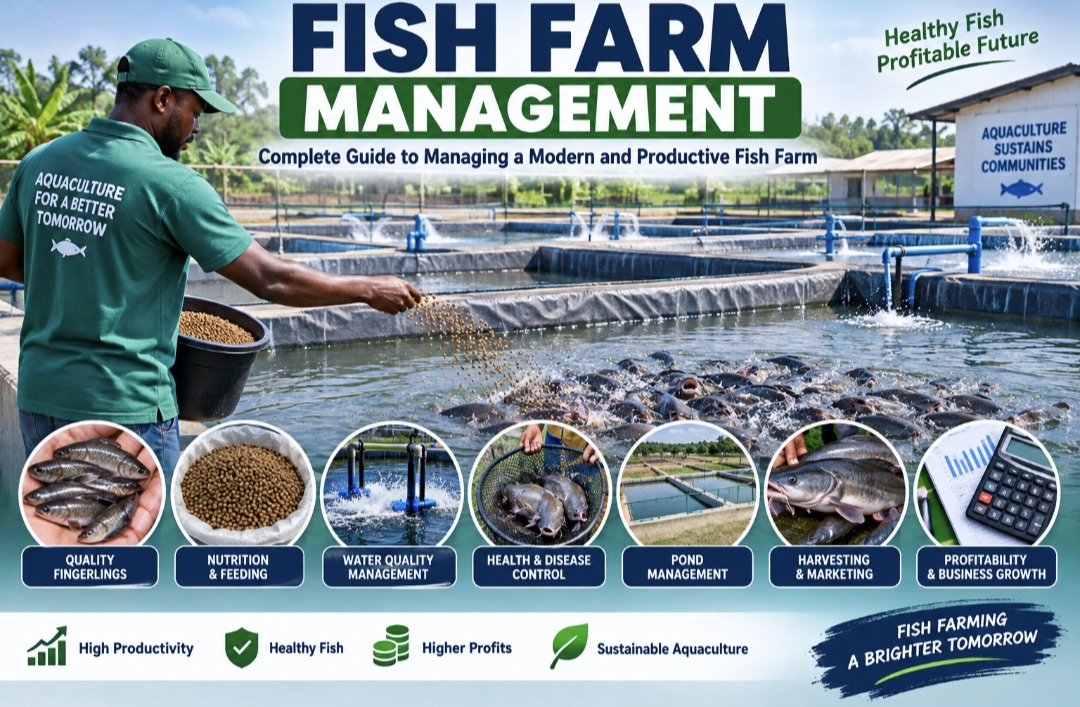
Fish farm management is the foundation of successful aquaculture. A productive fish farm requires much more than stocking fish in a pond and providing feed. Farmers must coordinate water quality, feeding, fish health, stocking density, infrastructure, labour, finances, harvesting, marketing and record keeping.
Whether a farm is small, medium-sized or highly commercialized, effective management helps turn resources into healthy fish and marketable products.
Modern aquaculture is increasingly becoming a data-driven business. Successful farmers monitor production performance, calculate biomass, track feed consumption, evaluate survival rates and make decisions based on measurable information rather than guesswork.
This comprehensive guide explains the major principles of fish farm management and provides a practical framework for running a productive, efficient and commercially sustainable aquaculture operation.
What Is Fish Farm Management?
Fish farm management is the organized planning, operation and supervision of all activities involved in producing and selling farmed fish.
It includes:
- Farm planning
- Species selection
- Stocking
- Feeding
- Water-quality management
- Fish health
- Biosecurity
- Stocking-density management
- Labour management
- Equipment maintenance
- Financial management
- Harvesting
- Processing
- Marketing
- Record keeping
- Risk management
Good management connects all these areas into one production system.
Why Fish Farm Management Is Important
Poor management can result in:
- Slow fish growth
- Feed wastage
- Poor water quality
- Disease outbreaks
- High mortality
- Increased production costs
- Low harvest weight
- Poor customer satisfaction
- Financial losses
Effective management can improve:
- Fish survival
- Growth rate
- Feed efficiency
- Water quality
- Production consistency
- Labour productivity
- Customer satisfaction
- Profitability
Setting Clear Fish Farm Objectives
Before starting or expanding a fish farm, the owner should define clear objectives.
Possible objectives include:
- Producing fish for household consumption
- Selling fresh fish
- Producing fingerlings
- Producing table-size fish
- Supplying restaurants
- Producing smoked fish
- Supplying wholesalers
- Developing a branded fish business
- Building an integrated aquaculture operation
Clear objectives make planning easier.
Choosing the Right Fish Species
Species selection is one of the first management decisions.
Potential aquaculture species include:
- Catfish
- Tilapia
- Carp
- Trout
- Salmon
- Barramundi
- Pangasius
- Eel
- Milkfish
- Various freshwater and marine species
The appropriate species depends on:
- Climate
- Water conditions
- Market demand
- Availability of fingerlings
- Feed availability
- Farm infrastructure
- Farmer expertise
- Local regulations
Understanding the Biology of the Farmed Fish
Farm managers should understand the basic biology of their chosen species.
Important characteristics include:
- Growth rate
- Feeding behaviour
- Temperature requirements
- Oxygen requirements
- Reproductive characteristics
- Disease susceptibility
- Harvest size
- Environmental tolerance
Understanding fish biology improves daily decision-making.
Choosing the Right Farm Location
Farm location can affect long-term profitability.
Important considerations include:
- Reliable water supply
- Land suitability
- Accessibility
- Electricity
- Security
- Proximity to markets
- Drainage
- Flood risk
- Availability of labour
- Availability of feed
- Transportation
A cheap site can become expensive if transportation and infrastructure costs are excessive.
Water Supply Management
Water is one of the most important resources in aquaculture.
The farm should have an adequate supply of suitable water.
Water sources may include:
- Boreholes
- Wells
- Springs
- Rivers
- Lakes
- Reservoirs
- Rainwater
- Municipal supplies
Water should be assessed for suitability before being used for intensive fish production.
Water Quality Management
Fish live in their water environment, so water quality directly affects their health and growth.
Important parameters include:
- Dissolved oxygen
- Temperature
- pH
- Ammonia
- Nitrite
- Alkalinity
- Salinity where applicable
- Water clarity
- Carbon dioxide
The ideal conditions vary according to species and production system.
Dissolved Oxygen Management
Dissolved oxygen is essential for fish respiration.
Oxygen demand increases as:
- Fish biomass increases
- Feeding increases
- Water temperature changes
- Organic matter accumulates
Aeration systems can help maintain oxygen availability.
Fish Farm Aeration
Aeration may be provided by:
- Paddlewheel aerators
- Air blowers
- Diffusers
- Air stones
- Surface aerators
- Venturi systems
The correct system depends on farm design.
High-density farms generally require greater oxygen-management capacity than low-density systems.
Backup Power
Electricity-dependent fish farms should have contingency plans for power interruptions.
Possible backup systems include:
- Generators
- Battery systems
- Solar power
- Backup aerators
- Emergency oxygen equipment
This is particularly important in intensive systems.
Temperature Management
Temperature affects fish:
- Metabolism
- Appetite
- Growth
- Oxygen consumption
- Disease susceptibility
Farmers should understand the temperature requirements of their species and avoid unnecessary temperature stress.
pH Management
pH affects fish health and water chemistry.
Sudden changes can stress fish.
Regular monitoring can help farmers detect changes before they become serious.
Ammonia Management
Ammonia is produced through fish waste and decomposition of organic material.
Excessive ammonia can negatively affect fish.
Management measures may include:
- Avoiding overfeeding
- Controlling stocking density
- Removing waste
- Maintaining biological filtration
- Conducting appropriate water exchange
- Monitoring water quality
Nitrite Management
Nitrite can accumulate when biological filtration is insufficient or when waste production exceeds system capacity.
Regular testing and proper filtration can help manage nitrite.
Managing Stocking Density
Stocking density should match the production system.
The farmer should consider:
- Number of fish
- Fish size
- Water volume
- Oxygen capacity
- Filtration
- Water exchange
- Feed input
- Expected harvest weight
A system should not be stocked beyond what it can reliably support.
Calculating Fish Biomass
Biomass is the total weight of fish in the production system.
The formula is:
Biomass = Number of fish × Average fish weight
For example:
5,000 fish × 0.2 kg average weight
= 1,000 kg biomass
Biomass information helps farmers adjust feeding and monitor production capacity.
Monitoring Fish Growth
Fish growth should be measured rather than assumed.
Farmers can periodically sample fish and record:
- Average weight
- Length
- Size variation
- Growth rate
- Mortality
Sampling should be done carefully to minimize stress.
Fish Feeding Management
Feed management is one of the largest components of fish-farming economics.
Good feeding management means providing enough nutrition without unnecessary waste.
Factors influencing feeding include:
- Species
- Fish size
- Biomass
- Temperature
- Water quality
- Feed quality
- Fish appetite
Feeding Frequency
Feeding frequency depends on:
- Species
- Age
- Fish size
- Production system
- Feed type
- Farm management strategy
Smaller fish may require different feeding schedules from larger fish.
Farmers should follow appropriate feeding recommendations for their species and production system.
Avoiding Feed Waste
Feed waste increases costs and contributes to poor water quality.
Farmers should avoid feeding more than fish can consume appropriately.
Signs of potential overfeeding may include:
- Uneaten feed
- Cloudy water
- Excessive organic matter
- Rising ammonia
- Poor water quality
Feed Conversion Ratio
Feed conversion ratio, or FCR, is an important production indicator.
A simplified formula is:
FCR = Feed consumed ÷ Fish weight gained
For example, if 1,200 kg of feed produces 800 kg of fish weight gain:
1,200 ÷ 800 = 1.5 FCR
Lower feed usage per unit of fish gain generally indicates better feed efficiency, although the appropriate benchmark varies by species and production conditions.
Choosing Quality Fish Feed
Good feed should provide appropriate:
- Protein
- Energy
- Lipids
- Vitamins
- Minerals
- Amino acids
The formulation should match the nutritional requirements of the species and life stage.
Fish Health Management
Fish health management focuses on preventing problems rather than waiting for disease to become severe.
Important practices include:
- Good water quality
- Proper nutrition
- Appropriate stocking density
- Quarantine
- Biosecurity
- Regular observation
- Prompt response to unusual behaviour
Recognizing Unhealthy Fish
Farmers should watch for:
- Loss of appetite
- Unusual swimming
- Surface gasping
- Skin lesions
- Abnormal colour
- Fin damage
- Swollen abdomen
- Excessive mucus
- Sudden mortality
These signs may have different causes, including water-quality problems, parasites, bacterial disease, nutritional issues or stress.
Fish Disease Prevention
Disease prevention can involve:
- Quality fingerlings
- Good water management
- Proper nutrition
- Appropriate density
- Quarantine
- Equipment hygiene
- Removing dead fish
- Limiting unnecessary movement between ponds
Farmers should seek professional veterinary or aquaculture advice when serious disease is suspected.
Biosecurity on Fish Farms
Biosecurity reduces the introduction and spread of pathogens.
Important measures include:
- Controlling farm access
- Cleaning equipment
- Separating production units where practical
- Quarantining new fish
- Avoiding unnecessary fish movement
- Removing dead fish properly
- Maintaining good hygiene
Managing Dead Fish
Dead fish should be removed promptly.
Leaving dead fish in a pond or tank can contribute to:
- Water-quality deterioration
- Increased pathogen load
- Attraction of predators
- Reduced farm hygiene
Disposal should follow appropriate local environmental and biosecurity requirements.
Fish Farm Cleaning
Cleanliness is essential.
Farmers should regularly inspect:
- Tanks
- Ponds
- Pipes
- Filters
- Nets
- Feed storage
- Processing areas
- Storage rooms
Cleaning schedules should be documented where appropriate.
Pond Management
Earthen ponds require particular attention to:
- Water depth
- Leaks
- Embankments
- Inlet structures
- Outlet structures
- Vegetation
- Predators
- Sludge
- Water quality
Regular inspections can prevent small problems from becoming expensive failures.
Tank Management
Tank systems require monitoring of:
- Water flow
- Water level
- Aeration
- Drainage
- Filtration
- Tank cleanliness
- Fish biomass
Tank farms can be highly productive but often require closer technical management.
Recirculating Aquaculture System Management
RAS farms require careful control of:
- Mechanical filtration
- Biological filtration
- Water circulation
- Dissolved oxygen
- Temperature
- Ammonia
- Nitrite
- Carbon dioxide
- Pump operation
Because RAS systems depend heavily on mechanical and biological equipment, equipment failure can become a major risk.
Fish Cage Farm Management
Cage farms require monitoring of:
- Cage structure
- Net condition
- Water flow
- Fish health
- Feed
- Predators
- Theft
- Weather
- Oxygen
Cages should be inspected regularly for damage.
Managing Fish Fingerlings
Fingerling quality has a major influence on production outcomes.
Good fingerlings should generally be:
- Active
- Healthy
- Uniform
- Appropriately sized
- Free from obvious disease
- From a reliable source
Farmers should maintain records of fingerling purchases.
Acclimating Fingerlings
Fish should be acclimated appropriately before being released into a new production environment.
Differences in:
- Temperature
- pH
- Salinity
- Water chemistry
can cause stress.
Fish Grading
Grading separates fish by size.
It can help:
- Reduce competition
- Improve feeding
- Increase size uniformity
- Manage cannibalism where applicable
- Improve harvesting
- Create different market categories
Fish Harvest Management
Harvesting should be planned rather than improvised.
Before harvesting, farmers should prepare:
- Buyers
- Equipment
- Labour
- Ice
- Containers
- Weighing equipment
- Transport
- Processing facilities
Partial Harvesting
Partial harvesting can reduce biomass while generating revenue.
It may be useful when:
- Fish reach market size at different times
- The system becomes crowded
- Market demand appears
- The farmer needs cash flow
Complete Harvesting
Complete harvesting is normally conducted when the production cycle is finished or when the pond needs to be prepared for a new cycle.
Fish Processing Management
Farmers can sell fish:
- Whole
- Gutted
- Cleaned
- Frozen
- Smoked
- Dried
- Filleted
- Portion-sized
Processing decisions should be based on customer demand and economics.
Fish Storage
Fish storage must protect product quality.
Fresh fish generally requires appropriate chilling.
Frozen fish requires consistent freezing conditions.
Processed products require storage conditions appropriate to their characteristics.
Cold Chain Management
The cold chain covers:
Harvest → Chilling → Processing → Storage → Transportation → Customer
Any weak point can affect product quality.
Fish Farm Labour Management
Workers are responsible for many critical tasks.
Roles can include:
- Farm manager
- Fish technicians
- Feed workers
- Pond attendants
- Harvest workers
- Processing workers
- Drivers
- Sales personnel
- Security staff
Job responsibilities should be clearly defined.
Training Fish Farm Workers
Workers should understand:
- Feeding procedures
- Water-quality monitoring
- Fish handling
- Biosecurity
- Equipment operation
- Safety
- Record keeping
- Emergency procedures
Training reduces avoidable mistakes.
Daily Fish Farm Management Routine
A daily routine may include:
Morning inspection
Check:
- Fish behaviour
- Water level
- Aeration
- Equipment
- Mortality
- Water quality
Feeding
Provide the planned quantity and observe fish response.
Midday inspection
Check:
- Temperature
- Oxygen where possible
- Water flow
- Fish behaviour
Evening inspection
Check:
- Fish activity
- Aeration
- Feed response
- Equipment
Record keeping
Record all important observations and activities.
Weekly Fish Farm Management Routine
Weekly tasks may include:
- Fish sampling
- Biomass estimation
- Feed review
- Equipment inspection
- Water-quality analysis
- Stock records
- Mortality analysis
- Financial review
- Marketing review
Monthly Fish Farm Management Routine
Monthly management can include:
- Production analysis
- Financial statements
- Feed efficiency analysis
- Customer review
- Equipment maintenance
- Staff performance
- Market analysis
- Risk assessment
- Production planning
Fish Farm Record Keeping
Good records are essential for professional management.
Records can include:
- Stocking date
- Number stocked
- Fingerling size
- Fingerling source
- Feed quantity
- Feed cost
- Mortality
- Water-quality measurements
- Treatments
- Sampling results
- Harvest weight
- Selling price
- Labour expenses
- Electricity costs
- Transportation costs
Financial Management
A fish farm should be managed as a business.
Farmers should know:
- Total investment
- Operating costs
- Revenue
- Gross margin
- Net profit
- Cash flow
- Cost per kilogram
- Break-even point
- Return on investment
Fixed Costs
Fixed costs may include:
- Land
- Ponds
- Tanks
- Buildings
- Pumps
- Equipment
- Processing facilities
These costs may not change directly with the number of fish produced during a particular production cycle.
Variable Costs
Variable costs can include:
- Fingerlings
- Feed
- Labour
- Electricity
- Water
- Medication or approved treatments
- Packaging
- Transportation
- Ice
These generally change with production activity.
Calculating Cost Per Kilogram
A useful management metric is:
Cost per kilogram = Total production cost ÷ Marketable fish produced
For example:
Total production cost = $8,000
Marketable fish = 4,000 kg
Cost per kilogram:
$8,000 ÷ 4,000 = $2 per kg
If fish sell for an illustrative $3 per kg, the difference is $1 per kg before other business-level considerations.
Actual results vary according to farm conditions and market prices.
Break-Even Analysis
Break-even analysis identifies the level of sales required to cover costs.
A simplified calculation is:
Break-even quantity = Fixed costs ÷ Contribution per unit
For example, if fixed costs are $2,000 and contribution per kilogram is $1:
$2,000 ÷ $1 = 2,000 kg
This means approximately 2,000 kg would be required to cover the stated fixed-cost contribution under those assumptions.
Cash Flow Management
A profitable farm can still experience cash-flow problems.
Fish farming often requires expenses before fish are ready for sale.
Cash may be needed for:
- Fingerlings
- Feed
- Labour
- Electricity
- Water
- Maintenance
- Transportation
Farmers should maintain sufficient working capital.
Fish Feed Inventory Management
Feed should be stored properly.
Storage areas should be:
- Dry
- Clean
- Well ventilated
- Protected from pests
- Protected from moisture
Old feed should not be allowed to accumulate unnecessarily.
Equipment Maintenance
Equipment should be maintained before failure occurs.
Important equipment includes:
- Pumps
- Aerators
- Generators
- Pipes
- Filters
- Nets
- Weighing scales
- Freezers
- Vehicles
Preventive maintenance can reduce downtime.
Fish Farm Security
Security can be an important management issue.
Potential risks include:
- Fish theft
- Equipment theft
- Unauthorized access
- Vandalism
- Predators
Security measures may include:
- Fencing
- Controlled access
- Lighting
- Security personnel
- Cameras where appropriate
- Inventory records
Predator Management
Potential predators can include:
- Birds
- Snakes
- Frogs
- Other aquatic animals
- Terrestrial predators
Management should be appropriate to the species and local environment and should avoid unnecessary harm to wildlife.
Managing Farm Waste
Fish farms generate:
- Sludge
- Uneaten feed
- Dead fish
- Processing waste
- Wastewater
Waste should be managed responsibly to minimize environmental impacts.
Environmental Management
Responsible aquaculture should consider:
- Water discharge
- Nutrient loading
- Waste disposal
- Energy use
- Feed efficiency
- Escapes
- Habitat impacts
Farmers should follow relevant environmental requirements.
Fish Escape Prevention
Escaped farmed fish can create economic and ecological problems.
Farmers should inspect:
- Pond outlets
- Screens
- Pipes
- Cage nets
- Drainage structures
after heavy rain, storms or maintenance activities.
Managing Farm Risks
Important fish-farm risks include:
- Disease
- Poor water quality
- Power failure
- Flooding
- Drought
- Feed-price increases
- Fish theft
- Low market prices
- Equipment failure
- Poor fingerling quality
A risk-management plan should identify these risks before they occur.
Emergency Planning
A farm should have emergency procedures for situations such as:
- Power outage
- Oxygen shortage
- Fish mortality
- Flooding
- Equipment breakdown
- Water contamination
- Disease outbreak
- Security incidents
Workers should know who to contact and what actions to take.
Fish Farm Insurance
Where available and appropriate, insurance can help protect against certain risks.
Coverage varies by provider and jurisdiction.
Farmers should understand:
- What is covered
- What is excluded
- Deductibles
- Claim procedures
- Maximum coverage
Insurance should complement, not replace, good management.
Farm Biosecurity Plan
A biosecurity plan can define:
- Visitor procedures
- Equipment sanitation
- Fish movement
- Quarantine
- Mortality disposal
- Water-source management
- Disease reporting
Written procedures are particularly useful as farms become larger.
Fish Farm Marketing Management
Production and marketing should be connected.
Farm managers should know:
- Expected harvest quantity
- Target customers
- Expected market price
- Preferred fish size
- Delivery requirements
- Processing needs
This prevents production from becoming disconnected from demand.
Managing Customer Relationships
Good customer service can improve repeat business.
Farmers should:
- Respond promptly
- Deliver agreed quantities
- Maintain quality
- Communicate delays
- Handle complaints professionally
- Keep accurate order records
Production Planning
A production plan should define:
- Stocking dates
- Expected growth period
- Feeding plan
- Sampling dates
- Harvest target
- Expected production
- Sales plan
Production planning makes resource management easier.
Staggered Production
Large farms can use staggered production cycles.
Instead of stocking every production unit at once, different ponds or tanks can be stocked at different times.
Advantages may include:
- Regular harvests
- Continuous sales
- Better cash flow
- More consistent labour requirements
- More consistent market supply
Fish Farm Expansion
Expansion should be based on proven management capacity.
Before increasing production, evaluate:
- Market demand
- Water supply
- Feed availability
- Labour
- Equipment
- Capital
- Processing
- Storage
- Transportation
Increasing fish numbers without increasing supporting infrastructure can create management problems.
Measuring Farm Performance
Important performance indicators include:
- Survival rate
- Average harvest weight
- Total biomass
- Feed conversion ratio
- Cost per kilogram
- Mortality rate
- Production per pond
- Revenue
- Gross margin
- Net profit
- Customer retention
Survival Rate
Survival rate is:
Surviving fish ÷ Initially stocked fish × 100
For example:
Initial stock = 10,000 fish
Harvested = 9,000 fish
Survival:
9,000 ÷ 10,000 × 100 = 90%
Average Harvest Weight
Average harvest weight is:
Total harvested biomass ÷ Number of fish harvested
For example:
Harvest biomass = 4,000 kg
Fish harvested = 8,000
Average weight:
4,000 ÷ 8,000 = 0.5 kg
Production Efficiency
Production efficiency improves when the farm produces more marketable fish with fewer wasted resources.
Important areas include:
- Feed efficiency
- Survival
- Labour productivity
- Water use
- Energy use
- Equipment utilization
Digital Fish Farm Management
Technology can simplify farm management.
Farmers can use:
- Spreadsheets
- Mobile applications
- Digital scales
- Water-quality sensors
- Automatic feeders
- Digital accounting systems
- Customer-management tools
Digital records can make trends easier to identify.
Using Data to Improve Fish Farming
Data can answer important questions:
- Which pond performs best?
- Which feed gives better results?
- When is mortality highest?
- Which customers buy most?
- What is the actual cost per kilogram?
- Which production cycle was most efficient?
Data-based decisions are generally more reliable than memory alone.
Fish Farm Budgeting
Before each production cycle, prepare a budget.
Include:
Fingerlings
Expected quantity and cost.
Feed
Estimated quantity and cost.
Labour
Expected labour expenses.
Water and electricity
Expected operating costs.
Health and biosecurity
Expected costs.
Processing
Estimated harvesting and processing expenses.
Marketing
Advertising, packaging and transportation.
Contingency
Reserve funds for unexpected expenses.
Contingency Planning
Farmers should maintain a reserve for unexpected expenses.
Possible emergencies include:
- Equipment breakdown
- Sudden mortality
- Feed price changes
- Emergency water replacement
- Transportation problems
- Repairs
The amount required depends on the scale and risk profile of the farm.
Sustainable Fish Farm Management
Sustainable management focuses on producing fish efficiently without unnecessarily damaging the environment.
Important principles include:
- Efficient feed use
- Responsible water management
- Waste reduction
- Appropriate stocking density
- Proper fish health management
- Responsible sourcing of inputs
- Prevention of escapes
- Appropriate energy use
Improving Fish Farm Productivity
Productivity can be improved through:
- Better fingerlings
- Better feed
- Improved water quality
- Appropriate stocking density
- Better record keeping
- Staff training
- Preventive maintenance
- Improved harvesting
- Stronger marketing
Farmers should improve one system at a time and measure the result.
Common Fish Farm Management Mistakes
Overstocking
Keeping more fish than the system can support can create water-quality and health problems.
Overfeeding
Excess feed wastes money and can pollute water.
Poor Record Keeping
Without records, farmers may not know whether the business is actually profitable.
Ignoring Water Quality
Water problems can quickly affect fish health and growth.
Buying Poor-Quality Fingerlings
Poor fingerlings can undermine an entire production cycle.
No Backup Power
Intensive systems can be vulnerable to power failure.
Mixing Fish of Very Different Sizes
Size differences can create feeding competition and other management challenges.
Ignoring the Market
Producing fish without understanding customer demand can create marketing problems.
Poor Biosecurity
Moving contaminated equipment or fish between production units can spread disease.
Neglecting Equipment
Equipment failure can become expensive when maintenance is delayed.
Expanding Too Quickly
Rapid expansion without sufficient capital, management skills or infrastructure can increase risk.
Practical Fish Farm Management Checklist
A farmer can use the following checklist:
Daily
- Inspect fish
- Check water
- Check aeration
- Check equipment
- Feed appropriately
- Remove dead fish
- Record important observations
Weekly
- Sample fish
- Estimate biomass
- Review feed consumption
- Inspect infrastructure
- Review mortality
- Check water-quality records
Monthly
- Review financial performance
- Calculate production indicators
- Review customers
- Inspect major equipment
- Review staff performance
- Update the production plan
Before Harvest
- Confirm buyers
- Confirm fish size
- Prepare equipment
- Prepare ice
- Arrange labour
- Arrange transport
- Prepare packaging
After Harvest
- Record total production
- Calculate survival
- Calculate average weight
- Calculate revenue
- Calculate costs
- Analyze profitability
- Review lessons for the next cycle
Building a Professional Fish Farm Management System
A professional management system should connect:
Production + Water + Feed + Fish Health + Labour + Finance + Marketing + Records
These areas should not be managed independently.
For example, marketing determines the desired harvest size, which influences the production cycle. Production determines biomass, which influences feed requirements. Feed affects waste production, which affects water quality. Water quality affects fish health and growth, which affects harvest weight and profitability.
Everything is connected.
Final Thoughts
Fish farm management is the central system that brings every part of aquaculture together.
Successful fish farming requires more than purchasing fingerlings and feeding them until harvest. Farmers must manage water, fish health, feeding, stocking density, infrastructure, workers, finances, harvesting and marketing as interconnected components of one business.
Good management begins with planning. Before stocking fish, the farmer should understand the production system, available resources, expected market, operating costs and potential risks.
During production, the farmer should monitor fish behaviour, water quality, biomass, feed consumption and mortality. Regular records allow problems to be detected early and provide information for improving future production cycles.
Financial management is equally important. Farmers should know the cost of producing each kilogram of fish, the amount of feed used, the survival rate, the selling price and the resulting profit or loss.
Marketing should also be integrated into farm management. A production system designed around actual customer demand is more likely to have a clear route to market than one based entirely on production capacity.
Modern technology can further improve management through digital records, water-quality sensors, automatic feeding, monitoring systems and farm-management software.
Ultimately, the goal of fish farm management is not simply to produce more fish. It is to produce healthy, high-quality fish efficiently, safely and consistently while controlling costs and maintaining a reliable market.
A well-managed fish farm can become a structured agricultural enterprise in which production, finance, marketing and customer service work together. By continuously measuring performance, correcting problems and improving management practices, farmers can build stronger and more sustainable aquaculture businesses.
Latest posts
- Poultry Meat Benefits to Humanity: Complete Guide to Its Nutritional, Economic and Social Importance

- Tilapia Farming: Complete Guide to Raising Tilapia for Commercial Production

- Fish Pond Construction: Complete Guide to Designing and Building a Modern Fish Pond
- Grazing Livestock Farming Business: Complete Guide to Starting and Making Profit

- Commercial Cattle Farming: Complete Guide to Raising Cattle for Profit

- Goat Farming Business: Complete Guide to Meat and Breeding Production
- Sheep Farming: Complete Guide to Raising Sheep for Commercial Profit

- Modern Pasture Farming: How to Grow High-Quality Livestock Feed