Introduction
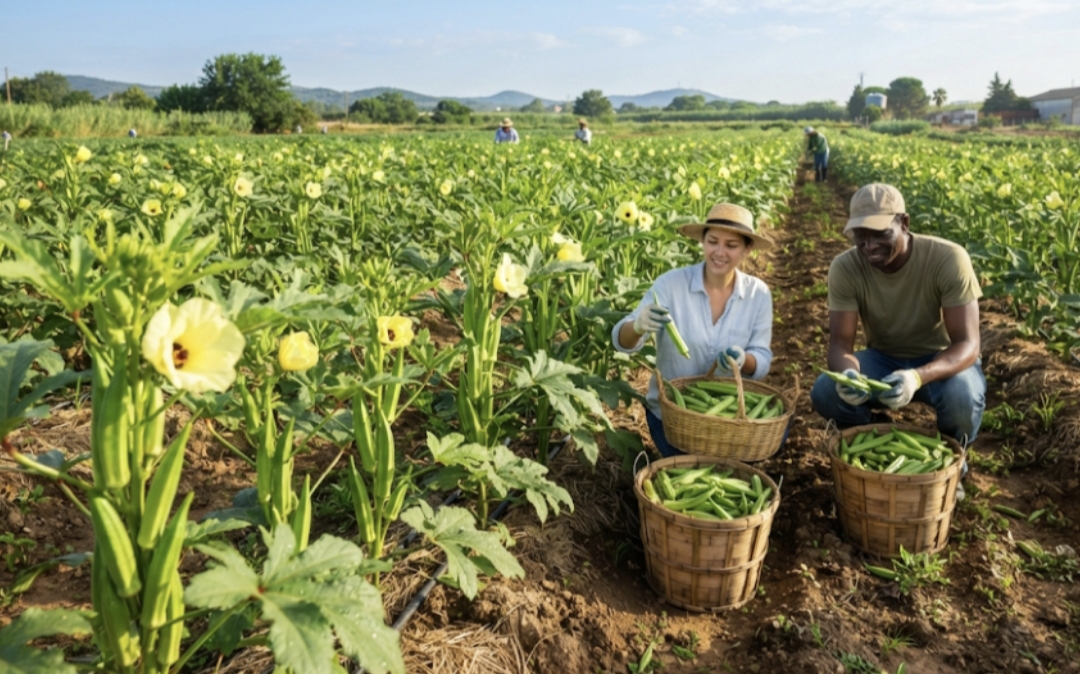
Okra farming is one of the promising vegetable farming opportunities in Africa because the crop grows relatively quickly, can perform well in warm climates and has strong demand in many local and regional food markets. Okra is consumed in different forms, including fresh, dried and processed products, making it a versatile crop for smallholder farmers, commercial growers and agribusiness entrepreneurs.
The scientific name of okra is Abelmoschus esculentus. It belongs to the Malvaceae family and is cultivated primarily for its edible immature green pods. The pods are commonly used in soups, stews, sauces and other dishes.
Commercial okra farming can generate income when farmers select suitable varieties, prepare the soil correctly, plant at the appropriate time, manage water and nutrients effectively, control pests and diseases, harvest regularly and establish reliable markets.
One of the major advantages of okra is its continuous harvesting potential. Unlike crops that are harvested once, okra pods can be harvested repeatedly over several weeks when plants are properly managed. This creates opportunities for farmers to generate recurring income from the same field.
This guide explains how to grow okra for profit in Africa, covering land selection, climate, soil preparation, seed selection, planting, spacing, irrigation, fertilization, weed management, pest and disease control, harvesting, post-harvest handling, marketing and profitability.
Why Okra Farming Is Profitable in Africa
Okra farming can be attractive because of the crop's relatively short production cycle and strong consumer demand.
The crop is commonly consumed by households and food businesses across many African markets. Demand can come from open markets, restaurants, food vendors, supermarkets, wholesalers and processors.
Another advantage is that okra can be grown on relatively small plots. This makes it possible for new farmers to start on a manageable scale before expanding.
Okra also provides multiple harvesting opportunities. Once the plants begin producing pods, farmers can harvest repeatedly rather than waiting for one single harvest date.
The crop can also be marketed fresh or dried, giving farmers more than one potential sales channel.
Understanding the Okra Plant
Okra is a warm-season annual crop in most commercial production systems.
The plant produces an upright stem with leaves, flowers and elongated seed pods.
The edible pods are normally harvested while they are still young and tender. If harvesting is delayed, the pods can become fibrous and unsuitable for some fresh-food markets.
Okra plants can vary considerably in height, pod colour, pod shape, maturity period and yield depending on the variety.
Choosing the right variety is therefore one of the most important decisions in commercial production.
Climate Requirements for Okra
Okra is well suited to warm climates and generally performs best where temperatures remain sufficiently warm throughout the growing period.
The crop requires adequate sunlight for strong growth and pod production.
Extremely cold conditions can slow germination, plant growth and flowering.
In many African production areas, okra can be grown during warm seasons, while irrigation can allow farmers to extend production into periods when rainfall is limited.
Choosing the Right Location for Okra Farming
Select farmland with good sunlight, suitable soil and access to water.
The location should preferably have:
- Good drainage
- Reliable water supply
- Adequate sunlight
- Fertile soil
- Easy road access
- Availability of labour
- Access to agricultural inputs
- Reasonable proximity to markets
Because fresh okra is highly perishable, farms located close to urban markets can benefit from reduced transportation time.
However, farmers in rural locations can also be successful if they have reliable buyers and efficient transportation.
Soil Requirements for Okra
Okra can grow in different soil types but performs best in fertile, well-drained soil.
Loamy and sandy-loam soils can be suitable because they provide a balance between drainage, moisture retention and root development.
Avoid fields that remain waterlogged after rainfall.
Where possible, conduct a soil test before planting.
A soil test can help determine soil pH and nutrient availability and can guide fertilizer application.
Preparing the Land for Okra Farming
Begin by clearing weeds, bushes and unwanted vegetation.
Remove large roots, stones and other debris.
Plough or loosen the soil to create a suitable planting environment.
In smaller farms, beds or ridges can be prepared manually.
In areas with drainage problems, raised beds can help reduce waterlogging.
Incorporate well-decomposed organic matter into the soil where necessary.
Avoid applying fresh manure directly around seeds because it can damage germinating plants.
Selecting Quality Okra Seeds
Quality seeds are essential for commercial okra production.
Purchase seeds from reliable agricultural seed suppliers.
Look for varieties with characteristics that match your target market.
Important characteristics may include:
- Early maturity
- High yield potential
- Good pod quality
- Strong plant vigour
- Disease tolerance or resistance where available
- Market-preferred pod size
- Suitable pod colour
- Good harvesting period
Do not select seeds solely because they are cheap.
Poor-quality seed can result in poor germination, uneven plants and reduced yields.
Popular Types of Okra
Okra varieties differ in plant structure and pod characteristics.
Common types include green-podded varieties, red or burgundy-podded varieties and different regional cultivars.
Some varieties produce long pods, while others produce shorter and thicker pods.
The best variety depends on consumer preference and market requirements.
Before planting commercially, speak with local traders, restaurants and consumers to determine which type sells most easily.
Seed Treatment Before Planting
Okra seeds have a relatively hard seed coat, which can sometimes slow water absorption and germination.
Some farmers soak seeds in clean water for several hours before planting to encourage faster germination.
Where commercial seed treatments are available, farmers should follow the manufacturer's instructions.
Do not use unapproved chemicals or treatments that could create food-safety or environmental problems.
Direct Sowing of Okra Seeds
Okra is commonly established directly in the field.
Make shallow planting holes or furrows according to the selected spacing.
Place the recommended number of seeds in each hole and cover lightly with soil.
Avoid planting seeds too deeply.
After planting, provide sufficient moisture to support germination.
Best Time to Plant Okra in Africa
The ideal planting period varies across Africa because the continent contains many different climate zones.
Generally, planting should coincide with warm conditions suitable for germination and growth.
In rain-fed systems, farmers often plant when there is sufficient and dependable rainfall.
With irrigation, production can be extended into dry periods.
Farmers should consider their local rainfall pattern, temperature, soil type and market season before deciding when to plant.
Okra Plant Spacing
Proper spacing is essential for healthy plant development and efficient harvesting.
Spacing depends on the variety and production system.
A common commercial range may be approximately 30–60 cm between plants and 60–100 cm between rows, but farmers should follow the recommended spacing for their specific variety.
Overcrowding can reduce airflow and increase competition for water and nutrients.
Very wide spacing can reduce land-use efficiency.
How to Water Okra
Okra requires adequate moisture, particularly during germination, flowering and pod development.
However, excessive water can create root problems and encourage disease.
Irrigation is particularly important when rainfall is unreliable.
Possible irrigation methods include:
- Drip irrigation
- Sprinkler irrigation
- Furrow irrigation
- Hose irrigation
- Other suitable systems
Drip irrigation can help farmers deliver water directly to the root zone while reducing water wastage.
Irrigating Okra During the Dry Season
Dry-season okra production can provide an opportunity to supply markets when fresh vegetable availability may be lower.
However, successful dry-season farming requires reliable access to water.
Farmers should calculate the cost of irrigation before starting.
The irrigation system should be capable of providing adequate water throughout the production period.
Fertilizer Requirements for Okra
Okra requires nutrients for vegetative growth, flowering and pod development.
Important nutrients include nitrogen, phosphorus and potassium.
Nitrogen supports vegetative growth, while phosphorus and potassium contribute to root development, flowering and overall plant performance.
Excessive nitrogen should be avoided because it can encourage excessive leaf growth at the expense of productive balance.
A soil test should ideally guide fertilizer application.
Using Organic Manure for Okra
Well-decomposed poultry manure, cattle manure, compost or other suitable organic materials can improve soil fertility.
Organic matter can improve soil structure and water-holding capacity.
Apply manure before planting and incorporate it properly into the soil.
Fresh manure should not be placed directly against seeds or young roots.
Weed Management in Okra Farming
Weeds compete with okra plants for nutrients, water, sunlight and space.
Weed competition is particularly harmful during the early stages of growth.
Farmers can manage weeds through:
- Hand weeding
- Hoeing
- Mulching
- Mechanical cultivation
- Appropriate herbicides
Weeds should be controlled before they become well established.
If herbicides are used, only products approved for the crop and local conditions should be used according to their labels.
Mulching Okra
Mulching can help conserve soil moisture and reduce weed pressure.
Suitable mulch materials may include clean crop residues, straw or other appropriate materials.
Mulching can also reduce soil erosion and moderate soil temperature.
However, excessive mulch around the plant stem should be avoided.
Thinning Okra Plants
If several seedlings emerge in one planting hole, thinning may be necessary.
Remove weaker plants and retain healthy plants according to the recommended population for the selected variety.
Thinning reduces competition and allows remaining plants to develop more strongly.
Managing Okra Pests
Several pests can attack okra.
Common pests may include:
- Aphids
- Whiteflies
- Flea beetles
- Caterpillars
- Stink bugs
- Fruit and pod-feeding insects
- Spider mites
- Root-feeding insects
Farmers should inspect plants regularly.
Pay particular attention to young leaves, shoots, flowers and developing pods.
Signs of Pest Infestation
Common signs include:
- Holes in leaves
- Curled leaves
- Yellowing
- Sticky leaf surfaces
- Stunted plants
- Damaged flowers
- Scarred pods
- Visible insects
- Premature leaf drop
Early detection makes pest management easier and can prevent significant economic losses.
Integrated Pest Management for Okra
Integrated pest management combines several approaches.
Farmers can use:
- Healthy seeds
- Crop rotation
- Weed control
- Field sanitation
- Regular crop scouting
- Biological control
- Physical control
- Resistant varieties where available
- Approved pesticides when necessary
Avoid routine pesticide spraying without identifying the pest problem.
Unnecessary pesticide use can increase production costs and may harm beneficial organisms.
Common Diseases of Okra
Okra can be affected by fungal, bacterial and viral diseases.
Disease problems may become more severe under conditions of excessive moisture, poor airflow, contaminated planting materials or weak plants.
Possible symptoms include:
- Leaf spots
- Yellowing
- Wilting
- Leaf distortion
- Stunted growth
- Root problems
- Pod discoloration
Correct diagnosis is important before treatment.
Preventing Okra Diseases
Farmers can reduce disease risks by:
- Using healthy seeds
- Maintaining good drainage
- Avoiding excessive irrigation
- Providing adequate spacing
- Controlling weeds
- Removing severely diseased plants
- Practicing crop rotation
- Keeping tools and equipment clean
- Avoiding contaminated planting materials
Prevention is generally easier and less expensive than managing severe disease outbreaks.
Crop Rotation for Okra
Growing okra repeatedly on the same land can increase the risk of certain soil pests and diseases.
Where practical, rotate okra with crops from different plant families.
A well-planned rotation can improve soil management and reduce the buildup of certain problems.
Flowering and Pod Formation
Okra produces flowers before developing pods.
Successful flowering is therefore important for commercial yield.
Adequate sunlight, moisture and nutrition can support healthy flowering.
Stress caused by severe drought, excessive heat, poor fertility or pest damage can affect flowering and pod development.
How Long Does Okra Take to Mature?
The maturity period depends on the variety and growing conditions.
Some early varieties can begin producing pods within approximately two months after planting, while other varieties take longer.
Farmers should use the maturity information provided for their specific seed variety as a guide.
When to Harvest Okra
Okra pods should generally be harvested while they are young and tender.
Waiting too long can cause pods to become tough and fibrous.
Harvesting frequency may increase as plants enter their peak production period.
Regular harvesting is essential because mature pods left on the plant can reduce the plant's continued productivity.
How Often Should Okra Be Harvested?
Commercial okra farms may require harvesting every one to three days during periods of heavy production.
The exact frequency depends on variety, weather, plant health and market requirements.
Regular harvesting ensures that pods remain within the preferred market size.
How to Harvest Okra
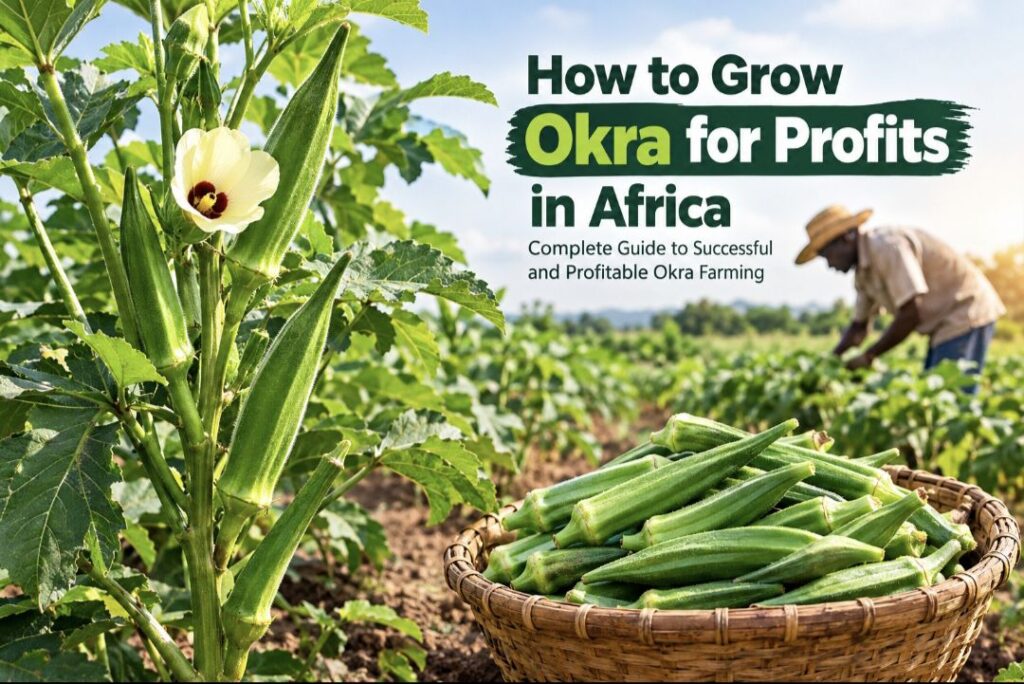
Use a clean knife or pruning tool where necessary.
Handle pods carefully to reduce physical damage.
Harvest marketable pods and separate damaged, diseased or over-mature pods.
Workers should use appropriate protective equipment because okra plants can sometimes cause skin irritation in sensitive individuals.
Post-Harvest Handling of Okra
Okra is perishable and can lose quality relatively quickly under unsuitable conditions.
After harvesting:
- Keep the produce away from excessive heat.
- Remove damaged pods.
- Sort according to size and quality.
- Avoid excessive compression.
- Use clean containers.
- Transport to the market promptly.
Good post-harvest handling can significantly improve the percentage of produce that reaches consumers in marketable condition.
Packaging Fresh Okra
Packaging should match the market.
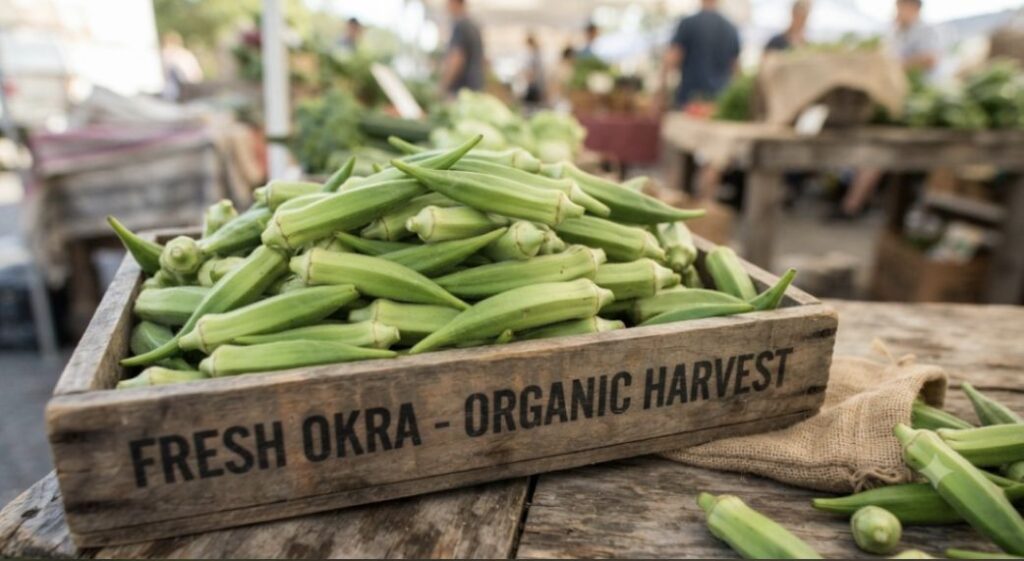
Small quantities may be packed in suitable baskets, crates or food-grade containers.
Supermarkets and premium customers may require standardized retail packages.
Packaging should protect pods from crushing while allowing appropriate ventilation.
Selling Fresh Okra
Potential markets include:
- Local markets
- Wholesale markets
- Restaurants
- Hotels
- Supermarkets
- Food vendors
- Caterers
- Vegetable distributors
- Food processors
Farmers should compare prices between different markets rather than automatically selling to the first available buyer.
Selling Dried Okra
Drying is another potential marketing strategy.
Dried okra can have a longer storage period than fresh pods when properly processed and stored.
Farmers can investigate local consumer preferences for dried products.
Commercial processing should follow appropriate food-safety and packaging requirements.
Finding Okra Buyers
Do not wait until harvest before searching for buyers.
Start contacting potential customers before planting.
Ask buyers:
- What quantity do you purchase?
- How often do you buy?
- What pod size do you prefer?
- Do you buy fresh or dried okra?
- What packaging do you require?
- What quality standards must suppliers meet?
- What are your payment terms?
This information can help farmers produce according to market demand.
Direct Sales to Restaurants
Restaurants can become valuable repeat customers.
A restaurant may prefer a farmer who can consistently supply fresh okra rather than one who delivers large quantities only occasionally.
Maintain consistent quality.
Deliver on schedule.
Keep communication open with customers.
Selling Okra to Supermarkets
Supermarkets may provide access to consumers willing to pay for clean, uniform and properly packaged produce.
However, supermarkets may have stricter quality requirements.
Farmers should understand the retailer's specifications before investing in specialized packaging.
Export Opportunities for Okra
Okra can potentially enter regional and international markets where demand exists.
However, export markets generally require stricter standards concerning:
- Quality
- Size
- Traceability
- Packaging
- Food safety
- Pesticide residues
- Cold-chain management
- Documentation
Farmers interested in exports should work with experienced produce exporters and understand the requirements of the destination market before production.
Okra Farm Record Keeping
Record keeping is essential for profitable farming.
Keep records of:
- Seed quantity
- Seed costs
- Land preparation
- Labour
- Fertilizer
- Irrigation
- Crop protection
- Harvest quantity
- Marketable harvest
- Selling prices
- Packaging
- Transportation
- Total revenue
- Net profit
Records allow farmers to determine the actual cost of producing each kilogram of okra.
Calculating Okra Farm Profit
The basic formula is:
Total Revenue = Total Marketable Produce × Average Selling Price
For example, suppose a farmer produces 4,000 kg of marketable okra.
If the average selling price is $1.20 per kg:
4,000 kg × $1.20 = $4,800
If total production and marketing costs are $2,700:
Net Profit = $4,800 − $2,700 = $2,100
This is only an illustrative example. Actual prices, yields and costs vary significantly across African countries, regions, seasons and farming systems.
Calculating Break-Even Point
The break-even point shows how much produce must be sold to recover production costs.
Suppose total costs are $2,700 and the average selling price is $1.20 per kg.
Break-even quantity:
$2,700 ÷ $1.20 = 2,250 kg
The farmer would therefore need to sell approximately 2,250 kg at $1.20 per kg to recover the assumed $2,700 cost.
How to Increase Okra Farm Profit
Farm profitability can potentially be improved by:
- Selecting productive varieties
- Improving seed germination
- Maintaining good plant populations
- Using efficient irrigation
- Controlling weeds early
- Managing pests promptly
- Reducing post-harvest losses
- Selling directly to reliable buyers
- Improving packaging
- Exploring dry-season production
- Adding value through processing
- Keeping accurate financial records
Farmers should focus on producing marketable pods efficiently rather than simply maximizing the number of plants.
Starting Okra Farming on a Small Scale
New farmers should consider starting with a manageable plot.
Small-scale production allows you to learn:
- Which varieties perform best
- Which planting period works best
- How much labour is required
- Which pests are common
- Which buyers offer good prices
- How quickly the crop matures
- What quality consumers prefer
After gaining experience, farmers can expand gradually.
Large-Scale Commercial Okra Farming
Large-scale production requires professional planning.
A commercial operation may require:
- Land
- Reliable irrigation
- Quality seeds
- Farm machinery or equipment
- Labour
- Fertilizer
- Crop-protection products
- Harvesting containers
- Packaging
- Transportation
- Storage
- Reliable buyers
Large farms should avoid planting more than they can realistically market.
Dry-Season Okra Farming
Dry-season production can be commercially attractive where irrigation water is available.
During periods of low rainfall, some markets may experience changes in vegetable supply.
Farmers who can produce good-quality okra consistently during these periods may benefit from favourable prices.
However, profitability should be calculated after including irrigation and additional labour expenses.
Rainy-Season Okra Farming
Rain-fed production can reduce irrigation expenses, but excessive rainfall can create challenges.
Heavy rainfall may cause:
- Waterlogging
- Nutrient leaching
- Soil erosion
- Disease outbreaks
- Difficult field access
Farmers should use well-drained land and appropriate planting structures.
Greenhouse Okra Production
Okra can be cultivated under protected systems, but greenhouse production is not always necessary.
Greenhouses can provide greater control over environmental conditions, but they also require higher initial investment.
Before investing in protected cultivation, farmers should determine whether increased yield, quality or market price can justify the additional cost.
Organic Okra Farming
Organic okra production can be developed using organic production practices.
Potential practices include:
- Compost
- Properly processed manure
- Biological pest control
- Mechanical weed management
- Soil-building practices
- Approved organic inputs
Farmers intending to sell okra as certified organic should comply with the relevant certification standards in their target market.
Value Addition in Okra Farming
Value addition can create additional income opportunities.
Possible products include:
- Dried okra
- Okra powder
- Packaged fresh okra
- Frozen okra
- Processed vegetable mixes
The feasibility of each product depends on consumer demand, processing costs, food regulations and available equipment.
Sustainable Okra Farming
Sustainable farming practices can improve long-term productivity.
Farmers can promote sustainability by:
- Using water-efficient irrigation
- Maintaining soil organic matter
- Practicing crop rotation
- Reducing unnecessary pesticide applications
- Using fertilizer efficiently
- Controlling erosion
- Recycling suitable crop residues
- Reducing post-harvest waste
Sustainable production can also reduce unnecessary operating costs.
Common Mistakes in Commercial Okra Farming
Farmers should avoid several common mistakes.
These include:
- Planting poor-quality seeds
- Choosing a variety without considering the market
- Planting too closely
- Poor drainage
- Irregular irrigation
- Excessive fertilizer application
- Late weed control
- Ignoring pest problems
- Harvesting pods too late
- Poor post-harvest handling
- Planting a large area without confirmed buyers
- Failing to keep financial records
Avoiding these mistakes can significantly improve commercial performance.
How to Increase Okra Yield
To increase production:
- Use high-quality seeds.
- Select a suitable variety.
- Prepare fertile, well-drained soil.
- Plant at the correct time.
- Maintain appropriate spacing.
- Provide adequate moisture.
- Apply nutrients according to crop requirements.
- Control weeds early.
- Monitor pests regularly.
- Prevent diseases through good farm hygiene.
- Harvest young pods frequently.
- Minimize post-harvest losses.
- Develop reliable markets.
Creating a Commercial Okra Production Schedule
A production schedule helps farmers organize farm operations.
The schedule can include:
Land preparation: Clear and prepare the field before planting.
Planting: Establish seeds at the recommended spacing.
Early growth: Monitor germination, weeds and pests.
Vegetative growth: Maintain adequate moisture and nutrition.
Flowering: Monitor plant health and pest pressure.
Pod formation: Ensure adequate moisture and nutrients.
Harvesting: Pick pods regularly when they reach marketable size.
Post-harvest: Sort, package and transport quickly.
How to Build an Okra Farming Business Plan
A commercial okra business plan should include:
Farm size: Determine the amount of land available.
Production system: Choose rain-fed, irrigated or protected production.
Variety: Select varieties according to climate and market requirements.
Seed requirement: Determine the amount of seed needed.
Irrigation: Calculate water requirements and infrastructure costs.
Labour: Estimate costs for land preparation, planting, weeding, spraying, harvesting and packaging.
Inputs: Budget for fertilizer, manure and crop-protection products.
Expected production: Estimate realistic marketable yield.
Market: Identify buyers before planting.
Selling price: Use realistic market information.
Transportation: Include delivery costs.
Profit: Calculate expected revenue, expenses and net income.
The Importance of Market Research
Market research can make the difference between a profitable okra farm and a difficult farming experience.
Before planting, investigate:
- Current prices
- Seasonal price changes
- Major buyers
- Consumer preferences
- Competing farmers
- Transportation costs
- Packaging requirements
- Demand for fresh versus dried okra
Do not base your entire business plan on the highest price you see in a market.
Use realistic average prices and include the possibility of price fluctuations.
Building a Long-Term Okra Business
Successful commercial farming requires consistency.
Build relationships with buyers.
Produce uniform quality.
Keep accurate records.
Improve your production methods after every season.
Invest in irrigation where economically justified.
Reduce post-harvest losses.
Explore different marketing channels.
Most importantly, expand according to actual market demand.
Conclusion
Okra farming can be a profitable agricultural business in Africa when it is properly planned and professionally managed.
The crop is particularly attractive because it is suited to warm conditions and can provide repeated harvests over a production period. Farmers can sell fresh pods to consumers, markets, restaurants, supermarkets and other food businesses, while dried and processed products can provide additional marketing opportunities.
The foundation of successful okra farming is selecting quality seed and a variety suitable for both the growing environment and target market.
Farmers should prepare fertile, well-drained soil, plant at appropriate spacing, provide adequate moisture and nutrients, control weeds and monitor pests and diseases throughout the production cycle.
Harvesting is particularly important because okra pods can become tough and fibrous if left on the plant for too long. Regular harvesting encourages continued production and helps maintain the quality demanded by buyers.
Commercial farmers should also remember that producing a large harvest does not automatically guarantee a large profit. Production costs, market prices, transportation, packaging and post-harvest losses all affect the final result.
The best strategy is to identify buyers before planting, start at a manageable scale, keep detailed financial records and gradually expand as production and marketing experience increases.
With proper planning, good agronomic practices, efficient harvesting and strong market relationships, okra can become an important source of income for small-scale, medium-scale and large-scale farmers across suitable regions of Africa.
Read more;
- Poultry Meat Benefits to Humanity: Complete Guide to Its Nutritional, Economic and Social Importance

- Tilapia Farming: Complete Guide to Raising Tilapia for Commercial Production

- Fish Pond Construction: Complete Guide to Designing and Building a Modern Fish Pond

- Grazing Livestock Farming Business: Complete Guide to Starting and Making Profit

- Commercial Cattle Farming: Complete Guide to Raising Cattle for Profit

- Goat Farming Business: Complete Guide to Meat and Breeding Production

- Sheep Farming: Complete Guide to Raising Sheep for Commercial Profit

- Modern Pasture Farming: How to Grow High-Quality Livestock Feed

- Rotational Grazing: Complete Guide to Improving Livestock Production

- Commercial Livestock Breeding: How to Build a Productive Herd
- Livestock Farming in Africa: Opportunities, Challenges and Modern Solutions