Preface
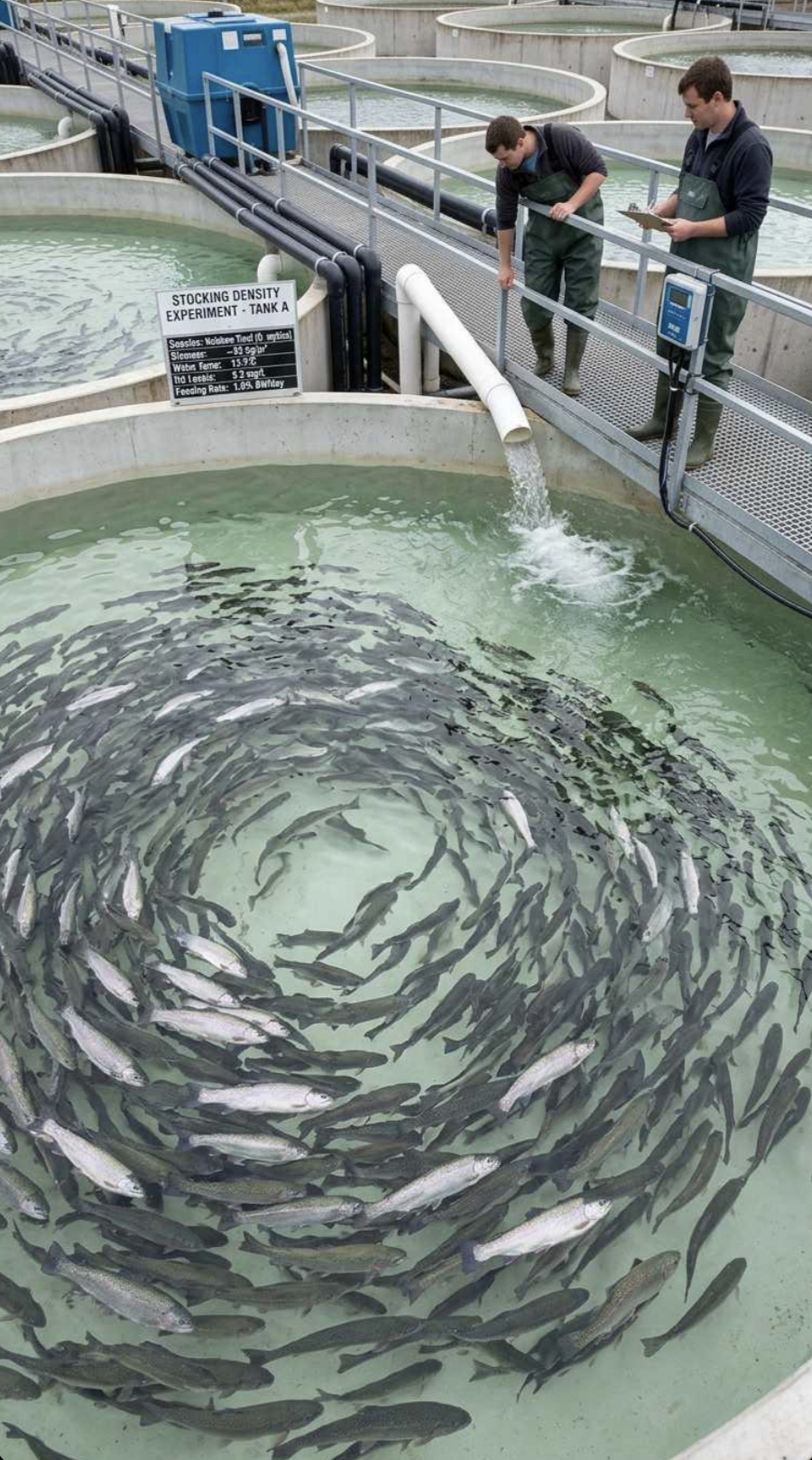
Fish stocking density is one of the most important factors that determines the productivity, health, growth rate and profitability of a fish farm. Whether you operate a small backyard pond, a commercial catfish farm, a tilapia farm, a fish hatchery, a tank-based system, a cage farm or a modern recirculating aquaculture system, the number of fish placed in a given production unit must be carefully planned.
Stocking too few fish can result in poor use of available space, water and infrastructure. On the other hand, stocking too many fish can place excessive pressure on water quality, oxygen availability, feed management, fish health and farm finances.
The ideal stocking density is therefore not simply the largest number of fish that can fit inside a pond or tank. It is the population that the production system can support while maintaining acceptable growth, survival, water quality, fish welfare and economic performance.
This comprehensive guide explains fish stocking density, how to calculate it, factors that influence it, how density affects fish growth and profitability, and how farmers can manage stocking throughout the production cycle.
What Is Fish Stocking Density?
Fish stocking density refers to the number or total biomass of fish kept within a specific volume or area of a production system.
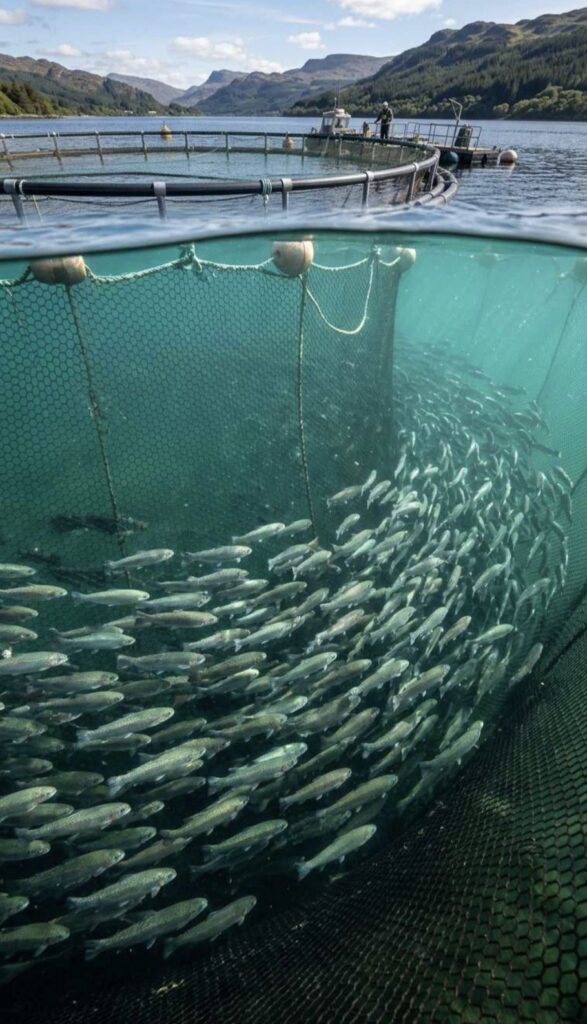
It can be expressed in several ways, including:
- Fish per square metre
- Fish per cubic metre
- Kilograms of fish per cubic metre
- Kilograms of fish per square metre
- Number of fish per pond
- Number of fish per tank
- Fish per cage
- Biomass per production unit
For example, if a farmer stocks 2,000 fish in a tank containing 20 cubic metres of water, the numerical stocking density is:
2,000 ÷ 20 = 100 fish per cubic metre
However, the number of fish alone does not provide a complete picture.
Two tanks can each contain 1,000 fish while having very different production conditions if the average fish size, water volume, aeration and filtration capacity differ.
This is why professional fish farmers increasingly consider biomass as well as the number of fish.
What Is Fish Biomass?
Fish biomass is the total weight of all fish in a production system.
For example, if a tank contains 1,000 fish and each fish weighs an average of 200 grams:
1,000 × 0.2 kg = 200 kg biomass
The tank therefore contains approximately 200 kg of fish biomass.
Biomass is important because larger fish consume more oxygen and produce more waste than small fingerlings.
A pond that comfortably supports 5,000 small fingerlings may not be able to support the same number of fish when they become large adults.
Why Stocking Density Matters in Fish Farming
Stocking density affects almost every major part of aquaculture management.
The number of fish in a production system influences:
- Oxygen demand
- Feed consumption
- Waste production
- Ammonia accumulation
- Nitrite levels
- Water clarity
- Disease transmission
- Fish stress
- Growth rate
- Mortality
- Labour requirements
- Water exchange requirements
- Aeration requirements
- Harvest size
- Production cost
- Revenue
- Profitability
A farmer who ignores stocking density can experience apparently unexplained problems such as slow growth, poor appetite, frequent disease outbreaks, high mortality or increasing feed costs.
Stocking Density and Carrying Capacity
Stocking density should not be confused with carrying capacity.
Stocking density refers to how many fish or how much fish biomass is placed in a system.
Carrying capacity refers to how much fish biomass the system can sustainably support under its specific management conditions.
Carrying capacity depends on factors such as:
- Water volume
- Oxygen supply
- Aeration
- Filtration
- Water exchange
- Temperature
- Fish species
- Fish size
- Feed quality
- Feeding rate
- Waste removal
- Pond design
- Management skill
A highly aerated and filtered tank may support a much greater biomass than a poorly managed pond of similar size.
Low, Moderate and High Stocking Density
Stocking density can generally be described as low, moderate or high depending on the production system.
Low stocking density means relatively few fish are maintained in relation to the system's capacity.
Advantages can include:
- Better water quality
- Reduced competition
- Lower oxygen demand
- Lower disease pressure
- Easier management
- Potentially faster individual growth
The disadvantage is that the farmer may not fully utilize available infrastructure.
Moderate stocking density attempts to balance production and management requirements.
It can provide good use of space while keeping environmental conditions manageable.
High stocking density involves maintaining a large amount of fish biomass in a relatively small production area or water volume.
High-density systems can produce large quantities of fish, but they generally require stronger management.
They may require:
- Continuous or frequent aeration
- Better filtration
- More frequent water exchange
- Better feed management
- More frequent water testing
- Strong biosecurity
- Backup power
- Close monitoring
High density does not automatically mean high profit.
Fish Species and Stocking Density
Different fish species have different environmental requirements, growth characteristics and tolerance to crowding.
Catfish Stocking Density
Catfish are widely farmed because many species can tolerate relatively intensive production systems.
However, tolerance to crowding should not be interpreted as unlimited tolerance.
As catfish grow, their oxygen demand and waste production increase. High stocking density therefore requires appropriate water management and aeration.
Farmers should determine stocking levels based on:
- Species
- Fish size
- Tank or pond design
- Water quality
- Aeration
- Feeding strategy
- Expected harvest size
- Water exchange capacity
Tilapia Stocking Density
Tilapia are also commonly raised under intensive and semi-intensive systems.
Their stocking density depends heavily on the production method.
Tilapia raised in fertilized ponds, tanks, cages and recirculating systems can have very different appropriate densities.
Because tilapia production can involve substantial biomass, farmers should monitor dissolved oxygen, ammonia, nitrite, temperature and feeding response carefully.
Carp Stocking Density
Carp production is practiced extensively in various parts of the world.
Stocking density depends on species, pond productivity, feeding intensity and water management.
In systems where natural food contributes significantly to fish nutrition, stocking decisions may differ from heavily fed intensive systems.
Trout Stocking Density
Trout generally require excellent water quality and adequate dissolved oxygen.
Because cold-water species can have demanding environmental requirements, stocking density should be closely matched to water flow, oxygen availability and temperature.
Other Farmed Fish
Other aquaculture species include:
- Salmon
- Barramundi
- Pangasius
- Catfish species
- Eel
- Sea bass
- Milkfish
- Carp species
- Freshwater prawns
- Various marine fish
Each species should be managed according to its biological and environmental requirements.
Pond Stocking Density
Pond-based farming is one of the most common forms of aquaculture.
Pond stocking density can be influenced by:
- Pond area
- Pond depth
- Water volume
- Natural productivity
- Water exchange
- Aeration
- Feed input
- Species
- Fish size
- Harvest target
For example, a farmer should not determine stocking simply by looking at pond surface area.
A deeper pond with adequate water volume may have different production characteristics from a shallow pond with the same surface area.
Tank Stocking Density
Tank systems make it easier to calculate stocking density because water volume can be measured relatively accurately.
The basic formula is:
Stocking density = Number of fish ÷ Water volume
For example:
A tank contains 5,000 litres of water.
5,000 litres = 5 cubic metres.
If the farmer stocks 1,000 fish:
1,000 ÷ 5 = 200 fish per cubic metre
However, this number should not be considered appropriate simply because the mathematical calculation works.
The actual sustainable density depends on the fish size and management system.
Cage Stocking Density
Cage farming uses floating or fixed cages placed in lakes, reservoirs, rivers or other suitable water bodies.
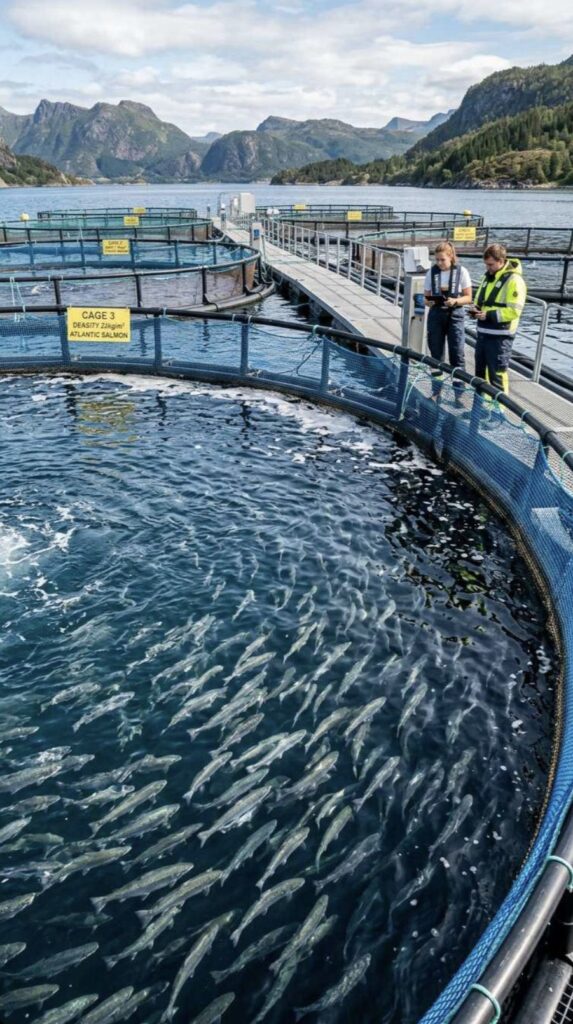
The cage's effective water volume is important when determining density.
Farmers should consider:
- Cage dimensions
- Water exchange
- Current
- Oxygen levels
- Fish species
- Fish size
- Feed input
- Local environmental conditions
- Waste accumulation
Cage systems with strong natural water exchange may support different biomass levels from stagnant or poorly flushed locations.
Recirculating Aquaculture System Stocking Density
Recirculating aquaculture systems, commonly called RAS, use mechanical and biological filtration to treat and reuse water.
Because water is continuously treated, RAS can support relatively high production densities.
However, high-density RAS farming requires technical management.
Important factors include:
- Biofilter capacity
- Mechanical filtration
- Dissolved oxygen
- Pump capacity
- Water flow
- Temperature
- Ammonia
- Nitrite
- Carbon dioxide
- Backup power
- Emergency oxygen
A high-density RAS farm without reliable backup systems can face serious losses if circulation or aeration fails.
Fish Size and Stocking Density
Fish size is one of the most important factors in determining practical stocking density.
Small fingerlings have relatively low biomass.
As they grow, the biomass increases dramatically.
Consider a tank containing 5,000 fish.
If the average weight is 10 grams:
5,000 × 0.01 kg = 50 kg biomass
If those fish later reach an average of 500 grams:
5,000 × 0.5 kg = 2,500 kg biomass
The number of fish has not changed, but the biomass has increased from 50 kg to 2,500 kg.
This demonstrates why stocking density must be monitored throughout the production cycle.
Fingerling Size and Initial Stocking
Farmers should know the size and quality of fingerlings before stocking.
Poor-quality fingerlings can lead to:
- Uneven growth
- High mortality
- Weak fish
- Increased disease risk
- Poor feed conversion
- Unpredictable harvests
Good fingerlings should generally be:
- Active
- Healthy-looking
- Uniform in size
- Free from obvious disease symptoms
- Properly acclimated
- Obtained from a reliable source
Biomass-Based Stocking Density
Biomass-based management is particularly useful in intensive aquaculture.
The farmer periodically estimates the total fish weight and compares it with the system's capacity.
The basic formula is:
Biomass = Number of fish × Average fish weight
For example:
Number of fish = 4,000
Average weight = 0.25 kg
Biomass:
4,000 × 0.25 = 1,000 kg
The farmer now has approximately 1,000 kg of fish biomass.
This information can be used to improve feeding, aeration and water-management decisions.
How to Calculate Fish Stocking Density
There are several useful calculations.
Number-based density:
Number of fish ÷ water volume
Area-based density:
Number of fish ÷ pond area
Biomass density:
Total fish biomass ÷ water volume
For example, assume a tank contains:
- 10 cubic metres of water
- 2,000 fish
- Average fish weight of 0.3 kg
Total biomass:
2,000 × 0.3 = 600 kg
Biomass density:
600 ÷ 10 = 60 kg per cubic metre
This gives the farmer a more meaningful picture of the production load than simply knowing that there are 2,000 fish.
Example of Pond Stocking Calculation
Imagine a rectangular pond measuring:
- 10 metres long
- 5 metres wide
- 1.5 metres average water depth
Approximate water volume:
10 × 5 × 1.5 = 75 cubic metres
If a farmer wants to stock 3,000 fish:
3,000 ÷ 75 = 40 fish per cubic metre
Again, this is only a mathematical density.
The actual suitable stocking level depends on the species, fish size, aeration, water exchange, filtration and production objective.
Stocking Density Should Be Based on the Production System
There is no single universal stocking density that works for every fish farm.
A recommendation suitable for one farm may be unsuitable for another.
For example, two farmers may raise the same fish species, but one operates:
- A large earthen pond
- Limited aeration
- Moderate feeding
- Regular water exchange
The other operates:
- Concrete tanks
- Strong mechanical aeration
- Intensive feeding
- Water filtration
- Frequent water exchange
- Backup oxygen
Their sustainable production densities may be very different.
Dissolved Oxygen and Stocking Density
Dissolved oxygen is one of the most important factors in intensive fish production.
As fish biomass increases, oxygen demand also increases.
Oxygen is required for:
- Fish respiration
- Beneficial bacteria
- Decomposition processes
Low oxygen can cause:
- Reduced feeding
- Slow growth
- Fish gathering near water inflows
- Surface gasping
- Increased stress
- Disease susceptibility
- Mortality
High stocking density therefore requires appropriate oxygen management.
Aeration and High-Density Fish Farming
Aeration adds oxygen to water and improves gas exchange.
Aeration may be provided through:
- Paddlewheel aerators
- Air blowers
- Diffusers
- Venturi systems
- Air stones
- Surface agitators
- Other specialized systems
The required aeration capacity depends on the production system.
Farmers should also consider backup power because a power failure in a high-density system can quickly become an emergency.
Water Quality and Stocking Density
Water quality generally becomes more difficult to manage as biomass increases.
Important parameters include:
- Dissolved oxygen
- Temperature
- pH
- Ammonia
- Nitrite
- Alkalinity
- Salinity where relevant
- Carbon dioxide
- Water clarity
The exact desirable ranges vary by species and production system.
Ammonia and Overstocking
Fish excrete nitrogenous waste, and uneaten feed and organic matter also contribute to waste production.
As fish biomass and feeding rates increase, ammonia production can increase.
Excessive ammonia can stress fish and interfere with normal growth and health.
Therefore, farmers operating high-density systems should monitor ammonia and maintain adequate biological filtration and water exchange.
Nitrite Management
Nitrite can accumulate when the biological filtration process cannot adequately handle the waste load.
Elevated nitrite can negatively affect fish health.
Proper stocking density, water exchange, biological filtration and feeding management all contribute to controlling nitrite.
Temperature and Stocking Density
Temperature influences:
- Fish metabolism
- Feeding
- Growth
- Oxygen demand
- Disease risk
- Water chemistry
A sudden temperature change can stress fish.
Because temperature also influences oxygen availability and metabolic activity, stocking density should be considered alongside temperature management.
pH and Stocking Density
pH affects fish physiology and water chemistry.
A heavily stocked system with large amounts of feed and organic waste may experience greater changes in water chemistry if it is poorly managed.
Regular testing helps farmers detect problems before they become serious.
Feeding and Stocking Density
Feed is usually one of the largest operating expenses in commercial fish farming.
As stocking density increases, feed demand generally increases.
However, simply increasing feed quantity is not enough.
Farmers should monitor:
- Fish biomass
- Feeding response
- Water temperature
- Fish size
- Feed quality
- Feed conversion ratio
- Water quality
Overfeeding creates unnecessary expenses and contributes to water pollution.
Stocking Density and Feed Conversion Ratio
Feed conversion ratio, or FCR, measures how much feed is required to produce a unit of fish weight gain.
A simplified formula is:
FCR = Feed consumed ÷ Fish weight gained
For example, if a farm uses 1,500 kg of feed to produce 1,000 kg of fish weight gain:
1,500 ÷ 1,000 = 1.5 FCR
A lower FCR generally means more efficient feed utilization, although actual performance varies according to species, feed, environment and management.
Overstocking and Feed Competition
When too many fish are kept together, competition for feed can increase.
Dominant fish may consume more food while weaker fish receive less.
This can lead to:
- Uneven growth
- Large size variation
- Cannibalism in some species
- Increased competition
- Difficulty harvesting uniformly
Proper feeding distribution and grading can help manage these problems.
Fish Size Uniformity
Uniform fish populations are easier to manage.
When fish sizes become highly uneven, farmers may need to:
- Grade fish
- Separate different size groups
- Adjust feed
- Change stocking arrangements
- Harvest larger fish
- Reduce competition
Size grading can be particularly important for species or production systems where competition or cannibalism is significant.
Grading Fish to Control Density
Grading means separating fish according to size.
It can help improve:
- Feed access
- Growth uniformity
- Management
- Harvest planning
- Survival
However, grading should be performed carefully to minimize handling stress.
Reducing Stocking Density Through Partial Harvesting
Farmers do not always have to wait until the final harvest to reduce density.
Partial harvesting can remove market-size fish while allowing smaller fish to continue growing.
This approach can:
- Reduce biomass
- Create additional space
- Reduce pressure on water quality
- Generate earlier revenue
- Improve management of remaining fish
Thinning Overcrowded Fish Stocks
Thinning involves reducing fish numbers when the production system becomes overloaded.
This can be done through:
- Partial harvest
- Transfer to another tank
- Transfer to another pond
- Sale of market-size fish
- Redistribution
Thinning can be preferable to allowing an overcrowded population to continue deteriorating water quality.
Stocking Density and Fish Mortality
Higher density can increase the consequences of disease and water-quality problems.
If one fish becomes infected in a crowded system, close contact may facilitate transmission depending on the disease.
High-density farming therefore requires strong biosecurity.
Quarantine Before Stocking
New fish should be handled carefully before introduction into an established population.
Where practical, quarantine can reduce the risk of introducing pathogens into the main production system.
Quarantine procedures may include:
- Separate holding facilities
- Observation
- Health screening
- Controlled equipment use
- Water-quality monitoring
The exact protocol should be appropriate for the species and local veterinary or aquaculture guidance.
Acclimating Fish Before Stocking
Fish should not always be transferred immediately from transport water into a completely different environment.
Differences in:
- Temperature
- pH
- Salinity
- Water chemistry
can cause stress.
Gradual acclimation helps fish adjust to their new environment.
Stocking Density During Different Growth Stages
Stocking density should be reviewed as fish grow.
A production cycle may involve:
Fingerling stage → Juvenile stage → Grow-out stage → Market-size stage
The same number of fish becomes a progressively larger biomass.
Therefore, the farmer should not assume that an initial stocking density will remain suitable throughout the entire production cycle.
Monitoring Fish Biomass
Farmers can estimate biomass by periodically sampling fish.
A simple procedure is:
- Catch a representative sample.
- Weigh the fish.
- Calculate average weight.
- Estimate the number of surviving fish.
- Multiply estimated fish number by average weight.
- Compare the biomass with the system's capacity.
- Adjust feeding and management accordingly.
Accurate records make this process easier.
Estimating Survival Rate
Survival rate is calculated as:
Survival rate (%) = Number of surviving fish ÷ Number initially stocked × 100
For example:
Initial stock = 10,000 fish
Surviving fish = 9,000
Survival:
9,000 ÷ 10,000 × 100 = 90%
Knowing survival rate helps farmers estimate biomass and future harvests.
Stocking Density and Fish Farm Profitability
Stocking density has a direct relationship with farm economics.
Increasing density can increase total production, but it may also increase:
- Feed costs
- Aeration costs
- Water-management costs
- Labour
- Disease risk
- Equipment requirements
- Mortality risk
The goal should therefore be to optimize production rather than simply maximize the number of fish.
Illustrative Financial Example
Consider a hypothetical production system that produces 2,000 kg of marketable fish.
Assume the average selling price is $3 per kg.
Revenue would be:
2,000 × $3 = $6,000
Now assume total production expenses are approximately $4,000.
Illustrative operating margin:
$6,000 − $4,000 = $2,000
If the farmer increases stocking density but production costs rise to $5,500 while harvest increases only to 2,300 kg:
Revenue:
2,300 × $3 = $6,900
Illustrative margin:
$6,900 − $5,500 = $1,400
This example demonstrates an important principle: more fish do not automatically mean more profit.
These figures are purely illustrative. Actual results vary considerably by species, location, feed prices, infrastructure, survival rate, selling price and management efficiency.
How to Determine an Appropriate Stocking Density
A practical stocking decision should consider several factors.
Start with the species.
Determine the fish's environmental requirements.
Calculate available water volume.
Evaluate aeration capacity.
Evaluate water-exchange capacity.
Determine the expected harvest size.
Estimate feed requirements.
Estimate expected survival.
Consider filtration and waste-management capacity.
Then establish a conservative starting density.
Monitor the system and adjust as biomass increases.
Signs That Fish Density May Be Too High
Farmers should watch for warning signs such as:
- Fish repeatedly gasping at the surface
- Fish gathering around water inlets
- Sudden reduction in feeding
- Slow growth
- Increasing mortality
- Persistent ammonia problems
- High nitrite
- Excessive organic waste
- Strong unpleasant water odour
- Severe size variation
- Repeated disease problems
- Rapid deterioration in water quality
These signs do not prove that stocking density is the only problem, but they should trigger an investigation.
How to Reduce Problems Caused by Overstocking
If a system becomes overcrowded, farmers can consider:
- Partial harvesting
- Moving fish to another production unit
- Increasing water exchange
- Improving aeration
- Improving filtration
- Reducing feed wastage
- Grading fish
- Separating size groups
- Improving waste removal
Emergency actions should prioritize fish survival and water quality.
Overstocking and Power Failure Risk
High-density systems can become particularly vulnerable during power outages.
If aeration and water circulation depend on electricity, loss of power can rapidly reduce oxygen levels.
Commercial farmers should consider backup systems such as:
- Generator
- Battery backup
- Solar-supported systems
- Backup aeration
- Emergency oxygen equipment
The appropriate solution depends on farm size and system design.
Record Keeping for Stocking Density
Professional fish farms should maintain detailed records.
Important records include:
- Date stocked
- Species
- Number stocked
- Average stocking size
- Source of fingerlings
- Pond or tank identification
- Water volume
- Feeding records
- Mortality
- Treatments
- Water-quality measurements
- Sampling weights
- Estimated biomass
- Partial harvests
- Final harvest
- Selling price
- Production expenses
Good records make it easier to identify the density and management conditions associated with successful production cycles.
Stocking Density Management Checklist
Before stocking fish, ask:
1. What species am I raising?
Different species have different requirements.
2. What is the water volume?
Measure the actual production volume rather than guessing.
3. What is the expected harvest weight?
Density requirements change as fish grow.
4. What is my aeration capacity?
Do not stock beyond what the oxygen-management system can support.
5. What is my water-exchange capacity?
Water replacement is important in many intensive systems.
6. What is my filtration capacity?
High biomass creates high waste loads.
7. How much feed will the fish require?
Feed input affects water quality and operating costs.
8. What happens during a power failure?
Have a contingency plan.
9. How will I monitor biomass?
Regular sampling is essential.
10. What will I do if the system becomes overcrowded?
Have a partial-harvest or transfer strategy ready.
Common Fish Stocking Density Mistakes
Stocking Based Only on Pond Size
A farmer may calculate stocking based only on surface area while ignoring water volume and management capacity.
Using One Density for Every Fish Size
Fish grow. A density suitable for fingerlings may become unsuitable at market size.
Ignoring Aeration
High biomass without adequate oxygen management can cause serious problems.
Overstocking to Increase Profit
More fish increase production potential but also increase costs and risks.
Failing to Monitor Biomass
Without estimating biomass, farmers may continue feeding and stocking based on outdated assumptions.
Ignoring Mortality
Dead fish reduce the population, but they also affect water quality if not removed promptly.
Mixing Very Different Fish Sizes
Large and small fish may compete for feed and space.
Poor Water Exchange
High-density systems require effective management of waste and water quality.
No Backup Power
A power failure can be particularly dangerous in heavily stocked tanks and intensive systems.
Overstocking New Fingerlings
Farmers sometimes focus on the small size of fingerlings and ignore their future biomass.
A stocking plan should be based on the expected production cycle rather than only the size of fish on stocking day.
How Technology Can Improve Stocking Density Management
Modern aquaculture increasingly uses technology to monitor production systems.
Useful technologies include:
- Digital water-quality meters
- Automatic feeders
- Dissolved oxygen sensors
- Temperature sensors
- pH meters
- Ammonia testing systems
- Automated aeration
- Water-level sensors
- Farm-management software
- Biomass estimation tools
Technology can help farmers respond more quickly to changes in production conditions.
Automatic Feeding and Stocking Density
Automatic feeders can improve feeding consistency.
However, automation does not eliminate the need for monitoring.
Feed should still be adjusted according to:
- Fish appetite
- Biomass
- Temperature
- Water quality
- Growth
- Mortality
Stocking Density in Sustainable Aquaculture
Sustainable fish farming seeks to produce fish efficiently while reducing unnecessary environmental pressure.
Appropriate stocking density can contribute to sustainability by reducing:
- Feed waste
- Fish mortality
- Excessive water pollution
- Unnecessary resource use
Efficient feed conversion and responsible water management are especially important.
Balancing Production and Fish Health
The objective of stocking-density management is not simply to maximize the number of fish.
A successful farmer must balance:
Fish numbers + biomass + water quality + feed + oxygen + growth + survival + market demand + cost
When these factors are balanced, the production system becomes easier to manage.
How Stocking Density Changes Farm Management
As density increases, management generally becomes more demanding.
Low-density systems may allow more tolerance for management mistakes.
High-density systems generally require greater precision.
This means the farmer should match stocking density with management ability.
A farmer with limited equipment and experience may need to begin at a conservative density and gradually increase production as management capacity improves.
Scaling Up Fish Farm Stocking
Farm expansion should not focus only on adding more fish.
A better approach is to increase:
- Water capacity
- Aeration capacity
- Filtration
- Backup systems
- Labour
- Feed-storage capacity
- Monitoring
- Biosecurity
- Marketing capacity
before significantly increasing biomass.
Stocking Density and Market Planning
Before stocking, farmers should understand the intended market.
If the target market prefers smaller fish, the production cycle may be shorter.
If customers prefer larger fish, the farmer may need to maintain fish for a longer period.
A longer production cycle means biomass continues increasing, making density management more important.
Planning Stocking Density Around Harvest
Farmers should work backward from their target harvest.
For example:
Target harvest biomass → expected survival → number of fish required → initial stocking quantity.
This approach is more useful than simply asking how many fish can fit into a pond.
Final Thoughts on Fish Stocking Density
Fish stocking density is a fundamental component of successful aquaculture. The correct density depends on much more than the physical size of a pond or tank.
Species, fish size, water volume, oxygen availability, filtration, water exchange, feeding intensity, temperature, disease management and the farmer's technical capacity all influence the amount of fish a system can sustainably support.
The most important principle is to avoid treating stocking density as a fixed number.
Fish grow, biomass increases, environmental conditions change and production systems have different capacities. Consequently, stocking density should be monitored and adjusted throughout the production cycle.
A profitable fish farm is not necessarily the farm with the highest number of fish. It is a farm that produces healthy fish efficiently, controls costs, maintains suitable water quality and converts available resources into marketable fish.
By calculating stocking density carefully, monitoring biomass, maintaining good water quality, providing adequate oxygen and adjusting fish populations when necessary, farmers can build a more productive and manageable aquaculture operation.
Latest posts;
- Beans Farming: A Complete Guide to Different Types of Beans, Their Uses, Nutrition, and Farming
- Cassava Farming in Africa: A Complete Guide to Planting, Growing, Harvesting and Making Profit from Cassava
- CATFISH FARMING(HYBRID): THE COMPLETE STEP-BY-STEP GUIDE FOR BEGINNERS AND COMMERCIAL FARMERS (2026 EDITION)
- Cattle Fattening Business: Complete Guide to Raising Beef Cattle for Profit
- COCOA FARMING IN AFRICA: A Complete Professional Guide (Part 1)
- COCOA FARMING IN AFRICA: A Complete Professional Guide (Part 2)
- Commercial Carrot Farming: A Complete Guide to Growing Carrots for Profit
- Commercial Cashew Farming: A Complete Guide to Growing Cashew for Profit
- Commercial Cattle Farming: Complete Guide to Raising Cattle for Profit